Jiamu Huang, Douglas N.C. Lin, Keith Horne
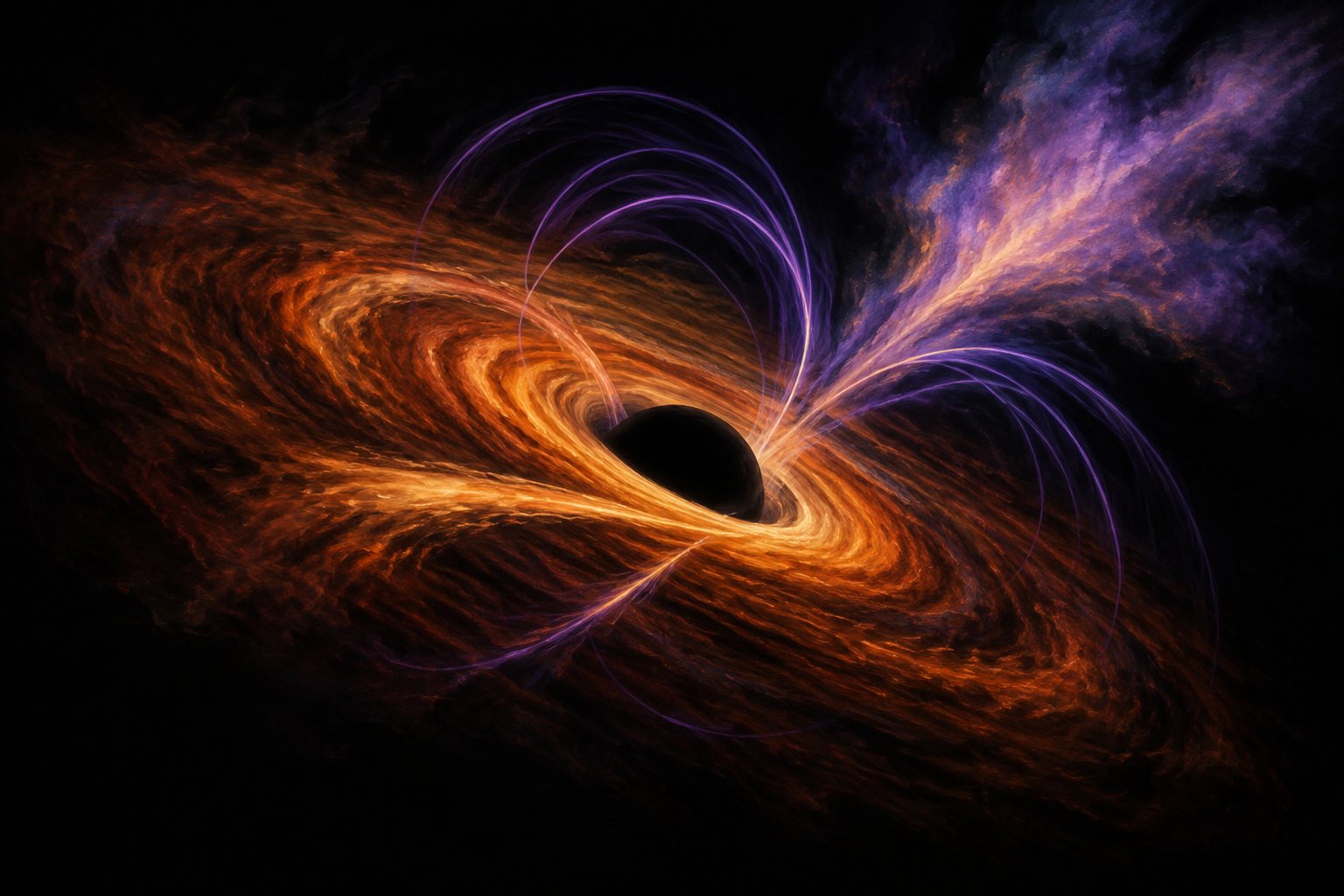
AstronomerThis modeling study investigates reverberation signatures of hypothetical disc-surface pillars heated by massive stars forming in gravitationally unstable outer AGN discs, within the broad-line-emitting region. Pillars are represented as 2D Gaussian height perturbations under lamp-post irradiation, with line responses weighted using Cloudy photoionization grids. A single modeled pillar produces a localized velocity-delay hotspot and a time-dependent spectral S-wave; the latter persists, diluted, for roughly 100 pillars. Shadows suppress line fluxes but raise Mg II/Hβ and lower C IV/Hβ, providing a proposed distinction from purely kinematic features that would modulate all lines similarly. Parameter scans yield optical continuum reverberation lags of the observed magnitude. Once-per-orbit modulation increases with sin i through foreshortening, while sufficiently high inclinations introduce geometric self-occultation and sharper near/far contrast. These are predicted diagnostics for velocity-resolved reverberation campaigns, not an observational detection of pillars or in situ star formation.
PublicMassive stars might form in the outer parts of the gas discs around active galactic nuclei. Their heat could raise local pillars on the disc surface. This study models how such hypothetical structures would change the delayed responses of gas emission and disc light to illumination from a central source. The calculations predict a localized feature in maps of gas speed and response time, along with an S-shaped pattern in spectra over time that remains weaker but recognizable even with about 100 pillars. Pillar shadows also affect emission lines differently: relative to the hydrogen Hβ line, magnesium emission strengthens while carbon emission weakens. This contrast could help distinguish pillars from features caused only by gas motion. The models produce optical light-response delays comparable in size to observed delays, but that agreement does not establish that pillars exist. The predicted signatures offer ways to search for stars forming within these discs.
Young explorerSome galaxies have a big, bright disc of gas in their middle. Scientists wonder whether new stars growing inside that gas could heat it and make little bumps. They used computer models to see how the bumps might change the light and make shadows. In the models, the bumps make a moving, S-shaped pattern in the light, and their shadows change different kinds of light in different ways. Scientists could look for these clues to help find growing stars. This study does not show that the bumps or stars have actually been found.
Macon Magno, Emmanuel Momjian, Krista L. Smith+4 more
AstronomerVLA A-configuration observations at 22 GHz with 0.13-arcsecond resolution localize a water maser feature offset by 541 km/s from the systemic velocity of the Seyfert 2 galaxy NGC 1106. The continuum reveals a 352 pc nuclear structure, while the maser occupies a compact region about 1 kpc (3.12 arcseconds) from the nucleus. Comparison with earlier 1-arcsecond observations places the maser near the boundary of a radio extension aligned with the jet axis. Its position, velocity offset, flux density, and alignment, considered alongside Galactic and extragalactic maser comparisons, are consistent with an origin at the AGN-outflow–ISM interface, rather than establishing that origin definitively. The authors caution that unresolved high-velocity maser features can include contributions from kiloparsec-scale shocks, potentially complicating maser-based black hole mass measurements when disk geometry is ambiguous.
PublicHigh-resolution radio observations of the galaxy NGC 1106 locate a compact source of amplified radio emission from water molecules about 1,000 parsecs from the galaxy's center. This water maser has a velocity offset of 541 kilometers per second from the galaxy's overall motion and lies near the edge of a radio extension aligned with a jet. Its location and other properties suggest that it comes from the meeting point between an outflow from the active galactic nucleus and gas in the galaxy, though this explanation is not proven. The finding highlights a potential pitfall in weighing black holes using water masers: observations that cannot separate their locations may mistake some emission from distant shocks for emission from a disk around the black hole.
Young explorerScientists used a radio telescope to find a tiny spot in a galaxy where water molecules send out strong radio signals. The spot is far from the galaxy's center. They think it may be where gas rushing out from the center bumps into other gas, but they are not sure. This matters because scientists sometimes use these signals to work out how heavy a black hole is. Signals coming from somewhere else could make that harder.
Jeremy Darling, Jennie Paine, Matthew Hosek Jr.+6 more
AstronomerThe study updates the stellar maser-based astrometric reference frame for the inner parsec of the Galactic Center, tying it to the radio continuum of Sgr A* using 30 years of 43 GHz observations of 15 SiO stellar masers. The uncertainty in the ensemble’s mean positional offset from Sgr A* is currently 0.08 mas and is projected to be 0.10 mas in 2030, equivalent to 0.6 and 0.8 AU at an adopted distance of 8.2 kpc. These scales are comparable to or smaller than the stellar SiO-emitting region. Mean maser proper-motion uncertainties are 0.05 mas/yr in RA and 0.08 mas/yr in Dec. The reported stability between infrared and maser astrometry is 10 microarcseconds/yr in RA and 15 microarcseconds/yr in Dec. Substantial flux-density and velocity-structure variability is observed, including a 30-fold brightening of an IRS 7 blueshifted component since 2022. Such variability may limit future astrometric precision, particularly radial-acceleration measurements. The frame supports studies of the black hole, surrounding mass, and gravity; no new gravity-test result is reported.
PublicTo study stars orbiting the Milky Way’s central black hole, astronomers need a precise, stable coordinate system. This study updates that system using 30 years of radio observations of 15 stars with SiO maser emission, anchored to the radio source Sgr A*. The current uncertainty in the stars’ average position relative to Sgr A* corresponds to about 0.6 times the Earth–Sun distance, assuming the distance adopted in the study; it is projected to reach about 0.8 times that distance by 2030. The stars’ radio emission also changes substantially: one component from IRS 7 has brightened thirtyfold since 2022. These changes may limit further improvements in tracking stellar positions and measuring changes in their motion. The work provides a foundation for studying the black hole and testing gravity, rather than reporting a new gravity test.
Young explorerAstronomers made a better map for watching stars near the big black hole in the middle of our galaxy. They used 30 years of radio signals from 15 stars. But those signals change, which may make it harder to measure exactly how the stars move.
Xin Wang, Timur Mufakharov, Guiping Tan+6 more
AstronomerNine years of SMMAN C- and K-band monitoring of the blazar 4C+72.28 reveal different secular trends: a stronger K-band decline produces a gradual decrease in the C–K spectral index. After accounting for these trends, timing diagnostics identify a candidate quasi-periodic modulation near 1000 days, clearest in C band. The C-band GLSP peak has 3.29σ local significance but only about 2σ global significance, and the baseline spans roughly three cycles. Independent and joint MCMC fits support a phenomenological linear-trend-plus-recurrent-component description; assuming a shared period, the joint fit yields approximately 1027 days and similar fractional recurrent amplitudes of about 5.45%. Information criteria favor the linear-plus-sinusoidal model in both bands. A nominal K-leading cross-correlation offset in the original light curves becomes a centroid consistent with zero lag after detrending, although the lag distributions overlap substantially. The findings are consistent with common recurrent modulation superposed on slower, frequency-dependent jet evolution. Geometrical Doppler-factor modulation is a plausible interpretation, not an established mechanism; intrinsic and opacity-related processes remain possible.
PublicNine years of radio observations of the blazar 4C+72.28 show that its brightness changed differently in two radio bands, with a stronger long-term decline in the K band. After accounting for those trends, researchers found hints of a repeating brightness variation about every 1000 days, most clearly in the C band. A model combining a steady trend with a repeating wave is favored over the alternatives compared, but the repetition is not firmly established: the observations cover only about three cycles, and the overall statistical significance is modest. After removing the long-term trends, the timing comparison is consistent with no delay between the bands. The authors suggest that a shared variation may accompany slower changes in the jet. Changes in its geometry could alter its apparent brightness through the Doppler effect, but processes within the source or changes in how readily radio waves escape could also explain the pattern.
Young explorerScientists watched radio light from a faraway object for nine years. In two kinds of radio light, it faded differently. They also found a hint that it might brighten and dim again about every three years, like a very slow blinking light. But they have seen only about three possible repeats, so they are not sure it really blinks that way or what would make it happen.
Bangzheng Sun, Haojing Yan
AstronomerUsing public JWST NIRCam imaging across nine fields totaling approximately 1,045 arcmin², the authors select 3,733 F090W-dropouts and 2,396 F115W-dropouts, targeting z≈7.4 and z≈10. Secure NIRSpec redshifts for 338 and 99 objects, respectively, provide subsamples for estimating magnitude-dependent contamination. After statistical corrections for incompleteness and contamination, the z≈7.4 luminosity function is well described by a Schechter function with faint-end slope α=−1.70±0.16, significantly shallower than most previous z≈7–8 estimates. Imaging and spectroscopy reaching approximately 30 mag are needed to verify this finding. At z≈10, a Schechter function fits poorly; a power law Φ(M)∝10^[−0.4(β+1)M] with β=−2.36±0.16 is more consistent with the data. This behavior is largely driven by high number densities at M_UV≲−21.8 mag and is supported by existing spectroscopic confirmations, but further bright-end spectroscopy at apparent magnitudes ≲26 is needed to strengthen the result.
PublicThe researchers used public James Webb Space Telescope images to study how common galaxies of different brightnesses were at two early stages of cosmic history. They selected thousands of candidate galaxies, with a smaller subset confirmed through spectroscopy, and statistically corrected their counts for missed galaxies and objects mistakenly included. At the later of the two stages, around redshift 7.4, their results suggest a less steep rise in galaxy numbers toward faint brightnesses than most earlier studies found. At the earlier stage, around redshift 10, the brightness distribution is more consistent with a power law than with the conventional model, largely because very bright candidates are relatively numerous. Existing spectroscopic confirmations support that finding, but more observations are needed: deeper imaging and spectroscopy to check the faint-galaxy result, and additional spectroscopy to strengthen the bright-galaxy result.
Young explorerThe researchers used pictures from the Webb telescope to count galaxies that look bright or faint from long ago. Some still need checking to make sure they belong in the count. In one group, the number of galaxies did not rise as quickly toward the faint ones as earlier studies suggested. In a group from even longer ago, very bright galaxies were common enough that the usual counting pattern did not fit well. The researchers need more pictures and more checks to be sure.
Sava Donkov, Valentin Kopchev, Ivan Z. Stefanov+1 more
AstronomerThis theoretical study develops differential and integral mass-density–size scaling laws to describe local and global fractal structure in molecular clouds. It represents an ensemble of clouds sharing a density probability distribution and effective size by an abstract spherical cloud, with substructure scales defined by its radii. The authors express both scaling exponents in terms of the density distribution and derive and exactly solve a first-order linear differential equation linking them. Applications to log-normal and power-law-tail distributions, associated respectively with earlier turbulence-dominated and later star-forming stages, yield exponents reported to agree qualitatively and numerically with relevant observations and simulations. These are results of an abstract model, rather than new cloud measurements.
PublicThe study uses a mathematical model to explore how gas density changes with size inside molecular clouds, whose structure has patterns on different scales. Rather than mapping individual clouds, the authors represent clouds with the same density statistics and overall size as an idealized sphere. They derive linked descriptions of small-scale and whole-cloud structure, then apply them to two density distributions associated with earlier, turbulence-dominated clouds and later clouds where stars form. The resulting scaling values are reported to be consistent with observations and computer simulations, although the work itself is a theoretical model rather than a new observational survey.
Young explorerBig clouds in space have gas packed more tightly in some places than in others. The researchers used a pretend round cloud and math to study how that packing changes when you look at smaller or bigger parts. They tried two ways of describing the gas, linked to younger clouds and clouds where stars are forming. Their math gave answers that fit what other studies have seen and what computer models show. They did not take new pictures of clouds for this study.
Myank Singhal, Ladislav Šubr, Jaroslav Haas+2 more
AstronomerNear-infrared observations have revealed a spectroscopic stellar binary embedded in D9, one of the dusty objects orbiting Sgr A*. The authors present N-body simulations of an eccentric binary-star disk resembling the observed young stellar disk. In the simulations, some binaries are driven toward Sgr A* and merge through Kozai-Lidov oscillations. Combined with D9's binary nature, this supports a possible origin for the dusty population as stellar-merger products surrounded by gas and dust, rather than establishing that origin observationally. The simulated binary fraction increases with distance from Sgr A*, consistent with observational constraints. The simulations also suggest merger products within the young disk that might be identified through chemical peculiarities or rapid rotation.
PublicAstronomers have been tracking mysterious dusty objects around the Milky Way's central supermassive black hole. One idea is that these objects contain stars formed when two stars merge, wrapped in gas and dust. Recent observations found a pair of stars inside one dusty object, D9. To explore how such systems might evolve, the researchers simulated a disk of star pairs resembling the young stellar disk around the black hole. Some simulated pairs moved toward the black hole and merged as their orbits underwent a process called Kozai-Lidov oscillations. This offers a possible explanation for the dusty objects, but does not prove that they formed this way. The model also produces a larger proportion of star pairs farther from the black hole, consistent with observational constraints, and suggests that other merger products in the disk might be recognized by unusual chemistry or fast spinning.
Young explorerNear the giant black hole in the middle of our galaxy, astronomers see mysterious dusty things. Inside one of them, called D9, they found two stars circling each other. The researchers made a computer model of many star pairs near the black hole. In the model, some pairs moved closer to the black hole and joined together into one star. That might help explain the dusty things we see, but we do not yet know if that is really how they were made.
Shi-Jiang Chen, Jun-Xian Wang, Zhen-Ya Zheng+10 more
AstronomerA pilot Einstein Probe/FXT study of six V-shaped broad-line green pea galaxies at z∼0.3, selected as local analogs of JWST little red dots at z∼4–8, finds diverse X-ray properties. X-normal sources resemble type 1 AGNs in X-ray luminosity and optical variability. The X-weak stack is detected at ∼3.3σ and lies ∼0.5–0.7 dex below standard unobscured-quasar scaling relations, while remaining compatible with the representative high-redshift LRD stack and 95% of published individual limits. X-weak sources have redder optical continua and no detected optical variability. Rest-frame ∼2–3 keV constraints disfavor the typical unobscured super-Eddington model and local-AGN-like Compton-thick geometry examined, but modified variants remain possible. The authors favor a mildly X-ray-weak corona, Δαox∼−0.1 to −0.2, with Compton-thin absorption, NH∼10^22–10^23 cm−2, consistent with independent Balmer diagnostics. This interpretation offers a testable route for understanding LRD X-ray weakness, not a definitive explanation for the high-redshift population.
PublicWhy do JWST’s distant little red dots appear faint in X-rays? Researchers used Einstein Probe to study six nearby galaxies selected for their resemblance to these objects. Some showed X-ray brightness and optical variability like typical active galaxies. Others were relatively X-ray faint; combining their observations produced a modest detection. These X-ray-faint galaxies also had redder visible-light spectra and no detected optical variability, making them closer matches to the distant red dots. The combined X-ray signal is difficult to explain with two specific models tested, although modified versions remain possible. The authors favor a somewhat weaker X-ray-emitting corona combined with absorption by intervening material. This nearby study provides a way to test explanations, but does not settle what makes the distant objects X-ray faint.
Young explorerSome tiny red dots far away in space look faint in a kind of light called X-rays. Scientists studied six closer galaxies that look a bit like them. Some were brighter in X-rays than others. Adding together the faint ones’ signals helped scientists spot them. They think these galaxies might make fewer X-rays, with some also hidden by material. That idea could help explain the faraway dots, but they are not sure yet.
Fred S. Thompson, Julien Devriendt, Adrianne Slyz+2 more
AstronomerMotivated by JWST detections of unusually bright, lensed star-cluster candidates in the first billion years, this study uses cosmological radiation-hydrodynamics zoom-in simulations of a galaxy whose halo reaches a virial mass of 10^10 solar masses at z=6. Clusters are modeled as accreting sink particles with stellar radiation and supernova feedback, without prescribing an efficiency per free-fall time or a fixed formation duration. Schechter fits to the central galaxy’s initial cluster mass function yield truncation masses near 6 million solar masses, with substantial uncertainty. At fixed resolution, stellar radiation changes the low-mass slope from −1.60 to −1.34; doubling spatial resolution steepens it to −1.54, demonstrating numerical sensitivity. Radiation also reduces low-mass cloud abundance, especially at lower gas densities, and shortens cluster formation to about 1 Myr, before the first supernovae. More rapidly fed clusters accrete longer on average, producing a superlinear relation between final mass and initial accretion rate that contributes to a flatter mass function. At fixed host-galaxy star formation rate, the brightest simulated clusters have UV luminosities comparable to the observed candidates; this is not a confirmation of their nature.
PublicJWST has spotted unusually bright objects that may be star clusters in galaxies from the universe’s first billion years. To investigate how such clusters could form, researchers simulated an early galaxy, allowing model clusters to gather gas and produce starlight and supernova explosions that regulate their growth. In the simulations, radiation from stars reduced the number of low-mass gas clouds and shortened cluster formation to about a million years, before the first supernovae. Clusters supplied with gas faster also tended to keep gathering it longer, helping favor more massive clusters. However, the predicted balance of smaller and larger clusters changed with the simulation’s resolution, and the estimated mass cutoff remains substantially uncertain. For galaxies forming stars at the same rate, the brightest simulated clusters were comparably bright in ultraviolet light to the observed candidates. That agreement does not establish what those observed objects are.
Young explorerA space telescope saw very bright spots in faraway galaxies. They might be groups of stars. Scientists made a computer model to explore how such groups could grow. In the model, groups gathered gas to make stars, and the stars’ light helped limit their growth. Some pretend groups shone about as brightly as the real spots. But changing the model’s detail changed some answers, so there is still more to learn.
S.R. Berlanas, M. Pantaleoni González, J. Maíz Apellániz
AstronomerUsing 14,017 spectroscopically confirmed ALS III OB stars with Gaia DR3 five-dimensional astrometry, revised distances and corrected proper motions, the authors jointly fit the Galactic rotation curve and solar motion. A fourth-degree Chebyshev polynomial is fitted directly to proper motions by weighted least squares, with uncertainties from 1,000 bootstrap resamplings. Over the constrained range of 5.5–11 kpc, the curve rises inside the solar circle and declines gently outside it. At the adopted solar radius of 8.178 kpc, the inferred circular speed is 236.3 ± 1.1 km/s and the local gradient is −3.81 ± 0.38 km/s/kpc. The inferred solar motion is (U, V, W) = (8.06 ± 0.41, 10.91 ± 0.86, 7.53 ± 0.14) km/s, and the Oort constants are A = 16.35 ± 0.21 and B = −12.54 ± 0.19 km/s/kpc. The dynamically cold tracer and direct proper-motion fit avoid asymmetric-drift corrections and Jeans modelling, yielding systematics distinct from those of older tracers. Agreement with older-tracer determinations in the overlapping region supports the interpretation that the outer decline is not a methodological artefact. The authors caution that tangential data poorly constrain the solar radial motion, without affecting the curve. Depending on selection, 1,474–1,662 strongly deviant stars are identified as OB runaway candidates, not confirmed runaways; their analysis with Gaia DR4 is deferred to a forthcoming paper.
PublicAstronomers used the motions of 14,017 young, massive stars to estimate how the Milky Way’s rotation speed changes with distance from its centre. These stars still largely retain the motions of the gas that formed them, providing a different way to trace the Galaxy’s mass distribution than older stars. Fitting Gaia measurements, the team inferred that rotation speeds rise inside the Sun’s orbit and decrease gently beyond it, across a measured range of 5.5–11 kiloparsecs from the Galactic centre. At the Sun’s distance, the inferred circular speed is 236.3 ± 1.1 kilometres per second. The outer decline agrees with results from older stars where the studies overlap, making a method-related explanation less likely, though this method has its own sources of systematic uncertainty. The fit also estimates the Sun’s motion, but its motion toward or away from the Galactic centre is poorly constrained by these data; the authors report that this does not affect the rotation curve. About 1,500–1,700 stars depart strongly from the fitted pattern and are possible runaway stars, with further analysis planned rather than reported here.
Young explorerOur galaxy is full of stars moving around its middle. Astronomers watched how more than 14,000 young, big stars move to work out how fast stars go around at different distances. Their best-fit pattern says the speed gets faster toward the Sun’s path, then slowly gets slower farther out. Other studies using older stars found a similar slowdown where they looked at the same part of the galaxy. Some young stars move very differently from the pattern. They might be runaway stars, but the astronomers still need to study them more.
Alfred Castro-Ginard, Anthony G.A. Brown, Eduardo Belotto Evangelista+9 more
AstronomerThe authors estimate the Gaia DR3 source-catalogue selection function across the sky and full magnitude range using Gaia catalogue data and the nominal scanning law supplied by the Gaia Observation Forecast Tool. A hierarchical Bayesian model jointly infers scan counts and source-detection efficiency, fitted by Markov chain Monte Carlo to 1,806,196,447 sources with positions, G magnitudes, and astrometric matched transit counts. They infer essentially complete coverage for 5 < G < 19.5 in the on-sky median, not uniformly at every position. At fainter magnitudes, completeness declines with structure reflecting the scanning law and crowding; it is also reduced at the very bright end. An unexpected inferred rise beyond G ~ 21 is attributed to extended-source contamination, supported by cross-matching with Euclid's Q1 catalogue. Inferring the scanning law on a fine sky grid using sources at all magnitudes removes the need for an explicit crowding correction. The selection function is released through GaiaUnlimited and is valid wherever Gaia data are available.
PublicA star catalogue does not include every source equally well: whether an object appears can depend on its brightness, where it lies in the sky, and how the telescope observes it. This study estimates those inclusion chances for Gaia's third data release by combining its catalogue with information about its planned scanning pattern in a statistical model. The authors find that Gaia DR3 is essentially complete over a broad brightness range, G magnitudes between 5 and 19.5, when judged by the median across the sky; individual regions can differ. Fainter sources are increasingly missed, with patterns linked to scanning coverage and crowded regions, and very bright sources are also less completely recorded. An apparent improvement for extremely faint sources, beyond about G = 21, is interpreted as an artefact from extended objects rather than a genuine gain in completeness, supported by comparison with Euclid's Q1 catalogue. The resulting tool, available in the GaiaUnlimited Python package, helps researchers account for what Gaia may have missed.
Young explorerGaia makes a huge list of things in the sky, but it can miss some. Scientists used its list and information about where it looks to work out how likely things are to get on the list. They found that Gaia lists almost everything in a big middle range of brightness in a typical part of the sky, but it misses more things that are very bright or faint. Busy patches of sky can be harder, too. It looked as if Gaia got better at finding the very faintest things, but the scientists say that was a misleading effect caused by objects that look spread out rather than like tiny dots. They shared a tool to help other scientists understand the missing pieces.
Wenjun Zhang, Xiaohui Sun, Jie Wang+2 more
AstronomerFAST continuum and polarization observations of NGC 315 at 1.0–1.5 GHz detect diffuse, large-scale polarized emission at 4-arcminute resolution with a noise level of 0.065 mJy per beam. The derived rotation-measure map has an uncertainty of 1.1 rad m⁻², including systematic error; an intrinsic RM map was obtained by subtracting the Galactic foreground contribution. The authors estimate a total magnetic-field strength of ≲1 μG across the source and a thermal electron density of approximately 10⁻⁴ cm⁻³ toward the northwest lobe. Fractional polarization analysis suggests a random magnetic-field component over a large area toward that lobe.
PublicObservations with the FAST radio telescope reveal faint, extended polarized radio emission from the radio galaxy NGC 315. The researchers mapped how the polarization rotates and subtracted the contribution from our own Galaxy to isolate the rotation associated with NGC 315. They estimate a magnetic-field strength across the source of about one microgauss or less and a thermal electron density of roughly 0.0001 electrons per cubic centimetre toward its northwest lobe. The polarization analysis suggests that a randomly oriented magnetic-field component extends over a large part of that lobe, rather than establishing this definitively.
Young explorerScientists used a big radio telescope called FAST to study a galaxy named NGC 315. They found faint radio waves spread over a large area. The waves have a special pattern that gives clues about magnetic fields. After taking away the effect of our own galaxy, the scientists estimated that NGC 315 has a very weak magnetic field. Their clues also suggest that some of the field points in mixed-up directions across a big part of one side of the galaxy, but they are not sure.
Rakshit Chauhan, Smitha Subramanian
AstronomerUsing GALEX FUV imaging, the authors compare radial star formation rate surface density profiles in 272 isolated starburst dwarf galaxies: 17 post-mergers and 255 non-interacting systems, spanning stellar masses of 10^7–10^9.6 solar masses and redshifts of 0.01–0.12. Isolation is defined by the absence of a massive galaxy within a volume of 1 Mpc^3. Both samples show enhanced star formation rate surface density at all sampled radii, with approximately uniform enhancement within uncertainties. This suggests that low-mass starbursts can exhibit galaxy-wide enhancement regardless of their triggering mechanism, unlike the centrally concentrated star formation reported for merger-driven starbursts in massive galaxies. Shallow gravitational potentials and interaction-induced compression of extended gas envelopes are proposed explanations for the lack of central concentration in the dwarf post-mergers, not demonstrated mechanisms. Deeper observations with higher spatial resolution are needed to clarify the spatial distribution.
PublicA study of 272 small galaxies undergoing bursts of star formation finds that the increase in star formation is spread roughly evenly across them, within measurement uncertainties. The researchers used ultraviolet images from GALEX to compare 17 galaxies that had undergone mergers with 255 classified as non-interacting. Both groups showed enhanced star formation throughout their measured regions. This differs from previous observations of massive merger-driven starburst galaxies, where star formation is concentrated toward the center. The authors suggest that weaker gravity and the squeezing of extended gas during interactions might help explain the small galaxies’ more widespread activity, but this explanation is not established. Deeper, sharper observations are needed to test the picture more closely.
Young explorerScientists looked at 272 small galaxies that are busy making stars. Some had joined with another galaxy, and most showed no signs of interacting with one. In both groups, the extra star-making seemed spread across the galaxies, rather than crowded in the middle. That is different from what has been seen in big galaxies making lots of stars after joining together. The measurements are not exact, so scientists need clearer pictures to learn more.
I. S. Proshina, O. K. Sil'chenko, A. Yu. Kniazev+1 more
AstronomerLong-slit spectroscopy detects ionized gas in three optically ringed S0 galaxies: PGC 48114, ESO 234-011, and ESO 444-076. In PGC 48114, the gas excitation mechanism varies around the ring despite the previously reported agreement between gas and stellar kinematics. Narrow-band Hα and [NII] λ6583 imaging reveals a star-forming arc in the ring’s northwestern sector. In ESO 234-011 and ESO 444-076, the gas sampled along the slit is shock-excited and kinematically discrepant with the stars. The authors interpret this as evidence for accretion inclined to the main disk, likely inhibiting ongoing star formation. The late-type companions have extensive ongoing star formation and could supply the gas; alternatively, each pair could draw from a common reservoir.
PublicThe researchers detected ionized gas in three ringed, lens-shaped galaxies. In one, PGC 48114, images reveal an arc of star formation in the northwestern part of its ring. The process energizing the gas varies around that ring, even though earlier work found that the gas and stars move consistently with one another. In the other two galaxies, ESO 234-011 and ESO 444-076, the sampled gas is energized by shocks and moves differently from the stars. The researchers interpret this as gas arriving at an angle to the galaxies’ main disks, which likely hinders ongoing star formation. Nearby companion galaxies are actively forming stars and may supply this gas, but each galaxy pair might instead share a common gas supply.
Young explorerScientists studied three galaxies with rings and found gas in all three. In one galaxy, they saw a curved patch where new stars are forming. In the other two, the gas moves differently from the stars and is energized by shocks. The scientists think this gas may be coming in at a slant, making it harder for new stars to form. It might come from nearby galaxies, or the neighboring galaxies might be getting gas from the same supply. They do not yet know which.
Pedro Salas, Kimberly L. Emig, Matteo Luisi+4 more
AstronomerThis abstract outlines the prospective use of radio recombination lines (RRLs) with the Square Kilometre Array (SKA) to characterize the diffuse interstellar medium and its role in star-formation feedback. RRLs provide extinction-free diagnostics of gas kinematics, density, temperature, and radiation field: hydrogen RRLs trace ionized hydrogen, while carbon RRLs trace cold gas in the atomic-to-molecular hydrogen transition layers. The authors anticipate that the SKA’s sensitivity, spatial resolution, field of view, and spectral capabilities will enable efficient measurements constraining thermal and turbulent balance, chemical enrichment, sizes, and ionization rates of cold and ionized Galactic gas on angular scales from degrees to arcseconds. These are anticipated capabilities, not reported observational results.
PublicCold gas between stars supplies the material for new stars, while radiation, shocks, and cosmic rays feed energy back into that gas. The abstract describes how future observations with the Square Kilometre Array could help scientists study this cycle in our Galaxy. Radio signals called recombination lines can reveal gas properties without being obscured by dust: hydrogen lines trace ionized gas, and carbon lines trace cold regions where hydrogen changes from individual atoms to molecules. The authors expect these observations to reveal gas motions, temperatures, densities, chemical enrichment, and ionization across both broad regions and fine details. The abstract presents expected scientific opportunities rather than new measurements.
Young explorerStars are born from very cold gas in space, and stars also send out light and energy that change the gas around them. Scientists plan to use a radio telescope called the Square Kilometre Array to listen for special signals from that gas. The signals could help them learn how warm the gas is and how it moves, even when dust hides it from view. This is what scientists hope to learn, not something they have already measured in this study.
Milind Sarkar, Aritra Ghosh, Andrew Connolly+6 more
AstronomerThe authors present per-galaxy Bayesian posteriors for bulge-to-total light ratio, effective radius, and flux in g, r, and i for nearly 10 million HSC-SSP Wide galaxies over approximately 1400 square degrees, selected at z ≤ 0.75 and m < 23. Approximately 3.9 million have full multi-band coverage. They describe this as, to their knowledge, the largest multi-band bulge–disk structural catalog with per-galaxy posteriors. Using the Bayesian deep-learning framework GaMPEN, they adapt previously trained single-band models to new bands through transfer learning on approximately 0.5% of the dataset. The resulting estimates reproduce light-profile fitting measurements, and posterior calibration shows a mean deviation of ≲6%. Performance is robust across most bands and redshift ranges but degrades significantly in g at z ≳ 0.5, where that band increasingly traces rest-frame ultraviolet emission; these measurements are excluded from the public release. The catalog is intended to support statistical studies of wavelength-dependent structure and morphological color gradients. Applications to Rubin, Euclid, and Roman data are proposed for future work, not demonstrated here.
PublicA galaxy can look different in different colors of light because each color highlights different stars and parts of the galaxy. This study presents a catalog estimating how much light comes from a galaxy’s central bulge, its effective size, and its brightness for nearly 10 million galaxies in the HSC-SSP Wide survey. About 3.9 million have coverage in all three studied color bands. The researchers used a machine-learning system that provides a range of plausible values for each measurement, rather than just one estimate. Adapting existing models with training on only about 0.5% of the dataset reproduced measurements from fitting galaxy light profiles and produced well-calibrated uncertainty estimates. There is an important limitation: measurements in the g band become substantially less reliable at redshifts of roughly 0.5 and above, so those measurements are left out of the public release. The catalog is designed to help researchers study how galaxy appearance changes with color and how galaxies evolve. Using the method for Rubin, Euclid, and Roman data remains future work.
Young explorerA galaxy is a huge group of stars, and it can look different when we look at different colors of its light. Scientists used a computer helper to study nearly 10 million galaxies. It estimated how big they look, how bright they are, and how much light comes from their middle bulges. The helper also showed how unsure its answers were. One color was harder to measure for some faraway galaxies, so the scientists left those less reliable answers out of the shared list. They hope the list will help people learn how galaxies change.
Yiting Wang, Sebastian Heinz, Alexander Tchekhovskoy
AstronomerOdd Radio Circles (ORCs) are roughly arcminute-scale, edge-brightened diffuse radio rings of uncertain origin. This study tests the proposed shock-bubble interaction (SBI) mechanism, in which a merger or accretion shock re-energizes a fossil radio lobe and forms a vortex ring. A Monte Carlo population-synthesis model combines galaxy demographics, radio-AGN incidence, halo merger histories, bubble inflation and buoyant survival, and synthetic fluxes and geometries from magnetohydrodynamic SBI simulations. With survey-specific selection, it predicts 2.7 detectable ORCs in the ASKAP-EMU Pilot at 944 MHz, with a quoted range of 1.1–6.6, consistent with the three observed. It predicts 268 in LoTSS at 144 MHz, with a range of 120–599; 7.5, with a range of 3.3–17.0, would have 1.4 GHz counterparts. Predicted hosts are predominantly central galaxies in group-scale halos. However, predicted rings are physically smaller and at lower redshifts than inferred for known ORCs using their identified hosts. This suggests either that SBI mainly explains the nearby population or that some host associations are incorrect. The model also predicts many faint, steep-spectrum ORCs detectable through deeper low-frequency surveys. SBI can therefore account for at least part, but not necessarily all, of the observed ORC incidence.
PublicOdd Radio Circles are faint rings seen in radio emission, and their origin remains uncertain. This study models one possible explanation: a shock wave strikes an old bubble inflated by an active galaxy, reviving its radio emission and shaping it into a bright-edged ring. The model predicts about three detectable rings in the ASKAP-EMU Pilot survey, matching the three actually found, although the prediction has substantial uncertainty. It also predicts hundreds in the low-frequency LoTSS survey; these are predictions, not reported detections. There is an important mismatch: the simulated rings are physically smaller and closer than inferred for known rings from the galaxies identified as their hosts. The mechanism may therefore explain mainly nearby rings, or some rings may have been linked to the wrong galaxies. The model further predicts a hidden population of faint rings that deeper low-frequency surveys could reveal. The results support this mechanism as an explanation for at least some Odd Radio Circles, rather than establishing a single origin for all of them.
Young explorerAstronomers have found faint circles that shine in radio waves, but they do not know for sure what makes them. One idea is that a space shock hits an old bubble made by a galaxy and makes it glow again around its edge. The researchers tried this idea in computer models. For one search, the model expected about three circles, and astronomers really found three. But the model's circles were smaller and nearer than the known circles seem to be. So this idea might explain some circles, not all of them. The model also says there may be many more faint circles waiting to be found.
V. M. Sampaio, Y. Jaff'e, A. Moretti+7 more
AstronomerThe study classifies DESI Legacy Imaging Surveys galaxies using ten non-parametric morphological indices measured with galmex, cross-validated Bayesian kernel-density classifiers in two-dimensional diagnostic planes, and probability-calibrated LightGBM models. For regular spirals, regular ellipticals, and perturbed systems, entropy paired with M20 or asymmetry provides the most informative planes, with balanced accuracies of 0.76–0.77. Survey-specific probabilistic boundaries are supplied for entropy–M20 and entropy–shape-asymmetry planes. Separating mergers from jellyfish galaxies, treated as ram-pressure-stripping candidates, is harder: the best two-dimensional combinations involve concentration and reach approximately 0.73 balanced accuracy. The three-class LightGBM model achieves balanced accuracy and macro-F1 of 0.89; the four-class model achieves 0.75 and 0.76, respectively. Class probabilities and preferred classifications are provided for 1,744,454 galaxies. The results support identifying broad structural disturbance more reliably than its physical origin: jellyfish candidates occupy a relatively coherent parameter-space region, while mergers have diverse, overlapping morphologies. Diagnostic boundaries remain dependent on image quality and preprocessing.
PublicResearchers used galaxy images from the DESI Legacy Imaging Surveys to test how well measurements of shape and light distribution can distinguish ordinary spiral galaxies, elliptical galaxies, merging galaxies, and possible jellyfish galaxies. Jellyfish candidates may be losing gas through a process called ram-pressure stripping, but the classification does not confirm that explanation. A machine-learning model separating spirals, ellipticals, and disturbed galaxies achieved a balanced accuracy of 89%; a model that also separated mergers from jellyfish candidates reached 75%. The study supplies class probabilities and preferred labels for 1,744,454 galaxies. Its main finding is that galaxy appearance reveals disturbance more reliably than it reveals the cause: mergers show varied shapes that overlap with other categories. The classification boundaries are specific to the survey and depend on image quality and how the images are prepared.
Young explorerGalaxies are huge groups of stars, and they can have different shapes. Researchers taught a computer to sort galaxy pictures into groups, including spirals, smooth oval shapes, and shapes that look disturbed. The computer did better at spotting disturbed galaxies than at telling why they looked that way. Some might be merging with another galaxy, while others might be losing gas—but a picture alone does not tell for sure. The researchers gave possible labels to more than a million galaxies, and how well the sorting works depends on the pictures.
Swaraj Pradhan, Pablo Renard, Enrique Gaztanaga+2 more
AstronomerThe authors apply the cosmic chronometer method to a photometry-selected sample of massive, passive VIPERS PDR2 galaxies at 0.5 ≤ z ≤ 0.8. They infer age posteriors in fine redshift bins from D4000 using stellar population synthesis grids, marginalizing over metallicity with a Gaussian prior to address the age–metallicity degeneracy. Convolution of the age posteriors yields differential-age posteriors, from which they obtain a weighted-average expansion rate of H(z=0.65) = 93.68 ± 28.27 (stat.) ± 10.67 (syst.) km s⁻¹ Mpc⁻¹. This measurement is consistent with existing spectroscopic cosmic chronometer results and the Planck ΛCDM prediction. It is a proof of concept, rather than a demonstration of wholly photometric age measurement, for extending cosmic chronometers to photometric and spectro-photometric surveys; the proposed benefit of larger samples remains conditional on careful passive-galaxy selection, metallicity priors, and control of stellar-population systematics.
PublicResearchers estimated how fast the universe was expanding by comparing the inferred ages of galaxies at different redshifts. They selected massive galaxies with little ongoing star formation using colors and mass, then estimated ages from a feature in their light, guided by models of stellar populations and an assumption about their chemical composition. Their inferred expansion rate at redshift 0.65 is consistent, within substantial statistical and systematic uncertainties, with earlier galaxy-clock measurements and the prediction of the standard cosmological model based on Planck. The study provides an initial demonstration toward using this approach in surveys that rely more on photometry rather than high-quality spectra. Larger samples could help offset lower spectral resolution, but reliable galaxy selection and careful treatment of chemical composition and stellar models remain essential.
Young explorerScientists used old galaxies a bit like clocks to help work out how fast the universe was growing. They studied the galaxies’ light and used models to estimate their ages. Their answer had a lot of uncertainty, but it agreed with earlier checks and with a model of the universe. This is a first step toward using the idea in more galaxy surveys. The scientists still need to choose the galaxies carefully and check that their age estimates are trustworthy.
Gijs Vermariën, Serena Viti, Tobias M. Dijkhuis+4 more
AstronomerThis manuscript describes an updated release of UCLCHEM, a gas-grain astrochemical framework for evolving reaction networks within a parcel of gas and dust under specified, time-dependent physical conditions. Its rate-equation solver treats three phases: gas, ice surface and bulk ice, including freeze-out, thermal and non-thermal desorption, and a geometrical treatment of surface and bulk growth and shrinkage. Supported applications include parametrized cloud collapse, protostellar cores and shocks, user-defined physical histories, and post-processing of hydrodynamical simulations. Release improvements include an object-oriented Python interface, the transition from two to three phases, and expanded support for simulation post-processing and custom parametrizations. The paper presents the framework’s physics, chemistry, solver and interface, rather than reporting new observational findings.
PublicThe paper introduces an updated version of UCLCHEM, software that models how molecules form and break apart in interstellar gas and dust. Given a description of how conditions such as temperature and density change over time, it calculates how the chemistry evolves. The model distinguishes molecules in gas, on the surface of ice and within the ice, and accounts for molecules freezing onto dust or returning to the gas. It can use simplified descriptions of environments such as collapsing clouds and shocks, or physical histories supplied by users and simulations. This release adds a new Python interface, more detailed ice modelling and broader support for working with simulations. It describes a modelling tool intended to help interpret observations, not a new observation of space.
Young explorerScientists have updated a computer tool that helps them work out how tiny bits of matter called molecules might change in space. It follows molecules floating in gas, sitting on icy dust or buried inside the ice. Scientists tell the computer how the surroundings change, and it calculates what might happen to the molecules. The update gives the ice an extra layer of detail and makes the tool easier to use. This paper explains the tool, rather than reporting something newly seen in the sky.
Ke Xu, Tao Wang
AstronomerThe study examines external influences on cool-gas accretion in central galaxies, building on the reported relation μ_HI ≡ M_HI/M_star ∝ M_BH^−0.6 and the interpretation that competition between halos and central black holes regulates gas supply internally. Galaxies departing significantly from this relation are overwhelmingly isolated centrals without substantial satellites. The gas-poor isolated centrals have systematically higher black-hole-to-stellar-mass ratios, more prominent bulges, and a preference for proximity to massive neighboring halos. The authors propose a “cosmic siphoning” interpretation involving replenishment through satellites and cosmic-web gas flows. This proposed external mechanism complements internal black-hole regulation; the reported associations do not establish siphoning directly.
PublicA galaxy’s supply of cool gas is linked to its central black hole: earlier studies report that galaxies with more massive black holes have less atomic hydrogen relative to their stellar mass. This study examines galaxies that depart strongly from that pattern. Most are central galaxies without substantial satellite companions. The gas-poor examples have comparatively large black holes, more prominent central bulges, and tend to lie near massive neighboring halos. The authors suggest that these massive neighbors may benefit from a “cosmic siphoning” process involving gas supplied through satellites and the cosmic web. This is a proposed explanation for the pattern, not a directly demonstrated transfer of gas.
Young explorerGalaxies are huge groups of stars, and some have very little cool gas. The researchers found that many gas-poor galaxies without big satellite companions sit near much bigger neighbors. They also have extra-large black holes compared with the amount of stars they have. The researchers think the bigger neighbors might get more of the gas flowing through space. That could help explain the missing gas, but it is still an idea to test.
Bhavesh Mukheja, Snehanshu Saha, Anwesh Bhattacharya+3 more
AstronomerThe authors revisit 46,061 galaxies flagged but rejected by GOTHIC as dual active galactic nucleus (DAGN) candidates, primarily because of fibre-aperture or separation cuts. A supervised YOLOv11 oriented-bounding-box model trained on annotated SDSS images achieves validation precision 0.919, recall 0.905, and F1 0.912. Removing star-dominated and blended detections leaves 29,605 dual-nucleus candidates; structured visual inspection suggests 54.5–62% are consistent with genuine dual nuclei, implying approximately 14,000–18,000 plausible systems. Cross-calibration with GOTHIC centroid separations and a cut at d ≤ 6.87 arcseconds yield a conservative subset of approximately 13,672 candidates, with calibrated separations reaching approximately 0.56 arcseconds. Spectra of the most compact systems, with separations ≤ 1 kpc, are dominated by stellar absorption and lack resolved double-peaked emission. The catalogue reduces contamination and expands the candidate pool, but neither imaging classifications nor these spectra confirm DAGN; higher-resolution follow-up is required.
PublicTwo active supermassive black holes in a merging galaxy can be difficult to identify: foreground stars and overlapping structures can look like a pair of galactic centres. The researchers used a trained image-recognition model to re-examine 46,061 galaxies previously flagged but rejected by an automated search. After filtering out star-dominated and blended detections, they obtained 29,605 candidate double centres. Visual checks suggest that roughly 55–62% could be genuine double centres, rather than misleading alignments. A stricter separation-based selection produced about 13,672 candidates. These are not confirmed pairs of active black holes. Spectra of the most closely spaced systems were dominated by starlight and showed no resolved double-peaked emission, so sharper follow-up observations are needed to establish their nature.
Young explorerWhen galaxies come together, they can have two centres, each with a giant black hole. But a star in front of a galaxy can fool us into thinking we see two centres. Scientists taught a computer to look through galaxy pictures and pick out possible pairs. It found many places worth checking, but some may still be look-alikes. The scientists need sharper views to find out whether these really hold two active black holes.
Callum Dewsnap, Pauline Barmby, Sarah C. Gallagher
AstronomerThe study decomposes 96 X-ray-selected AGN in the Extended Groth Strip using AstroPhot Sersic-plus-point-source fits in up to 13 JWST and HST imaging bands, alongside nonparametric host characterization. Separate CIGALE fits to the decomposed host and AGN photometric spectral energy distributions estimate host stellar masses, star formation rates, and AGN disk luminosities. Across the sampled redshifts, the hosts occupy the same stellar-mass–star-formation-rate locus as massive non-AGN control galaxies. The inferred AGN disk luminosities yield bolometric-to-X-ray flux ratios in the expected range of 5–20:1. The work also evaluates limitations of Sersic modeling and recommends practices for multiband JWST AGN–host decomposition; the inferred physical properties depend on the image decomposition and spectral modeling.
PublicResearchers studied 96 galaxies with active supermassive black holes, using images from the James Webb and Hubble space telescopes. They modeled each galaxy’s light separately from its bright active center, then used the separated light to estimate stellar mass, the rate of new-star formation, and the brightness of the active black hole’s disk. Across the range of cosmic times sampled, the galaxies showed a relationship between stellar mass and star formation similar to that of massive galaxies without active nuclei in the comparison sample. The estimated disk brightnesses also gave total-to-X-ray flux ratios within the expected range. These findings rely on models, and the study discusses their limitations and offers guidance for separating galaxy and active-center light in Webb images.
Young explorerA galaxy can have a very bright middle around a huge black hole. That bright middle can make the rest of the galaxy hard to study. Scientists used pictures from two space telescopes and computer models to separate the two kinds of light in 96 galaxies. Their estimates suggest that these galaxies have amounts of stars and make new stars much like other big galaxies without bright, active middles. The computer models are not perfect, so the scientists also looked at where they can go wrong.
Jaehyun Lee, Kyungwon Chun, Taysun Kimm+18 more
AstronomerDARWIN is a RAMSES cosmological simulation suite designed to study dwarf-galaxy formation and evolution across environments. DARWIN-1 models a cubic volume 65.5 comoving Mpc on a side with a minimum cell size of 500 pc; DARWIN-2 zooms into 24 field regions and a Milky Way analog connected to a filament, reaching 62.5 pc resolution. The baryonic prescriptions are tailored to each simulation, with DARWIN-2 including radiative transfer in three photon energy bands to follow hydrogen and helium ionization. DARWIN-1 reasonably reproduces the cosmic star-formation-rate density and galaxy stellar mass functions at z > 1. Both simulations broadly match observed stellar mass–halo mass relations, chemical abundances, star-formation surface densities, and black hole–galaxy scaling relations. At lower redshift, DARWIN-1 overproduces massive galaxies, although inferred stellar content in massive halos depends on the stellar-mass definition. Resolution, feedback efficiency, and environmental selection introduce further systematic differences. The team generates mock images with SKIRT and Powderday and explores, rather than establishes, a machine-learning correction for resolution-driven biases in DARWIN-1 dwarf properties using DARWIN-2.
PublicThe DARWIN project uses computer simulations to investigate how small galaxies form and change in different cosmic surroundings. One simulation follows a large volume of the universe, while another examines selected regions in finer detail. Their simulated galaxies broadly agree with observations in several properties, including their chemical makeup and relationships between stars, surrounding halos, and central black holes. The large-volume simulation also reasonably matches the history of star formation and the abundance of galaxies by stellar mass in the earlier universe. At later times, however, it produces too many massive galaxies, and some comparisons depend on how a galaxy's stellar mass is defined. Results also vary with simulation detail, the efficiency of feedback processes, and the environments selected. The researchers make simulated images for comparison with observations and explore whether machine learning can reduce biases caused by limited resolution. These are tests of computer models, not new observations of galaxies.
Young explorerScientists made computer pretend universes to learn how small galaxies grow. One model shows a big space, and another looks more closely at smaller parts. Many things in these pretend galaxies are similar to what astronomers see in real ones, but the models are not perfect. One makes too many big galaxies at later times. The scientists also make pretend pictures to compare with real pictures and are trying a computer-learning tool to help with mistakes caused by not seeing tiny details.
Thomas Herard-Demanche, Pascal A. Oesch, Rychard Bouwens+19 more
AstronomerThe study presents the first [CII] 158-micron luminosity function at z~7 based on a sizeable UV-selected ALMA sample. It uses 27 significant [CII] detections from REBELS and its pilot programs, together with ALPINE detections, to calibrate UV luminosity–[CII] luminosity and stellar mass–[CII] luminosity relations. Because the REBELS selection volume is difficult to define precisely, three complementary approaches infer the LF using published UV luminosity functions and stellar mass functions rather than direct sample-volume counts. The UV-based LF is a lower limit because it misses the most dust-obscured systems. The stellar-mass-based estimate gives a Schechter characteristic luminosity of 10^(9.11 +0.11/-0.27) solar luminosities and a steep faint-end slope. The inferred LF evolves from z~7 to z~5 by +0.3 dex in normalization and +0.1 dex in characteristic luminosity. The results indicate that models generally underpredict high-redshift [CII] emitter abundances, potentially including massive, UV-faint systems implied by the stellar-mass-based method. They further suggest that massive, [CII]-bright systems account for 63% of the star formation rate density and that bright UV selections may miss approximately 60–90% of z~7 [CII] emitters, motivating surveys targeting massive, UV-faint galaxies.
PublicResearchers estimated how common galaxies of different brightnesses were in an infrared emission line from carbon at an early stage of the universe, around redshift 7. They used 27 galaxies detected by ALMA, additional survey detections, and published measurements of galaxy ultraviolet brightness and stellar mass. This is an indirect estimate: the volume represented by the main sample is difficult to establish, and the ultraviolet-based approach misses the most dust-obscured galaxies, making it a lower limit. The inferred abundance of carbon-line-emitting galaxies is generally higher than models predict. The analysis also suggests that massive galaxies bright in this line account for 63% of star formation at that epoch, while selections based on bright ultraviolet light may miss roughly 60–90% of carbon-line emitters. These estimates motivate searches specifically for massive galaxies that are faint in ultraviolet light.
Young explorerGalaxies shine in different kinds of light. Scientists studied a special kind of light from carbon in very faraway galaxies and used it to estimate how many galaxies there were. Their estimate suggests that looking only for bright ultraviolet light could miss lots of galaxies. They want to look more closely for big galaxies that are hard to see that way. The numbers are estimates, not a count of every galaxy.
Daniel Giovanni Vargas, Darío Barreiro-Lage, Marcelino Agúndez+3 more
AstronomerThe authors develop a natural-language-processing pipeline linking molecular structures encoded as chemical strings to column densities in TMC-1. Astrochemically informed embeddings feed a neural-network regression model applied to the original inventory and out-of-distribution species. Reported train+validation/validation metrics are MSE 0.17/0.58, MAE 0.29/0.59, and R² 0.88/0.51. The authors interpret the latent representations as encoding chemical relationships and potential interstellar detectability. Applying them to systematic permutations of the TMC-1 inventory identifies candidates for future detection, along with numerous apolar species; these are model-selected candidates, not newly detected molecules. Training on inventories representing different historical epochs leads the authors to conclude that recent detections have reshaped the inferred chemical landscape transformatively rather than incrementally. The work presents these representations as a basis for further data-driven astrochemical exploration.
PublicThis study uses machine learning to connect molecular structures with estimates of how much of each molecule lies along our line of sight through the interstellar cloud TMC-1. The system learns from chemical structures written as strings of characters and builds mathematical representations that help it predict molecular column densities. The authors report stronger performance on the combined training-and-validation data than on the validation data alone. They use the learned patterns to suggest promising molecules to search for in TMC-1, but do not report detecting those candidates. By comparing models trained on molecular inventories from different historical periods, they also argue that recent discoveries have fundamentally changed the picture of the cloud's chemistry, rather than merely adding details.
Young explorerA cloud in space called TMC-1 has many kinds of molecules, tiny pieces of matter. Scientists taught a computer to look for patterns in the molecules' written recipes and guess how much of each kind might be in the cloud. The computer suggested some molecules that scientists could look for next. Those guesses do not mean the molecules have been found. The team also thinks recent discoveries have changed our picture of the cloud's chemistry in a big way.