Astrophysics preprints, explained

Tonight’s sky of new research

A guided tour of today’s 166 astro-ph abstracts, sorted into 6 arXiv subject areas. The busiest were High Energy Astrophysical Phenomena (51) and Astrophysics of Galaxies (32), with recurring themes of high energy physics - phenomenology, general relativity and quantum cosmology and high energy physics - theory. Every paper is explained three ways — choose the level that suits you.

Cosmology and Nongalactic Astrophysics

The origin, contents and expansion of the cosmos

32

Less is More: Unbiased Galaxy Clustering from Fewer Merger Trees

Oscar J. Hickman, Sownak Bose, Kai Wang+2 more

AstronomerThe Sparse and Unbiased Clustering Estimator (SaUCE) enables clustering calculations from semi-analytic models run on random subsets of whole haloes. Processing m of k disjoint merger-tree partitions reduces computational cost by k/m, but retaining or discarding each halo’s galaxies together makes the naive estimator overstate small-scale clustering by that factor. SaUCE corrects this using parameter-free weights determined solely by m and k, yielding exactly unbiased pair counts and applying to any pair-count statistic under this sampling scheme. In a simulation test using 7 per cent of the P-Millennium merger trees, 68 per cent of random selections recover the full-box z=0 correlation function within 0.05 dex in each bin over 0.03–30 h⁻¹ Mpc at a galaxy number density of 10⁻² h³ Mpc⁻³, providing a fourteen-fold computational saving. The required sampling fraction increases with redshift and decreasing number density; it is unchanged between the two tested model variants and transfers between boxes through galaxy and pair counts. A closed-form scatter calculation shows strong inter-bin correlations, requiring the full covariance in likelihood analyses. The authors provide a fraction-selection recipe for model calibration and simulation-based inference.

PublicThis study offers a cheaper way to calculate how galaxies group together in computer models, rather than reporting new telescope observations. Running a galaxy model on only a random selection of whole dark-matter haloes saves time, but a straightforward calculation then exaggerates clustering on small scales. The new method, SaUCE, corrects that sampling bias without adjustable parameters. In a simulation test, modelling just 7 per cent of the merger trees cut the computational cost fourteen-fold. At the tested galaxy density and present-day simulation epoch, 68 per cent of random selections reproduced the full simulation’s clustering within the stated tolerance in each distance bin. More sampling is needed at earlier cosmic times or for rarer galaxies. Errors at different distances are linked and must be treated together when comparing models with data.

Young explorerScientists use computers to make pretend universes and see how galaxies bunch together. Checking only some galaxy groups is faster, but it can make the galaxies seem too bunched up. The researchers made a new counting rule to fix that mistake. It worked well in their computer test, though checking only some groups still leaves uncertainty.

Fast Scrambling Cosmology

Aliv Sahoo, Fatima Abbasi, Jake McNaughton+1 more

  • General Relativity and Quantum Cosmology
  • High Energy Physics - Theory

AstronomerMotivated by quantum-gravity arguments limiting the lifetime of de Sitter space, this theoretical study adds −ΓH²/ln(M_Pl²/H²) to the Raychaudhuri equation for Ḣ. The resulting slowly varying parameter σ = Γ/ln(M_Pl²/H²) replaces de Sitter expansion with an evolving vacuum admitting an exact Lambert-W solution; for constant σ, the expansion history is obtained analytically for arbitrary matter sources. The effective dark energy contains a vacuum mode with w = −1 + 2σ/3 and a history-dependent contribution retaining residuals from changes in species’ equations of state, including an order-σm_ν⁴ density shift when neutrinos become nonrelativistic. A covariant clock-field completion reproduces the background; an additional gravitational-rescaling term removes its short-wavelength instability during the dark-energy era. Big Bang nucleosynthesis constraints yield a proxy bound Γ = −3.7 ± 6.1 at 68% confidence. Existing CMB, BAO and supernova fits translate into a separate proxy estimate Γ ≃ −2.8 ± 0.9, or σ ≃ −0.01 today. The negative-Γ branch qualitatively resembles the DESI DR2-inferred w₀wₐCDM evolution at z ≳ 1. These are background-level comparisons, not a dedicated likelihood analysis of this theory; structure-formation analysis remains needed.

PublicCould a theoretical limit on how long steady cosmic expansion can last affect dark energy? This paper proposes a small change to the equation governing cosmic expansion, inspired by quantum-gravity arguments. In the model, perfectly steady expansion becomes slowly evolving, and dark energy retains a mathematical memory of changes in the universe’s contents—for example, when neutrinos slow enough to become nonrelativistic. The authors also construct a supporting field theory, with an added term that removes an instability during the dark-energy era. Indirect estimates drawn from existing cosmological constraints allow or favor certain model parameters, and one branch qualitatively resembles dark-energy evolution inferred from DESI DR2. These comparisons do not establish that the proposed mechanism operates in nature: they concern the overall expansion, and the authors call for a dedicated analysis of how cosmic structure would grow in the theory.

Young explorerThe universe is getting bigger. These scientists tried a new math idea: what if it cannot keep growing in exactly the same steady way forever? In their model, its growth slowly changes and keeps a kind of memory of earlier changes. Some clues about the universe make the idea worth checking, but scientists have not shown that it is how the real universe works.

Millimeter-Wavelength Constraints on Circular Polarization of the Cosmic Microwave Background at Arcminute Scales with the Simons Array

POLARBEAR Collaboration, Kam Arnold, Darcy R. Barron+16 more

  • Instrumentation and Methods for Astrophysics

AstronomerDedicated Simons Array observations at 90 GHz, using a quarter-wave plate and rotating half-wave plate, constrain CMB circular-polarization anisotropy rather than establish a detection. The V-mode power-spectrum analysis covers 300 ≤ ℓ ≤ 2000 in bins of Δℓ = 100, corresponding to 5.4–36 arcmin and roughly tripling the highest multipole previously reached by such measurements. The 95% confidence upper limits on ℓ(ℓ+1)Cℓ^VV/(2π) range from approximately 22 μK_CMB² at the ℓ = 350 bandpower to approximately 3.5 × 10³ μK_CMB² at ℓ = 1950. The data comprise approximately 2.5 months of observations of each of two fields away from the Galactic plane, totaling approximately 12 deg² of effective sky area. Marginalization over known foreground contamination makes these conservative limits on the CMB signal within instrumental sensitivity. A future detection could probe proposed generation mechanisms involving Standard Model astrophysics or physics beyond it; these constraints do not establish any mechanism. The study also provides an experimental and analytical framework for circular-polarization observations with other telescopes.

PublicResearchers used the Simons Array to search for circular polarization—a pattern in which light’s electric field rotates—in the cosmic microwave background. They report upper limits, not a detection. Observations at 90 GHz examined patterns spanning 5.4–36 arcminutes, extending this type of measurement to finer angular scales than previously reached. The team observed each of two small sky regions away from the Galactic plane for about 2.5 months. Their analysis accounts for known foreground contamination, yielding conservative limits on how strong the signal could be within the instrument’s sensitivity. Detecting this polarization could help test proposed explanations involving established astrophysics or physics beyond it, but these observations do not establish such an explanation. The researchers also describe a framework for making similar measurements with other telescopes.

Young explorerScientists used a telescope to look for a special twisting pattern in very old light from space. They did not report finding it. Instead, they worked out how strong that pattern could still be without their telescope spotting it. They also described how other telescopes could look for it.

OASIS: A Fast Dynamical Halo Finding Algorithm

Bayli Hayes, Edgar M. Salazar, Eduardo Rozo+5 more

AstronomerThe authors introduce OASIS (Orbiting-mass ASsIgnment Scheme), a fast, energy-based algorithm for constructing catalogs of dynamical halos, defined as particles orbiting their self-generated potential. Using a single simulation snapshot, OASIS yields orbiting-mass estimates with approximately 9% scatter relative to the SPARTA particle-tracking algorithm. Applications to the Quijote and Erebos simulation suites show that the z=0 dynamical halo mass function is nearly universal across cosmologies. A modified Press-Schechter form with an effective collapse threshold of δ_sc = 1.54 describes the intermediate-mass regime well, but fails at high masses.

PublicThe researchers present OASIS, a fast method for identifying halos in computer simulations by finding particles that orbit in the gravity they collectively generate. It uses just one snapshot of a simulation, rather than tracking particles over time. Its halo-mass estimates show about 9% scatter compared with those from the SPARTA particle-tracking method. In two simulation suites, the abundance of halos as a function of mass at the present-day epoch follows nearly the same pattern across different cosmological models. A modified mathematical description fits halos of intermediate mass well, but does not work at high masses. These findings come from simulations, not direct observations.

Young explorerScientists use computer-made universes to study groups of tiny bits held together by their own gravity. They made a quick new tool called OASIS that uses one picture to estimate how much stuff is orbiting in each group. Its answers are close to those from a tool that follows the bits as they move, but they do not match exactly. In their computer universes, the numbers of groups of different sizes follow almost the same pattern even when the universe's settings change. A math rule works well for medium-sized groups, but not for the biggest ones.

The unified bound dark energy--bound dark matter model confronted with DESI DR2, ACT and SPT-3G, and the Unite supernovae measurements

Jose Agustin Lozano Torres, Axel de la Macorra

AstronomerThe unified bound dark energy–bound dark matter (BDE-BDM) model assigns dark energy to the lightest meson and dark matter to heavier bound states of a single supersymmetric SU(3) dark gauge group. Gauge-coupling unification fixes the condensation scale, leaving no additional dark-energy parameter relative to ΛCDM; the dark-matter sector adds the formation velocity v_c. Fits to DESI DR2 BAO, Planck/ACT DR6/SPT-3G D1 CMB spectra, combined ACT and SPT CMB lensing, and Unite supernovae yield Λ_c=43.74±0.11 eV, consistent with the unification prediction of 34 with a +16/−11 eV range. In this model, dark energy thaws without crossing the phantom divide and reaches w_0=−0.9267±0.0003. BDE-BDM has the best DESI BAO fit among the four models considered, reducing BAO χ² by 20% relative to ΛCDM, but the full data combination leaves it statistically equivalent to ΛCDM and w_0w_aCDM, with ln B=−0.50 and −0.15, respectively. Within bound dark energy, bound dark matter is moderately preferred to cold dark matter, with ln B=+3.2 and Δχ²=−9.0, driven mostly by the CMB. The inferred v_c=0.37±0.14 implies a matter-power free-streaming cutoff at k_1/2=1.49 h Mpc⁻¹ and S_8=0.807±0.007. These are model-dependent inferences, with future high-redshift, Lyman-alpha forest, growth, and lensing measurements identified as decisive tests.

PublicThis study tests a model in which dark energy and dark matter arise from the same underlying dark-particle system. Its lightest bound particle would act as dark energy, while heavier bound particles would make up dark matter. Comparing the model with measurements of cosmic distances, the cosmic microwave background, gravitational lensing, and supernovae, the authors infer a formation energy scale consistent with their theoretical prediction. The model fits the DESI distance measurements better than the other models considered, including the standard ΛCDM model. Across the complete data set, however, it is statistically on a par with ΛCDM and another model that allows dark energy to evolve. Within the proposed dark-energy framework, the data moderately favor bound dark matter over cold dark matter. The model also implies less clustering and a cutoff in matter fluctuations on small scales. These findings do not establish a shared origin for dark matter and dark energy; future measurements of distant matter, cosmic growth, and lensing are needed to test the idea.

Young explorerScientists are testing an idea that two mysterious parts of the universe—dark matter and dark energy—might come from the same hidden family of tiny particles. They compared the idea with measurements of space. It matched some measurements better than other ideas, but with all the measurements together, it did not clearly win. So scientists do not yet know whether it is right. More measurements will help them check.

Scalar-Induced Gravitational Waves Probing Phase Transitions in the Standard Model and Beyond

Peizhi Du, Xiang-Xi Zeng, Jiahang Zhong

  • High Energy Physics - Phenomenology

AstronomerThis study refines calculations of scalar-induced gravitational waves (SIGWs) through cosmological phase transitions, incorporating a time-dependent background and initial conditions with an entropy-conserving Standard Model thermal history. It offers physical interpretations of spectral features, including a prominent entropy-dilution step for a scale-invariant curvature spectrum. The predicted QCD-crossover signature lies near 10 nHz, within the pulsar-timing-array band. Analyses of NANOGrav 15-year data mildly favor a QCD-crossover model over standard radiation domination for two choices of curvature spectra; this is not a definitive identification of the crossover or of SIGWs as the source. The calculations also predict that beyond-Standard-Model transitions at TeV scales could produce signatures near mHz, accessible to future space-based experiments such as LISA, Taiji and TianQin.

PublicChanges in the state of matter in the early Universe may have left features in gravitational waves generated by primordial density variations. The researchers improve calculations of how those features depend on the changing properties of the hot cosmic material. Their model predicts a signature of the QCD crossover near 10 nanohertz, a frequency range explored by pulsar timing arrays. An analysis of 15 years of NANOGrav data shows a mild preference for including this transition over a standard radiation-dominated model, for two assumed patterns of primordial fluctuations. That preference is not a confirmed detection of the transition, and these waves remain only a possible explanation of the pulsar-timing data. The study also predicts that hypothetical transitions associated with physics beyond the Standard Model could leave millihertz signatures accessible to future space missions.

Young explorerWhen the Universe was very young and hot, its matter changed in ways that might have left marks in tiny ripples in space. Scientists calculated what some of those marks could look like. They also checked signals collected by watching pulsars, stars that act like clocks. The signals fit a little better when one early change in matter was included, but that does not prove the change made the signals. Future space experiments might look for marks from other possible changes.

Self-Interacting Neutrinos in NEDE and DRMD Cosmologies: Posteriors, profiles and evidence using CLiENT

Magnus Uggerhøj, Tobias Johannessen, Jeppe Pagaard Thybo+2 more

AstronomerThis analysis combines self-interacting neutrinos (SIν) with dark radiation matter decoupling (DRMD) in hot new early dark energy to test a joint extension of ΛCDM proposed to address the Hubble tension. The 12-parameter model has a bimodal neutrino-interaction posterior and several flat parameter directions. Using the CLiENT likelihood emulator, trained on about 300,000 likelihood evaluations per dataset, the authors derive posteriors, best fits and profile likelihoods; all quoted χ² values use the true likelihood. They analyse Planck, DESI BAO and Pantheon+ combinations, plus combinations using ACT and SPT small-scale CMB spectra, with and without SH0ES calibration. For the most aggressive combination, SIν+DRMD yields H₀ = 70.94 ± 0.60 km/s/Mpc and improves χ² relative to ΛCDM by 27.6, versus 9.9 for DRMD and 4.0 for SIν separately. Its ΔAIC relative to DRMD is −15.7. The result demonstrates a dataset-dependent, greater-than-additive fit improvement from combining extensions, rather than establishing either mechanism as physical reality.

PublicProposed explanations for the disagreement over how fast the universe expands are usually tested one at a time. This study instead tests two together: interactions among neutrinos and a process involving dark radiation and an early-dark-energy model. A computational tool makes it practical to explore the combined model’s many adjustable parameters. With the most aggressive data combination tested, the joint model fits substantially better than either proposal alone, with a gain larger than the sum of their separate improvements. That analysis estimates an expansion rate of 70.94 ± 0.60 kilometres per second per megaparsec. The comparison also favours the combined model over the dark-radiation proposal alone after accounting for model complexity using the Akaike information criterion. These are results from fitting proposed models to data, not a detection of the proposed physics or proof that the expansion-rate disagreement is resolved.

Young explorerScientists have different answers for how fast the universe is growing. They tried putting two ideas together to see whether the pair could explain their clues better than either idea alone. A computer tool helped them check all the different settings. For one set of clues they tested, the two ideas together worked much better. But fitting the clues better does not mean scientists have proved that these ideas are really what happens in the universe.

Impact of Primordial Magnetic Field-induced Small-scale Power on Non-linear Structure Formation and Cosmic Reionization

Hiten, Kanhaiya Lal Pandey, Rajesh Mondal+2 more

AstronomerThe authors combine collisionless N-body simulations of PMF-modified initial spectra with semi-numerical reionization and 21-cm calculations in the saturated spin-temperature limit. Relative to ΛCDM, four models with B0 = 100–170 pG and nB = −2.9 produce enhanced small-scale clustering, more early low-mass haloes, and reionization midpoints earlier by Δz50 ≈ 0.50–2.14, with altered ionization morphology and 21-cm power spectra. Thomson optical depth increases from approximately 0.0547 to 0.0595–0.0786. These are simulation comparisons with fixed cosmology and source prescriptions: the common ionizing efficiency is calibrated to a reference history approaching completion near z ≈ 6 and an optical depth close to Planck 2018, without model-specific retuning. Optical-depth offsets of 0.66–3.28 times the Planck uncertainty are not exclusion significances. Subsequent magnetic-field evolution and dissipative magnetic heating are omitted; observational bounds require joint treatment of astrophysical degeneracies and numerical uncertainties.

PublicCould magnetic fields left over from the early universe change when cosmic gas became ionized? In computer simulations, four magnetic-field models produced more early, low-mass concentrations of matter and brought reionization forward compared with a model without those primordial fields. They also changed the simulated patterns of ionized gas and the hydrogen 21-centimetre signal. These are model predictions, not an observational detection of primordial magnetic fields. The comparison kept the assumptions about ionizing sources fixed rather than adjusting them separately for each model. It also left out later magnetic-field evolution and heating caused by magnetic dissipation. Although the predicted optical depths differ by amounts comparable to the uncertainty in Planck measurements, those differences do not establish that any model is ruled out. Reliable observational limits must also account for uncertain astrophysics and numerical modelling.

Young explorerScientists made computer versions of the young universe to ask what ancient magnetic fields might do. In versions with these fields, more little clumps of matter formed early, and gas lost its electrons sooner. This is what the computer models showed, not something scientists saw happen in space. The models left some things out, so they cannot yet tell us which ancient magnetic fields really existed.

Stable cosmology under flexible covariances: Rescaling and cross-survey correlations in DESI BAO and supernova data

Eleni-Anna Kolonia, Haoye Li, Hanyu Zhang+1 more

AstronomerThe authors test whether covariance misestimation could explain the reported preference for evolving dark energy in combined CMB, BAO, and Type Ia supernova data. Their phenomenological framework frees dataset covariance normalizations and permits effective correlations between supernova compilations, using DESI DR2 BAO, Planck 2018 temperature and polarization, and a joint Pantheon+, Union3, and DES-Dovekie likelihood on a common redshift basis. DESI, Union3, and DES-Dovekie are consistent with their published covariances; Pantheon+ mildly favors additional covariance. Error bars up to approximately 1.7 times the published values remain allowed at 95% credibility, but freeing the rescaling parameters improves the best fit by less than one in chi-squared. Pantheon+ and Union3 show positive effective correlation, r approximately 0.4–0.5, plausibly attributable to shared supernovae. Pantheon+–DES-Dovekie correlation is weaker and model dependent, while Union3–DES-Dovekie correlation is consistent with zero. The extra freedom broadens cosmological constraints without shifting them. For the full combination, the chi-squared improvement of w0waCDM over LambdaCDM falls only from 12.8 to 12.3, nominally from 3.15 to 3.07 sigma. The preference therefore survives the particular forms of covariance misestimation tested, rather than establishing robustness to every possible systematic uncertainty.

PublicCombined cosmic microwave background, galaxy-distance, and supernova data favor dark energy that changes over time rather than the constant dark energy of the standard model. This study asks whether that preference could come from inaccurate estimates of measurement uncertainty or overlooked connections between supernova surveys. The authors allow the uncertainty estimates to grow or shrink and account for correlations between the supernova datasets. They find a clear connection between two compilations, plausibly because they contain some of the same supernovae. The added flexibility makes the cosmological conclusions less precise but barely changes the preference for evolving dark energy: its nominal statistical strength drops from 3.15 to 3.07 sigma. This is not proof that dark energy evolves; it shows that the preference withstands the specific uncertainty adjustments tested here.

Young explorerScientists have a hint that something called dark energy might change over time. They checked whether the hint would stay if they gave their measurements more room to be uncertain and allowed some groups of measurements to be connected. The hint stayed almost as strong. That does not prove dark energy changes, and they have not checked every possible way the measurements could be uncertain.

Cosmic String Networks with Time-Varying Tension: Field-Theory Simulations and an Analytic Model

José Correia, Ivan Rybak

  • High Energy Physics - Phenomenology

AstronomerThe authors report the first numerical field-theory simulations of cosmic string networks with time-dependent tension in an expanding Universe. They use a modified Abelian-Higgs model with μ ∝ a^(-2m), grids of 8192^3 points, and m between -0.5 and 0.5 in radiation- and matter-dominated epochs. Within this model, networks form only when the potential decreases more slowly than the field-oscillation amplitude redshifts through expansion. Once formed, the networks exhibit standard scaling behavior predicted by the velocity-dependent one-scale (VOS) model. Their asymptotic simulation results agree well overall with a calibrated VOS model incorporating time-dependent tension. These are simulation findings, not observational evidence for cosmic strings; implications for observational signatures remain potential.

PublicSome theories of the early Universe predict cosmic strings, with a tension that can change as the Universe expands. This study uses large computer simulations to investigate how networks of these hypothetical strings would form and evolve. In the model tested, a network forms only if the field's potential decreases more slowly than expansion reduces the size of the field's oscillations. Networks that do form settle into the standard scaling pattern predicted by a simpler model of string-network evolution. The simulations broadly agree with that model after calibration. The work may help researchers understand possible observational signs of cosmic strings, but it does not report a detection.

Young explorerSome scientists think the young Universe might have made things like tiny threads stretching through space. We do not know from this study whether those threads are really there. The scientists made a computer pretend-Universe where the threads could get tighter or looser as space grew. In their model, thread webs formed only under certain conditions. When webs did form, they changed in a way that mostly matched the scientists' simpler model.

Connecting field-level and n-point function measurements of galaxy bias

Hsiang-Ming Huang, Henrique Rubira, Fabian Schmidt

AstronomerThis study uses the renormalization group (RG) to connect galaxy bias coefficients inferred by field-level analyses at finite cutoff Λ with those defined by low-k renormalization conditions in n-point analyses. In mock galaxy fields generated with a Lagrangian perturbation theory forward model and a galaxy bias expansion, RG predictions reproduce the measured cutoff dependence. As Λ approaches zero, they agree with tree-level n-point measurements of b_δ, b_δ², and b_G₂. Tests on halo catalogs from full N-body simulations also show agreement within the predicted systematic errors. These simulation-based results support RG flow as a framework for translating bias measurements between cutoffs and analysis schemes.

PublicTo learn about the universe from galaxy surveys, astronomers need to describe how galaxies trace the distribution of matter. The parameters describing this relationship can differ depending on the smallest scales included in an analysis and the method used. This study tests a mathematical framework called the renormalization group for connecting those parameters. In artificial galaxy fields, its predictions match how the measured parameters change with the scale cutoff and, in the limit of a cutoff approaching zero, agree with a leading-order calculation using another analysis method. Tests on simulated dark-matter halo catalogs also agree within the predicted systematic uncertainties. The findings support a way to compare these analyses, but come from simulated data rather than observations of real galaxies.

Young explorerScientists use maps of galaxies to learn about the universe. But two ways of studying a map can give different numbers, especially when they include different amounts of tiny detail. The researchers tested a math rule to help match those numbers. They tried it on pretend galaxies and groups of matter made in computers. The rule worked well in those tests, though the answers are not exact. This could help scientists compare what different ways of studying galaxy maps tell them.

096 Cross-listed arXiv:2611.13080

Thermal damping of spectator scalar dark matter: Relaxing the overclosure and isocurvature bounds

Erwin H. Tanin, Sarunas Verner

  • High Energy Physics - Phenomenology
  • General Relativity and Quantum Cosmology

AstronomerThis theoretical study examines a light scalar that acquires a misalignment during inflation and later constitutes dark matter. Its fluctuations, independent of the inflaton, generate isocurvature; combined isocurvature and overclosure bounds exclude the simplest scenario at high inflationary scales. The authors show that weak coupling to the primordial plasma can relax both constraints. Thermal damping, arising from the plasma’s finite equilibration time, reduces the scalar abundance. If damping grows with oscillation amplitude, it can also drive different initial amplitudes toward a common, radiation-temperature-dependent attractor, suppressing isocurvature. For any damping rate quadratic in amplitude, regardless of temperature dependence, the isocurvature bound on the inflationary scale relaxes by exactly the abundance-reduction factor, with additional relaxation from the larger initial misalignment permitted. These are theoretical results, not an observational detection.

PublicA light field present during the universe’s early inflationary expansion could later become dark matter. But the simplest version can produce too much dark matter and fluctuations that conflict with limits when inflation occurs at high energy scales. This theoretical study shows how a weak interaction with the early universe’s hot plasma could ease both problems. The plasma damps the field’s oscillations, reducing its abundance. If stronger oscillations experience stronger damping, regions starting with different amplitudes can approach a shared behavior set by the local radiation temperature, reducing the unwanted fluctuations. The authors derive an exact relationship between abundance reduction and the easing of the fluctuation limit when damping is proportional to amplitude squared. This is a theoretical mechanism, not a discovery of dark matter.

Young explorerScientists studied an idea for dark matter, the unseen stuff in space. Imagine something wobbling in the very young universe. Hot matter could gently slow its wobbles, leaving less of it. Under the right rules, this could also help places with different starting wobbles follow the same pattern. The scientists worked this out as an idea; they have not seen it happen.

097 Cross-listed arXiv:2611.13090

First constraints on axion-like particles with SPHEREx data

Connor Hainje, Elena Pinetti, David W. Hogg

  • High Energy Physics - Phenomenology

AstronomerThe authors report the first search for axion-like particle dark matter with SPHEREx, using a conservative analysis of its first 16.5 months of data. They derive limits competitive with previous work over 0.496 < m_a < 3.32 eV. Their tightest coupling limit relative to previously published constraints is g_aγγ < 2.10 × 10^-11 GeV^-1 at m_a = 0.606 eV; the median limit is g_aγγ < 4.16 × 10^-11 GeV^-1. Expressed as model-independent dark matter lifetime constraints, the median limit is τ > 6.5 × 10^25 s. Several expected emission features, including atmospheric He I and the 3.3 μm PAH feature, are detected at high significance; these are not reported as dark matter detections. A Cramér–Rao bound calculation and comparison with sensitivity forecasts suggest that methodological improvements alone could strengthen the limits by more than an order of magnitude.

PublicResearchers searched the first 16.5 months of SPHEREx data for signs of hypothetical dark matter particles called axion-like particles. They report constraints rather than a dark matter discovery: for particles in the studied mass range, the analysis limits how strongly they could interact with light. The limits are competitive with earlier studies and can also be expressed as lower limits on how long dark matter particles survive. The team clearly detected several expected light-emission features, including one from helium in Earth's atmosphere, but these are not evidence for dark matter. Calculations suggest that better analysis methods could make the constraints more than ten times stronger; that improvement has not yet been demonstrated.

Young explorerScientists looked at light collected by SPHEREx for clues about tiny particles that might make up dark matter, something mysterious in space. They found some familiar kinds of light, but did not report finding the mystery particles. Instead, they worked out better rules about what those particles could be like. They think better ways of studying the light could help them search more carefully.

101 Cross-listed arXiv:2611.13537

Helicity Decay to Baryons: The Cosmological Evolution of L(μ)-L(τ) Gauge Fields and Baryogenesis

Kohei Kamada, Fumio Uchida, Di Wu

  • High Energy Physics - Phenomenology

AstronomerThis theoretical study investigates baryogenesis from the post-inflationary decay of helical U(1)_{L_mu-L_tau} gauge fields produced during axion inflation. Assuming Schwinger pair production is suppressed during inflation, the fields can acquire a large helicity-to-entropy ratio while leaving negligible initial lepton asymmetry. After reheating, helicity dissipation generates lepton asymmetry through the chiral anomaly; electroweak sphalerons partially convert it into baryon asymmetry. The authors identify parameter regions that reproduce the observed baryon asymmetry for both turbulent and dissipation-dominated field evolution. In the turbulent case, production is nevertheless dominated by the preceding, nearly frozen stage. Successful baryogenesis constrains the inflationary Hubble parameter and generated helicity density more strongly than requiring negligible gauge-field backreaction on inflaton dynamics. These are conditional theoretical findings, not observational evidence for the proposed mechanism.

PublicWhy does the universe contain an excess of matter over antimatter? This theoretical study explores whether twisting fields created during an early period of rapid cosmic expansion could explain it. As those fields dissipate afterward, they could produce an imbalance among particles called leptons, which other particle processes could partly turn into the matter imbalance observed today. The calculations find that this is possible for some model settings, assuming that a process producing particle pairs was suppressed during the early expansion. Both turbulent and dissipation-dominated field evolution can work, although in the turbulent case most of the imbalance develops before turbulence begins. Matching the observed imbalance places tighter limits on the model than simply requiring the fields not to disrupt the expansion. The study does not establish that this mechanism actually occurred.

Young explorerThe universe has more matter than antimatter, and scientists want to know why. These researchers calculated whether invisible fields with a twist, made when the young universe grew very quickly, could help explain it. As the twists faded, they could start a chain of changes that left extra matter. The idea works in some of their calculations, if certain conditions are met. That does not mean we know it really happened.

102 Cross-listed arXiv:2611.13583

Active learning at a graduate summer school: feasibility, student response, and the role of instructor training

Nicholas Kamp, Louis Deslauriers, Carlos A. Argüelles+2 more

  • Physics Education
  • High Energy Astrophysical Phenomena
  • High Energy Physics - Experiment
  • High Energy Physics - Phenomenology

AstronomerA study at a one-week graduate summer school in neutrino and astroparticle physics examined the introduction of Peer Instruction-style active learning for 38 students from eight countries. Six lecturers with little or no relevant teaching experience received approximately four hours of expert-led preparation. Each of three main lecture streams used traditional teaching on one day and active learning on another. Across active lectures involving three instructors and three topics, 82–100% of survey respondents said interactive segments helped them stay engaged and check their understanding. Students rated difficulty as better matched on the active day in every stream. At week's end, 33 of 36 respondents wanted this approach in future graduate courses, with none disagreeing. All six instructors considered it productive and intended to reuse it, although only two found implementation straightforward. These survey findings support feasibility and acceptance in this setting, rather than establishing measured learning gains.

PublicResearchers studied a change in teaching at a one-week graduate school in neutrino and astroparticle physics, attended by 38 students from eight countries. After about four hours of preparation with a teaching specialist, lecturers introduced interactive learning alongside their usual lectures. In every active lecture studied, 82–100% of respondents said the interactive parts helped them stay engaged and check their understanding. Students also found the difficulty better matched to them on interactive days. By the end, 33 of 36 respondents wanted similar teaching in future graduate courses, and none opposed it. All six teachers wanted to use it again, though only two found it straightforward to implement. The findings concern participants' reported experiences, not demonstrated improvements in learning.

Young explorerAt a school for grown-ups learning about tiny particles and space, teachers tried lessons where students took part instead of only listening. Most students said these parts helped them pay attention and check what they understood. The teachers wanted to try it again, even though it was not always easy. This tells us people liked the lessons, but not how much more they learned.

103 Cross-listed arXiv:2611.13617

Self-interacting dark matter and neutrino masses from MeV-scale lepton-number breaking

Manoranjan Dutta

  • High Energy Physics - Phenomenology

AstronomerThis theoretical study links inverse-seesaw neutrino masses and self-interacting dark matter through a scalar whose MeV-scale vacuum expectation value breaks lepton number. The same expectation value splits pseudo-Dirac dark matter states, with the splitting predicted to scale as the self-interaction coupling times the expectation value; a sizable splitting is required for a strong central interaction. The CP-even mediator decays to neutrinos at a rate fixed by neutrino masses, independently of Higgs mixing. With the coupling fixed by the relic abundance, exact partial-wave calculations fit the velocity-dependent self-interaction cross sections inferred from dwarf galaxies through clusters. Fits follow a narrow band, m_s ≈ 1.9 MeV × (m_chi/GeV), up to m_chi ≈ 12 GeV, with a best fit near m_chi ≈ 7.6 GeV and m_s ≈ 15 MeV; higher-mass resonant islands give comparable fits. Cluster data impose an upper mass bound, yielding model-dependent allowed dark matter masses of about 3–70 GeV at 95% confidence, correlated with mediator masses of 6–28 MeV. Combined effective-neutrino-number, SN 1987A and direct-detection constraints confine the lepton-number-breaking scale to a window of a few hundred MeV and strongly favor normal neutrino mass ordering. These are model fits and predictions, not detections of the proposed particles. Future effective-neutrino-number measurements, low-threshold direct detection and neutrino-ordering measurements can test the allowed parameter space.

PublicThe authors propose a shared explanation for tiny neutrino masses and dark matter that interacts with itself. In their model, a new light particle both helps generate neutrino masses and carries interactions between dark matter particles. Their calculations can match the way dark matter self-interactions are inferred to vary between dwarf galaxies and galaxy clusters. This is a fit of a theoretical model, not a discovery of the proposed particles. Within the model, the inferred allowed dark matter mass is about 3–70 GeV at 95% confidence, with a much lighter interaction-carrying particle of 6–28 MeV. Combining several existing constraints also strongly favors the normal ordering of neutrino masses, but does not establish that ordering. Future measurements of the effective number of neutrino species, sensitive dark matter searches and tests of neutrino mass ordering could check the proposal.

Young explorerScientists have an idea that might connect two puzzles: why tiny particles called neutrinos have mass, and how dark matter might bump into itself. They imagine a new little particle that helps with both. Their calculations can fit clues from galaxies, but nobody has found these imagined particles in this study. Future experiments could help show whether the idea works.

105 Cross-listed arXiv:2611.13842

Ultra-Heavy Dark Matter Through Exponential Production Mechanism

Disha Bhatia, Ranjeet Kumar, Rahul Srivastava

  • High Energy Physics - Phenomenology

AstronomerThis theoretical study constrains non-thermal exponential dark matter production through χ + ξ → χ + χ, with scalar dark matter χ carrying Z3 charge and a Standard Model singlet bath particle ξ. Requiring perturbativity yields an upper dark matter mass of order 10^15 GeV when the bath and dark matter masses are comparable. The authors argue that the calculation has minimal model dependence within scenarios whose renormalizable production couplings effectively reduce to χ^3ξ interactions. The framework permits ultra-heavy dark matter with large couplings; this is a theoretical possibility, not an observational detection. They also construct a UV-complete Dirac Type-I seesaw extension in which Z3 survives as a residual subgroup of global U(1)B−L, connecting the production framework to the neutrino sector.

PublicThe researchers explore a proposed way to make dark matter: an existing dark matter particle collides with another kind of particle and produces two dark matter particles, allowing the population to grow exponentially. Their theoretical calculations suggest that dark matter made this way could be extremely heavy. When the two particle types have similar masses, requiring the interaction strengths to remain within the range where their calculation is reliable gives an upper dark matter mass of roughly 10^15 GeV. This limit applies to the class of interactions studied, not to every possible dark matter theory. The authors also extend their model to connect it with neutrino physics. These are theoretical results, not evidence that this production process actually occurred.

Young explorerScientists are studying an idea about how dark matter might have been made. In their idea, one dark matter particle bumps into a different particle and turns the pair into two dark matter particles. If this keeps happening, the number of dark matter particles can grow very fast. Their math suggests these particles could be very heavy, but there is a limit in the kind of model they studied. This is an idea worked out with math, not something they have seen happen.

116 Revised arXiv:2512.03411

Conformal Holographic Dark Energy and the Neutrino-Mass Tension

Mario A. Rodríguez-Meza, Jorge L. Cervantes-Cota, Tonatiuh Matos

AstronomerMotivated by recent DESI indications of evolving dark energy, the authors propose and test conformal holographic dark energy (CHDE), whose density follows a power law in conformal time with exponent n. CHDE adds one parameter to ΛCDM and recovers it at n=0. Fits to BAO, CMB, and Type Ia supernova datasets, using DESI-style combinations in flat and non-flat cosmologies, favor n approximately −0.25 to −0.32, with uncertainties below ±0.1. Within CHDE, the n=0 limit is disfavored at 4.4–4.5σ; importantly, model-comparison statistics do not consistently favor CHDE over ΛCDM. Neutrino-mass posteriors peak at positive values and remain compatible with terrestrial limits, avoiding the negative-mass preference reported for ΛCDM. The authors interpret CHDE as a viable alternative consistent with current observations, not as an established replacement for constant dark energy.

PublicThe researchers test a proposed model in which dark energy changes rather than staying constant. They compare it with observations of cosmic expansion, the early universe’s background radiation, and exploding stars. Their fits favor change within the proposed model, but comparisons between models do not consistently show that it is better than the standard constant-dark-energy model. The proposed model also gives neutrino-mass estimates compatible with limits from experiments on Earth, with the most favored values positive rather than negative. The study presents a possible alternative explanation of cosmic expansion, not proof that dark energy changes.

Young explorerSpace is getting bigger. Scientists tested an idea in which dark energy, something used to explain this growth, can change instead of staying the same. Their idea fits what we see, but the tests do not clearly show that it is better than the old idea. It is a possibility, not a sure answer.

123 Revised arXiv:2606.02719

Beyond Self-Similarity: Reconciling X-Ray Scaling Relations in Galaxy Clusters and Groups

S. Ettori

  • Astrophysics of Galaxies

AstronomerAn MCMC meta-analysis of published X-ray scaling relations models departures from self-similar expectations using power-law gas mass fraction f_g and temperature variation f_T. The calibration indicates that f_g decreases significantly toward lower halo mass but shows no significant evolution with cosmic time; f_T increases mildly with both mass and redshift. Relative to the self-similar baseline, the generalized model reduces the fraction of relations in >3σ (>5σ) tension from 49% (36%) to 11% (3%), leaving four (one) of 39 relations discrepant. The framework also predicts scaling slopes and redshift evolution, including for Y_LGT0 = L^(-1) M_g^2 T^(a_L), a volume proxy independent of f_g and f_T by construction. Its predicted mass scaling, M ∝ Y_LGT0 E_z^2, is reported as validated against hydrodynamical simulations and observational constraints.

PublicPublished X-ray observations show that the hot gas in galaxy clusters and groups does not follow the simplest scaling expectations, especially in lower-mass systems. This study combines existing measurements and models those departures using two ingredients: the fraction of a system's mass in gas and a measure of temperature variation. The calibrated model indicates that lower-mass systems have a smaller gas mass fraction, with no significant change in that fraction over cosmic time. Temperature variation increases mildly with mass and redshift. Accounting for these effects greatly reduces disagreements between the model and published scaling relations, although some remain. The study also introduces a combination of X-ray quantities designed to trace cluster volume without depending on those two ingredients, and reports that its predicted relationship with mass is supported by simulations and observational constraints.

Young explorerGalaxy clusters are huge groups of galaxies with hot gas between them. Scientists already had measurements showing that this gas does not behave quite as a simple rule says it should. This study made a better rule by allowing for differences in how much gas there is and how its temperature varies. The measurements suggest that smaller clusters and groups have a smaller share of their mass in gas. The better rule matches most of the measurements more closely, but it still does not explain every case.

124 Revised arXiv:2606.05166

Compressed Gaussian likelihood for the Planck low-ℓ data

Nanoom Lee

AstronomerThe authors construct a compressed likelihood for Planck low-multipole CMB E-mode polarization from SRoll2, which they describe as providing the tightest current constraint on the reionization optical depth, τ. To make the non-Gaussian low-ℓ likelihood usable in Gaussian χ²-based Fisher analyses, they exploit the Gaussian form of an offset log-normal χ² in log-transformed power-spectrum amplitudes, without an explicit change of variables. They approximate SRoll2 with a small number of piecewise offset log-normal functions. Validation using MCMC with Planck and ACT DR6 data finds excellent agreement with full SRoll2 across ΛCDM parameters and the extended cosmological models tested; Fisher uncertainty estimates also agree well with full MCMC posteriors. The released lightweight Python package, planck-gaussian-lowl, includes a previously developed compressed low-ℓ TT likelihood. This is a validated likelihood approximation for analysis and forecasting, not a new measurement of τ.

PublicThis work makes existing measurements of the cosmic microwave background, the universe’s ancient background light, easier to use in certain statistical analyses. The researchers build a compact approximation to SRoll2, a method for analyzing Planck’s large-angular-scale polarization data that provides especially tight constraints on reionization, when cosmic gas became ionized again. The original likelihood has a mathematical shape that does not fit the requirements of commonly used Fisher-matrix calculations. The new approximation puts it into a compatible form. Tests combining Planck and ACT DR6 data found excellent agreement with the original method for the cosmological models examined, and its estimated uncertainties agreed well with more complete statistical calculations. The authors release the method as a lightweight Python package. It is a new analysis tool rather than a new observation, and its agreement was established through the tests described.

Young explorerScientists study very old light from space to learn about the universe. They made a smaller, easier-to-use math tool for working with some measurements of that light. They checked it against the fuller tool and found that it gave very similar answers in the tests they tried, including how uncertain the answers were. They shared the new tool so other scientists can use it. They did not take new pictures of space for this work.

125 Revised arXiv:2606.11300

Calibration of CMB Polarisation Using Cross-Experiment Correlations

Claire Rigouzzo, Eugene Lim, Susanna Azzoni+1 more

  • Instrumentation and Methods for Astrophysics

AstronomerThe authors propose a data-driven calibration of relative polarisation angles between CMB experiments using cross-correlations over a shared sky region. Unlike standard self-calibration, the method does not assume zero isotropic cosmic birefringence or primordial EB correlations, preserving sensitivity to parity-violating signals. In a proof-of-concept forecast, assuming the Simons Observatory (SO) Small Aperture Telescopes achieve the anticipated wire-grid calibration uncertainty of 0.08°, the SO Large Aperture Telescope and Planck could reach angle-calibration uncertainties of 0.10° and 0.17°, respectively, at approximately 145 GHz. These are forecast sensitivities, not achieved calibrations or detections of parity violation. The approach requires at least one well-calibrated reference instrument and complements other calibration methods.

PublicSearching for physics that treats mirror images differently in the Universe’s oldest light requires very accurate alignment of instruments measuring its polarisation. The authors propose comparing measurements of the same sky region to calibrate the relative alignment of different experiments. Unlike standard self-calibration methods, this approach does not assume away certain possible signals of that physics, including cosmic birefringence. Their forecast suggests that, if the Simons Observatory’s Small Aperture Telescopes achieve an expected calibration uncertainty of 0.08 degrees, they could serve as a reference to calibrate its Large Aperture Telescope and Planck to uncertainties of 0.10 and 0.17 degrees at about 145 GHz. These are projected capabilities, not measured achievements or evidence of new physics, and the method needs at least one accurately calibrated instrument.

Young explorerScientists study very old light from space to look for clues about how the Universe works. But first, they must check that their tools agree about which way the light’s patterns point. This study suggests comparing tools looking at the same patch of sky, using one carefully checked tool as a guide. That could help without accidentally hiding some of the clues they want to find. The scientists calculated how well this might work; they have not shown that it works yet, and it needs a guide tool that is already checked very carefully.

126 Revised arXiv:2606.18908

Impact of lensing magnification on the power spectrum turnover

Yolanda Dube, Roy Maartens, Bikash R. Dinda+2 more

AstronomerThe matter-power-spectrum turnover, inherited by the standard galaxy power-spectrum monopole, traces matter–radiation equality and provides a standard ruler independent of baryon acoustic oscillations. Using Euclid-like Hα and proposed MegaMapper-like Lyman-break galaxy mock surveys, the authors forecast how scale-dependent lensing magnification corrections distort the monopole and bias recovery of the intrinsic turnover. The forecast bias grows with redshift, reaching approximately 0.4σ for the Euclid-like case and 3.6σ for the MegaMapper-like case. For the latter, keeping the bias below 1σ requires a maximum redshift of approximately z = 2.9; the range 2.9 ≲ z ≤ 5 does not directly yield reliable intrinsic-turnover recovery, and the turnover disappears from the mock survey monopole at z ≳ 3.7. These are mock-survey forecasts, not observational detections, and motivate careful inclusion of lensing magnification when measuring the turnover at high redshift.

PublicA broad change in the pattern of how matter is clustered can serve as a cosmic ruler, carrying information about the era when matter and radiation contributed equally to the universe. But gravitational lensing can change the apparent galaxy clustering pattern and shift this ruler. The researchers tested this effect with simulated surveys resembling Euclid and the proposed MegaMapper survey, rather than with actual survey measurements. They predict that the distortion becomes stronger at higher redshift, with a maximum bias of about 0.4 times the statistical uncertainty for the Euclid-like survey and 3.6 times for the MegaMapper-like survey. In the MegaMapper-like simulations, the original ruler cannot be recovered reliably by direct measurement above about redshift 2.9, and its characteristic turn disappears from the simulated clustering pattern above about redshift 3.7. The study argues that lensing must be carefully modelled to use this ruler at high redshift.

Young explorerScientists look at patterns in where galaxies are to find a special bend in the pattern. That bend can work like a ruler for studying the universe. But gravity can bend the galaxies’ light and make the pattern look different. The scientists tried pretend galaxy surveys on computers and found that this could move the bend, or even make it disappear from the pattern for very faraway galaxies. This is a prediction from their pretend surveys, not something they measured in the real sky. They say scientists need to account for the bent light when using this ruler.

130 Revised arXiv:2607.24910

Cosmological evolution with decaying dark matter: an integral-equation approach

Nanoom Lee, Anna Bencke, Marc Kamionkowski+1 more

AstronomerCLASSIER-DDM extends the CLASSIER Boltzmann solver to model generic two-body dark matter decays into lighter daughters of arbitrary masses, including massless dark radiation and massive warm products. Daughter perturbations are computed through iteratively solved integral equations, without a Boltzmann hierarchy or fluid approximation. The implementation includes background evolution and a small-scale analytic approximation. The authors report sub-0.1% convergence in the matter and CMB lensing power spectra with a modest number of iterations across observationally relevant parameter space. About 100 momentum bins yield approximately 0.1% accuracy in the present-day matter power spectrum up to k ≈ 3 Mpc⁻¹, with evaluation runtimes of order one minute. These are numerical performance results, not evidence for dark matter decay. The work also discusses effects on cosmological observables, emphasizing two massive daughters, and makes DDM parameter estimation numerically tractable.

PublicThe researchers present CLASSIER-DDM, a computer tool for calculating how the universe would evolve if dark matter particles decayed into two lighter particles. It can handle decay products with different masses, including massless particles. Rather than detecting such decays, the study tests an efficient way to calculate their possible effects on the distribution of matter and the bending of cosmic microwave background light. The authors report that repeated calculations settle to within 0.1% using relatively few iterations, and that a model evaluation takes roughly one minute. They also test how finely the decay products’ momenta must be represented to obtain accurate matter predictions on the scales considered. The tool makes it practical to estimate the parameters of decaying-dark-matter models; it does not establish that dark matter actually decays.

Young explorerScientists made a computer program to ask a what-if question: what if a dark matter particle broke into two smaller particles? The program works out how that might change the way matter gathers in the universe. They tested how steadily and quickly the program gives its answers. It can do a calculation in about a minute. This does not mean they saw dark matter break apart—it is a tool for exploring what could happen.

143 Revised arXiv:2610.37383

Cosmological constraints on single-field inflation models from ACT/SPT data and observations at sub-Mpc scales

Qing-Yang Wang, Jing-Zhi Zhou, Fei-Yu Chen+1 more

  • General Relativity and Quantum Cosmology
  • High Energy Physics - Theory

AstronomerThis theoretical study examines single-field inflation models that enhance curvature perturbations on sub-Mpc scales while satisfying cosmological constraints. The authors highlight tension between such enhancement and the ACT/SPT measurements of the scalar spectral index, n_s, which disfavor several conventional models. They propose bump/dip-modified, step-like, and double-inflection-point potentials that can amplify primordial perturbations while predicting n_s within the current observational 2-sigma bounds. They constrain model parameters using CMB, BAO, PBH, PTA, and CMB-distortion observations. Some models can satisfy ACT/SPT constraints and account for current PTA observations, but simultaneously respecting PBH abundance limits remains challenging. These are model-based possibilities, not observational confirmation of the proposed potentials.

PublicThe study explores theoretical models of inflation, an early phase of cosmic expansion, that could produce unusually strong variations on small scales. Producing these variations without conflicting with ACT and SPT measurements is difficult for several conventional models. The authors propose three types of modified models whose predictions can fall within the current measurements' stated uncertainty range while strengthening small-scale variations. They test the models against several cosmological constraints. Some could also account for current pulsar timing array observations, but keeping the predicted abundance of primordial black holes within observational limits remains difficult. The findings identify possible explanations rather than establish which inflation model describes our universe.

Young explorerThe researchers used math to explore how the very young universe might have made big ripples in tiny places. Some older ideas have trouble matching what astronomers measure. They suggest three kinds of new ideas that could make those ripples and still fit some measurements. Some might also explain signals astronomers have found by watching pulsars. But it is still hard to make everything fit, including limits on how many black holes could have formed very early. These are possible stories about the universe, not things we know happened.

144 Revised arXiv:2610.37596

A self-supervised machine learning approach to identify instrumental systematics in 21cm Cosmology

Ajith Sampath

AstronomerUsing simulated interferometric visibilities, this study tests whether self-supervised learning can identify an instrumental systematic: the amplitude of a spectral ripple in beam width. A convolutional autoencoder exploits drift-scan sky rotation and observations of the same sky under different instrument states to learn separate instrument and sky latent vectors. A linear probe predicts the systematic across 15 held-out instrument states with R² = 0.9975, compared with −3.55 for a random-encoder baseline. The instrument latent contains no detectable sky signal under a total-power sky proxy in the held-out tests, but the two representations are only partially disentangled; sky-latent purity remains the main open problem. These simulation results suggest a route toward ML-based foreground cleaning for 21cm BAO measurements, rather than demonstrating full instrument–sky separation or successful cosmological signal recovery.

PublicSound waves from the early universe left a pattern in the distribution of galaxies that serves as a ruler for studying cosmic expansion. Future radio arrays aim to measure that pattern using 21cm emission, but instrumental imperfections can mix bright foreground emission into the much fainter cosmological signal. In simulations, researchers trained an AI model to separate information about the sky from information about one particular instrument imperfection. It predicted the strength of that imperfection very accurately in 15 instrument settings excluded from training. Its instrument-focused representation showed no detectable sky information according to the test used, but the separation was incomplete: keeping instrument information out of the sky-focused representation remains a challenge. The work is a promising step toward cleaner radio measurements, not yet a demonstration of complete separation or recovery of the cosmological signal.

Young explorerScientists want to hear a very faint radio message from space, but their listening machines can add confusing patterns. They made pretend radio data and taught a computer to tell one machine pattern apart from the sky. The computer was very good at spotting how strong that pattern was, even in examples it had not practiced on. But it still mixed up some machine and sky information. This is a helpful first step, not a finished way to uncover the faint message.

149 Revised arXiv:2611.08633

Short-term optical monitoring of quadruply imaged quasars

L. J. Goicoechea, V. N. Shalyapin, A. Esteban-Gutiérrez+2 more

AstronomerTwo case studies demonstrate the utility of short-term optical monitoring of quadruply imaged quasars with ground-based 2m-class telescopes lacking sophisticated atmospheric-distortion correction. Liverpool Telescope and TTT3 g- and r-band observations from July 2025 to January 2026 revealed microlensing variability on a roughly 150-day timescale in QSO 2237+0305. Its A–B g-band difference light curve constrained the g-band source half-light radius to 3.5–16 light-days at 1σ confidence. For PS J0147+4630, r-band light curves of the arc-like ABC images yielded new AB and AC time-delay constraints with approximately two-day uncertainties at 2σ, informing the lensing mass distribution. These results provide a proof of concept for appropriately selected targets and monitoring strategies, rather than demonstrating equal performance for all quads. The study also reports the first validation of TTT3 for precision photometric monitoring of gravitationally lensed quasars.

PublicGravity can act like a lens, producing four images of the same distant quasar. Researchers monitored two such systems over several months using the Liverpool Telescope and TTT3. In QSO 2237+0305, brightness changes caused by microlensing helped constrain the radius enclosing half the source’s green-band light to 3.5–16 light-days, at the reported one-sigma confidence level. In PS J0147+4630, they constrained the delays between brightness changes appearing in different images, with uncertainties of about two days at the two-sigma level. Those delays helped investigate how the lensing mass is distributed. The cases show that short monitoring campaigns can be useful with suitable targets and observing strategies, even without sophisticated correction for atmospheric distortion. This was also TTT3’s first validation for this kind of precise brightness monitoring.

Young explorerGravity can work like a magnifying glass in space, making one faraway bright object look like four. Scientists watched two of these sets of pictures for a few months. Changes in brightness helped them work out how big one glowing region might be and study how gravity bends the light in the other set. Their answers still have some uncertainty.

155 Revised arXiv:2512.21234

Gravitational open effective field theory of inflation

Perseas Christodoulidis, Jinn-Ouk Gong

  • High Energy Physics - Theory
  • General Relativity and Quantum Cosmology

AstronomerThis theoretical study constructs an open-system gravitational extension of the effective field theory of inflation within the Schwinger-Keldysh framework. Although physical symmetries permit many open operators, the authors find that most overconstrain the equations of motion and produce inconsistent dynamics. They identify a minimal open operator compatible with propagating scalar and tensor modes and construct a local gravitational action that recovers known dissipative inflation models. The abstract reports a formal construction, not observational evidence or a new observational prediction.

PublicThe authors develop a mathematical description of inflation, an early period of cosmic expansion, that includes gravity and allows dissipative effects. They find that most of the extra terms permitted by the theory's symmetries impose too many constraints, making the dynamics inconsistent. They identify a minimal term that allows both scalar and tensor disturbances to propagate, and their construction reproduces existing models of inflation with dissipation. This is theoretical work rather than a finding from observations.

Young explorerScientists used math to study how the very young universe could grow. They tried adding rules that let energy spread away, but found that most of those rules made the math stop working properly. They found a simple addition that lets two kinds of ripples travel and fits with some models scientists already had. They did not report seeing this happen in the sky.

158 Revised arXiv:2603.02652

Weinberg Angle, Neutron Abundance in BBN, and Lifetime

Cheng Tao Yang, Johann Rafelski

  • High Energy Physics - Phenomenology
  • Nuclear Theory

AstronomerThis theoretical study uses kinetic theory to determine the neutron abundance available for Big Bang nucleosynthesis. Motivated by laboratory neutron-lifetime measurements and uncertainty in the finite-temperature weak-interaction coupling G_F in the primordial Universe, it examines the dependence of G_F on the Weinberg-angle parameter s²_W. The authors establish how changing this parameter through its effect on G_F influences both neutron abundance and neutron lifetime. The abstract gives no numerical results or observational validation.

PublicThe researchers calculate how the strength of the weak interaction could affect the number of neutrons available when the early Universe formed its first atomic nuclei. Their theoretical work connects a particle-physics parameter called the Weinberg angle to both neutron lifetime and neutron supply. Laboratory measurements of neutron lifetime help motivate the study, but the weak-interaction strength at the early Universe’s temperatures remains uncertain; the abstract reports no numerical findings.

Young explorerWhen the Universe was very young, tiny particles called neutrons helped make the centers of atoms. The scientists used math to study how a force could change how long neutrons last and how many were left to help. They are not sure how strong that force was in the hot, young Universe.

161 Revised arXiv:2606.23787

Multi-peaked high-frequency gravitational waves from PBH-assisted leptogenesis

Debasish Borah, Nayan Das

  • High Energy Physics - Phenomenology

AstronomerThis theoretical study explores probing non-thermal leptogenesis through a multi-peaked, high-frequency gravitational-wave spectrum. Heavy right-handed neutrinos produced by primordial black hole evaporation generate a lepton asymmetry through their decays, which also produce gravitational waves through graviton bremsstrahlung; heavier neutrinos enhance the latter signal. In the proposed scenario, an epoch dominated by ultra-light primordial black holes supplies sufficient neutrinos, avoids the strong washout associated with very-high-scale thermal leptogenesis, and yields a bremsstrahlung spectrum distinct from the thermal-bath stochastic background. Density perturbations and direct Hawking emission of gravitons provide two additional gravitational-wave sources. In the most optimistic very-high-scale seesaw scenario consistent with neutrino mass and leptogenesis, the combined spectrum has multiple peaks in the MHz–EHz range. These are model predictions, not reported detections.

PublicThe researchers explore a possible way to test an explanation for an early-universe imbalance between particles called leptons and their antimatter counterparts. In their proposed scenario, evaporating primordial black holes produce heavy neutrinos whose decays create this imbalance and emit gravitational waves—ripples in spacetime. A period when tiny black holes dominated the universe would help produce enough neutrinos and protect the imbalance from being erased. Two other gravitational-wave sources, associated with density variations and the black holes’ evaporation, could combine with the neutrino signal to make several peaks at extremely high frequencies. This multi-peaked pattern is predicted for the study’s most optimistic scenario; the abstract reports no detection.

Young explorerImagine tiny black holes long ago giving off very heavy particles as they disappear. Scientists explored an idea in which those particles break apart, leaving more of one kind of particle than its opposite and making little ripples in space. Other effects involving the black holes could make ripples too. Together, the ripples might make a pattern with several peaks, like several very high notes. This is a prediction from an idea scientists are studying, not something they have found in the sky.

162 Revised arXiv:2608.13206

Long-term 3+1 simulations of primordial black hole formation during radiation domination

Zhuan Ning, Rong-Gen Cai, Shao-Jiang Wang+1 more

  • General Relativity and Quantum Cosmology
  • High Energy Physics - Phenomenology

AstronomerThe authors develop a three-dimensional numerical-relativity framework in GRChombo for primordial black-hole formation from superhorizon curvature perturbations in a radiation-dominated Universe, implementing flux-conservative relativistic hydrodynamics. A cosmologically scaled Gamma-driver lets the cosmic-time step grow with the scale factor; in one representative long-term simulation, it reduces coarse-level advances by approximately a factor of 94 relative to the standard driver while preserving apparent-horizon mass evolution and constraint behavior. A conformal-time moving-puncture gauge provides a consistency check. For a spherical Gaussian curvature profile, simulations yield a collapse threshold of μ_c ≃ 0.7958 and approximate critical mass scaling consistent with earlier spherically symmetric results. Late-time mass growth is fitted to the Zel'dovich–Novikov accretion law. These numerical tests demonstrate near-critical collapse and long-term post-formation evolution in three dimensions; applications beyond spherical symmetry remain future work.

PublicThe researchers developed a three-dimensional computer framework to simulate how primordial black holes could form from disturbances in the early Universe, when radiation dominated. Their revised method for advancing the simulation through time required about 94 times fewer coarse-grid advances in one representative long simulation, while preserving key checks on the calculation and the black hole's mass evolution. Testing a spherical disturbance, they found a threshold for collapse consistent with earlier spherical calculations and approximately reproduced the expected pattern of black-hole mass near that threshold. They also fitted the simulated black hole's later growth to an established accretion law. These are simulation results, not observations of primordial black holes. Studying formation from nonspherical disturbances is a future application.

Young explorerThe scientists made a computer model to explore how a black hole might have formed when the Universe was very young. They tested a round bump in the model and found how strong it needed to be to collapse into a black hole. They also followed how the black hole grew afterward. A new way of running the model needed far fewer computer steps in one long test, while keeping important results consistent. This was a computer experiment, not a black hole they saw in space. They hope to use the model to study bumps that are not round, too.

164 Revised arXiv:2609.17412

Cosmological Constrained Axion-Portal Inelastic Dark Matter for the LZ Event

Haipeng An, Fei Gao, Jia Liu+2 more

  • High Energy Physics - Phenomenology
  • High Energy Physics - Experiment

AstronomerMotivated by LUX-ZEPLIN’s reported high-recoil candidate, this theoretical study follows both populations in a two-state inelastic dark-matter model with an off-diagonal axion-like-particle (ALP) coupling and ALP couplings to gluons and photons. The excited state survives to the present, with its abundance set by conversion between pairs of excited and lower-state particles. For scalar transition couplings, nonperturbative, resonant conversion produces an excited-state fraction varying nonmonotonically with mediator mass, from roughly 10^-4 to 1/2 across the studied parameter range; the balance between endothermic and exothermic scattering is therefore parameter dependent. Pseudoscalar transition couplings instead retain an excited-state fraction near 1/2, with exothermic down-scattering dominating the benchmark recoil spectra. Benchmarks in all four scenarios can peak near the candidate’s recoil energy of 250 keV, but this is not a dark-matter identification. The calculations show how early-Universe evolution can select the dominant scattering direction. Annual modulation measurements could distinguish the scenarios with additional data, and the authors identify direct collider probes of the ALP portal.

PublicA reported high-energy recoil candidate in the LUX-ZEPLIN detector motivates this theoretical exploration; it is not an established dark-matter detection. The researchers consider dark matter with two states linked through a hypothetical particle called an axion-like particle. In their model, some dark matter can remain in the higher-energy state until today. Calculations show that the surviving share depends strongly on the type of interaction and on conversions between the two states in the early Universe. This affects whether dark matter mainly gains or releases internal energy when it scatters in a detector. Example predictions in four scenarios can peak near the candidate’s reported recoil energy of 250 keV, without establishing its origin. With more data, yearly changes in the signal could help distinguish these possibilities; collider experiments could also test the proposed interaction.

Young explorerA detector saw a candidate bump that made scientists wonder about dark matter, but they do not know that dark matter caused it. They explored a model where dark-matter particles have two forms, one holding more energy than the other. Their calculations suggest that what happened long ago could change which form we might find today. The model could make a bump like the reported one, but scientists need more clues to test the idea.

165 Revised arXiv:2609.38316

Constraints on Complex Electroweak WIMPs from Solar Capture

Juan P. Luengas, Maxim Pospelov, Harikrishnan Ramani

  • High Energy Physics - Phenomenology
  • High Energy Physics - Experiment

AstronomerThe authors analyze solar capture, energy loss, and annihilation of scalar and Majorana-fermion electroweak multiplet dark matter, extending earlier Higgsino results to other representations. Sub-MeV mass splittings can permit large inelastic scattering cross sections. The doublet behaves somewhat differently, while higher multiplets show self-similar behavior; for these higher representations, the analysis of IceCube results constrains the splitting to δ ≳ 350 keV for dark matter masses up to 100 TeV. Assuming thermal freeze-out and a Standard Halo Model velocity distribution, these bounds exclude most electroweak dark matter models as explanations of LZ's single reported high-recoil event. A high-velocity tail, such as one induced by the Large Magellanic Cloud, instead shifts the LZ-preferred splitting above the solar bounds for many multiplets, allowing those interpretations to evade these constraints.

PublicThis study tests a class of hypothetical dark matter particles by calculating how they would be captured by the Sun, lose energy, and annihilate. Applying IceCube results, the authors constrain the small mass difference between related particle states: for the larger particle families studied, it must be at least about 350 keV for dark matter masses up to 100 TeV. Under assumptions about how dark matter formed and how fast it moves near us, this rules out most of these models as explanations for a single high-recoil event reported by LZ; that event is not established as dark matter. The conclusion depends on the assumed speeds: adding a fast-moving population, such as one caused by the Large Magellanic Cloud, allows many of the models to explain the event without conflicting with the Sun-based limits.

Young explorerScientists are studying possible kinds of dark matter, invisible stuff whose identity we do not yet know. They calculated what might happen if some of it got caught inside the Sun, and used IceCube results to check their ideas. With their usual guesses about how dark matter formed and moves, most of these ideas cannot explain one signal reported by an experiment called LZ. But if some dark matter moves extra fast, many of the ideas could still fit. The signal does not prove that dark matter was found.

Astrophysics of Galaxies

Galaxies, their black holes and the Milky Way

32

Revealing Hidden Excitation in the Core of NGC 4696: New Infrared Diagnostic Diagrams with JWST

Olivia R Pereira, Julie Hlavacek-Larrondo, Michael Reefe+35 more

  • High Energy Astrophysical Phenomena

AstronomerJWST/NIRSpec integral-field spectroscopy resolves H I and ro-vibrational H₂ emission across the central 620 × 620 pc of NGC 4696, the Centaurus cluster BCG, including compact nuclear apertures, a circumnuclear swirl, and filaments. H₂ excitation diagrams indicate characteristic low-excitation temperatures of approximately 1,800–2,200 K, with higher-energy curvature requiring hotter or non-thermal components. Filamentary H₂ 1–0 S(1)/Paα ratios are 4–8 times those in compact nuclear apertures, whereas matched-aperture optical diagnostics show much less regional separation and place all regions in a low-ionization locus. The authors introduce spatially resolved near-infrared diagnostic diagrams that distinguish these molecular excitation conditions. The ratios are broadly consistent with contributions from AGN-related photoionization, ICM-related cooling radiation, and non-radiative heating, but do not uniquely establish their relative importance.

PublicNear-infrared observations with the James Webb Space Telescope reveal differences in warm gas around the center of NGC 4696, the central galaxy of the Centaurus cluster, that conventional visible-light classifications largely miss. The observations distinguish a compact central region, a surrounding swirl, and gas filaments. In the filaments, the ratio of a molecular hydrogen emission line to a hydrogen recombination line is 4–8 times higher than near the nucleus. Molecular hydrogen emission indicates characteristic temperatures of about 1,800–2,200 kelvin, while higher-energy emission requires hotter gas or excitation that is not explained by temperature alone. The researchers introduce diagnostic diagrams to map these differences. Several energy sources could contribute, including radiation associated with the active galactic nucleus, radiation from cooling cluster gas, and heating without radiation, but the observations cannot yet determine how much each contributes.

Young explorerScientists used the James Webb Space Telescope to look at glowing gas near the middle of a galaxy. They saw a small middle part, a swirl, and long strands. The gas glows differently in these places, even though another way of looking makes them seem more alike. The scientists made new charts to show those differences. Several things might be giving the gas energy, but they do not yet know how much comes from each one.

Dust Reverberation Mapping of Low-Mass Active Galactic Nuclei

Chi-Zhuo Wang, Hengxiao Guo, Xue-Bing Wu+5 more

AstronomerA systematic dust reverberation study using Zwicky Transient Facility optical and WISE infrared light curves yields a quality-selected core sample of 65 AGNs hosting black holes of approximately 10^6–10^7 solar masses. W2 lags are generally longer than W1 lags, with a median W2/W1 ratio of 1.24 with reported uncertainties of +0.33 and −0.21. Combining these sources with a higher-luminosity sample gives dust radius–luminosity relations spanning nearly seven orders of magnitude in bolometric luminosity, with W1 and W2 slopes of 0.47 ± 0.01 and 0.44 ± 0.01, respectively, below the radiative-equilibrium expectation of 0.5. Lag deviations anticorrelate with Eddington ratio; slim-disk self-shadowing is a possible interpretation, not an established cause. Luminosity-dependent SED changes in SPHEREx composite spectra also suggest that individual luminosity proxies may incompletely trace intrinsic dust heating. Both effects may contribute to the shallow slopes. Future joint Rubin LSST and Roman monitoring is expected to extend this work to fainter AGNs with lower-mass black holes.

PublicResearchers measured how infrared changes in dust around actively feeding black holes lag behind changes in visible light, using these delays to study the dust’s distance from the central source. Their quality-selected sample contains 65 galaxies with black holes about one million to ten million times the Sun’s mass. Changes in the longer-wavelength infrared band generally arrived later than those in the shorter-wavelength band. Combining this sample with brighter active galaxies, the team found that dust radius increases with brightness, but slightly less steeply than a simple dust-heating expectation. Two possible contributors are shadows cast by the material feeding the black hole and limitations in how well brightness estimates represent the light that actually heats the dust. The observations do not establish these explanations as the causes. Future monitoring with the Rubin and Roman observatories is expected to reach fainter active galaxies hosting smaller black holes.

Young explorerDust near a feeding black hole can shine after the light around the black hole changes—like a light echo. Scientists measured these waits in 65 galaxies. One kind of infrared light usually changed later than another. Looking at these galaxies and brighter ones together, they found that brighter centers tend to have their glowing dust farther away, but the pattern was a little different from a simple prediction. Shadows or how scientists measure the light might help explain this, but they are not sure yet.

Giant Radio Galaxies from the Third Data Release of the LOFAR Two-metre Sky Survey (LoTSS-DR3): Physical Characteristics and Environments

Souvik Manik, Netai Bhukta, Sabyasachi Pal+1 more

AstronomerThe study presents 2,333 giant radio galaxies from LoTSS-DR3, spanning projected sizes of 0.7–2.9 Mpc, redshifts of 0.126–3.517, and 150-MHz luminosities of 1.72 × 10^24–3.04 × 10^28 W Hz−1; 726 sources, about 31%, lie at z ≥ 1. Inferred equipartition pressure declines with projected size, consistent with decreasing lobe energy density during expansion, and correlates positively with redshift even after controlling for radio power and size. About 75% of sources with available WISE photometry occupy the empirical AGN/HERG colour region, within a diverse host population. For GRGs hosted by brightest cluster galaxies, physical projected size has no significant dependence on cluster mass. The decline of D/(2r500) with cluster mass is consistent with self-similar cluster-radius scaling, rather than independent evidence for suppressed radio-source growth. The high-redshift sample offers opportunities to study early-epoch GRGs, but surface-brightness dimming and inverse-Compton losses against the cosmic microwave background can limit detectability.

PublicResearchers present a sample of 2,333 giant radio galaxies: galaxies with active central engines whose radio-emitting structures extend over enormous distances. Their projected sizes range from 0.7 to 2.9 million parsecs, and about 31% are at redshifts of 1 or higher, allowing studies of these systems at earlier cosmic times. Estimated pressure in their radio lobes is lower in larger sources, consistent with energy becoming more spread out as the structures expand. Pressure also rises with redshift even when radio power and size are accounted for. Infrared colours reveal varied host galaxies. For giants hosted by the brightest galaxies in clusters, the researchers find no significant link between physical projected size and cluster mass. Their smaller size relative to larger clusters does not independently demonstrate that massive clusters restrict their growth. Distant examples can be difficult to detect because their radio emission becomes harder to see and loses energy through interactions with the cosmic microwave background.

Young explorerSome galaxies send out huge jets that make giant shapes we can detect with radio telescopes. Researchers studied 2,333 of these radio giants, including many we see as they were long ago. They found that bigger radio shapes tend to have lower estimated pressure, which fits the idea that their energy spreads out as they grow. For giants living in the brightest galaxies in galaxy groups called clusters, they found no clear sign that heavier clusters make the giants smaller. Faraway radio giants can be hard to spot, so some may be missed.

TITAN DR1: The Type Ia Supernova Trove from ATLAS in the Nearby Universe - Host Galaxies I: Associations, Redshifts and Derived Properties

Jack W. Tweddle, Yukei S. Murakami, Maria Vincenzi+14 more

  • Cosmology and Nongalactic Astrophysics

AstronomerThe TITAN DR1 host-galaxy catalogue accompanies 8378 spectroscopically confirmed Type Ia supernovae at z ≲ 0.15, described as the largest homogeneous low-redshift SN Ia sample to date. Four association methods plus manual vetting securely identify hosts for 7856 events (93.8%). The catalogue includes 5522 host spectroscopic redshifts, CMB-frame and peculiar-velocity-corrected redshifts, and PSF-matched photometry for 7568 hosts. Measurements cover global FUV–MIR fluxes and local optical fluxes within a 1.5 kpc aperture centred on each SN; Bagpipes provides successful local SED fits for 7329 hosts. Optical data robustly constrain stellar mass and rest-frame g−z colour, but reliable star-formation rates, dust attenuation and mass-weighted ages require broader wavelength coverage to resolve age–dust degeneracies; these properties are reported for 5827 hosts. MIR coverage suffices in this redshift range without far-IR data. Hosts have median log10(M*/M☉) = 10.22; 60% exceed log10(M*/M☉) = 10, and 71% meet the adopted star-forming threshold. Analyses of the luminosity step and environmental effects on SN Ia standardization and cosmology are forthcoming, not results of this catalogue paper.

PublicResearchers have assembled a catalogue of the galaxies associated with 8378 confirmed Type Ia supernovae in the relatively nearby universe. They securely identified a host galaxy for 93.8% of the explosions and measured light from 7568 host galaxies, examining both whole galaxies and regions around the supernovae. By fitting models to the galaxies’ light, they estimated properties such as stellar mass, colour, star formation, dust and stellar age. An important limitation is that optical light alone reliably constrains mass and colour, but a wider range of wavelengths is needed to distinguish the effects of stellar age and dust on the other estimates. The catalogue will support future studies of how a supernova’s galactic surroundings affect its use in cosmology; those studies are not yet presented here.

Young explorerScientists made a big list of galaxies where a certain kind of star explosion happened. They found the home galaxies for most of the explosions and studied their light to learn about their stars and dust. Some things were harder to work out, so they needed different kinds of light. Later, they plan to use this list to study whether a galaxy’s surroundings matter when these explosions help us learn about the universe.

Intermediate-redshift slow rotators as the progenitors of the most massive galaxies at z ∼ 0

C. Muñoz López, Davor Krajnović, B. Epinat+5 more

AstronomerThe study combines resolved stellar kinematics and star formation histories for 218 star-forming and quiescent galaxies at 0.1 < z < 1 in CANDELS and COSMOS, observed with VLT/MUSE. It derives λ_R for 113 group galaxies and uses earlier measurements for the remainder. Seventeen galaxies, about 8%, are classified as slow rotators. The slow-rotator fraction shows no significant change relative to z ≈ 0, although the nearby comparison sample has higher mean λ_R. Flux-limited selection leaves the full sample without the local λ_R bimodality; the z < 0.6 subsample more closely resembles nearby galaxies in mass, size, and stellar populations. At z > 0.6, the authors find evidence for a kinematic morphology–density relation. Slow rotators mostly formed their stellar mass in one or two main episodes, completing this star-formation-driven assembly by z ≈ 1, but whether angular-momentum loss coincided with the final episode remains unclear. Their mass–size locations are consistent with their being progenitors of today's most massive slow rotators, with subsequent growth through dry mergers; this is an evolutionary interpretation rather than a directly observed sequence.

PublicAstronomers studied how stars move and when they formed in 218 galaxies, including galaxies in crowded groups. They classified 17, about 8%, as slowly rotating. That fraction does not differ significantly from the nearby-galaxy comparison, although nearby galaxies have stronger average stellar rotation. The study also finds evidence, in its more distant subset, that rotation-based galaxy types are related to how crowded their surroundings are. The slowly rotating galaxies formed most of their stars in one or two main episodes, finishing that star formation by about redshift 1. It remains uncertain whether their loss of rotation was linked to the last episode. Their masses and sizes suggest they could later become today's most massive slow rotators by merging with other galaxies containing little gas, but the study does not directly follow that transformation. Because the surveys select galaxies by brightness, the sample is not a complete picture of the galaxy population.

Young explorerScientists looked at how stars move inside 218 galaxies, which are huge groups of stars. They found that 17 galaxies had stars that turned around the galaxy only slowly overall. Those galaxies made most of their stars in one or two big bursts. The scientists do not know whether the galaxies lost their spin during the last burst. They think these galaxies might later grow into very big, slowly turning galaxies by joining with other galaxies that have little gas. That is an idea supported by their sizes and masses, not something the scientists watched happen.

The UV luminosity function at 1.6 < z < 2.2 from UVCANDELS

Lei Sun, Shamuhawu Hailanhazi, Xin Wang+12 more

AstronomerUsing UVCANDELS F435W imaging and photometric redshifts, the authors measure the rest-frame UV luminosity function for 5,212 galaxies at 1.6 < z < 2.2, reaching M_UV = -16.8. They restrict the sample to sources above 30% completeness to reduce faint-end uncertainties. Maximum-likelihood Schechter fitting gives a faint-end slope of α = -1.586 ± 0.042 at median z ≈ 1.9. Redshift subsamples yield α = -1.488 ± 0.055 at z ≈ 1.75 and -1.604 ± 0.066 at z ≈ 2.05; the difference is only about 1.4σ, while M* brightens at about 2.3σ significance. Integrating the fitted LF to M_UV = -15, fainter than the catalog limit, gives a model-derived UV luminosity density of (1.821 ± 0.037) × 10^26 erg s^-1 Hz^-1 Mpc^-3. Combining these measurements with earlier UVCANDELS F275W results and literature data, the authors model UV luminosity-density evolution over z ≈ 0–10.

PublicThe researchers used ultraviolet images to estimate how common galaxies of different ultraviolet brightnesses were during an earlier period of the universe. Their sample contains 5,212 galaxies. Comparing two redshift groups suggests changes in the brightness distribution, but the statistical evidence is modest, especially for the relative abundance of faint galaxies. They also estimated the total ultraviolet light emitted per volume of space by extending their fitted distribution to galaxies fainter than their catalog reaches, so that estimate is not entirely a direct measurement. Together with earlier studies, these results were used to model how the universe’s ultraviolet light output changed over cosmic history.

Young explorerAstronomers studied special light from 5,212 faraway galaxies to learn how many were bright and how many were faint. They found hints that the mix changed over time, but those hints are not strong enough to be sure. They also used a math model to estimate light from galaxies too faint for their list.

Molecular signatures of shocked gas and enhanced cosmic-ray ionization in supernova remnant W₄₉B revealed by ALMA

Wenjin Yang, Ping Zhou, Zhi-Yu Zhang+10 more

AstronomerALMA and APEX observations of HCO+ J=1–0, 3–2, and 4–3 and CO J=3–2 toward eastern and western W49B identify twelve western regions with broad HCO+ and CO profiles (FWHM 25–60 km/s), providing clear evidence of supernova-remnant interaction with molecular clouds. The emission is compact at approximately 5 arcsec resolution and coincides with 2.12 μm H2 emission, but is generally offset from [Fe II] and radio continuum peaks. Non-LTE analysis infers shocked-gas densities of (0.5–1.6) × 10^5 cm−3 and N(HCO+)/N(CO) ratios of (4.2–14.5) × 10−4. Reproducing these ratios requires cosmic-ray ionization rates of a few 10−14–10−13 s−1, approximately 3–4 orders of magnitude above the standard Galactic level; these rates are inferred rather than directly measured. Enhanced HCO+/CO intensity ratios in some high-velocity wings may reflect unresolved shocks with differing velocities and densities, spatially varying ionization rates, or both. Other regions show nearly velocity-independent ratios, motivating exploration of low-energy cosmic-ray propagation through the post-shock layer. An energy-budget analysis of one representative shocked clump finds that the shock-associated kinetic-energy reservoir substantially exceeds cumulative cosmic-ray and X-ray heating inputs, with cosmic-ray heating exceeding X-ray heating.

PublicObservations of the supernova remnant W49B reveal twelve regions on its western side where unusually broad molecular emission lines show that the remnant is striking molecular clouds. The emitting gas overlaps glowing molecular hydrogen but generally lies away from peaks in radio emission and emission from singly ionized iron. Analysis of the molecular lines indicates dense, shocked gas with an unusually high abundance of HCO+ relative to CO. Explaining those abundances requires a cosmic-ray ionization rate thousands of times above the usual Galactic level; this is an inference from the gas chemistry, not a direct measurement of cosmic rays. Differences in the emission at different gas speeds could arise from several unresolved shocks, variations in cosmic-ray ionization, or both. For one representative gas clump, an energy-budget calculation indicates that energy stored in shock-related motion greatly exceeds the accumulated heating supplied by cosmic rays and X-rays.

Young explorerA star exploded long ago, leaving a cloud that is bumping into other space clouds. Scientists looked at light from molecules and found signs of these bumps in twelve places. The gas also has an unusual mix of molecules. They think tiny, speedy particles called cosmic rays may help explain that mix, but they did not measure those particles directly.

On the Existence of an Equilibrium Density Profile for Massive Collisional Star Clusters

Ambreesh Khurana, Renyue Cen

AstronomerUsing the Monte Carlo cluster-evolution code CMC-COSMIC, the authors simulate density-profile evolution under relaxation, strong encounters, stellar evolution, and galactic tides. For fixed initial mass and binding energy, their cluster models converge toward a characteristic density profile largely independent of the initial density distribution. Convergence occurs in the late-time, quasi-static phase, when energy generation by core black hole binaries balances gravitational contraction. The profile is well represented by a King model with W_0=6.8, while the final virial radius is about seven times the initial value. In the simulations, perturbations decay and the models return toward this equilibrium profile, indicating dynamical stability. These are model findings, not observational measurements.

PublicComputer simulations suggest that dense star clusters with the same starting mass and gravitational binding energy can develop similar patterns of stellar density, even if their stars initially have different spatial distributions. The researchers find this convergence late in the simulated clusters' evolution, when energy supplied by pairs of black holes in the core balances gravitational contraction. The resulting density pattern closely matches a mathematical description called a King profile, and the final virial radius, a measure of cluster size, is about seven times its starting value. When disturbed, the simulated clusters tend to return toward the same pattern. The study establishes this behavior in models, rather than through observations of real clusters.

Young explorerThe scientists made computer models of crowded groups of stars. Some groups started with their stars arranged differently, but had the same total mass and the same energy holding them together. As the models grew older, the stars settled into similar patterns. Pairs of black holes near the middle supplied energy that balanced the stars' pull inward. When the scientists disturbed the patterns, the model groups moved back toward them. This happened in a computer, so it does not by itself show that real star groups do the same thing.

Tracing early galaxies back in time: implications for the dearth of galaxies beyond z 15

L. Ciesla, C. Carvajal-Bohorquez, D. Elbaz+8 more

AstronomerThe authors develop an Ornstein-Uhlenbeck star formation history model to represent bursty star formation in high-redshift galaxies. Validation against SPHINX20 mock catalogs shows accurate recovery of stellar masses and star formation rates, and population-level reconstruction of cumulative histories; formation redshifts are well constrained at z ≳ 9 but not at z ≈ 8. Applied to 400 UNICORN/GOODS-South galaxies at 9 < z < 15, the model indicates that galaxies observed below z = 10 typically accumulated 20% of their stellar mass no earlier than z ≈ 12, disfavoring a clear evolutionary connection to spectroscopically confirmed galaxies at z ≳ 13. Of 218 galaxies at 10 < z < 15, 28 are inferred to have reached the 20% threshold by z = 15, with median formation redshift 16.9 ± 1.1; only 11 of those 28 reached it by z = 17. The authors also infer that 24% of their sample had reached 10 million solar masses by z = 15. Derived detection areas are consistent with or slightly more optimistic than previous bright-end constraints, but exceed some faint-end estimates. One reconstructed progenitor reaches the 20% threshold by z = 20, giving a tentative abundance constraint of one object with ultraviolet absolute magnitude −18.1 ± 0.6 per roughly 200 square arcminutes. These model-based reconstructions, not direct observations at those earlier epochs, suggest a slow decline in star formation activity from z ≈ 15 to 17, followed by a steeper decline toward z ≈ 20.

PublicThe beginnings of star formation remain beyond direct observation, even with the James Webb Space Telescope. This study estimates those earlier beginnings by reconstructing how observed galaxies built up their stars. The researchers developed a model that allows star formation to occur in bursts and tested it on simulated galaxy catalogs before applying it to 400 observed galaxies. Their reconstructions suggest that galaxies seen below redshift 10 generally built up 20% of their stellar mass too late to show a clear evolutionary link to known galaxies beyond redshift 13. Among 218 galaxies observed at redshifts between 10 and 15, only 28 are inferred to have reached that mass fraction by redshift 15, and only 11 of those had done so by redshift 17. Just one is inferred to have reached it by redshift 20. These are estimates of earlier histories, not direct sightings of galaxies at those earlier times. The results suggest that star formation activity declines relatively slowly when looking back from redshift 15 to 17, then more sharply toward redshift 20; the estimate at redshift 20 is tentative.

Young explorerScientists want to know when the first galaxies started making stars, but they cannot see those beginnings directly. They made a computer model that lets galaxies make stars in bursts, tested it on pretend galaxies, and used it to study real ones. The model suggests that only a few of these galaxies had already made a big share of their stars very, very early. This is a clue about their past, not a picture of what happened, and it is still uncertain.

Deriving physical parameters of unresolved star clusters. X. Size evolution of young star clusters in the M31 disc

Karolis Daugevičius, Eimantas Kriščiūnas, Rima Stonkutė+1 more

AstronomerA statistical analysis of 1,918 M31 disc clusters aged up to 800 Myr, using a catalogue based on PHAT photometry, finds compact young clusters with R50 approximately 1.8 pc and an age–size pattern indicating more than a doubling in size during the first approximately 20 Myr. At later ages, the relation is weak: R50 ∝ t^(0.12 ± 0.01). No significant size–galactocentric-distance correlation is detected. The authors interpret these findings as favouring internal processes over galactic tides in early structural evolution, with stellar-evolution-driven mass loss and internal dynamical interactions as likely drivers rather than established causes. Clusters older than 100 Myr show a shallow mass–radius relation, R50 ∝ M^(0.18 ± 0.01), while the younger-cluster trend remains uncertain. Diverse mass–radius relations among nearby spiral galaxies motivate further theoretical work.

PublicResearchers analysed the sizes, ages, masses and locations of 1,918 young star clusters in Andromeda’s disc using a catalogue based on Hubble survey images. Comparing clusters of different ages suggests that these compact groups more than double in size during their first roughly 20 million years, then grow much more slowly. Cluster size showed no significant connection to distance from the galaxy’s centre. The authors interpret this as evidence that internal changes, such as stars losing mass and stars interacting within a cluster, probably matter more for early growth than the galaxy’s tidal pull; the causes are not established directly. Among clusters older than 100 million years, more massive clusters tend to be slightly larger, but the pattern for younger clusters is uncertain. Differences between spiral galaxies leave more work needed to explain how clusters form and evolve.

Young explorerScientists looked at many groups of stars in the Andromeda galaxy. When they compared younger and older groups, they found signs that the groups spread out quickly at first, then much more slowly. Groups farther from the galaxy’s middle were not clearly bigger or smaller. The scientists think changes inside each group may help it spread out, but they are not sure exactly how.

Measuring the Milky Way potential with the phase snail shape curves

Rui Guo, Zhao-Yu Li, Juntai Shen+2 more

AstronomerVertical phase-space spirals indicate disequilibrium in the Galactic disk, but their origin remains uncertain. This study constrains the Galactic potential by extracting spiral-shape curves from density-contrast maps, mapping them into vertical frequency–angle space through orbital integration, and fitting linear relations. A test-particle simulation recovers vertical potential profiles in excellent agreement with the input models. Applied to observed spirals at guiding-center radii of 8–11 kpc, the shape-only model yields M200 = (0.81 +0.22/-0.23) × 10^12 solar masses and a local dark matter density of 0.0076 +0.0019/-0.0021 solar masses per cubic parsec. The inferred vertical potentials agree with commonly used Milky Way models, but the predicted rotation curve is flatter than observed. Joint fitting of the spirals and rotation curve yields M200 = (0.87 +0.31/-0.33) × 10^12 solar masses and a local dark matter density of 0.0097 +0.0002/-0.0009 solar masses per cubic parsec. The authors attribute the high precision of the latter to joint constraints near the Sun. The estimated perturbation time is 400–750 million years ago, with a median of 564 million years, consistent with recent measurements.

PublicSpiral patterns in stars’ heights above the Milky Way’s disk and their up-and-down speeds show that the disk is not in equilibrium. Their shapes also carry information about the Galaxy’s gravity. The researchers developed a way to extract that information and successfully tested it in a particle simulation before applying it to observed stellar patterns. Using the spiral shapes alone gave gravitational models broadly consistent with commonly used Milky Way models, but a rotation curve flatter than observed. Combining the spirals with measurements of Galactic rotation gave a model-based Galactic mass estimate of about 870 billion solar masses, with uncertainties of roughly 310 billion above and 330 billion below that value. The combined model also constrained the dark matter density near the Sun. The study estimates that the disturbance occurred 400–750 million years ago, but its cause remains unknown.

Young explorerStars in our galaxy move up and down in patterns that look like snail shells. Scientists used those shapes to learn about the galaxy’s gravity. They tested their idea with pretend stars in a computer, then studied real star patterns. Their model suggests something disturbed the galaxy hundreds of millions of years ago, but they still do not know what caused it.

Dust in Stellar Populations: Grid-Based and Bayesian Spectral Energy Distribution Fitting of AGB Stars with SEDust and MCM-SEDust

Hamidreza Mahani, Atefeh Javadi, Amirhossein Rabiee

AstronomerThis review examines how dust shapes stellar-population spectral energy distributions (SEDs), from circumstellar envelopes to the interstellar medium of galaxies. It surveys the ingredients of stellar population synthesis models: the initial mass function, stellar evolutionary tracks, stellar spectral libraries, and dust models. It also presents SEDust, an automated pipeline for finding the best-fitting DUSTY radiative-transfer model for dusty asymptotic giant branch (AGB) star SEDs, and its extension, MCM-SEDust. The authors discuss connections between individual dusty-star physics and population-level dust budgets; the abstract reports no quantitative fitting results or validation tests.

PublicDust changes how the light from stars and galaxies is distributed across wavelengths. This paper reviews the ingredients scientists use to model the combined light of groups of stars, including how stars evolve and how dust affects their light. It also introduces SEDust, an automated tool that selects the best-fitting model of light passing through dust around aging stars, and an extension called MCM-SEDust. The authors discuss how studying individual dusty stars can connect to understanding the amount of dust in whole stellar populations, but the abstract gives no numerical results.

Young explorerDust around stars changes the light we see from them. This paper explains how scientists make models of stars and their dust. It also introduces a computer tool that finds which dust-and-light model best matches the light from certain old stars, plus an expanded version of the tool. Studying one dusty star can help scientists think about the dust around lots of stars.

A Virgo Environmental Survey Tracing Ionised Gas Emission (VESTIGE). XXIII. NGC 4569 past orbit reconstruction with ORFEO

E. Sarpa, L. Pizzuti, A. Boselli+19 more

AstronomerThe first application of ORFEO to NGC 4569 reconstructs its orbit and stripping chronology from the sky positions and LOS velocities of the galaxy and 94 Hα-emitting regions. The inverse model incorporates gas surface-density constraints, a spherical Virgo Cluster A potential derived with MG-MAMPOSSt, and an X-ray-based ICM density profile. At an assumed distance of 16.5 Mpc, it infers a dynamical tail age of 250 (+37/−19) Myr and peak ram pressure 163 (+15/−11) Myr ago, near a closest cluster-centric approach of 305 (+19/−25) kpc. These are model-dependent reconstructions, not direct measurements of past events. Varying the LOS distance yields comparably fitting low-distance post-peak and high-distance pre-peak branches rather than a unique solution. An independent stripping threshold at the observed disc truncation radius favours the low-distance branch, supporting a post-stripping interpretation. This branch also recovers the mostly west-to-east projected motion inferred from Hα morphology and agrees with previous chronology constraints. A runtime of about 10–11 minutes makes the framework practical for guiding tailored simulations and potential larger-sample applications.

PublicA galaxy’s long tail of glowing gas can hold clues to its recent journey through the hot gas of a galaxy cluster. Researchers applied a method called ORFEO to NGC 4569, using observed positions and line-of-sight velocities of the galaxy and 94 glowing gas regions to work backwards through its history. At an assumed distance of 16.5 megaparsecs, the model estimates that the tail records about 250 million years of evolution and that the pressure from the surrounding gas peaked about 163 million years ago. These estimates depend on the model and the assumed distance. Other distances allow similarly good fits in which the strongest pressure is still ahead. However, a separate check using where the galaxy’s gas disc is cut off favours the interpretation that the strongest pressure has already passed. The reconstruction takes about 10–11 minutes to compute and could help researchers design more detailed simulations.

Young explorerA galaxy called NGC 4569 has a long tail of glowing gas. That tail gives scientists clues about where the galaxy has been, a little like footprints. They used a computer model to work backwards from where the gas is and how it is moving. Their best-supported explanation is that the galaxy has already passed the strongest push from the gas around it. But they are not certain: different guesses about how far away the galaxy is can give different stories.

The PAU Survey: Dissecting strong-lensing systems with narrow-band photometric redshifts

Shuaibo Geng, Pablo Renard, Qiuhan He+9 more

  • Instrumentation and Methods for Astrophysics

AstronomerThe authors test lens-model-informed component photometry on eight known strong lenses. Broad-band models define component regions, point-reflection subtraction reduces foreground contamination, and PAU narrow bands are combined with five HSC or CFHT broad bands. BCNz estimates separate deflector and source redshift distributions without imposing their expected ordering. All eight deflector redshift peaks agree with spectroscopy to an absolute value of delta_z no greater than 0.014, where delta_z = (z_b - z_spec)/(1 + z_spec). Four source peaks, all with spectroscopic source redshifts no greater than 1.23, agree to an absolute value of delta_z no greater than 0.025. Symmetric subtraction lowers the median source absolute value of delta_z from 0.336 to 0.071. At an absolute value of delta_z below 0.05, the narrow- plus broad-band BCNz analysis yields eight deflector and four source matches, compared with three and two for EAZY using broad bands alone. This small known-lens test supports component redshift recovery and redshift-based candidate assessment alongside morphology and colour. Application to larger narrow-band surveys such as J-PAS remains prospective, pending uncertainty calibration and blind candidate tests; Euclid's anticipated large candidate samples motivate the work.

PublicA foreground galaxy can bend light from a more distant galaxy into faint arcs, but the foreground light makes the distant galaxy's redshift difficult to estimate. Redshift helps establish how far away each galaxy is. In a test of eight known gravitational lenses, researchers used models to separate the components, subtracted foreground light using its symmetry, and combined narrow-band images with five broad-band measurements. They estimated the two redshifts independently, without requiring the background galaxy to have the higher value. All eight foreground estimates closely matched spectroscopic measurements, with normalized errors of at most 0.014. Four background estimates matched within 0.025; all four had measured redshifts no greater than 1.23. Foreground subtraction reduced the median absolute normalized background error from 0.336 to 0.071. Using an error threshold below 0.05, the combined-band method matched eight foreground and four background redshifts, versus three and two with EAZY using broad bands alone. The results support using redshifts alongside shape and colour to assess lens candidates. Extending the method to larger surveys remains a possibility, requiring calibrated uncertainties and tests on candidates not already known to be lenses.

Young explorerA nearby galaxy can act like a magnifying glass, bending a faraway galaxy's light into curved shapes. But the nearby galaxy's glow makes the faraway one hard to study. Scientists tested a way to separate their light in eight examples they already knew about. They checked redshift, a clue about how far away a galaxy is. Their best redshift guesses were close to earlier measurements for all eight nearby galaxies and four faraway galaxies. Taking away some of the nearby glow helped, but the method did not get every faraway galaxy right. It might help with bigger sky surveys later, but scientists still need to check how trustworthy its guesses are and test it on new possible lenses.

Shot noise, aperture and resolution in Fourier measurements of disc lopsidedness: TNG50-1 and TNG100-1 analysed with TNGGalaxyLab

Abbos Omonov, Karamat Mirtadjieva, Salakhutdin Nuritdinov+1 more

AstronomerTNGGalaxyLab is a public, open-source Python pipeline for particle-based Fourier decomposition of simulated stellar discs, measuring m = 1–4 amplitude and phase profiles in the Rix–Zaritsky normalisation. Synthetic-disc tests recover injected amplitudes to better than 2% at 500,000 particles. Because positive-definite amplitudes are biased upward by particle noise, the pipeline estimates per-galaxy noise floors by randomising azimuths. Downsampling TNG50-1 discs to the TNG100-1 particle mass raises uncorrected A1 by 40–60%, whereas corrected A1 is recovered within approximately 10%. Applying matched measurements to 915 TNG50-1 and 6,717 TNG100-1 central galaxies with 3.16 × 10^9 < M*/Msun < 10^11, in the 1.5–2.5 Rd aperture, reduces the TNG100/TNG50 median A1 ratio from 2.3 to 1.6 after bootstrap and shot-noise corrections. At fixed stellar mass, kinematically selected TNG100-1 discs remain 1.5–1.9 times more lopsided. This excess survives aperture choices in Rd or kpc, is not explained by kappa_rot or D/T, and peaks at 3.5–6 kpc. TNG50-1 is statistically consistent with the mass-matched S4G observational sample; TNG100-1 is not. The results argue against interpreting the previously reported low TNG100 A1 as a resolution deficit, but do not establish the cause of the remaining difference. Code and catalogues are public.

PublicThe researchers introduce freely available software for measuring how unevenly stars are distributed around simulated disc galaxies. A key complication is that representing a galaxy with fewer particles can make it appear more lopsided simply through random noise. Tests show that the software’s correction substantially reduces this effect. With consistent measurements and bias corrections, galaxies in the TNG100-1 simulation still appear more lopsided than those in TNG50-1: selected discs of the same stellar mass differ by a factor of 1.5–1.9. The difference persists under alternative choices of measurement region and is not explained by the two measures of galaxy rotation and disc structure examined. TNG50-1 agrees statistically with a mass-matched sample of observed galaxies, while TNG100-1 does not. The study does not establish why the simulations remain different, but shows that an earlier low estimate of TNG100 lopsidedness should not be treated as evidence that its resolution suppresses the signal.

Young explorerScientists made a free computer tool to check whether pretend galaxies have more stars on one side than the other. Using fewer dots to stand for stars can make a pretend galaxy look uneven by accident. The tool helps fix that counting problem. Even after the fix, galaxies in one computer simulation were still more uneven than those in another. The study does not tell us why. One simulation also matched real galaxies better in this test.

Tracing the Epoch of Reionization through extreme emission line galaxies around Cosmic Noon

M. Delgado Mancheño, J. Gallego, S. Pascual+5 more

AstronomerA J-band color-excess selection in CANDELS/EGS identifies 102 Hβ+[OIII] emitters at z≈1.7 and 127 Hα emitters at z≈1.0, with spectroscopic validation from multiple facilities. These EELGs are compact (≈1.6 kpc), low-mass (log(M★/M☉)≈8), and strongly star-forming (sSFR≈10⁻⁸ yr⁻¹). Estimated selection purities are 84.3±1.5% and 76.8±2.0%, respectively; spectroscopic confirmation rates are 85% and 63%. There is no evidence of significant AGN contamination. A joint Bayesian fit using a completeness-corrected truncated likelihood gives log(M★/M☉)=(6.71±0.16)+(3.31±0.46)log(1+z), suggesting redshift evolution in the sample’s characteristic mass. Despite this evolution, the measured properties resemble those of z>5 JWST extreme emitters, supporting their use as intermediate-redshift analogues. This similarity does not establish that the selected galaxies reproduce every property relevant to reionization.

PublicThe faint galaxies thought to have driven cosmic reionization are difficult to study, even with JWST. Researchers therefore searched for more accessible galaxies from later cosmic times that might resemble them. They identified two groups totaling 229 galaxies with unusually strong emission lines, and used spectroscopy to assess the selection. The galaxies are small, low in stellar mass, and forming stars intensely, with no evidence of significant contamination by active galactic nuclei. The selection is not perfectly pure. A statistical analysis also suggests that the sample’s characteristic stellar mass changes with cosmic time. Their similarities to much earlier extreme-emission galaxies support using them as comparison objects, rather than proving they are exact counterparts of the galaxies responsible for reionization.

Young explorerSome very early galaxies are so faint that they are hard to study. Astronomers found small galaxies from a later time that are busy making stars and shine strongly in certain kinds of light. They seem similar to the early galaxies, so studying them could help us learn about those early ones. But they might not be alike in every way.

A Statistical Analysis of Lopsidedness in Disk Galaxies

Abbos Omonov, Karomat Mirtadjieva, Salakhutdin Nuritdinov+1 more

AstronomerA deduplicated, heterogeneous compilation contains 606 galaxies, including 442 with measured m = 1 Fourier amplitudes (A1), of which 302 also have m = 2 amplitudes (A2). Both amplitude distributions are well described by log-normal forms, strongly preferred over Rayleigh or exponential alternatives; the authors interpret this as evidence for multiplicative amplification rather than random-phase superposition. A1 and A2 correlate (A2 = 0.29 A1 + 0.11; Spearman rho = 0.501). A1 increases toward later morphological T-types and anti-correlates with gas rotation velocity (rho = -0.432) and stellar mass (rho = -0.395 in a cross-matched subsample of 246 galaxies). The authors interpret weaker lopsidedness in massive, rapidly rotating disks as evidence that internal dynamics regulate m = 1 amplitudes, rather than tidal perturbations alone setting them. Separately, TNG50-1 reproduces the observed A1–stellar-mass anti-correlation with a nearly identical rank coefficient, but its median A1 is about 1.4 times lower. The authors note that this offset is consistent with heterogeneous observational target selection.

PublicThis study examines how unevenly material is distributed in galaxies, using a compilation of 606 unique objects, 442 of which have measurements of one-sided asymmetry. Galaxies with stronger one-sided asymmetry also tend to have stronger twofold structure. One-sided asymmetry generally increases toward later galaxy types and is weaker in galaxies with faster gas rotation or greater stellar mass. The statistical patterns suggest that processes within galaxies help control their unevenness, rather than gravitational disturbances from outside acting alone, although this is an interpretation of the correlations. A computer simulation reproduces the tendency for more massive galaxies to be less lopsided, but its typical asymmetry is lower than observed. The authors suggest that the varied selection of galaxies in the observational compilation could account for that difference.

Young explorerSome galaxies look more uneven on one side than the other. Scientists compared measurements of many galaxies and found that heavier galaxies, and ones whose gas spins faster, tend to look less uneven. They think what happens inside a galaxy helps decide its shape, not just pulls from outside. A computer-made set of galaxies showed the same pattern with weight, but looked less uneven overall than the real galaxies.

Dwarf galaxy simulations with stellar-core mass- and metallicity-dependent core-collapse supernova explosion energies

Natalia Lahén, Kiril Maltsev, Thorsten Naab+1 more

AstronomerThe authors implement a core-mass- and metallicity-dependent core-collapse supernova prescription in SPHGal, calibrated to three-dimensional explosion simulations and including black hole formation through failed explosions and partial ejecta fallback. In simulations of isolated, low-metallicity galaxies, the prescription produces nearly three times as many black holes as the canonical model, but the reduced number of successful explosions has little effect on star formation because the failed fraction is low. The dominant change comes from the mean explosion energy, approximately 33% of the conventionally assumed 10^51 erg: star formation increases and becomes less bursty, outflows and mass-loading factors decline, and star cluster formation efficiency, chemical enrichment, and metal recycling in star-forming regions increase. Outflows still dominate the galactic baryon cycle, and white dwarfs contain most compact-remnant mass. These simulation results contrast with lower-resolution modelling in which canonical supernova feedback is typically used to reproduce observed galaxy scaling relations.

PublicExploding stars supply galaxies with energy and chemically enriched material, but galaxy simulations often assign every explosion the same energy. This study instead models whether a star explodes and how powerful its explosion is using properties of the star, with guidance from three-dimensional supernova simulations. In simulated isolated galaxies with low abundances of elements heavier than helium, the new model forms nearly three times as many black holes as the standard model. The small fraction of failed explosions has little effect on star formation. More important is the lower average explosion energy, about one-third of the usual assumption: the simulated galaxies form more stars, with less bursty activity, and expel less gas. They also form star clusters more efficiently and enrich and recycle material more effectively in star-forming regions. Gas outflows remain the main driver of matter cycling through these galaxies. These are simulation findings, not observations, and they differ from the picture in lower-resolution models that use standard explosion energies to match observed galaxy trends.

Young explorerWhen big stars die, they can explode and push gas around. Scientists made computer versions of galaxies to try a different way of deciding which stars explode and how strong their explosions are. In these pretend galaxies, more stars became black holes. But what mattered most was that the explosions were weaker on average. They pushed less gas away, so more new stars could grow, and star-making happened more steadily. This is what happened in the computer models, not something the scientists watched happen in real galaxies.

r-Process Abundance Variations in Globular Clusters as Fossils of Turbulent Mixing

Lailani Kenoly, Isabelle Connor, Melinda Soares-Furtado+3 more

  • Solar and Stellar Astrophysics

AstronomerSeveral metal-poor Galactic globular clusters show substantial star-to-star r-process abundance variations at nearly fixed [Fe/H], with observations suggesting smaller variations at higher metallicity. This study tests whether such structure could be inherited from incomplete mixing in their natal environments. Parsec-scale simulations of rare-element transport in a supernova-driven turbulent disk produce persistent [Eu/Fe] inhomogeneities in gas selected to trace star-forming environments. The available abundance variance declines as chemical evolution proceeds, and spatial averaging over larger regions reduces differences between their characteristic abundances. The simulated pre-collapse variance is substantial at low [Fe/H] and broadly follows the observed decline toward higher metallicity. These results support, but do not establish, an inherited origin for at least some cluster r-process variations, potentially preserving a record of mixing between rare enrichment events and star formation.

PublicIn several globular clusters in our Galaxy, stars with nearly the same iron abundance contain markedly different amounts of elements made by the rapid neutron-capture process, or r-process. The observations suggest that these differences are smaller in clusters with higher metal abundances. Researchers used simulations to test whether the differences could originate in unevenly mixed gas before the clusters formed. In the simulations, rare enrichment events create chemical patches that persist in a turbulent galactic disk. The abundance differences decrease as chemical evolution progresses, while averaging over larger regions also makes the regions look more alike. The simulations broadly resemble the observed trend, supporting the possibility that some clusters inherited their chemical differences from their birth environments rather than establishing that this is the explanation.

Young explorerSome groups of stars have different amounts of certain rare ingredients, even when they have about the same amount of iron. Scientists used a computer to explore whether the gas that made the stars could have been unevenly mixed, like batter that still has patches of sprinkles. In the computer model, patches of rare ingredients lasted long enough that stars might form from gas with different mixtures. This could explain some of the differences astronomers see, but it does not prove that this is what happened.

099 Cross-listed arXiv:2611.13170

Depletion of Dark Matter Spikes by Massive Black Hole Mergers

Charlie Sharpe, Thomas F. M. Spieksma, Yonadav Barry Ginat+3 more

  • General Relativity and Quantum Cosmology

AstronomerThis study assesses whether dark-matter spikes survive massive-black-hole mergers long enough to produce detectable gravitational-wave dephasing in IMRIs/EMRIs; it does not report a dark-matter detection. The authors find that one merger with mass ratio q = 0.03 can lower spike densities by roughly 3 orders of magnitude at 100 Schwarzschild radii and 5 orders at 5 Schwarzschild radii, across all polar angles and independently of primary black-hole mass. Larger mass ratios produce stronger depletion, while even q = 0.005 can reduce central densities by 2–3 orders of magnitude, making dephasing difficult to detect. In Horizon-AGN cosmological simulations, 50% and 95% of black holes with masses of 3 × 10^7 and 10^8 solar masses, respectively, have experienced q > 0.03 mergers at z = 0; the corresponding masses at z = 3 are 2 × 10^7 and 5 × 10^7 solar masses. Accretion-driven adiabatic growth does not appreciably rebuild spikes between mergers in these simulations. Combined with previous EMRI-depletion studies, these results constrain the potential host-mass range for detectable spikes to 10^6–5 × 10^7 solar masses at z ≤ 3.

PublicDense concentrations of dark matter around massive black holes could subtly change the timing of gravitational waves from smaller objects spiraling inward. But these concentrations must survive to leave a detectable signal. This study finds that a black-hole merger can drastically thin them out: even a companion with just 0.5% of the larger black hole’s mass can reduce central dark-matter densities by factors of 100–1,000. Using Horizon-AGN cosmological simulations, the authors find that more massive black holes are more likely to have experienced disruptive mergers, and that growth by accretion does not substantially rebuild the concentrations between mergers. Together with earlier work, the results suggest that detectable concentrations may be limited to black holes with roughly one million to fifty million times the Sun’s mass over the cosmic epochs studied. No dark matter was detected here.

Young explorerA black hole might have lots of invisible stuff called dark matter crowded around it. That stuff could change the ripples in space made by something circling the black hole. The researchers found that another black hole coming in to join it could scatter much of the dark matter away, making its clue harder to find. This study did not find dark matter; it explored where we might look.

114 Revised arXiv:2510.02432

The Entangling of Supernova Feedback Impacts with Coarsening Simulation Resolution

Eric Zhang, Laura V. Sales, Thales A. Gutcke+11 more

  • High Energy Astrophysical Phenomena

AstronomerTwo independent high-resolution simulations of isolated dwarf galaxies, LYRA and RIGEL, indicate that supernova-driven outflows and direct star-formation suppression operate through distinct channels. At gas mass resolution of approximately one solar mass, the simulations suggest that local density best predicts a supernova’s galactic-scale effect: explosions in diffuse gas primarily drive outflows, expanding to cooling radii on roughly kiloparsec scales, whereas dense star-forming regions are disrupted locally on roughly parsec scales. Distinguishing these channels requires resolving mass scales of about 100 solar masses or less. Coarse averaging substantially misestimates interstellar gas densities and erases regional differences. Consequently, coarse-resolution information alone cannot self-consistently determine either a supernova’s contribution to outflows versus direct star-formation suppression or a region’s star-formation rate. The authors suggest that subgrid prescriptions, including supernova cooling radii and star-formation density thresholds, may need more detailed treatments informed by high-resolution studies.

PublicTwo detailed computer simulations of isolated dwarf galaxies suggest that exploding stars affect galaxies in two distinct ways, depending largely on the density of nearby gas. Explosions in thinly spread gas mainly help drive gas outward over large distances, while explosions in dense, star-forming gas disrupt those regions more locally. These are simulation findings, not direct observations. The distinction becomes blurred when simulations average gas properties over larger amounts of material. The study argues that this coarse information alone cannot reliably establish which role an explosion plays or how quickly a region forms stars. Models that cannot resolve these details may therefore need improved recipes informed by more detailed simulations.

Young explorerScientists made two very detailed computer versions of small galaxies. In these models, exploding stars did different things depending on how crowded the gas was nearby. In thin gas, they mostly helped push gas far outward. In crowded gas where stars were forming, they broke up smaller patches nearby. When the computer picture was made too blurry, these differences were hidden. The scientists say blurry pictures alone cannot tell which job an explosion does or how fast new stars form.

115 Revised arXiv:2510.11156

Measuring the Evolution of Bulge, Disk and Colour Gradients in HST Observations of Galaxies with 3D Modelling

N. Welikala, L. Miller, A. N. Taylor+1 more

  • Cosmology and Nongalactic Astrophysics

AstronomerUsing HST imaging, the authors jointly fit 3D bulge+disk models to 2,505 GOODS-South galaxies in seven bands (bvizYJH), to I_AB = 25.5, allowing different component ellipticities and inclination-dependent dust extinction. Extinction strongly affects inferred structural parameters and colour gradients in about 26% of the sample, predominantly edge-on systems with central obscuration and B-band face-on optical depth τ ≃ 4; near-infrared images reveal clear bulges in these systems. The model reproduces observed colour gradients well despite irregular morphologies. At z ≃ 1, typical bulge Sérsic indices n ≃ 1.0 and bulge-to-disk size ratios R_e/h_d ≃ 0.15 differ markedly from local values, suggesting—but not establishing—that most galaxies host pseudo-bulges formed through secular evolution. Galaxy ellipticity correlates strongly with disk scale-length. Across z ≃ 0–2.5, bulges are redder than disks in observed-frame colours below z = 1.4, while component colours converge at higher redshifts and fainter magnitudes. Redder galaxies have redder cores relative to their outskirts, and brighter galaxies have redder cores. The measurements constrain component evolution and supply empirically motivated input distributions for assessing colour-gradient systematics in weak-lensing surveys.

PublicThe researchers used Hubble Space Telescope images to measure the central bulges, surrounding disks and colour changes within 2,505 galaxies. Their three-dimensional models account for dust and the angle at which each galaxy is viewed. Dust strongly affects the inferred shapes and colour patterns in about a quarter of the sample, especially galaxies seen edge-on; near-infrared images reveal central bulges obscured at shorter wavelengths. Bulges at a redshift of about 1 have structural properties unlike those of nearby bulges. The authors interpret this as evidence that most are pseudo-bulges formed by gradual internal evolution, rather than a definitive demonstration of that history. In the observed colours, bulges are redder than disks below redshift 1.4, but their colours become more alike at higher redshifts and among fainter galaxies. Redder galaxies have redder centres compared with their outer regions, and brighter galaxies also have redder centres. These measurements help constrain how galaxy components evolve and can inform assessments of colour-related errors in surveys that measure weak gravitational lensing.

Young explorerGalaxies are huge groups of stars. Many have a middle bulge and a disk around it. Scientists studied space-telescope pictures of 2,505 galaxies to see their shapes and colours. Dust hides parts of some galaxies, especially when we see them from the side, but pictures in near-infrared light help show their middles. In some galaxies, the middle looks redder than the disk; in others, their colours look more alike. The shapes of many faraway bulges suggest they may have grown slowly as their galaxies changed inside, but the pictures do not prove how they grew.

117 Revised arXiv:2602.13385

Modeling Globular Cluster Stellar Streams with a Basis-Expansion N-body Code

Brian T. Cook, Kerwann Tep, Carl L. Rodriguez+6 more

  • Instrumentation and Methods for Astrophysics

AstronomerThe authors present the stellar-stream modeling capabilities of KRIOS, a basis-expansion N-body code for collisional stellar dynamics intended to bridge the cost–accuracy gap between particle-spray methods and direct N-body calculations. In simulation comparisons, KRIOS reproduces NBODY6++GPU cluster models and their streams more accurately than particle-spray methods, while requiring a fraction of the NBODY6++GPU wall-clock time. Comparisons with several particle-spray methods on 10 orbits resembling those of known Milky Way streams show the largest morphological and kinematic disagreements when the progenitor is tightly bound to its host, where tidal forces are often stronger. The authors also discuss which aspects of progenitor physics matter most and how they might be incorporated into particle-spray methods. These are modeling results, not observational measurements of streams or dark matter.

PublicStreams of stars escaping from globular clusters can help scientists study how galaxies form and may reveal how dark matter is distributed. This paper introduces KRIOS, a computer code designed to model these streams without the full expense of detailed star-by-star calculations or the strong simplifying assumptions of faster methods. In simulation tests, KRIOS matched the reference code NBODY6++GPU more closely than the simplified methods did, while taking only a fraction of its computing time. Tests on 10 paths resembling those of known Milky Way streams found the largest differences in stream shapes and stellar motions when the parent cluster was tightly bound to its galaxy, where tidal forces are often stronger. The paper also discusses possible improvements to simplified models; it does not report a new measurement of dark matter.

Young explorerA big group of stars can lose stars that make a long trail through space. Scientists use computers to work out what those trails might look like. They tested a new program called KRIOS. It made pretend star groups and trails that matched a more time-consuming program better than simpler programs did, and it took less time. The programs disagreed most when a star group was tightly held by its galaxy, where stronger pulls can tug on it. These were computer tests, not new pictures of real star trails.

118 Revised arXiv:2603.28862

Enhanced Multiphase Circumgalactic Medium and Gas Cycling in Galaxy Mergers

Maolan Yang, Suoqing Ji, Robert Feldmann+9 more

AstronomerUsing the FIREbox cosmological hydrodynamic simulation, the study compares matched merging and isolated galaxies at z=0 with stellar masses of approximately 10^10–10^11 solar masses and merger mass ratios greater than 1:10. In the simulation, mergers enhance CGM radiative cooling, producing cooling times shorter than free-fall times over large volumes, stronger multiphase structure, and more cool/cold gas near 10^4 K. Both inflow and outflow mass fluxes increase, with enhancements most pronounced in the cool (~10^4 K) and hot (~10^6 K) phases, reaching at least approximately 1 dex. Cool gas forms primarily through in-situ radiative cooling rather than arriving in pre-existing streams. Gas-cycling analysis finds an approximately 27-fold enhancement in the effective transfer rate from cold/cool cosmic inflow to galaxy inflow, mediated by rapid cycling through intermediate CGM phases and supplying the ISM and star formation. Simulated inner-CGM column densities increase for low- and intermediate-temperature ions, while high-temperature species remain largely unaffected. These are simulation findings, not reported observational measurements.

PublicA computer simulation suggests that galaxy mergers can substantially change the gas surrounding galaxies, helping it cool and feed star formation. Compared with similar isolated galaxies in the simulation, merging galaxies have more cool gas and stronger flows both inward and outward. Most of the extra cool gas forms as surrounding gas loses heat, rather than arriving in already-cool streams. The analysis finds that rapid cycling through different gas phases boosts the effective transfer rate from incoming cool cosmic gas to gas entering galaxies by about 27 times. The simulated mergers also have higher concentrations of certain ions along sightlines through their inner gas surroundings, while ions associated with high temperatures change little. These results come from simulated galaxies, not direct observations.

Young explorerGalaxies have lots of gas around them. Scientists used a computer to explore what happens when galaxies join together. In their pretend universe, more of the nearby gas cooled down, and gas moved in and out more strongly. Some gas could then reach the galaxies and help make new stars. This is what the computer showed, not something the scientists watched happen in real galaxies.

121 Revised arXiv:2604.22401

Quiescent fractions in high-redshift galaxy groups reflect their hot-or-cold state of gas accretion

Guillaume Elias, Emanuele Daddi, Chiara D'Eugenio+15 more

AstronomerThe study estimates quiescent fractions in 16 spectroscopically confirmed groups at 1.6 < z < 3.6, with halo masses of 10^12.8–10^13.9 solar masses, using SED fits to COSMOS2020 candidate members and probabilistic membership weighting. Comparison with each halo’s expected accretion regime reveals evidence for a correlation: quiescent fractions reach approximately 50% in hot-accretion groups but are consistent with zero in cold-accretion groups. In mature hot-accreting groups, massive quiescent galaxies show a 4.4-sigma excess within 0.5 virial radii relative to the outskirts. Most groups have no clearly established brightest group galaxy and have small stellar-mass gaps, typically M*,1/M*,2 < 3, suggesting ongoing assembly. The dominant galaxy’s stellar-mass excess relative to the stellar-to-halo mass relation does not predict the quiescent fraction. These findings support, but do not establish, a role for the cold-to-hot accretion transition in quenching. Inside-out starvation through filament disruption in shock-heated group gas is a proposed explanation, and the authors interpret the results as favoring environmental over internal processes in these structures.

PublicGalaxies need a continuing supply of gas to keep making stars. In 16 galaxy groups in the early universe, researchers estimated how many galaxies had largely stopped forming stars and compared those fractions with whether each group was expected to receive cold or hot gas. The fraction reached about half in groups expected to accrete hot gas, while in groups expected to accrete cold gas it was consistent with zero. In mature hot-accreting groups, massive galaxies with little star formation were more concentrated toward the center. Most groups nevertheless showed signs of ongoing assembly rather than being fully developed systems. The findings suggest that a galaxy’s surroundings help shut down star formation. One possible explanation is that hot group gas disrupts the streams supplying fresh fuel, starving galaxies from the group’s center outward; this mechanism is an interpretation, not a demonstrated result.

Young explorerGalaxies need gas to make new stars, a bit like a garden needs water to grow flowers. Scientists studied 16 groups of galaxies. In groups where they expected incoming gas to be hot, more galaxies had mostly stopped making stars. Where they expected cold gas, they found no clear sign of galaxies that had stopped. They think hot gas might interrupt the supply of fresh gas, like stopping water from reaching a garden. That is a possible explanation, not something they have proved.

132 Revised arXiv:2608.01940

Environmental dependence of galaxy properties in the DESI DR1 Bright Galaxy Survey: Star formation, morphology, and AGN activity at z < 0.55

Duho Kim

AstronomerUsing about 1.4 million DESI DR1 BGS_BRIGHT galaxies at 0.05 < z < 0.55 and an extended halo-based group catalogue, the study measures sSFR, Sérsic index, and AGN fractions versus halo mass. Population-level conclusions rely on comparisons above the quiescent-galaxy completeness limit. At fixed stellar mass and redshift, median sSFR is generally lower in clusters than in the field. At intermediate stellar masses and z < 0.25, satellites also have lower median sSFR than centrals at fixed stellar and halo mass. The environmental trends reflect central–satellite differences and variations in satellite fraction. Sérsic index increases only weakly with halo mass. Among galaxies with all four diagnostic emission lines detected, Seyfert and LINER fractions show no strong environmental dependence at fixed stellar mass: any cluster enhancement is marginal, with the largest but most uncertain differences at the highest stellar masses.

PublicAn observational study of about 1.4 million galaxies finds that galaxies in clusters generally form stars more slowly relative to their existing stellar mass than comparable galaxies in less crowded surroundings. The comparisons account for stellar mass and redshift, and the main population conclusions use galaxies above a sample-completeness threshold. At intermediate stellar masses and lower redshifts, satellite galaxies also show lower relative star-formation rates than central galaxies with comparable stellar and surrounding halo masses. Differences between these galaxy types, and how common satellites are, contribute to the environmental pattern. Galaxy light profiles change only weakly with halo mass. Among galaxies with the four emission lines needed for classification, two classes of nuclear activity show no strong environmental trend; possible increases in clusters are marginal and especially uncertain for the most massive galaxies.

Young explorerGalaxies are huge groups of stars. Astronomers studied about 1.4 million of them and found that galaxies in crowded clusters usually make new stars more slowly for their size than similar galaxies in quieter places. Smaller companion galaxies sometimes make stars more slowly than the main galaxy in their group, too. The scientists made careful comparisons because their survey cannot include every galaxy equally well. They also looked for certain signs of activity in galaxy centers, but did not find a clear difference between crowded and quieter places among the galaxies they could check.

135 Revised arXiv:2608.22231

The Cosmic Ultraviolet Background at the Galactic Poles

Jayant Murthy, James Overduin, Raj Manas+3 more

AstronomerUsing archival GALEX data toward the Galactic Poles, the authors separate the ultraviolet background into dust-scattered light and an offset. Their single-scattering model gives 1σ albedo ranges of 0.54–0.71 at 1530 Å and 0.66–0.73 at 2360 Å, with phase-function asymmetry factors of 0.74–0.83 and 0.71–0.77, respectively: moderately reflective, strongly forward-scattering grains. The offsets are 277–284 and 513–520 photu, respectively, and are reported as spatially constant over these regions, with variances of 20–30 photu. After accounting for known Galactic and extragalactic sources, the authors report residual excesses of 165 ± 18 and 346 ± 34 photu. The residual intensity and NUV-to-FUV ratio appear consistent with predictions for Axion Quark Nuggets, proposed dark-matter candidates; this consistency does not establish their presence or identify the excess's origin.

PublicArchival GALEX observations reveal an unexplained ultraviolet glow in regions toward the Milky Way's poles. The researchers used a model to separate light scattered by interstellar dust from a roughly uniform background component. After accounting for known sources inside and outside our Galaxy, they report excess light in both ultraviolet bands studied. Their model also suggests that the dust is moderately reflective and scatters light mostly forward. The excess's brightness and the balance between its two ultraviolet bands appear compatible with predictions involving proposed dark-matter objects called Axion Quark Nuggets. That agreement is a possible interpretation, not a detection of these objects or proof that dark matter causes the glow.

Young explorerScientists looked at old pictures of the sky taken in a kind of light our eyes cannot see. They worked out how much light might be bouncing off space dust and how much could come from other known things. Some extra glow was still left over. One idea about mysterious things called dark matter might help explain it, but the scientists do not yet know what makes the extra glow.

136 Revised arXiv:2608.30698

Constraining Baryonic Feedback at z∼1 with the Hα Luminosity Function

Ivan Rapoport, Vincent Desjacques, Ehud Behar+1 more

AstronomerThis simulation study tests how baryonic feedback affects the Hα luminosity function in Illustris and IllustrisTNG. The emission models include star-forming H II regions, diffuse-gas collisional excitation and recombination, and AGN photo-excitation, with direction- and metallicity-dependent dust attenuation, thermal sputtering, and Lyman-series photon propagation. A single parameter linking star formation rate to H II-region Hα luminosity is calibrated against observed luminosity functions at z≈1–1.5. In both simulation sets, diffuse gas supplies approximately 5–15% of total Hα luminosity for galaxies above 10^41 erg s−1. AGN photo-excitation modestly enhances the bright-end counts but dominates the Hα emission of the most luminous Illustris galaxies. Lower-feedback IllustrisTNG models fit the observed luminosity function across all emission prescriptions considered; higher-feedback Illustris struggles at both ends. The authors identify tension with stacked kSZ constraints, motivating joint use of these probes to constrain feedback and gas-emission physics.

PublicThe researchers used two sets of galaxy simulations to study how feedback changes the numbers of galaxies emitting different amounts of Hα light from hydrogen. They modeled light from star-forming regions, more spread-out gas, and gas excited by active galactic nuclei, while accounting for dust. After calibrating the models against observed galaxy counts, they found that the lower-feedback IllustrisTNG simulations matched those counts better than the higher-feedback Illustris simulations. In the modeled luminosity range examined, spread-out gas typically supplied about 5–15% of the Hα light. Active galactic nuclei changed the predicted counts of very luminous galaxies only modestly. These are simulation-based findings, and tension with separate stacked kSZ measurements means the feedback picture remains unsettled.

Young explorerScientists made pretend galaxies on computers and compared their hydrogen light with real galaxies. The pretend galaxies with gentler feedback matched the real ones better. They also found that some light came from gas spread around the galaxies, not just places making stars. But another kind of measurement leaves a puzzle, so the answer is not settled.

139 Revised arXiv:2609.30551

Breaking the AGB Color Degeneracy with Variability and H₂O: A Consistent Picture of AGB Chemistry, Dust, and the J-Region Across Environments

Caroline D. Huang, Massimo Marengo, Antonio Capodagli+7 more

  • Cosmology and Nongalactic Astrophysics
  • Solar and Stellar Astrophysics

AstronomerThe study links environment-dependent AGB color-classification boundaries, overly blue hydrostatic predictions in H2O-sensitive bands, and field-dependent JAGB luminosities through pulsation. It combines SPHEREx spectroscopy of LMC AGB stars with JWST/NIRCam photometry and HST time-series observations of M101, using synthetic photometry for a common scale. A new F182M index sensitive to 1.9 μm H2O absorption distinguishes variable O-rich stars from C-rich stars that overlap in broadband colors. The authors attribute hydrostatic-model difficulties to molecular absorption arising in extended atmospheric layers. Nearly all stars with substantial infrared excess are variable, but many variables have little dust, supporting—not establishing—a picture in which pulsation initiates mass loss and dust formation enhances it. Variable O-rich stars in M101 are up to about 0.7 mag redder in dust-sensitive colors than LMC counterparts, consistent with more efficient silicate-dust production at higher metallicity; C-rich populations show less environmental dependence. LMC-calibrated C-rich color selections contain 33–68% O-rich stars in metal-rich M101. This challenges JAGB standard-candle universality in ways standard self-consistency checks may miss. The authors recommend combining variability or infrared excess with molecular-feature photometry for classification across 0.75–5.0 μm.

PublicSome aging stars change brightness, have different surface chemistry, and surround themselves with dust. This study finds that these properties can make familiar color-based ways of identifying stars unreliable in a different galaxy. Using observations of the Large Magellanic Cloud and M101, the researchers developed a way to detect water absorption that helps distinguish oxygen-rich stars from carbon-rich stars even when their broad colors look alike. Nearly all stars with a strong infrared excess vary in brightness, although many changing stars show little dust. This supports the idea that stellar pulsations help start material flowing outward, with dust formation strengthening the process. Oxygen-rich variable stars in M101 have redder dust-sensitive colors, consistent with greater silicate-dust production in its more metal-rich environment. A color selection that cleanly identifies carbon-rich stars in the Large Magellanic Cloud instead includes 33–68% oxygen-rich stars in M101. Such mixing challenges the assumption that these selected stars provide a universal brightness reference for measuring distances. The researchers recommend combining brightness changes with measurements of molecular absorption to identify the stars more reliably.

Young explorerSome old stars get brighter and dimmer, and some have lots of dust around them. Scientists found that different kinds of stars can look like the same color, making them easy to mix up. Looking for signs of water helps tell them apart. The findings suggest that a star’s pulsing helps push material outward, but they do not prove it. Mixing up these stars could make them less reliable as guides for measuring distances in space.

140 Revised arXiv:2610.12398

ACORN I. Massive Black Hole Seeding and Tidal Disruption Events from Star Clusters in Cosmological Simulations

Yihao Zhou, Tiziana Di Matteo, Claire E. Williams+6 more

  • High Energy Astrophysical Phenomena

AstronomerMotivated by JWST observations of massive star clusters at z ≳ 6, the authors introduce a subgrid MBH-seeding prescription based on runaway stellar collisions. Cluster formation depends on local interstellar conditions, and evolution includes stellar evolution, two-body relaxation, metallicity-dependent winds, tidal disruption events (TDEs), and gravitational-wave recoil after MBH mergers. In a constrained simulation of a 5σ overdense region, clusters of 10^4–10^8 solar masses produce seeds of 10^3–10^5.6 solar masses. The authors argue that environment-dependent seed masses and abundances yield a more physical black-hole–galaxy mass relation for galaxies of roughly 10^6–10^9 solar masses. Multiple seeds form in individual halos, producing spatial clustering and an approximately 100-fold higher MBH merger rate than other seeding models, with an enhanced predicted LISA event rate. TDEs can dominate growth for 10^3–10^4-solar-mass MBHs and generate predicted peak luminosities of roughly 10^42–10^43 erg/s. Seeding accelerates growth at z ≳ 8, but subsequent self-regulated gas accretion brings central MBHs to similar masses near 10^9 solar masses by z = 6 across models. These outcomes are simulation results for the selected overdense environment, not observational confirmations of this formation channel.

PublicJWST has revealed massive star clusters in the early universe, suggesting possible birthplaces for the first massive black holes. This study tests that idea with a new computer model in which repeated collisions between stars create black-hole seeds whose masses depend on their clusters and surroundings. In a simulated region with an unusually high density of matter, the model produces seeds ranging from about a thousand to several hundred thousand times the Sun’s mass. Several black holes can form within the same halo, leading to roughly 100 times as many black-hole mergers as in other seeding models and a higher predicted rate of gravitational-wave events for LISA. The model also suggests that black holes tearing apart stars could help smaller seeds grow and produce bright flares. Although this prescription speeds up early growth, later gas feeding brings the central black holes to similar final masses across the models. These are predictions from a selected simulated environment; the JWST observations do not establish that this black-hole formation process actually occurred.

Young explorerJWST has seen big groups of stars in the young universe. Scientists made a computer model to explore whether stars bumping into one another in these groups could make black holes. In their model, several black holes can be born near each other and later join together. Some can also grow by tearing stars apart, making bright flashes. This happened in a computer version of a very crowded part of space, so it is an idea to test—not something the telescope has shown happening.

147 Revised arXiv:2611.03131

Molecular gas in the disks and tails of ram pressure stripped Coma galaxies

Anežka Srbljanović, Pavel Jáchym, Ming Sun+8 more

AstronomerIRAM 30 m CO(1–0) and CO(2–1) observations detect molecular gas in four of five ram-pressure-stripped Coma galaxies, with clear tail detections in three extending up to approximately 50 kpc from the stellar disks. Tail molecular masses are a few times 10^8 solar masses, reaching 10–20% of the molecular gas remaining in the parent disks. Several galaxies show elevated molecular-to-stellar ratios relative to field scaling relations despite H I deficiency, including toward the sample’s lower-mass end. This is consistent with, rather than direct proof of, ram-pressure compression and enhanced H I-to-H2 conversion in the disks. Including tail molecular gas brings most total gas fractions close to those of field galaxies at similar stellar masses, supporting simultaneous gas removal and phase transformation. CO is preferentially detected in Hα-bright stripped regions, but increased scatter relative to earlier studies suggests contributions from both star-forming and diffuse molecular components. The authors interpret the observations as evidence that ram pressure both removes gas and promotes molecular gas formation in disks and tails, with implications for short-term star formation.

PublicNew radio observations of five galaxies in the Coma cluster show how gas stripping can have two effects at once. Molecular gas was detected in four galaxies, and three have molecular gas in stripped tails reaching as far as about 50 kiloparsecs from their stellar disks. The tails contain molecular gas amounting to as much as 10–20% of what remains in the parent disks. Several galaxies have relatively large molecular gas supplies despite being depleted in atomic hydrogen. The researchers interpret this as evidence that the pressure stripping gas away can also compress it and help turn atomic hydrogen into molecular hydrogen. When molecular gas in the tails is counted, most galaxies have total gas fractions close to those of comparable galaxies outside clusters. Comparisons with glowing ionized gas suggest that the tails contain both star-forming and more diffuse molecular gas, although that mixture is an interpretation rather than a direct measurement.

Young explorerA galaxy is a huge group of stars with gas around them. Astronomers looked at five galaxies and found long tails of a kind of gas in three of them. Gas was being pushed away from the galaxies. But the scientists think that push may also squeeze some gas and change it into a form that can help make stars. So the same push may take gas away and help prepare gas for new stars.

150 Revised arXiv:2611.11075

Season by season causal analysis of the continuum and velocity-resolved Hβ emission of NGC 5548

Ayan Mitra, Vasilios Zarikas

  • Instrumentation and Methods for Astrophysics

AstronomerAn adapted Synergistic-Unique-Redundant Decomposition analysis probes possible causal influences in five seasons of NGC 5548 monitoring from 1989–1993. The authors examine 7,200 decompositions of the H-beta blue wing, core and red wing together with either total H-beta or the 5100 Angstrom continuum, varying lag configurations, two- or three-state flux representations, and base delays of 1–30 days. In 1989, unique continuum information about the core reaches 0.799 and 0.387 of target entropy for two and three states, respectively, with leakage of 0.047 and 0.276. In 1992, red-wing history supplies unique information about the future blue wing across both variable sets and state counts, peaking at 0.106–0.166 of target entropy. For the 1991 core, two-state joint continuum–blue-wing and continuum–red-wing components contribute 0.187 and 0.125 at 20 days, with leakage 0.087, despite a vanishing unique continuum term. Core–wing redundancy suggests inputs for simpler predictive models. Large late-lag leakage, reaching approximately 0.97 in the total-H-beta set, motivates additional driver measurements and richer temporal histories. These season-dependent information relationships complement reverberation-mapping delays and velocity structure, generating causal hypotheses for the evolving broad-line region rather than establishing physical causation.

PublicResearchers studied five years of changing light from NGC 5548 to look for possible connections between different parts of its H-beta emission and its continuum light. Their information-based method separates predictive information supplied by one signal, shared by several signals, or available only when signals are considered together. The relationships differed between years: continuum light carried unique information about the line’s core in 1989, while the red side of the line helped predict its blue side in 1992. In one 1991 analysis, combinations of signals provided information even though the continuum alone supplied no unique information. Some results depended on how the light measurements were grouped, and substantial reported information leakage at longer delays points to a need for additional measurements and more detailed histories. The findings offer hypotheses about influences within the broad-line region, not proof that one changing signal physically causes another.

Young explorerScientists watched light from a faraway object called NGC 5548. They asked whether changes in one part of its light could help them guess what another part would do next. Sometimes one part helped, and sometimes they needed two parts together. The clues changed from year to year. These clues do not prove that one part makes another change, and the scientists say more measurements could help.

High Energy Astrophysical Phenomena

Explosions, jets, compact objects and cosmic rays

51

Early X-ray emission as an observational diagnostic of gamma-ray burst progenitors

Annarita Ierardi, Alessio Mei, Gor Oganesyan+5 more

AstronomerThe authors propose a GRB progenitor classifier based on early X-ray steep-decay emission, addressing the large scatter and recent challenges affecting prompt-emission classifications. They perform time-resolved spectral fits for 23 Swift-detected collapsar-driven GRB candidates over 0.3–150 keV using physical synchrotron and empirical Band models. The inferred rest-frame synchrotron cooling frequency–isotropic-equivalent luminosity relation is clearly separated from that of merger-driven candidates; the Band-derived rest-frame peak energy–luminosity relation shows a similarly distinct separation. They also report separation between the candidate populations in steep-decay photon index and X-ray luminosity, and propose this diagnostic for Einstein Probe Wide-field X-ray Telescope transients, whose 0.5–4 keV coverage limits spectral modelling to a simple power law. These are reported separations among candidate progenitor classes, supporting a proposed classification method rather than establishing definitive progenitor identities.

PublicGamma-ray bursts can be associated with collapsing stars or mergers, but identifying their origins from the initial burst alone is difficult. This study proposes using the early X-ray glow as it rapidly fades instead. The researchers analysed 23 bursts detected by Swift that are considered candidates for a collapsing-star origin. They found that relationships between the X-rays’ spectral properties and luminosity were clearly different from those of merger-origin candidates. They also found a distinction using a simpler measure of spectral shape together with X-ray luminosity, and propose applying it to fast X-ray flashes detected by Einstein Probe. The findings offer a promising way to classify these flashes, but the bursts used for comparison remain candidate members of the two origin groups.

Young explorerA gamma-ray burst is a bright flash in space. It can happen when a star collapses or when two objects crash together. Scientists studied the quickly fading X-ray light from 23 flashes thought to come from collapsing stars. They found patterns different from those in flashes thought to come from crashes. They suggest using these patterns to help tell new flashes apart, but the clues do not make every flash’s story certain.

Standalone Validation of a Pulsar Evolution Subroutine for NBODY6++GPU: Seven Test Scenarios

Maria Rah

AstronomerThe authors present standalone validation of a pulsar-evolution subroutine intended for NBODY6++GPU, before integration into full globular-cluster simulations. Seven controlled scenarios test magnetic-field decay, spin evolution, accretion-driven recycling, and environmental torques across isolated and binary regimes. Two independent numerical implementations agree to better than 0.1% across all tested physical quantities and timescales. Isolated-pulsar tests reproduce analytical solutions, and a characteristic timescale of about 1 Gyr is consistent with millisecond-pulsar observations in clusters such as 47 Tucanae. An accretion-recycling test yields a final period of 1.0 ms and period derivative of approximately -5.9e-19 s/s, with accretion dominating by a factor of about 14; these are numerical outcomes, not new measurements. Environmental torques are negligible in the tested dense-cluster conditions, and compact-binary spin-down is validated, but gravitational-wave orbital decay is deferred. Validation codes, test suites, and integration instructions are publicly available.

PublicResearchers have tested a computer-model component designed to track how pulsars—spinning neutron stars—change inside dense groups of stars called globular clusters. The component has not yet been integrated into full cluster simulations. In seven controlled tests, two separate numerical implementations agreed to better than 0.1%. The tests reproduced mathematical solutions for isolated pulsars and produced long-term evolution consistent with observations of some cluster pulsars. They also modeled how gaining matter can speed a pulsar up, reaching one rotation per millisecond in one test. These are model-validation results, not newly observed pulsars. Effects from the surrounding cluster were negligible in the tested conditions. Orbital shrinking caused by gravitational waves remains future work, and the testing software and integration instructions are publicly available.

Young explorerPulsars are tiny stars that spin very fast. Scientists tested a computer program that follows how their spinning changes, including when they gain material from another star. They tried seven test situations, and two versions of the calculations gave almost exactly the same answers. Some answers also matched simple math rules and what astronomers have seen. These were computer tests, not new discoveries in the sky. The program still needs to be added to a bigger model of a whole star group, and one way that pairs of stars move closer together is left for later work.

The Ordinary Days of Extraordinary Blazar 3C 454.3

Sajeesh George, P N Naseef Mohammed, Aminabi Thekkoth+2 more

AstronomerA multi-wavelength study examines the flat-spectrum radio quasar 3C 454.3 (z = 0.859) in quiescent states during June 2022 and May 2023, coinciding with its first IXPE X-ray polarimetric and NuSTAR hard X-ray observations. No X-ray polarization was detected, while NuSTAR detected the source on every occasion and measured mild hard X-ray flux variations. Five broadband SEDs were constructed from quasi-simultaneous Fermi-LAT, NuSTAR, and Swift observations and fitted with a one-zone leptonic model using JetSet. A standard accretion disk model reproduced the observed optical-ultraviolet upturn. External Compton emission with seed photons from the broad-line region and accretion disk provided a good explanation of the X-ray-to-gamma-ray spectrum. These are model-based interpretations of the quiescent-state emission, rather than unique determinations of its origin.

PublicAstronomers studied the blazar 3C 454.3 during relatively quiet periods in June 2022 and May 2023, combining observations across several kinds of light. NuSTAR detected hard X-rays each time it observed the source, with only mild brightness changes. IXPE did not detect X-ray polarization, a preferred orientation of the light; this does not establish that polarization was absent. The team assembled five broadband spectra and compared them with a model of emission from a single region of the jet. In their modeling, a disk of material feeding the central black hole reproduced an upturn in optical and ultraviolet light. The X-ray and gamma-ray emission was well explained by energetic electrons boosting photons supplied by the disk and nearby gas. The observations offer clues to the blazar's quiet-state behavior, but the model does not uniquely establish how all of its light is produced.

Young explorerScientists watched a bright object in space called 3C 454.3 while it was relatively quiet. They saw X-rays every time one telescope looked, and that light changed only a little in brightness. Another telescope could not find a preferred direction in the X-ray light, but that does not mean there was none. The scientists tried a model to explain the different kinds of light. It worked well when they included light from a disk around a black hole and tiny speedy particles giving some light extra energy. That is an explanation that fits what they saw, not proof that it is the only explanation.

Unidentified Sources in the 4FGL-DR4 Fermi-LAT Catalog as Potential Dark Matter Satellites

Fernando Valenciano, Miguel A. Sánchez-Conde, Jorge Martin Camalich

  • Cosmology and Nongalactic Astrophysics

AstronomerThe authors search the 2428 unassociated sources in the 14-year Fermi-LAT catalog, 4FGL-DR4, for dark satellite candidates. In ΛCDM, Galactic dark matter subhalos too small to retain gas or stars could emit gamma rays through WIMP annihilation if WIMPs constitute dark matter. After filtering sources by expected dark satellite properties and performing detailed spectral analyses, the authors find no remaining source with a statistically significant preference for a dark matter interpretation. They derive conservative constraints on annihilation cross section versus WIMP mass, reaching values a factor of 2–3 above the thermal relic cross section at the lowest masses considered in their conservative scenario. Assuming the method's sensitivity reach, they exclude thermally produced WIMPs below approximately 50 GeV in the b-quark–antiquark annihilation channel. These conditional constraints complement those from dwarf spheroidal galaxies and probe the cosmologically predicted dark satellite population; they do not establish a dark matter detection.

PublicSome unidentified gamma-ray sources might be small concentrations of dark matter without gas or stars. If dark matter consists of hypothetical particles called WIMPs, their annihilation could make these otherwise unseen objects shine in gamma rays. The researchers searched 2428 unidentified sources in a 14-year Fermi-LAT catalog, narrowing the list using expected properties of such objects. Detailed analysis found no remaining source that statistically favored a dark matter explanation. The study instead limits possible WIMP properties. Its conservative limits remain above a reference cross section for thermally produced dark matter. Under an additional assumption about the search's sensitivity, it rules out thermally produced WIMPs lighter than about 50 GeV for one particular annihilation channel. The findings complement other searches but do not identify what dark matter is.

Young explorerScientists do not yet know what dark matter is. They looked at mysterious spots of very energetic light to see whether some might come from clumps of dark matter with no stars. One idea says dark matter particles could meet and make this light. The search did not find a spot that clearly favored that idea. Instead, it helped scientists narrow down some possibilities, depending on their assumptions.

Accretion variability as a probe of black holes and their environments: Light curve signatures of a single hot spot

I. Urso, C. Deffayet, A. Held+1 more

  • General Relativity and Quantum Cosmology

AstronomerSagittarius A* shows broadband brightness variability on horizon-scale timescales of minutes to hours. This study models a single compact, intrinsically fluctuating emission region to isolate how light propagation maps variability onto the observer’s sky plane. Simulated image sequences in Minkowski, Schwarzschild, and Kerr space-times yield light curves and power spectra for both full images and selected angular sectors. A semi-analytical flat-space-time model reproduces all qualitative features of the curved-space-time spectra at moderate inclinations. The simulations characterize dependencies on geometry, inclination, and source velocity, and show that orthogonal two-sector angular decompositions carry information about system orientation and lensing. These effects are predicted to contribute to accretion-flow timing signatures accessible to current and future facilities; their applicability to realistic disc configurations remains untested.

PublicSagittarius A*, the compact radio source at the Milky Way’s centre, changes brightness over minutes to hours. Researchers simulated a single flickering patch of hot material near a black hole to study how the paths taken by its light shape those changes for a distant observer. They compared simulations with no space-time curvature with simulations around non-spinning and spinning black holes. A simplified model without curvature reproduced the main qualitative patterns in the curved-space-time brightness spectra for moderately tilted views. The simulations also showed that comparing brightness changes in different parts of an image can reveal clues about orientation and the bending of light. These are modelling results, not newly observed features of Sagittarius A*. The researchers expect the effects to appear in real accretion flows, but still need to test whether their conclusions hold for realistic discs.

Young explorerThe middle of our galaxy has a black hole, and the light from nearby changes in brightness. Scientists made computer pretend versions of one little glowing patch near it. They watched how the patch’s flickering would look when its light took different paths to reach us. In their pretend pictures, comparing flickers in different parts gave clues about how the scene was tilted and how light was bent. They still need to check whether this works when lots of glowing material surrounds the black hole.

Detectability of Seyfert galaxies in point-source and stacking searches with a global network of neutrino telescopes

Lena Saurenhaus, Francesca Capel, Foteini Oikonomou

AstronomerMotivated by evidence for high-energy neutrino emission from NGC 1068 and other nearby Seyferts, this study forecasts detection prospects using a model of stochastic particle acceleration in magnetized AGN coronae and a network comprising IceCube, Baikal-GVD, KM3NeT/ARCA, and P-ONE. The model identifies Circinus as the most promising Southern-sky point source and predicts a 5-sigma detection by 2038 at the latest, conditional on Seyferts accounting for the diffuse astrophysical neutrino flux up to 100 TeV and Circinus being at least as efficient a neutrino emitter as the population average. Other individual Seyferts are expected to remain difficult to detect; X-ray-informed stacking searches offer the strongest prospects within the next decade. The authors argue that joint neutrino-telescope analyses and future MeV gamma-ray observations will be essential to establish Seyferts as neutrino sources and test a coronal origin for their emission.

PublicEvidence suggests that some nearby galaxies with active central regions may produce high-energy neutrinos. This study uses a model in which particles gain energy in magnetized regions around active galactic nuclei to predict what a network of four neutrino observatories could detect. It identifies the Circinus Galaxy as the best target in the Southern sky and predicts a detection meeting the 5-sigma statistical threshold by 2038 at the latest—but only if Seyfert galaxies produce the diffuse astrophysical neutrino flux up to 100 TeV and Circinus produces neutrinos at least as efficiently as the average member of that population. This is a conditional forecast, not a new detection. Most other nearby Seyferts are expected to be harder to detect individually, so combining their signals using X-ray observations to guide the search may be more effective. Joint neutrino searches and future gamma-ray observations could help establish whether these galaxies are neutrino sources and test where the particles originate.

Young explorerSome galaxies may send out tiny particles called neutrinos. Scientists used a model to work out whether several particle detectors working together could spot them. A galaxy called Circinus looks like the best target in the southern sky. The model says its signal should be spotted by 2038, but only if the scientists’ ideas about how many neutrinos these galaxies make are right and Circinus is at least as good at making them as the average galaxy of its kind. This is a prediction, not something they have already seen. For other galaxies, looking for their signals together may work better than looking at each one alone.

Early--Narrow and Late--Wide Populations of GRB X-ray Flares

H. Dereli-Bégué, A. Pe'er

AstronomerUsing X-ray flares detected in 61 bursts from a previously analyzed sample of 89 Swift GRBs with measured redshifts, the authors fit a multivariate Gaussian mixture model to rest-frame peak times and widths. They identify early-narrow flares (80%; characteristic peak time about 100 s; w/t_pk ≤ 1) and late-wide flares (20%; characteristic peak time about 10^3.5 s; w/t_pk ≥ 2). Early-narrow flares account for 55 of 61 single or first flares and 23 of 36 second flares; late-wide second flares have substantially longer waiting times. The width–peak-time correlation is significant only for the early-narrow population, while no width–energy correlation is found. Luminosity declines with peak time primarily in the early-narrow population, with no statistically significant trend for late-wide flares. The authors interpret these differences as inconsistent with a simple temporal shift between populations. Peak times are consistent with expectations for an accretion disk formed after the collapse of a stellar-size massive star. Together with their previous finding of independence from X-ray plateau presence, the results favor, but do not establish, prolonged accretion-driven central-engine activity over external-shock variability.

PublicThe source of the X-ray flares that accompany some gamma-ray bursts is still debated: they could reflect continuing activity in the burst’s central engine or changes in the outward-moving shock. An analysis of flares in 61 bursts identifies two statistical groups. About 80% peak earlier, typically around 100 seconds in the burst’s own reference frame, and are relatively narrow; about 20% peak later, around 3,200 seconds, and are broader. A relationship between flare duration and peak time is statistically significant only in the early group. Earlier flares also tend to be more luminous, a pattern driven mainly by that group, while flare duration shows no correlation with energy. The authors argue that the two groups cannot be explained simply by making the same flare process start later. Their timing is consistent with expectations for a disk of material feeding the central engine after a massive star collapses. Together with earlier work, this favors continued feeding of the engine rather than changes in the external shock, but does not settle the flares’ origin.

Young explorerSome huge flashes in space have extra X-ray flashes. Scientists studied these extra flashes in 61 bursts and found two groups: most came sooner and were shorter, while fewer came later and lasted longer. The scientists think the flashes may happen because material keeps falling into the burst’s hidden power source, like adding more fuel. The clues favor that idea over changes in a shock moving outward, but they do not prove it.

Identification of the C IV λλ5801, 5812 Emission in the Off-Nuclear TDE 2025abcr

Jingbo Sun, Hengxiao Guo, Sjoert van Velzen+9 more

  • Astrophysics of Galaxies

AstronomerVLT follow-up spectroscopy of TDE 2025abcr, approximately 9 kpc in projected separation from its host nucleus, identifies C IV λλ5801, 5812 emission for the first time in a TDE. The authors propose continuum fluorescence combined with photon trapping in the 312 Å transition, analogous to a mechanism in nitrogen-sequence Wolf-Rayet winds. This interpretation requires intense EUV illumination and high optical depth. Together with relatively narrow broad emission lines, Bowen fluorescence features, and a small inferred blackbody radius, these requirements favor, but do not establish, a compact, dense envelope. The doublet may have been overlooked in earlier TDE studies; detailed radiative-transfer calculations and larger samples from Rubin/LSST and WFST are needed to test whether C IV-emitting TDEs systematically favor compact photospheres.

PublicSpectra taken with the Very Large Telescope reveal a pair of carbon emission lines never before identified in a tidal disruption event, in which a black hole tears apart a star. The event, TDE 2025abcr, lies about 9 kiloparsecs from its galaxy’s center as projected on the sky. The researchers propose that intense extreme-ultraviolet light and the trapping of photons in surrounding gas produce the lines through a process similar to one operating in certain Wolf-Rayet stars. That explanation, combined with other spectral features and an inferred small emitting region, points toward a compact, dense envelope of gas, but does not prove this picture. More detailed calculations and future observations could test whether other events with these carbon lines also have compact light-emitting surfaces.

Young explorerA black hole tore apart a star, and astronomers found a pair of carbon light signals that had never been spotted in this kind of event before. They think strong light shining into thick gas, where some light gets trapped, could make these signals. Other clues also suggest the gas may form a small, tightly packed cloud around the event. Scientists still need more calculations and observations to check that idea.

Flux Variation of the Crab Pulsar Observed Using Fermi LAT and NuSTAR

Koothodil Abhijith Augustine, Hsiang-Kuang Chang

AstronomerThe authors report stochastic variability in the flux and photon index of the Crab pulsar’s gamma-ray and X-ray emission, using archival Fermi LAT observations at 0.1–100 GeV spanning 17 years and NuSTAR observations at 3.0–79.0 keV spanning 13 years. This challenges the usual assumption that pulsed emission remains steady on timescales much longer than the rotation period, apart from a smooth secular decline associated with pulsar aging. The authors suggest that magnetic-field configuration adjustments in the neutron star’s superconducting and superfluid interior might explain the fluctuations, but the origin remains uncertain.

PublicThe Crab pulsar’s pulses are usually assumed to maintain a steady brightness over times much longer than a single pulse, aside from a gradual fading as the star ages. Using 17 years of archived gamma-ray observations from Fermi LAT and 13 years of X-ray observations from NuSTAR, the researchers report random fluctuations in both brightness and the distribution of photon energies. They suggest that changes in the magnetic field inside the neutron star could be responsible, but this explanation is not established.

Young explorerThe Crab pulsar is a star that sends out flashes like a lighthouse. Scientists looked at many years of observations and found that the flashes change in brightness and in the mix of X-rays and gamma rays they contain, rather than staying steady. They wonder if the star’s magnetic field is shifting inside it, but they do not yet know what causes the changes.

AGN feedback destroying group cool cores --- a case study on IC 2476 with a remnant radio AGN and an exceptionally low abundance

Wenhao Liu, Ming Sun, Paul Nulsen+5 more

AstronomerDeep XMM-Newton observations (~180 ks) of the X-GAP group IC 2476 probe a remnant-feedback phase: the central radio AGN has shut down, but its radio lobes remain detectable. The intragroup medium retains a compact cool core (~10 kpc), with a temperature of ~0.45 keV and an X-ray luminosity of ~3.4 × 10^40 erg/s. The measured abundance is exceptionally low, below ~0.2 solar even centrally. Asymmetric X-ray surface brightness includes a depression coincident with the eastern radio lobe, suggesting, rather than establishing, an X-ray cavity. Scaled gas entropy within 0.1 r500 is among the highest for X-ray groups of similar system temperature. The authors interpret these findings as evidence that a powerful past radio outburst disrupted the cool core, with the cavity subsequently dissipating or mixing into the surrounding gas. Gradual re-establishment of a larger cool core is proposed, not observed; the moderate present radio luminosity does not represent the inferred past outburst strength.

PublicDeep X-ray observations of the galaxy group IC 2476 reveal an unusual aftermath of activity in its central galaxy: the central radio source has switched off, but its radio-emitting lobes are still visible. The group contains a small central region of comparatively cool gas, with an unusually low temperature and very few elements heavier than helium relative to the Sun. Its X-ray glow is uneven, including a dim patch aligned with one radio lobe that may be a cavity in the gas. The gas also has unusually high entropy compared with groups of similar temperature. The researchers interpret these clues as signs that a stronger past outburst disrupted the group's cool central region and that a cavity has since dispersed or mixed with nearby gas. A larger cool region might gradually return while the central source remains inactive, but that recovery has not been demonstrated.

Young explorerA group of galaxies has hot gas around it, with a small, cooler patch in the middle. Its central galaxy once had an active engine that is now quiet, though radio signals from its old activity can still be seen. Scientists found a dim spot in the gas that might be a leftover bubble. They think an earlier burst from the engine disturbed the cooler middle and that the bubble has been fading or mixing into the gas. A bigger cool patch might grow back while the engine stays quiet, but they have not seen that happen yet.

Cross-experiment tests of the atmospheric-muon excess

G.I. Rubtsov, S.V. Troitsky

  • High Energy Physics - Phenomenology

AstronomerThe study compares published atmospheric-muon measurements from four experiments with reference predictions using a common hadronic interaction model and primary cosmic-ray flux. Measurements predominantly exceed the central predictions across surface and deep-detector techniques; this recurring excess is more consistent than any inferred energy or zenith-angle dependence. Energetic atmospheric muons preferentially trace energetic mesons produced early in the cascade, whereas total extensive-air-shower muon content also probes later interactions. The authors therefore argue that a common explanation of both excesses must increase the effective supply of energetic muon parents, not merely soft-particle multiplicity. This offers a discriminator among explanations of the cosmic-ray muon puzzle, rather than establishing a specific mechanism.

PublicWhen high-energy cosmic rays strike the atmosphere, they trigger chains of particle collisions that produce muons. Simulations often predict too few muons in the resulting large particle showers. This study examines whether a similar mismatch appears for energetic atmospheric muons, comparing published measurements from four experiments with predictions made using a shared model and cosmic-ray input. Most measurements exceed the central predictions, across different detection methods. That pattern is clearer than any trend with energy or arrival angle. Because energetic atmospheric muons mainly come from energetic particles formed early in the collision chain, the authors argue that an explanation covering both mismatches must provide more of those energetic parent particles, not simply more low-energy particles. The comparison helps test possible explanations but does not identify a particular cause.

Young explorerWhen speedy particles from space hit the air, they start a chain of bumps that makes tiny particles called muons. Scientists compared measurements from four experiments with computer predictions. Most measurements showed more muons than the computers expected. The speedy muons mostly come from other speedy particles made near the start of the chain. The scientists say that an idea explaining both this mismatch and a similar muon puzzle must account for more of those speedy parent particles—not just more slow particles. They have a clue to test ideas, but they have not found the answer yet.

Log-normal behavior of Optical Polarization in a sample of Blazars: Evidence for Multiplicative Magneto-hydrodynamic Processes in Relativistic Jets

A. Singh, A. Tolamatti, K. K. Singh+3 more

AstronomerUsing nearly a decade of Steward Observatory photo-polarimetry of a blazar sample, the study finds that the optical degree of polarization, like optical flux, is generally well described by a log-normal distribution and exhibits an approximately linear relation between variability amplitude and mean value. The authors interpret these statistical similarities within an MHD framework in which shocks, turbulence, velocity shear, and large-scale jet dynamics repeatedly alter the magnetic field, producing cumulative, multiplicative variability. The observations support, but do not establish, a common magnetic-field-evolution origin for the long-term flux and polarization statistics.

PublicNearly a decade of observations from the Steward Observatory reveals similar patterns in the changing brightness and polarization of light from blazar jets. Polarization describes how strongly the light’s vibrations favor a particular orientation. Both brightness and the degree of polarization generally follow a statistical pattern called a log-normal distribution, and the polarization tends to fluctuate more when its average value is higher. The researchers suggest that repeated changes in the jets’ magnetic fields could produce both patterns through effects that multiply together. Shocks, turbulence, and other jet motions are possible drivers in this interpretation, rather than causes directly established by the observations.

Young explorerScientists watched light from powerful space jets for almost ten years. They studied how bright it was and how much its light waves lined up. Both changed in similar patterns, and the lining-up amount usually changed more when its average was higher. The scientists think changing magnetic fields inside the jets might help explain both patterns, but they have not shown for sure that this is the cause.

Constraints on Lorentz Invariance Violation from PeV Gamma Rays of Cygnus X-3 Observed by LHAASO

Zhen Cao, F. Aharonian, Y.X. Bai+97 more

  • High Energy Physics - Phenomenology

AstronomerLHAASO detected photons up to 3.7 PeV from Cygnus X-3 during a flare. Their extreme energies and the source’s large distance make them sensitive probes of Lorentz invariance violation (LIV). In superluminal LIV scenarios, rapid photon decay would produce a sharp spectral cutoff, but the reported hard intrinsic spectrum shows no evidence of one. The authors infer a lower bound above 10^{-2}M_pl on the second-order LIV energy scale, improving previous limits by nearly an order of magnitude. This is a constraint on the considered LIV scenarios, not a detection of LIV.

PublicThe LHAASO observatory detected exceptionally energetic light from the binary system Cygnus X-3 during a flare, reaching energies of 3.7 PeV. The researchers used this light’s energy and its long journey to test possible departures from Lorentz invariance, a principle underlying relativity. In the scenarios they considered, sufficiently energetic photons would rapidly decay, creating a sharp cutoff in the spectrum. No evidence of that cutoff was found. The authors therefore place a stronger limit on these possible departures, improving earlier limits by nearly a factor of ten rather than finding a violation.

Young explorerScientists caught tiny bits of very energetic light from a faraway pair of objects in space while it was having a bright burst. Some ideas about how nature works say this kind of light could fall apart before reaching us, leaving a special pattern in the light we see. The scientists did not find that pattern. This helps them put tighter limits on those ideas, but it does not prove that every other idea is wrong.

Ultra-high-energy cosmic rays require metal-rich sources

E. Podlesnyi, F. Oikonomou, D. Ehlert+1 more

AstronomerThe authors infer UHECR elemental abundances by fitting Pierre Auger Observatory data and comparing compositions at fixed rigidity rather than fixed energy. They identify two solution classes consistent with measurements above 10^17.8 eV: one with the hydrogen flux at Earth dominated by secondary nucleons from photodisintegration of heavier nuclei in extragalactic photon fields, and another with a smaller secondary contribution. Only the latter, yielding both primary and secondary protons at Earth, permits a source hydrogen abundance comparable to that of low-energy cosmic rays. Both classes nevertheless require an excess of silicon–iron-group nuclei relative to the candidate seed populations considered. Other published source models also fail to reproduce the full elemental composition, leaving the origin of the inferred heavy-element excess unresolved.

PublicThe researchers used Pierre Auger Observatory measurements to infer which elements make up ultra-high-energy cosmic rays. To compare them fairly with possible populations of particles that could be accelerated to these energies, they evaluated abundances at equal rigidity, which depends on momentum and electric charge, rather than equal energy. Two types of model fit the measurements: in one, most hydrogen arriving at Earth comes from heavier nuclei broken apart by light between galaxies; in the other, this contribution is smaller. Only the second type allows the hydrogen abundance at the source to resemble that of low-energy cosmic rays. Yet both require more silicon-to-iron elements than the proposed starting populations contain. Other published source models also fail to match the complete elemental mixture, so the reason for this inferred excess of heavy elements remains unknown.

Young explorerTiny bits of matter called cosmic rays zip through space with enormous energy. Scientists used measurements to work out what kinds of bits they might be. They found two possible explanations: lots of the hydrogen bits could be pieces broken off bigger bits, or fewer could come from that breaking. But both explanations need extra heavy kinds of matter, such as silicon and iron, compared with the possible starting mixtures they checked. Scientists still do not know why.

Two-component γ-Ray Structure from the CR Sources

Lin Nie, Ming-Jun Chen, Zong-Kang Zeng+1 more

AstronomerThe authors statistically study cosmic-ray sources with two-component gamma-ray spectra above GeV energies using a two-component source model to investigate a possible common physical origin. Their analysis finds that ambient density strongly influences spectral morphology: sources in low-density surroundings with dense molecular clumps show clearly separated peaks, whereas sources embedded in dense environments with additional nearby clumps show smoother overlap, with the high-energy component appearing mainly as a broad shoulder. The results support, rather than establish, an interpretation in which local sources dominate the high-energy cosmic-ray contribution and sources elsewhere in the Galaxy collectively dominate at low energies. Calculated neutrino spectra provide theoretical predictions for future point-source and diffuse-neutrino tests of the model.

PublicAn increasing number of cosmic-ray sources show two parts in their gamma-ray emission at energies above a billion electronvolts. The researchers studied these sources statistically with a model to explore whether the patterns could have a shared explanation. Their analysis links the shape of the emission to the surrounding material: sources in thin surroundings with dense molecular clumps show two separate peaks, while those in denser surroundings with nearby clumps show more blended components, with a broad high-energy shoulder rather than a distinct second peak. The results support the idea that higher-energy cosmic rays come mainly from local sources, while lower-energy ones come mostly from the combined contribution of sources elsewhere in our Galaxy. This interpretation is not proven. The team also predicted neutrino emission that future observations could use to test the model.

Young explorerSome places in space give off very energetic light with a pattern that has two parts. Scientists studied these patterns using a model. They found that the gas around a source matters: with thinner gas and thick clumps nearby, the pattern has two clear bumps; in thicker gas with nearby clumps, the bumps blend together more. The study gives clues that the most energetic space particles come mostly from local sources, while less energetic ones come from many sources elsewhere in our galaxy. That idea still needs testing. The scientists also predicted tiny particles called neutrinos that people could look for to check their model.

NuSTAR view of the NGC 4151 corona: thermal balance and astroparticle constraints

Luigi Foschini

AstronomerAn analysis of all publicly available NuSTAR observations of NGC 4151 from 2012–2024 finds that thermal Comptonization describes the hard X-ray continuum well. For slab geometry, inferred coronal electron temperatures are kT_e ≈ 40–125 keV and optical depths are τ ≈ 0.4–1.2. Their observed anti-correlation is consistent with thermostat-like behavior at a constant Compton parameter γ ≈ 3.12, calculated following Sunyaev and Titarchuk (1980). Hour-scale variability constrains the emitting-region size to R ≈ 250–1200 gravitational radii, with compactness ℓ ≲ 4. The source lies in the same compactness–temperature region as other local Seyferts, without evidence for pair runaway. The reported IceCube neutrino excess corresponds to L_ν/L_X ≈ 0.3%, interpreted as energetically negligible for the observed coronal balance. Pair injection from a hypothetical X17 boson would not produce significant changes unless its rate exceeded the photoproduction rate; no anomalies are found. These data provide no evidence for significant neutrino cooling or X17-related pair injection.

PublicPublicly available NuSTAR observations taken from 2012 to 2024 show that the high-energy X-rays from the nearby active galaxy NGC 4151 are well explained by photons gaining energy from hot electrons in a region called the corona. The analysis finds that higher electron temperatures go with lower optical depths, a measure of how readily photons encounter electrons. This pattern is consistent with a thermostat-like balance, rather than proving a particular regulating mechanism. Brightness changes over hours help constrain the emitting region’s size, and the analysis finds no evidence for runaway production of electron–positron pairs. It also examines two particle-physics possibilities. A previously reported neutrino excess toward the galaxy represents only about 0.3% of its X-ray luminosity, too little to appreciably affect the corona’s energy balance. The hypothetical X17 particle could significantly change the corona only if it supplied pairs faster than light-driven pair production. No corresponding anomalies are found, so these X-ray data offer no evidence for either substantial neutrino cooling or an X17-related effect.

Young explorerScientists studied strong X-ray light from a galaxy called NGC 4151. The light fits an explanation in which tiny bits of matter called electrons give light extra energy. When the electrons were hotter, light seemed less likely to bump into them. This could be like a thermostat helping keep things balanced. The scientists also checked whether tiny particles might carry away much energy, or whether an imagined particle called X17 might change things. They found no signs of those changes in these observations. That does not prove X17 cannot exist.

Empirical constraints on cosmic-ray scattering in NGC 1333 from dust polarisation

Szu-Ting Chen, Ellis R. Owen, Alison M. W. Mitchell+2 more

  • Astrophysics of Galaxies
  • Instrumentation and Methods for Astrophysics

AstronomerThe study uses dust-polarisation maps of nine NGC 1333 regions from JCMT/POL-2 and two regions in its embedded protostellar core IRAS 4A from ALMA Band 7 to estimate local cosmic-ray scattering. Plane-of-sky magnetic-field estimates and fluctuation spectra derived from polarisation-angle structure functions are combined with quasi-linear gyro-resonant theory where the spectra are sufficiently constrained. The measured fluctuations constrain scattering for proton energies of approximately 0.24–5.3 PeV in NGC 1333 and 10–57 TeV in IRAS 4A; inferred effective diffusion coefficients span roughly 3×10^28–10^31 cm² s⁻¹ within these intervals. Scattering varies substantially among regions and is stronger where magnetic-field angular dispersion is greater. Extrapolation to common energies, rather than a direct comparison within the measured intervals, suggests scattering in IRAS 4A is one to two orders of magnitude stronger than in its surroundings. Because inferred scattering mean free paths exceed individual region sizes, these coefficients describe local scattering conditions, not an established cloud-scale diffusive regime. Cloud-scale diffusion requires cosmic rays to sample multiple regions with differing scattering rates.

PublicCosmic rays influence the ionization and chemistry of clouds where stars form, and irregular magnetic fields can change how these particles travel. Researchers used observations of polarised dust emission to map magnetic structure in the star-forming cloud NGC 1333 and its embedded core IRAS 4A. They then applied a theoretical model to estimate how strongly those fields scatter high-energy cosmic rays, rather than measuring the particles’ paths directly. The estimates vary widely between regions, with stronger scattering where magnetic-field directions vary more. Extending the estimates beyond their directly constrained energy ranges suggests that scattering in IRAS 4A is about 10 to 100 times stronger than in its surroundings, but that comparison depends on extrapolation. Importantly, the estimated distance between scattering events exceeds the size of each individual region. The results therefore describe local conditions; understanding diffusion across the cloud requires considering particles travelling through multiple regions.

Young explorerTiny particles zip through space and can change the gas in clouds where stars grow. Magnetic fields can turn those particles as they travel. Scientists looked at light from dust to learn how the magnetic fields change from place to place in one star-making cloud. Then they used a maths model to work out how much the particles might turn. Their estimates suggest more turning where the field directions vary more. They did not watch the particles travel, and each small patch is not enough to tell us how particles move through the whole cloud.

A large radiatively loud anti-glitch in 1E 2259+586 with a protracted recovery

Han-Long Peng, Ming-Yu Ge, Shan-Shan Weng+6 more

AstronomerX-ray timing with EP, NICER, and IXPE identifies a 2025 anti-glitch in magnetar 1E 2259+586, the largest reported for this source: Δν ≈ −1.174(7) × 10⁻⁷ Hz and Δν/ν ≈ −8.19(4) × 10⁻⁷. Unlike the relatively quiescent 2019 event, this anti-glitch was radiatively loud, with a roughly 106% increase in persistent X-ray flux and a recovery exceeding 320 days. The pulse-profile valley became modestly but significantly shallower, then recovered alongside the flux; the spectrum also changed. Fermi-GBM detected a short soft gamma-ray burst near the event. This phenomenology resembles the radiatively loud 2012 anti-glitch. The authors describe the source as unique among magnetars, with an anti-glitch rate comparable to normal spin-up glitch rates and both loud and relatively quiescent events. An apparent monotonic increase in fractional anti-glitch amplitudes requires further verification. Continued monitoring is needed to understand the mechanisms.

PublicAstronomers observed an abrupt decrease in the rotation rate of the highly magnetic star 1E 2259+586 in 2025. This “anti-glitch” was the largest recorded for this star. Its persistent X-ray brightness roughly doubled, followed by a recovery lasting more than 320 days. The pattern of X-ray pulses changed slightly but significantly, and the distribution of X-ray energies also changed. A short gamma-ray burst was detected near the event, though that timing alone does not establish a causal connection. The event resembles the star’s brightening-associated anti-glitch in 2012, unlike its relatively quiet 2019 event. Its fractional slowdowns appear to be growing, but that possible trend needs confirmation. Regular observations are needed to understand what causes these events.

Young explorerAstronomers watched a spinning star with a very strong magnet suddenly spin a tiny bit slower. Its X-ray light became about twice as bright, and the recovery lasted more than 320 days. The pattern of its flashes changed a little, too. This was the biggest sudden slowdown seen in this star so far. Scientists need to keep watching to understand why it happens.

Spectral-Timing Evolution of the Black Hole X-ray Binary LMC X-3: An XPoSat View

Sayantan Bhattacharya, Aman Kaushik, Sudip Bhattacharyya

AstronomerA spectral-timing analysis of 2024 and 2025 XPoSat/XSPECT observations of the persistent high-mass black hole X-ray binary LMC X-3 finds evolution from a relatively harder, more variable state to a brighter, softer, less variable state. Hardness-intensity and hardness-rms diagrams separate the observing campaigns and also distinguish observations within 2024. Power spectra show stronger broadband variability in 2024 than in 2025. Spectral modeling indicates a disk temperature increase from 0.8 to 1.17 keV, accompanied by an approximately fivefold increase in X-ray flux between epochs. The decline in fractional rms with increasing brightness and decreasing hardness is consistent with a larger contribution from a stable thermal accretion disk, rather than directly establishing that interpretation.

PublicObservations with XPoSat's XSPECT instrument show that LMC X-3, a system containing a black hole and a massive companion star, changed between 2024 and 2025. Its X-rays became brighter, shifted toward lower energies overall, and fluctuated less. Models of the X-ray spectrum indicate that the disk feeding the black hole grew hotter, while the measured X-ray flux rose by about five times. The combination of brighter emission and weaker fluctuations is consistent with a greater share of the X-rays coming from a relatively steady, heat-emitting disk, though that explanation is an interpretation of the observations.

Young explorerAstronomers watched X-rays from hot material swirling around a black hole. In 2025, the X-rays were brighter and flickered less than in 2024. The scientists think a steadier, glowing disk around the black hole may explain these changes.

Probing for anisotropies at different angular scales in the arrival directions of the cosmic rays detected at the Pierre Auger Observatory

Pierre Auger Collaboration, A. Abdul Halim, P. Abreu+97 more

AstronomerThe study analyzes arrival-direction anisotropy in Pierre Auger Observatory Phase I events above 4 EeV, collected from 1 January 2004 through 31 December 2022 with a total exposure of 123,000 km² sr yr. A novel method models excesses relative to isotropic expectations using a von Mises–Fisher distribution, enabling consistent, simultaneous analysis across angular scales. The most significant excess among the energy bins considered is a dipolar modulation at 8–16 EeV, compatible with earlier Auger findings. A dipolar modulation also appears present at higher energies; above 32 EeV, the analysis finds indications that it coexists with an intermediate-angular-scale overdensity in the Centaurus region.

PublicResearchers studied the directions from which ultra-high-energy cosmic rays reached the Pierre Auger Observatory between 2004 and 2022. Their new analysis method searches together for broad and more localized excesses compared with an even distribution across the sky. The strongest pattern in the energy ranges examined was a broad imbalance at 8–16 EeV, with more arrivals toward one side of the sky than the other, consistent with earlier findings. A similar pattern appears at higher energies. Above 32 EeV, there are also hints of an additional concentration in the Centaurus region. These patterns could help researchers investigate cosmic-ray origins, but the abstract does not identify their sources.

Young explorerScientists watched which parts of the sky very energetic particles came from. They found that, in one energy group, more particles came from one side of the sky than the other. For particles with even more energy, they saw hints of an extra crowded patch in a part of the sky called Centaurus. These clues may help them learn where the particles come from, but they have not solved that mystery here.

Unveiling the Extreme Universe with Recent IACT Discoveries

R. López-Coto

AstronomerThis plenary review synthesizes recent very-high-energy gamma-ray results from H.E.S.S., MAGIC, and VERITAS, alongside early LST-1 achievements. Highlights include RS Ophiuchi establishing recurrent novae as transient cosmic-ray proton accelerators; spatially resolved multi-TeV emission from microquasar jet termination shocks; and a 20 TeV pulsed component from Vela that challenges established magnetospheric emission models. Galactic Center diffuse ridge measurements favor, rather than definitively establish, a high-energy spectral cutoff. Detections of OP 313 and PKS 0346-27 at z ~ 1 constrain the Extragalactic Background Light. The review also covers multi-wavelength gamma-ray burst afterglows, including GRB 221009A, and joint indirect dark matter limits from dwarf spheroidal galaxies and the Galactic Center halo—not a dark matter detection. Deep-learning reconstruction advances and CTAO construction provide the forward-looking context.

PublicThis review brings together discoveries made with ground-based telescopes that study extremely energetic gamma rays. The findings show that recurrent stellar eruptions can accelerate cosmic-ray protons, reveal emission where fast jets from microquasars end in shocks, and identify exceptionally energetic pulses from the Vela pulsar that challenge existing explanations. Measurements near our Galaxy’s center suggest a cutoff in its diffuse gamma-ray spectrum, but do not establish one conclusively. Detections of distant galaxies with powerful jets help constrain the background light spread across the universe. The review also discusses gamma-ray burst afterglows and searches that place limits on dark matter rather than detect it. Improved data-analysis methods and the observatory CTAO, still under construction, frame the field’s next steps.

Young explorerSpecial telescopes study light from space that is much more energetic than the light our eyes can see. This review tells how scientists found that some stars that erupt again and again can speed up tiny particles. They also saw very energetic flashes from a spinning star, and those flashes are hard to explain with current ideas. Scientists used light from faraway galaxies to learn about the faint light spread through space. They also looked for signs of mysterious dark matter, but these searches gave limits on what it could be, not a discovery. A new observatory is still being built to help scientists explore more.

Relativistic tidal response and mode excitation in neutron-star binaries

Yong Gao, Jan Steinhoff

  • General Relativity and Quantum Cosmology
  • High Energy Physics - Phenomenology
  • Nuclear Theory

AstronomerThis theoretical study computes the relativistic dynamical tidal response of nonrotating neutron stars with composition stratification, elastic crusts and possible first-order phase transitions. Matching stellar perturbations through analytical Mano–Suzuki–Takasugi exterior solutions to an effective field theory yields response poles and residues. Across the inspiral band, the response is accurately represented by harmonic oscillators characterized by mode frequencies and mode-specific tidal deformabilities or overlaps. Coupling these modes to relativistic effective-one-body dynamics, including gravitational redshift and frame dragging, tracks excitation and gravitational-wave emission; analytical amplitudes derived from driven and free oscillations are accurate to a few percent during inspiral. For a representative 1.20 + 1.50 solar-mass hadronic–hybrid binary, the modeled gravity, interface and shear modes produce a gravitational-wave phase shift of at most about 0.01 radians. Reconstructed crustal strains nevertheless indicate that gravity-mode excitation can overstrain the crust near its base, while the lowest shear mode produces widespread overstrain. These are model results, not observational detections.

PublicAs neutron stars spiral toward one another, their tidal pull can excite internal vibrations and affect the gravitational waves they emit. This theoretical study models those vibrations in nonrotating stars with layered compositions, elastic crusts and possible abrupt changes in the state of matter. The researchers find that a collection of simple oscillators can accurately describe the tidal response during the inspiral, and they connect these oscillators to a relativistic model of the orbit. In one representative modeled pair, with masses of 1.20 and 1.50 times the Sun’s mass, the studied vibrations change the gravitational-wave phase by no more than about 0.01 radians. Despite that small effect on the waves, some vibrations can push the modeled crust beyond its strain limit, either near its base or over a wide region. The study does not report observations of crust failure.

Young explorerNeutron stars are stars with very tightly packed insides and a crust. When two move around each other, they pull on one another and can make their insides wiggle. Scientists used math to study these wiggles, not to watch them happen. In one example they modeled, the wiggles made only a tiny change to the waves the pair sends through space. But some wiggles could still stretch parts of a star’s crust more than it can handle.

Leveraging Lensing-driven Early Warnings: Joint Detectability of lensed Gravitational Waves and their LSST Optical Counterparts

Sourabh Magare, Anindya, Anupreeta More+1 more

  • Cosmology and Nongalactic Astrophysics

AstronomerThis simulation study assesses joint detection of gravitationally lensed binary neutron star (BNS) and neutron star–black hole (NSBH) mergers in O5 gravitational-wave data and their kilonova counterparts with LSST. Lensing could provide hours-to-days advance warning, enabling electromagnetic observations around merger time. The authors simulate an O5-detectable lensed population, generate lensed kilonova light curves using current benchmark forward models, and evaluate LSST detectability across bands and exposure limits. Within this modeled GW-detectable population, approximately 60% of BNS kilonovae and 10% of NSBH kilonovae are predicted to be observable in a single LSST exposure; quadruply imaged systems dominate the detectable population. A proposed detectability index characterizes optical detectability and is tested for robustness and generalizability within the simulated populations. These model-based results support the feasibility of lensing-enabled LSST follow-up during O5, rather than reporting observed joint detections.

PublicGravitational lensing could give astronomers hours or days of warning before a neutron star merges with another neutron star or a black hole, helping telescopes catch the brief light around the merger. This study explores that possibility using simulated events detectable in the O5 gravitational-wave observing run and models of their kilonova light. The simulations predict that LSST could see about 60% of the kilonovae from lensed neutron star pairs and 10% from lensed neutron star–black hole pairs in a single exposure, among mergers detectable through gravitational waves. Systems with four lensed images make up most of the detectable population. The researchers also introduce an index for assessing which events should be visible in optical light. These are predictions based on simulated populations and light models, not actual detections, but they suggest that this early-warning approach could make LSST follow-up practical.

Young explorerWhen a neutron star crashes into another neutron star or a black hole, it can make ripples in space and a short flash of light. Gravity can bend the ripples on their way to us, which could give scientists a warning hours or days ahead of the crash. The researchers made pretend crashes on computers to see whether a telescope survey called LSST could spot the flashes. Their models suggest it could catch some flashes, especially from pairs of neutron stars. They have not watched this happen in this study; they are testing how it might work.

New Constraints on the Ultrahigh Energy Neutrino Flux from the First Array-Wide Search with the Askaryan Radio Array

ARA Collaboration, N. Alden, S. Ali+59 more

  • Instrumentation and Methods for Astrophysics

AstronomerThe first array-wide ARA search for diffuse ultrahigh-energy neutrinos found no events, with an expected background of 0.13 ± 0.01 (stat.) +0.05/−0.06 (syst.) events. Located at the South Pole, ARA searches for nanosecond Askaryan radio impulses from particle cascades in a dielectric medium. The resulting flux upper limit is the most stringent from 50 to 1000 EeV and provides the first constraints on the flux reported by KM3NeT that complement optical Cherenkov and particle-detector constraints. It also constrains ultrahigh-energy cosmic-ray source models, excluding some with trans-GZK proton populations at 90% confidence. Using the largest Askaryan-detector dataset yet analyzed, the study demonstrates the feasibility and sensitivity of treating a large detector array as a single observatory; it reports a limit, not a neutrino detection.

PublicThe Askaryan Radio Array at the South Pole looks for extremely energetic neutrinos by searching for the brief radio flashes produced by particle cascades they trigger. In its first search combining the whole array, researchers found no events, against an expected background of about 0.13 events. That absence sets an upper limit on how many such neutrinos could be arriving. The limit is the strongest reported between 50 and 1000 exaelectronvolts and adds a complementary test of the neutrino flux reported by the KM3NeT Collaboration. It also rules out some models of ultrahigh-energy cosmic-ray sources at 90% confidence, but not all such models. This was the largest dataset yet analyzed from an Askaryan detector, showing the usefulness of combining an array into one observatory even without a detection.

Young explorerScientists at the South Pole used a group of detectors to listen for tiny, very quick radio flashes that can happen when super-energetic particles called neutrinos interact. They searched their data together and found no events. That does not mean these neutrinos do not exist. It helps scientists set a tighter limit on how many could be arriving and shows that some ideas about where very energetic space particles come from do not fit this test.

Analysis Methodology of the Search for Ultrahigh Energy Neutrinos in 10.6 Years of Askaryan Radio Array Data

ARA Collaboration, N. Alden, S. Ali+59 more

  • Instrumentation and Methods for Astrophysics

AstronomerThe first array-wide diffuse ultrahigh-energy neutrino search with all five Askaryan Radio Array stations uses 10.6 years of livetime, a dataset three times larger than previous ARA searches. ARA searches for Askaryan radio emission from interactions of neutrinos and their secondary particles in South Pole ice. The analysis achieves 28% efficiency for a neutrino flux corresponding to current experimental upper limits. No neutrino candidates are observed, with an expected background of 0.13 ± 0.01 (stat.) events and systematic uncertainties of +0.05/−0.06 events. The resulting diffuse-flux upper limit is reported as the most stringent from 50 to 1000 EeV. The paper details the methodology and discusses lessons for future searches with large radio arrays.

PublicThe Askaryan Radio Array searches for extremely energetic neutrinos by looking for radio signals produced when neutrinos and their secondary particles interact in Antarctic ice. Researchers combined data from all five stations for the first time in this type of search, using 10.6 years of observing livetime—three times the dataset of earlier ARA searches. They found no neutrino candidates; the estimated background was about 0.13 events. This is not a neutrino detection, but it sets a new upper limit on how much of this neutrino flux could be present. The authors report that their limit is the strongest available between 50 and 1000 EeV. They also discuss how the search can inform future large radio arrays.

Young explorerScientists put special radio listeners in the ice at the South Pole to look for tiny particles called neutrinos that carry lots of energy. They checked a big collection of recordings from all five listening stations, but found no possible neutrino signals in this search. That does not mean there are no neutrinos. It helps scientists put a tighter limit on how many could be passing through.

Spectral Constraints on Line-Seed Inverse-Compton Models for the MeV Feature in GRB 221009A

Nissim Fraija

AstronomerThe study tests inverse-Compton scattering of atomic and molecular line photons as an explanation for the evolving MeV feature observed by Fermi-GBM in GRB 221009A. Host-galaxy Hα and Paα detections motivate hydrogen recombination seeds, but support for Lyα is indirect. A marginal late-time Mg XII feature motivates metal seeds for this event; other metal candidates draw on historical reports from other bursts. Late-time JWST H2 emission at the projected burst position motivates the most detailed test. Assuming lateral illumination by the H2 1–0 S(1) line at 2.122 μm, calibrated lognormal electron distributions reproduce the observed MeV centroids and widths, with an additional requirement that IC emission from fluorescence-driving UV photons remain compatible with contemporaneous LAT observations. When accompanying molecular transitions are included, the most favourable configuration, based on the Rh3o photodissociation-region model, approximately describes the feature, but every tested configuration exceeds the adopted central spectral references at some energies. For an assumed precursor UV budget, favourable interception reduces the seed-photon deficit, yet compact examples remain short by factors of approximately 4–9 even with ideal excitation and internal escape. Collisional de-excitation, infrared escape and electron cooling add constraints. Atomic seeds remain kinematically possible, but their local photon supply is unestablished.

PublicResearchers explore whether the changing high-energy spectral feature seen in gamma-ray burst GRB 221009A could come from energetic electrons boosting lower-energy light through inverse-Compton scattering. Observations of hydrogen and molecular hydrogen emission motivate possible sources of that light, while evidence for some atomic candidates is indirect, marginal or drawn from other bursts. The most detailed model uses molecular hydrogen light, motivated by late-time James Webb Space Telescope observations at the burst’s projected position. By adjusting the electron distribution, the researchers can reproduce the feature’s measured central energies and widths, while also requiring compatibility with other high-energy observations. A test that includes additional molecular emission lines gives an approximate match in its most favourable case, but all tested versions predict too much emission at some energies compared with the adopted reference spectra. Supplying enough light is also a problem: even under ideal assumptions, the compact examples provide about 4–9 times too few photons in the reference line. Further physical constraints make the explanation challenging. The study therefore presents a possible mechanism, not an established explanation; atomic alternatives also lack a demonstrated local light supply.

Young explorerScientists saw a changing feature in the light from a powerful space explosion. They tested an idea: tiny, fast particles might give a big energy boost to light made by atoms or molecules. Their best-studied model uses light from hydrogen molecules, which a telescope saw later in the same patch of sky. The model can copy some parts of the feature, but it makes too much light in some places. Even with very helpful assumptions, the small regions they tested do not have enough of the starting light. So this is an idea scientists are checking, not an answer they have proved.

091 Cross-listed arXiv:2611.11157

Adaptive Quantum Metrology of Gravitational Waves

Wan-Ting He, Shuang-Quan Ma, Ke-Mi Xu

  • Quantum Physics

AstronomerThe authors develop a theoretical, feedback-controlled quantum-metrology scheme for probing weak gravitational waves through direct energy exchange with light. Adaptive SU(2) direction control, informed by current estimates of the wave frequency and phase, makes successive frequency shifts add rather than cancel; the persistent frequency difference is then converted into an optical phase difference for interferometric readout. For elliptical polarization, two transverse sensing channels separated by 45 degrees independently probe the + and × components, with their signals subsequently mapped onto orthogonal optical polarization modes for common-path phase accumulation. The derived quantum Fisher information matrix scales as T_int² T_ph² in the ideal coherent regime, and fixed-photon-number probes exhibit ideal Heisenberg-like 1/n sensitivity scaling. These are theoretical results under ideal conditions, not a reported gravitational-wave detection or experimental demonstration.

PublicThis paper proposes a way to sense weak gravitational waves by tracking the tiny frequency changes they could produce through energy exchange with light. Feedback based on estimates of the wave’s frequency and timing would adjust the sensing direction so that changes build up instead of canceling. The accumulated difference would then be converted into a difference in the light’s phase and read out by interference. An extended design uses two sensing channels to separate the wave’s two polarization components. The calculations predict favorable sensitivity scaling under ideal conditions, including an improvement proportional to photon number for a probe with a fixed number of photons. The abstract reports a theoretical scheme, not a working detector or an observed gravitational wave.

Young explorerThe researchers have an idea for using light to notice very tiny ripples in gravity. A ripple could change the light a little. Their plan keeps adjusting how they sense it so the little changes add up instead of undoing each other. They would then compare the light waves to look for a signal. Their math says the idea could work especially well in perfect conditions, but they have not reported catching a ripple with it.

098 Cross-listed arXiv:2611.13105

Galaxy clusters as cosmic lenses for high frequency gravitational-waves

Francesca Lecce, Francisco R. Candòn, Alessandro Lella+3 more

  • High Energy Physics - Phenomenology
  • General Relativity and Quantum Cosmology

AstronomerThe study investigates indirect constraints on stochastic high-frequency gravitational-wave backgrounds through graviton–photon conversion in astrophysical magnetic fields. It argues that extended galaxy-cluster magnetic fields can act as cosmic lenses, strongly enhancing conversion. Using X-ray and gamma-ray observations of the Virgo Cluster from eROSITA and COMPTEL, the authors derive amplitude limits over 10^17–10^22 Hz that improve on constraints based on the Galactic magnetic field by one to two orders of magnitude. These are indirect limits based on the conversion mechanism, not a gravitational-wave detection.

PublicThe researchers explore a way to constrain very high-frequency gravitational waves without detecting them directly: such waves could convert into light in cosmic magnetic fields. Their analysis indicates that the extended magnetic fields in galaxy clusters could strongly enhance this conversion, acting like cosmic lenses. Using existing X-ray and gamma-ray observations of the Virgo Cluster from eROSITA and COMPTEL, they set limits on a possible background of these waves at frequencies of 10^17–10^22 hertz. The limits are 10 to 100 times tighter than those derived using the Milky Way’s magnetic field, but they do not establish that these gravitational waves have been detected.

Young explorerScientists are looking for very fast ripples in space. They think the magnetic fields around a huge group of galaxies could help turn some of those ripples into light, making them easier to look for. Using pictures taken in X-rays and gamma rays, they worked out a stricter limit on how strong the ripples could be. They did not find the ripples themselves.

100 Cross-listed arXiv:2611.13197

Eccentricity greatly enhances the detectability of line-of-sight acceleration in gravitational wave signals

János Takátsy, Anna Puecher, Gonzalo Morras+1 more

  • General Relativity and Quantum Cosmology

AstronomerThe study finds that orbital eccentricity can substantially enhance gravitational-wave sensitivity to environmental line-of-sight acceleration (LSA), with the enhancement supported by Fisher forecasts and full Bayesian parameter estimation using eccentric waveform models. The key is to begin analysis when the first detectable eccentric harmonic enters the detector band, rather than waiting for the customary n=2 harmonic. This captures more of the early inspiral and allows a larger accumulated LSA-induced dephasing. For sufficient SNR, the analyses indicate an improvement in LSA constraints exceeding an order of magnitude between e20=0 and e20≈0.1; a factor-five enhancement is predicted even at low SNR. These are analysis-based findings, not a reported environmental detection. Exploiting the effect requires further improvements in efficient eccentric waveform models and likelihood evaluations for signals lasting thousands of seconds with many harmonics.

PublicGravitational waves from two compact objects orbiting each other could reveal how their surroundings accelerate the pair toward or away from us. This study finds that elongated, rather than circular, orbits can make that effect much easier to measure. Such orbits produce additional components of the wave signal that may become detectable earlier. Including them gives researchers a longer signal over which the acceleration can leave a measurable imprint. Forecasts and detailed statistical analyses support the improvement; the abstract does not report an actual detection of this acceleration. For sufficiently strong signals, the inferred constraints can improve by more than tenfold, while a fivefold gain is predicted even for weak signals. Taking full advantage will require faster, improved models and analysis methods.

Young explorerTwo very small, heavy objects circling each other can make ripples in space. If their path is stretched out instead of round, we may be able to catch an earlier part of those ripples. Following them for longer could help us tell whether something nearby is changing how the pair moves toward or away from us. Researchers tested ways to look for this clue and found that they could work much better. They have not reported finding the clue in a real pair here, and their tools still need improvement.

106 Cross-listed arXiv:2611.14077

Renormalized dynamical tidal response of neutron stars in binary dynamics

M. V. S. Saketh, Raj Patil, Godwin Martin+3 more

  • General Relativity and Quantum Cosmology
  • High Energy Physics - Theory

AstronomerThis theoretical study computes a neutron star’s relativistic dynamical tidal response using stellar perturbation theory and matches it to a worldline effective field theory through a tidal scattering phase, defined relative to the real part of the black-hole gravitational-wave scattering phase. Self-energy corrections are included through fourth post-Minkowskian order. For the BSk22 equation of state, matching to relativistic quadrupolar harmonic oscillators determines the frequencies and tidal couplings of the f-mode and low-frequency g-modes, together with the post-adiabatic dynamical tidal Love number. The matched oscillator model agrees excellently with the full calculated response. The authors also analyse induced-quadrupole tidal coupling and adiabatic binding energy for a circular binary, using an external tidal field through third post-Newtonian order. These are theoretical calculations, not observational measurements.

PublicThe researchers calculate how a neutron star deforms and vibrates under changing gravitational tides. They connect a detailed relativistic calculation to a simpler mathematical model of coupled oscillations, accounting for both the star’s fundamental vibration and slower gravity-driven vibrations. For the particular description of neutron-star matter studied, called BSk22, the simpler model reproduces the detailed calculated response extremely well. They also examine tidal interactions and binding energy for a neutron star in a circular binary orbit. The work develops theoretical models rather than reporting observations, and the demonstrated agreement is for the chosen description of stellar matter.

Young explorerA neutron star is a very compact star that can stretch and wiggle when gravity tugs on it. The scientists used maths to work out those wiggles, then made a simpler model to describe them. For the kind of star in their calculation, the simple model worked very well compared with the detailed one. They also studied the gravity tugs when a neutron star goes around with a partner. They calculated these things rather than watching a real star wiggle.

108 Cross-listed arXiv:2611.14197

Search Method for Continuous Gravitational Waves from Rotating Neutron Stars in Highly Eccentric Wide Orbits

M. Ball, S. Bussières, L. Mirasola+5 more

  • General Relativity and Quantum Cosmology

AstronomerThis feasibility study develops a directed continuous-gravitational-wave search for 21 potential neutron-star candidates in wide, highly eccentric binaries highlighted by Gaia DR3, and for similar systems. The authors compute a frequency metric for template placement that accounts for orbital-parameter uncertainties. Building on FastTracks, they combine downsampling and interpolation to reduce the computational cost of the binary Doppler correction across the high-dimensional search space. An injection campaign demonstrates the procedure’s performance and supports the viability of such a search; no gravitational-wave detection is reported. The proposed search would be the first to combine Gaia observations with continuous-wave analysis.

PublicGaia’s third data release has highlighted 21 possible neutron stars in pairs whose members follow wide, strongly elongated orbits. This study asks whether a targeted search for continuous gravitational waves from these systems would be practical. The researchers developed a way to cover uncertain orbital properties and adapted existing software to make the calculations less costly. Tests using injected signals support the method’s feasibility, but the study does not report a gravitational-wave detection or confirm that the candidates are neutron stars. A search using this approach would be the first to combine Gaia observations with continuous-gravitational-wave analysis.

Young explorerGaia has spotted 21 possible tiny, dense stars moving around partner stars on wide, stretched-out paths. Scientists want to look for steady ripples in space from these possible stars. They made a faster way to do the search and tested it with pretend signals. The tests suggest the search could work, but they have not found these ripples or shown for sure that the stars are the kind they are looking for.

109 Cross-listed arXiv:2611.14306

Images of Regular Black Holes with Hedgehog Scalar Hair Embedded in Radiatively Inefficient Accretion Flows

Yuxuan Shi, Hao Wei

  • General Relativity and Quantum Cosmology
  • High Energy Physics - Theory

AstronomerThis modeling study generates total-intensity synchrotron images of radiatively inefficient accretion flows around geometrically regular black holes with hedgehog scalar hair, adopting the mass and distance of M87*. It explores inclination, disk thickness, and observing frequency. In the fiducial 230 GHz setup, increasing the model parameter L/M from 0 to 0.9 reduces the critical-curve diameter by 4.78%, the half-flux radius by 4.07%, and the required electron-density scale by 9.15%. At 84 GHz, stronger synchrotron self-absorption moves the primary brightness peaks farther outside the critical curve; sharper rings at 230 and 345 GHz trace it more closely. These are simulated signatures, not observed deviations: distinguishing the modeled regular-core effects from a Schwarzschild black hole requires finer angular resolution than current baselines provide.

PublicResearchers made computer-generated images to explore how a proposed type of black hole, with a regular core and an additional scalar field, might look when surrounded by hot, glowing gas. They used the mass and distance of M87* but did not report detecting this type of black hole. In one model comparison, changing a black-hole parameter made a geometric boundary about 4.8% smaller and reduced the gas-density scale needed in the model by about 9.2%. The appearance also depended on observing frequency: absorption pushed the brightest features farther outside that boundary at 84 GHz, while rings at 230 and 345 GHz followed it more closely. The authors conclude that distinguishing these modeled differences from a Schwarzschild black hole would require finer detail than current telescope baselines can resolve.

Young explorerScientists used computers to make pretend pictures of glowing gas around black holes. They tested a different kind of black hole to see how its bright ring might change. In their pictures, the ring became a little smaller, and the kind of light they used changed how the ring looked. This does not mean they found that kind of black hole in space. Their study says today's telescope setups cannot see the tiny differences clearly enough.

110 Cross-listed arXiv:2611.14331

Perturbative QCD Constraints on Hot Neutron-Star Matter

Tyler Gorda, Aleksi Kurkela, Tuhin Malik

  • Nuclear Theory
  • High Energy Physics - Phenomenology

AstronomerThis theoretical study extends model-independent perturbative-QCD constraints on the dense-matter equation of state from cold, catalyzed matter to finite-temperature adiabats labeled by entropy per baryon, ŝ. Assuming thermodynamic consistency, causality, and mechanical stability, specific enthalpy h=(ε+p)/n_B replaces the zero-temperature baryon chemical potential. Increasing temperature monotonically contracts the allowed region, with a common form across the structurally distinct mean-field families examined. For DD2, the density at which the equation of state becomes inconsistent with perturbative QCD drops from 1.0 to 0.74 fm⁻³ as ŝ rises from 0 to 5, falling below the central density of the heaviest cold star. At ŝ=4, seven of eleven relativistic mean-field models are excluded at 6 n_sat; roughly half the equations of state in two Bayesian posteriors are excluded by ŝ≈3.4–4.4. Mapped onto the QCD phase diagram, the bound becomes active at 100–150 MeV, a regime transiently realized in neutron-star mergers and proto-neutron stars. These are theoretical consistency constraints, not observational exclusions.

PublicHow much freedom do physicists have when describing hot, extremely dense matter? This theoretical study extends a constraint based on the theory of quarks and gluons, previously established only for cold matter, to matter at finite temperature. With basic requirements for thermodynamic consistency, causality, and stability, the researchers find that higher temperatures leave less room for possible relationships between pressure, density, and energy. Several tested models fail these consistency checks under the conditions examined; this is not an observational rejection of those models. The constraint becomes relevant at temperatures of 100–150 MeV, conditions briefly reached in neutron-star mergers and in newly forming neutron stars.

Young explorerScientists use math recipes to describe the tightly squeezed stuff inside neutron stars. In this study, they extended a rule for checking those recipes from cold stuff to hot stuff. As things got hotter, fewer recipes passed the check. This was a math test, not a measurement of a star.

112 Revised arXiv:2504.13705

Interpretation of fast radio bursts from CHIME/FRB baseband data

Wenqi Ma, Zhifu Gao, Xianghan Cui+3 more

AstronomerUsing CHIME/FRB BaseCat 1, the authors apply the V_max method to estimate FRB energy functions and volumetric event-rate evolution with redshift without assuming a prior form for that evolution. Baseband data improve fluence and bandwidth measurements relative to Catalogue 1, and derived selection functions are used to reweight the number-density estimates. The inferred energy functions are Schechter-like, with a unified slope index γ between −1.8 and −1.6. Neither evolution tracking cosmic star-formation-rate density nor evolution tracking cosmic stellar-mass density can be ruled out. The rate-evolution trend suggests a delayed star-formation-related model with τ ≈ 4.66 Gyr, potentially pointing to delayed core-collapse supernovae or compact binary mergers; this is an interpretation, not an identification of FRB progenitors. The authors emphasize the need for BaseCat 2 data to investigate FRB populations and rate evolution further.

PublicFast radio bursts are brief radio pulses arriving from cosmological distances, but what produces them remains unknown. This study uses CHIME/FRB BaseCat 1 data, with improved measurements of burst energy-related properties, to examine how burst energies are distributed and how often bursts occur across cosmic history. The analysis accounts for which bursts the dataset is more likely to include. The inferred energy distribution follows a mathematical pattern called a Schechter-like function. The changing burst rate could still be consistent either with the history of star formation or with the buildup of stellar mass. One possible interpretation favors sources that produce bursts about 4.66 billion years after the star formation associated with them, potentially involving delayed stellar explosions or mergers of compact objects. This does not establish the bursts’ origin, and the authors say BaseCat 2 data are needed for further investigation.

Young explorerScientists find quick flashes of radio waves coming from very far away in space. They do not yet know what makes them. In this study, they used better measurements to look at how strong the flashes are and how often they happen at different times in the universe’s history. One idea is that the things making the flashes wait billions of years after stars are born. But other ideas still fit the clues, too. The scientists say they need more data to learn what is happening.

113 Revised arXiv:2506.01786

Science Prospects for the Southern Wide-field Gamma-ray Observatory: SWGO

SWGO Collaboration, P. Abreu, R. Alfaro+97 more

  • Instrumentation and Methods for Astrophysics

AstronomerSWGO is a proposed wide-field, ground-level particle-detection observatory intended to provide deep Southern-sky gamma-ray sensitivity from hundreds of GeV into the PeV domain. HAWC and LHAASO have demonstrated the technique’s complementary strengths: continuous overhead-sky monitoring, sensitivity to extended and transient emission, and the best available sensitivity above a few tens of TeV. No major Southern-sky observatory currently uses this approach; HESS has revealed rich inner-Galaxy TeV emission but has limited field of view and energy reach. SWGO is nearing the end of development, with construction planning in Chile underway. The paper presents the baseline design, expected sensitivity and resolution, and science goals for SWGO and its initial phase, SWGO-A. Its anticipated impact on cosmic-ray acceleration and transport, dark-matter studies, and multi-messenger astronomy, including synergies with the nearby CTA Observatory, is prospective rather than an observational result.

PublicAn international team is developing SWGO, a gamma-ray observatory planned for Chile that would monitor a broad region of the southern sky by detecting particles at ground level. Existing observatories HAWC and LHAASO have shown that this approach works especially well at very high energies and can track both large structures and short-lived events. The southern sky has no major observatory of this type yet. HESS in Namibia has revealed abundant gamma-ray emission from the inner Milky Way, but its view and energy range are limited. SWGO aims to cover energies from hundreds of billions to a million billion electron volts. Development is nearly complete and construction planning has begun, but the capabilities discussed here are expectations, not measurements from an operating SWGO. The paper outlines its design, initial phase and potential contributions to understanding energetic cosmic particles, investigating dark matter and combining different kinds of astronomical signals.

Young explorerScientists are planning a new sky watcher called SWGO in Chile. It would look for tiny particles that reach the ground when very energetic light from space hits the air. Other sky watchers have shown that this is a useful way to study space. SWGO would watch a big patch of the southern sky, helping scientists notice quick changes and study large glowing places. The team is still planning how to build it, so it has not made discoveries yet. They hope it will help explain how space gives particles so much energy and help them investigate mysterious dark matter.

119 Revised arXiv:2604.01420

Low-mass failed supernovae and the 10M(☉) peak in the merging black hole mass distribution

Isaac Legred, Jacob Golomb, Katerina Chatziioannou

AstronomerUsing 153 GWTC-4.0 observations, the authors infer a strong peak in the primary black-hole mass distribution near 10 solar masses, with a peak rate density of 7.36 (+6.35, −3.11) per solar mass per year per cubic gigaparsec. The inferred rate falls sharply, is consistent with zero at the 90% level between 12.0 and 16.1 solar masses, and becomes confidently nonzero again above about 16 solar masses before declining at higher masses. The structure persists in GWTC-5.0. Increased progenitor-core compactness may contribute to the 10-solar-mass excess but cannot fully explain the rate contrast. The authors propose that efficient direct collapse in a narrow mass range reinforces the peak, producing a distinct failed-supernova population. The inferred structure is consistent with this interpretation, but neither that formation channel nor a true mass gap is established.

PublicGravitational-wave observations suggest that merging black holes are much more common near 10 times the Sun’s mass than at slightly higher masses. An analysis of 153 observations finds a strong peak when the heavier black hole in each pair weighs about 10 Suns. The inferred merger rate then drops sharply between 12.0 and 16.1 solar masses before rising again above roughly 16 solar masses. In the low-rate interval, the data are compatible with no mergers at the stated 90% uncertainty level, but do not prove an empty gap. The authors suggest that some stars collapse directly into black holes without a successful supernova, preferentially making black holes near the peak. This is a possible explanation, not a demonstrated origin. The pattern also persists in the latest catalog.

Young explorerScientists studied tiny ripples in space made when black holes join together. They found a big bunch where the bigger black hole weighs about as much as 10 Suns, but far fewer where it weighs a little more. They wonder if some stars collapse into black holes without a successful star explosion, helping make that bunch. That idea fits the pattern, but they do not yet know if it is the right explanation. They also cannot be sure the quiet patch is completely empty.

122 Revised arXiv:2605.06162

Vacuum polarization and cyclotron resonance effects on radiative transfer and plasma deceleration in subcritical X-ray pulsars

I. D. Markozov, A. Y. Potekhin, A. D. Kaminker+1 more

AstronomerSelf-consistent radiation-hydrodynamic simulations investigate the emergent spectrum and polarization of a subcritical X-ray pulsar. The model treats polarized transfer in the two normal modes above the hot spot, including resonant Compton scattering in a strongly magnetized plasma and vacuum polarization. In the simulations, resonant scattering chiefly governs flow deceleration, while vacuum polarization dominates over plasma birefringence and strengthens both the cyclotron spectral feature and radiative braking. The simulated cyclotron-feature energy increases with accretion luminosity, consistent with the positive correlation reported in previous observations and its theoretical interpretation.

PublicThis study uses computer simulations to explore how matter falling onto a strongly magnetic X-ray pulsar slows down and produces radiation. The calculations follow both the spectrum and polarization, or orientation, of the light. In the modeled subcritical regime, resonant scattering—the interaction of radiation with matter at particular energies—is the main braking process. Vacuum polarization, an effect that changes how light travels even through empty space, outweighs the plasma's own polarization-dependent effects and strengthens both the braking and a characteristic cyclotron feature in the spectrum. The simulations also place this feature at higher energies when the pulsar is brighter from accretion, matching a trend reported in earlier observations. These are simulation findings, not new observational measurements.

Young explorerScientists made a computer model of matter falling onto a star with a very strong magnet. In the model, light bouncing off the falling matter helps slow it down. A strange effect of empty space makes that slowing stronger and makes a special mark in the light stand out more. When the star shines more brightly from falling matter, the mark moves to higher-energy light. That matches a pattern people have seen before, but this study tested it in a computer.

128 Revised arXiv:2607.00433

Heavy-element dust as an explanation for the late-time kilonova spectra

Nanae Domoto, Kenta Hotokezaka, Daniel Kasen

  • Solar and Stellar Astrophysics

AstronomerLate-time observations of the kilonovae AT2017gfo and AT2023vfi show strong infrared emission at temperatures below 1000 K that is difficult to explain with atomic processes alone. The authors propose dust formation from refractory r-process elements, including Zr, W, and Os, as a possible explanation. Kinetic calculations using a simplified, empirically derived single power-law temperature evolution and W reaction rates as a proxy suggest efficient dust formation, particularly in slow ejecta, in contrast to an earlier classical-nucleation study. Radiative transfer simulations show that such dust, if formed, could explain the late-time infrared emission, but matching individual events requires refinement of ejecta parameters and geometry. Dust formation and abundance depend strongly on ejecta mass, composition, and expansion velocity; dust emission is therefore a potential, not yet established, probe of heavy-element production.

PublicNeutron star mergers can produce heavy elements and a radioactively powered glow called a kilonova. Observations of two kilonovae reveal strong late infrared emission from material cooler than 1000 kelvin, which is hard to explain through atoms alone. This study proposes that dust made from heavy elements such as zirconium, tungsten, and osmium could help explain the glow. Calculations suggest that dust could form efficiently, especially in slower-moving material, and simulations show that it could produce the observed infrared emission if it forms. This is not a confirmed detection of dust: the calculations use simplified cooling assumptions and tungsten reaction rates to represent the chemistry, and models need further adjustment to match individual events. Whether much dust forms depends strongly on the amount, composition, and speed of the expelled material.

Young explorerWhen two neutron stars crash together, they can make heavy elements and throw out material that glows. Astronomers have seen a strong glow in invisible infrared light from two of these events that is hard to explain. The researchers suggest that tiny dust grains made of heavy elements might help make that glow. Their computer models say this could work, especially in material moving more slowly, but they have not shown that the dust is really there. The answer depends on what the material is made of, how much there is, and how fast it moves.

129 Revised arXiv:2607.13019

Gamma-Ray Modes in a Transitional Pulsar

Maksat Satybaldiev, Manuel Linares

AstronomerStacking Fermi-LAT data by modes identified through simultaneous X-ray observations reveals gamma-ray modes in PSR J1023+0038, the first confirmed transitional millisecond pulsar. In its subluminous disk state, gamma-ray and X-ray fluxes are anticorrelated: gamma rays are brighter in the X-ray low mode and fainter in the X-ray high mode. This contradicts the state-of-the-art pulsar-wind–disk interaction model, which predicts bright gamma rays only in the X-ray high mode through synchrotron and inverse Compton processes. The authors suggest that a jet may dominate the GeV emission in the gamma-ray high mode, when radio emission is also brighter and the pulsar wind is likely absent. They also discuss self-synchrotron Compton emission in a propeller state as an alternative interpretation; neither explanation is established by the reported finding.

PublicAstronomers have discovered that the gamma-ray brightness of the pulsar PSR J1023+0038 changes in the opposite direction to its X-ray brightness: when the X-rays are dimmer, the gamma rays are brighter, and vice versa. They found this by combining Fermi-LAT gamma-ray data according to brightness modes identified in simultaneous X-ray observations. This pulsar can occupy a faint disk state at the boundary between being powered by incoming matter and by its rotation. The observed pattern contradicts a leading model that predicts bright gamma rays only during the bright X-ray mode. The researchers suggest that a jet could instead supply most of the high-energy gamma rays during the dim X-ray mode, which is also brighter in radio waves. They discuss another possible mechanism involving a propeller state, so the source of the gamma rays remains open to interpretation.

Young explorerScientists watched a spinning star called a pulsar using two kinds of light our eyes cannot see: X-rays and gamma rays. They found a surprise: when its X-rays were dimmer, its gamma rays were brighter, and the other way around. A leading idea had predicted a different pattern. The scientists think a stream of material called a jet might help make the bright gamma rays, but they have another possible explanation too. They do not yet know which idea is right.

133 Revised arXiv:2608.03205

One year of broadband radio monitoring of the enigmatic transient GRB 250702B reveals the evolution of the relativistic jet

A. J. Goodwin, James C. A. Miller-Jones, Itai Sfaradi+18 more

AstronomerRadio monitoring of GRB 250702B, whose gamma-ray emission lasted over three hours, covers 0.65–233 GHz at 6–356 observer-frame days after discovery. Its smoothly evolving, peaked synchrotron spectrum is consistent with an adiabatic shock in a stratified medium with electron density proportional to R^-k, where k = 1.5–2. Significant variability at frequencies at or below 3 GHz is interpreted as interstellar scintillation, implying an approximate projected image-size bound of 1.2 × 10^16 to 5 × 10^17 cm. The flux-density and characteristic-frequency evolution permit either a wide-angle jet with opening angle at least about 15 degrees and Lorentz factor at most about 10, or a narrow, highly relativistic jet with opening angle at most about 2 degrees. The narrow-jet interpretation is compatible with a stellar-mass black hole engine, such as a helium-star merger, and a beaming-corrected kinetic energy around 10^51 erg, typical of long GRBs. The wide-angle interpretation requires prolonged accretion; disruption of a star by an intermediate-mass or stellar-mass black hole remains viable, with kinetic energy around 10^50 erg. A supermassive-black-hole tidal disruption is disfavoured by the observed timescales. A future jet shutoff within the next year would favour a white-dwarf disruption by an intermediate-mass black hole over main-sequence disruption channels, based on predicted super-Eddington accretion durations.

PublicGRB 250702B produced gamma rays for more than three hours. Radio observations from six to 356 days after discovery show an evolving signal consistent with a shock moving through surrounding material whose density decreases outward. The researchers interpret additional low-frequency flickering as an effect of interstellar material on the radio waves. The data do not uniquely identify the explosion's engine: they allow either a narrow, very fast jet or a wider, slower jet. A narrow jet could come from a stellar-mass black hole, possibly following a helium-star merger. A wider jet would require a longer-lasting supply of falling material; a star torn apart by a stellar-mass or intermediate-mass black hole is a viable explanation. A supermassive black hole is disfavoured because the timing does not fit. If the jet shuts off within the next year, that would favour—but not establish—the disruption of a white dwarf by an intermediate-mass black hole.

Young explorerAstronomers watched radio waves from a space event that made gamma rays for more than three hours. The radio waves give clues about a blast moving through nearby material. It might have a skinny, very fast spray or a wider, slower spray. Scientists do not yet know what started it. One possibility is a black hole tearing a star apart. Watching what happens next could help them choose between the ideas.

134 Revised arXiv:2608.18207

The fraction of periodic SN Ib/c light curves

Asaf Horowicz, Eran O. Ofek, Avishay Gal-Yam

AstronomerThe authors present the first systematic search for periodic luminosity modulation in 34 Type Ib/c supernovae with high-quality Zwicky Transient Facility photometry. Their statistically rigorous light-curve pipeline recovers the reported periodicity in SN 2022jli and SN 2022esa and identifies SN 2020sgf as an additional promising candidate. Injection-recovery simulations characterize sensitivity to modulation period and amplitude. Comparison with population-synthesis models indicates that intrinsic periodic fractions of roughly 20% are consistent with the observations under the adopted assumptions. With only three dual-band detections among 34 objects, this fraction is illustrative, not a precise measurement. Such modulation may indicate binary progenitors, and the findings suggest that SN 2022jli-like events could constitute a non-negligible stripped-envelope supernova subpopulation.

PublicSome supernovae show repeating rises and falls in brightness, a pattern that may hint that the exploding star had a companion. Researchers systematically searched observations of 34 stripped-envelope supernovae from the Zwicky Transient Facility. Their analysis recovered the previously reported repeating patterns in SN 2022jli and SN 2022esa and flagged SN 2020sgf as another promising candidate. Simulations tested which patterns the search could detect. Comparing the observations with models showed that a population in which roughly 20% of these supernovae have repeating brightness changes could fit the findings, depending on the assumptions. That is not a precise estimate: the inference rests on just three detections in two color bands. These events may therefore be uncommon without being exceptionally rare.

Young explorerWhen some stars explode, their light seems to get brighter and dimmer in a repeating pattern. Scientists looked at 34 exploding stars. They found the patterns already reported in two and spotted another that might do the same thing. A nearby companion star might help explain the pattern, but that is not certain. Computer tests helped them check what patterns they could spot. They still need more examples to know how common this is.

137 Revised arXiv:2609.06150

Implementation of a five-wave approximate Riemann solver for general relativistic magnetohydrodynamics in AthenaK

Jacob Fields, George N. Wong, James M. Stone

  • General Relativity and Quantum Cosmology

AstronomerThe authors implement an HLLD approximate Riemann solver in AthenaK for full general relativistic magnetohydrodynamics using a tetrad frame transformation. An improved initial guess removes an additional conserved-to-primitive inversion, accelerating the solver without reported loss of accuracy. First-order flux correction enables reliable operation at magnetizations above 10^4 in a simulated SANE accretion disk. Relative to HLLE, HLLD produces a more strongly magnetized funnel and more accurate horizon fluxes in that test. In equal-mass binary neutron star merger simulations with a long-lived remnant, HLLD enhances magnetic shear stresses in the outer layers and weakens differential rotation. The authors attribute the consistently less compact remnant to weaker post-merger gravitational-wave emission; the simulations also produce more dynamical ejecta and a more massive disk. HLLD costs approximately 10–25% more runtime than HLLE in the accretion disk tests and approximately 3% more in the merger runs with a microphysical equation of state. These are numerical comparisons, not observational findings.

PublicThis work improves a computer method for simulating how matter and magnetic fields behave in strong gravity. The new method, implemented in the AthenaK code, handles extremely magnetized regions reliably in the authors’ tests while avoiding an extra calculation that would otherwise slow it down. Compared with the existing HLLE method, it gives a more strongly magnetized funnel and more accurate fluxes across the horizon in a simulated accretion disk. In simulations of two equal-mass neutron stars merging, it also changes the surviving object: its outer layers have stronger magnetic stresses, its rotation varies less between regions, and it remains less compact while more matter is expelled and a heavier disk forms. These are simulation results, not observations. The new method takes about 10–25% longer in the disk tests and about 3% longer in the merger tests.

Young explorerScientists made a better way for a computer to pretend how matter and magnetism move near very strong gravity. They tested it with a swirling disk and two stars crashing together. Changing the computer method changed how the pretend matter moved and how much flew away. These were computer tests, not things seen in the sky.

142 Revised arXiv:2610.30286

Nuclear Millimeter Continuum Emission in Radio-Quiet Active Galactic Nuclei: an ALMA Spectral and Variability Study

Sophie M. Venselaar, Claudio Ricci, Yoshiyuki Inoue+8 more

  • Astrophysics of Galaxies

AstronomerQuasi-simultaneous ALMA observations at 100, 145, and 233 GHz probe the unresolved millimeter emission of nine nearby radio-quiet AGN at z ≈ 0.008–0.064. Power-law fits yield spectral indices from −0.05 (+0.09/−0.09) to 0.88 (+0.12/−0.11). Two 100 GHz epochs per source, separated by 4–11 days, reveal 30–56% flux-density variability at >3σ significance in three of nine sources. Spectral slopes alone do not constrain the emission origin. The rapid variability and inferred brightness temperatures are consistent with non-thermal emission from a compact region, with inferred size limits R_mm < 10^3–10^4 R_g, such as a corona or compact jet; they do not uniquely establish a coronal synchrotron origin. The study also reports correlations between 100/233 GHz and X-ray flux and a new linear correlation between 145 GHz and X-ray emission.

PublicThe origin of millimeter-wave light from radio-quiet active galactic nuclei remains uncertain. Researchers used ALMA to observe nine nearby examples at three frequencies at nearly the same time. In three of the nine, the brightness at 100 GHz changed by 30–56% between observations separated by 4–11 days. These rapid changes, together with inferred brightness temperatures, are consistent with non-thermal radiation from a small region, possibly the compact X-ray-emitting corona or a compact jet. The emission’s frequency dependence alone cannot distinguish its source, and the observations do not settle which explanation is correct. The team also found that millimeter and X-ray emission are correlated across the sample, including a newly reported linear relationship at 145 GHz.

Young explorerScientists looked at nine bright galaxy centers using a telescope called ALMA. They watched light called millimeter waves, which our eyes cannot see. In three of the centers, that light changed a lot over just a few days. The changes suggest it could come from a small place, perhaps a hot region or a small jet. But scientists still do not know for sure where it comes from. They also found that centers brighter in millimeter light tended to be brighter in X-rays.

148 Revised arXiv:2611.03846

SS 433 Eastern Jet Turbulence Revealed by Spatially-Resolved IXPE Data Analysis

Ningyue Fan, Jack T. Dinsmore, Roger W. Romani

AstronomerA reanalysis of the 2023 IXPE observation of the eastern extended X-ray jet in SS 433/W50 with LeakageLib improves polarization constraints relative to standard PCUBE and spectropolarimetric analyses and enables spatially resolved measurements. A model allowing independent polarization properties in the head, spine, and sheath is preferred over a single-zone model at >3 sigma. The sheath has lower polarization than the head and spine, while electric vector position angles are consistent across the regions, indicating magnetic fields aligned with the jet axis. The authors interpret the polarization contrast as enhanced magnetic turbulence at the jet boundary; Kelvin-Helmholtz instabilities are a possible driver, not an established cause.

PublicResearchers reanalyzed a 2023 X-ray observation of the eastern part of the extended jet in SS 433/W50 to investigate its magnetic field. Their method provided tighter measurements of polarization, the preferred orientation of the X-rays. A model treating the jet’s head, central spine, and outer sheath separately fit significantly better than one treating them as a single region. The sheath showed less polarization than the head and spine, but the polarization directions were consistent throughout, indicating magnetic fields aligned along the jet. The researchers interpret the weaker polarization at the edge as evidence of greater magnetic turbulence. They suggest Kelvin-Helmholtz instabilities as a possible cause, but the measurements do not establish that explanation.

Young explorerScientists looked again at special light called X-rays from a long stream in space. The light at the stream’s edge was less lined up than the light in its middle and head. This gives clues that the magnetic field points along the stream but is more jumbled near the edge. The scientists have an idea about what might cause that jumbling, but they do not know for sure.

152 Revised arXiv:2611.12595

The Edge of the Warm Corona in Active Galactic Nuclei

Parikshit Partha Biswas, Agata Różańska, Debora Lančová+4 more

  • Astrophysics of Galaxies

AstronomerThe study models a warm, dissipative corona above an accretion disk as an explanation for the observed soft X-ray excess (SXE) in AGN. Ray-traced spectra computed using photoionization calculations with Comptonization include emitted and reflected components. In the model, SXE strength depends on the corona’s outer radius. The transition to a disk atmosphere is governed by line cooling, which replaces Compton cooling farther from the black hole; a sharp vertical temperature drop occurs at a narrow front where Fe XXV–XXVI recombine to Fe XVII. This transition occurs at an internal-heating value of approximately 1.6 × 10^-23 erg cm^3 s^-1, independent of Eddington ratio in the calculations. At fixed metal abundance, higher accretion rates produce larger SXE-emitting areas, consistent with reported findings in changing-look AGN. The overall warm-corona spectrum is featureless, with iron K-alpha arising only from reflection; the model predicts a stronger, more gravitationally distorted line at lower accretion rates because of the corona’s size. Increasing iron abundance moves the ionization front inward and strengthens the locally emitted iron-line complex.

PublicActive galactic nuclei show extra soft X-ray emission whose origin this study seeks to explain. The researchers calculate radiation from a warm layer of gas above a disk feeding a black hole, including both emitted and reflected light. Their model links the strength of the extra X-rays to how far this warm layer extends. Farther out, cooling through atomic emission becomes dominant, producing a sharp temperature drop associated with a change in iron’s ionization state. At fixed metal abundance, the model predicts a larger X-ray-emitting area when matter feeds the black hole faster, consistent with reported behavior in changing-look active galaxies. It also predicts changes in the strength and gravitational distortion of reflected iron emission. These are model results, not new observational measurements.

Young explorerSome galaxies have a black hole with a disk of gas around it. Scientists used a computer model to study whether a warm gas blanket above the disk could explain extra X-rays astronomers see. In their model, a wider blanket changes the X-rays. When gas feeds the black hole faster, the blanket grows wider.

154 Revised arXiv:2510.16341

Investigating production of TeV-scale muons in extensive air shower at 2400 m underground

Xinshun Zhang, Shaomin Chen, Wei Dou+32 more

  • High Energy Physics - Experiment

AstronomerUsing 1,338.6 live days from the one-ton Jinping Neutrino Experiment prototype, the authors measured the underground flux of air-shower muons beneath 2,400 m of vertical rock overburden. The rock effectively shields against muons below 3 TeV, allowing surviving high-energy muons to probe early shower interactions and primary cosmic rays from tens of TeV to PeV energies and beyond. The measured flux differs by about 40% from predictions of several leading hadronic interaction models, with reported significances above 2σ. Interpretation is conditional: adopting expected cosmic-ray spectra constrains modeling of the first hadronic interactions and may inform the muon puzzle, whereas assuming particular interaction models yields a preference for a lighter cosmic-ray composition. These results demonstrate the potential of deep underground measurements to study forward hadron production and cosmic-ray composition, rather than establishing a unique explanation for the discrepancy.

PublicResearchers measured muons—particles produced when cosmic rays strike the atmosphere—using a one-ton detector deep inside the China Jinping Underground Laboratory. Its 2,400 metres of rock filter out lower-energy muons, leaving high-energy particles that can reveal information about the earliest stages of these atmospheric particle showers. Over 1,338.6 days of data collection, the measured muon rate differed by about 40% from predictions made with several leading particle-interaction models, with statistical significances above two standard deviations. What this difference means depends on the assumptions: using expected cosmic-ray spectra lets researchers test the interaction models, while choosing particular models makes the data favor lighter cosmic-ray particles. The findings could help address the long-standing muon puzzle, but do not establish its solution.

Young explorerWhen tiny particles from space hit the air, they make showers of other particles. Some, called muons, can travel deep into rock. Scientists used a detector under a mountain to count the muons that got through. Their count did not match what several science models predicted. That might mean the models need changes, or that the space particles have a different mix of weights. The answer depends on what scientists assume, so they have not solved the mystery yet.

157 Revised arXiv:2602.04951

Impact on Inferred Neutron Star Equation of State due to Nonlinear Hydrodynamics, Background Spin, and Relativity

Joseph Bretz, Hang Yu

  • General Relativity and Quantum Cosmology

AstronomerThis study uses Hamiltonian Monte Carlo simulations to estimate systematic biases in inferred neutron-star tidal deformability when corrections to the fundamental-mode frequency are individually neglected. Tidal resonance can affect equation-of-state inference, but the commonly used frequency–deformability universal relation assumes an isolated, non-spinning star and linear fluid perturbations. The authors consider corrections from nonlinear hydrodynamics, background spin, and relativity, examining both loud individual binary-neutron-star signals and stacked detection populations. These scenarios are anticipated for next-generation detectors with roughly an order-of-magnitude improvement in sensitivity. The abstract reports the study's scope but gives no bias magnitudes or comparative results.

PublicAs two neutron stars spiral together, their mutual gravity deforms them, leaving clues in gravitational waves about how matter behaves inside the stars. This tidal effect grows stronger near a resonance with the stars' natural vibrations. A commonly used model for those vibrations relies on simplifying assumptions that may not fully apply during a binary inspiral. The researchers use computer simulations to estimate how neglecting corrections from nonlinear fluid motion, stellar spin, or relativity could skew estimates of how easily the stars deform. They consider both strong individual signals and information combined from many detections, as expected with more sensitive future detectors. The abstract does not say how large these errors are.

Young explorerTwo neutron stars moving around each other can pull on and stretch one another. They also make ripples in space that can carry clues about what the stars are like inside. The stars can wobble especially strongly when the pulling matches their natural wobble. Scientists are using computer simulations to ask whether leaving out parts of how the stars wobble could make us misunderstand them. This could matter for future machines that listen for much fainter ripples, but this short description does not tell us how big the mistakes might be.

159 Revised arXiv:2603.28689

Probing soft signals of gravitational-wave memory with space-based interferometers

Yan Cao, Yong-Liang Ma, Yong Tang

  • General Relativity and Quantum Cosmology
  • High Energy Physics - Phenomenology

AstronomerThis study forecasts the detectability of soft gravitational-wave memory signals with future space-based laser interferometers; displacement memory remains undetected. It examines moderately relativistic, nonspinning compact-binary scattering and comparable-mass, quasicircular, nonprecessing black hole mergers, finding that their low-frequency spectra can be described by soft displacement-memory waveforms with finite-frequency corrections. The universal spectral shapes offer templates for matched filtering and parameter estimation. Under the adopted instrumental-noise models, simulated Bayesian analyses indicate that one LISA-like detector can constrain memory amplitude and arrival time at matched-filter signal-to-noise ratios of order 10. BBO Stage 1 could measure null displacement memory from sufficiently loud stellar-mass compact-binary mergers. The study also evaluates an idealized stochastic background of soft displacement-memory signals. These are detection prospects, not observational detections.

PublicGeneral relativity predicts that gravitational waves can leave a lasting change in the relative positions of objects, called displacement memory, but this effect has not yet been detected. This paper explores whether future space-based laser detectors could measure its low-frequency signal. The researchers examine waves from close encounters between compact objects and from merging black holes, describing their low-frequency signals with simple memory patterns plus corrections. In simulated analyses using assumed detector-noise models, a single detector like LISA could estimate the memory's strength and arrival time for signals with a signal-to-noise ratio around 10. A proposed Big Bang Observer Stage 1 could also measure one form of memory from sufficiently strong mergers of stellar-mass compact objects. The paper additionally considers an idealized background made up of many memory signals. These findings identify promising future targets rather than report a detection.

Young explorerWhen very heavy things in space pass close together or join up, they can make ripples in space. Scientists predict that these ripples can leave a lasting change in how far apart things are, like a tiny memory. No one has detected this memory yet. Researchers used computer simulations to explore whether future space detectors could spot it. Their tests suggest that some strong signals might let a detector work out how big the memory is and when it arrived, if the detector works as assumed.

160 Revised arXiv:2606.17132

Are neutrinos Majorana? Fixed-target and high-energy astrophysical searches decide

Gabriela Barenboim, Mauricio Bustamante, Qinrui Liu

  • High Energy Physics - Phenomenology
  • High Energy Physics - Experiment
  • High Energy Physics - Theory
  • Nuclear Theory

AstronomerThis version withdraws the original proposed diagnostic of Dirac versus Majorana neutrinos: the claimed Majorana-specific signature does not exist. The original proposal invoked a heavy neutral lepton (HNL) producing a high-energy shift in active-flavor mixing, intended to complement blind spots in electron-only neutrinoless double beta decay searches. The abstract identifies the upcoming SHiP beam-dump experiment as capable of discovering GeV-scale HNLs and measuring their active-flavor mixing, but this prospective capability does not establish the invalidated Majorana signature. No observational detection is reported. The analysis is superseded by Barenboim:2026udr, and the original version remains available as v1 for the record.

PublicThis paper corrects an earlier proposal for testing whether neutrinos belong to the Dirac or Majorana category, an unresolved question in particle physics. The proposed test involved a heavy neutral lepton and a change in how neutrino types mix, offering a possible complement to conventional searches. The current version explicitly says that the proposed telltale sign does not exist, so it cannot resolve the question as originally suggested. SHiP is described as a future experiment that could discover such heavy particles and measure their mixing, not as having already done so. The analysis has been superseded by another paper.

Young explorerScientists want to find out which of two kinds of particle neutrinos are. They suggested looking for a special clue using another particle. But this updated paper says that clue does not exist, so their original idea cannot give the answer. A future experiment could still look for the other particle, but this paper does not report finding it.

163 Revised arXiv:2609.00157

Magnetic field-induced enhancement and quenching of Urca emission in quark matter

William Gyory, Igor A. Shovkovy

  • High Energy Physics - Phenomenology
  • Nuclear Theory

AstronomerFirst-principles field-theoretic calculations predict that Landau quantization of electrons and quarks strongly modifies Urca neutrino emission from dense quark matter under conditions relevant to compact stars. Quark quantization restricts the phase space in which electron and quark energies can simultaneously lie near their respective Fermi surfaces. At moderately strong fields, before pronounced quark quantization, the emission rate tends to increase on average with field strength. At very strong fields, the calculations yield Shubnikov–de Haas-type oscillations followed by resonance-like spikes at discrete Urca-resonant field values, with strong suppression between them. Emission becomes nearly completely quenched when the absolute value of eB is approximately greater than or equal to 6 μ_e μ_u, corresponding to B approximately greater than or equal to 1.5 × 10^19 G for the representative model parameters considered. The calculations also predict significant anisotropy in longitudinal momentum emission near the resonant fields. These are theoretical findings, not observations of compact stars.

PublicA theoretical study examines how extremely strong magnetic fields could change neutrino emission from dense quark matter under conditions relevant to compact stars. The calculations account for magnetic fields confining electron and quark motion to discrete energy levels, which limits the combinations of particle states available for neutrino-producing Urca reactions. At moderately strong fields, emission tends to increase on average as the field strengthens. At much stronger fields, the predicted rate oscillates and then develops sharp peaks at particular field strengths, with strong suppression between them. Emission becomes almost completely suppressed when the absolute value of eB is approximately greater than or equal to 6 μ_e μ_u. For the representative model parameters studied, this corresponds to magnetic fields of approximately 1.5 × 10^19 gauss or more, rather than a universal threshold. Near the peaks, the calculations also predict a substantial directional imbalance in the momentum carried away along the magnetic field. These predictions have not been presented as observations of stars.

Young explorerScientists used calculations to explore how tiny particles called neutrinos might come out of very dense quark matter, the kind of material they study for compact stars. In their model, a stronger magnetic field can at first help more neutrinos come out. But much stronger fields leave fewer ways for the particles to make neutrinos, so the amount goes up and down, with sharp peaks and very little coming out between them. Eventually, almost none come out. For the example they calculated, that happens at about 1.5 × 10^19 gauss or more; the number depends on the model settings. Near the peaks, neutrinos also carry away momentum unevenly along the magnetic field. This is what the calculations predict, not something scientists watched happen in a star.

166 Revised arXiv:2610.41082

Two-Fluid Radial Stability of Dark-Matter-Admixed Compact Objects: Dark Compact Planets, Dark White Dwarfs, Dark Neutron Stars, and Dark Oysters

José C. Jiménez, Oscar Pastor, Laura Tolos

  • High Energy Physics - Phenomenology
  • Solar and Stellar Astrophysics
  • General Relativity and Quantum Cosmology
  • Nuclear Theory

AstronomerThis theoretical study constructs two-fluid compact-object equilibria in which ordinary matter and cold, self-interacting fermionic dark matter couple through spacetime. The ordinary-matter equation of state is consistent with low-density nuclear theory, high-density perturbative QCD, and current astrophysical constraints. Scanning the central pressures of both fluids for dark-particle masses of 2, 5, 10, and 100 GeV and interaction strengths y = 0.1 and 1000 yields configurations classified as dark compact planets, dark white dwarfs, dark neutron stars, and dark oysters, all stable against two-fluid radial oscillations. Their relative representation in the sampled stable configurations depends strongly on the assumed dark-matter parameters; some classes disappear for particular parameter combinations within the sampled domain. Strong self-repulsion also supports stable, dark-matter-dominated branches with compact ordinary-matter cores and extended dark halos, approaching the self-interacting fermion-star limit. Calculated gravitational redshifts at the ordinary-matter surface, including the halo contribution, exceed 2 for some radially stable configurations. These are model results, not detections, and the stability assessment concerns radial oscillations.

PublicCould compact objects contain both ordinary matter and dark matter? This theoretical study explores that possibility by treating the two components as fluids linked through gravity, with dark-matter particles that also interact with one another. The calculations produce several classes of objects, given names such as dark compact planets, dark white dwarfs, dark neutron stars, and dark oysters. In the models, these objects remain stable when tested against radial pulsations—expansion and contraction of their layers. Which classes appear depends strongly on the assumed dark-particle mass and interaction strength; the study does not establish how common they would be in nature. Strong repulsion between dark particles can also support objects with a small ordinary-matter core inside an extended dark halo. For some stable models, the calculated gravitational redshift at the ordinary-matter surface exceeds 2, including the halo's contribution to how much gravity stretches escaping light. None of these modeled objects is reported as an observational discovery.

Young explorerScientists used math to imagine small, tightly packed space objects made of ordinary stuff mixed with dark matter. They tried different kinds of dark-matter particles and found several possible shapes and sizes. Some had a little middle made of ordinary stuff inside a much bigger cloud of dark matter. In their calculations, these objects could stay steady when their layers puffed out and squeezed in. Some could also stretch the light leaving their ordinary-stuff surface a lot because of gravity. These are possibilities from the math, not objects the scientists have found in space.
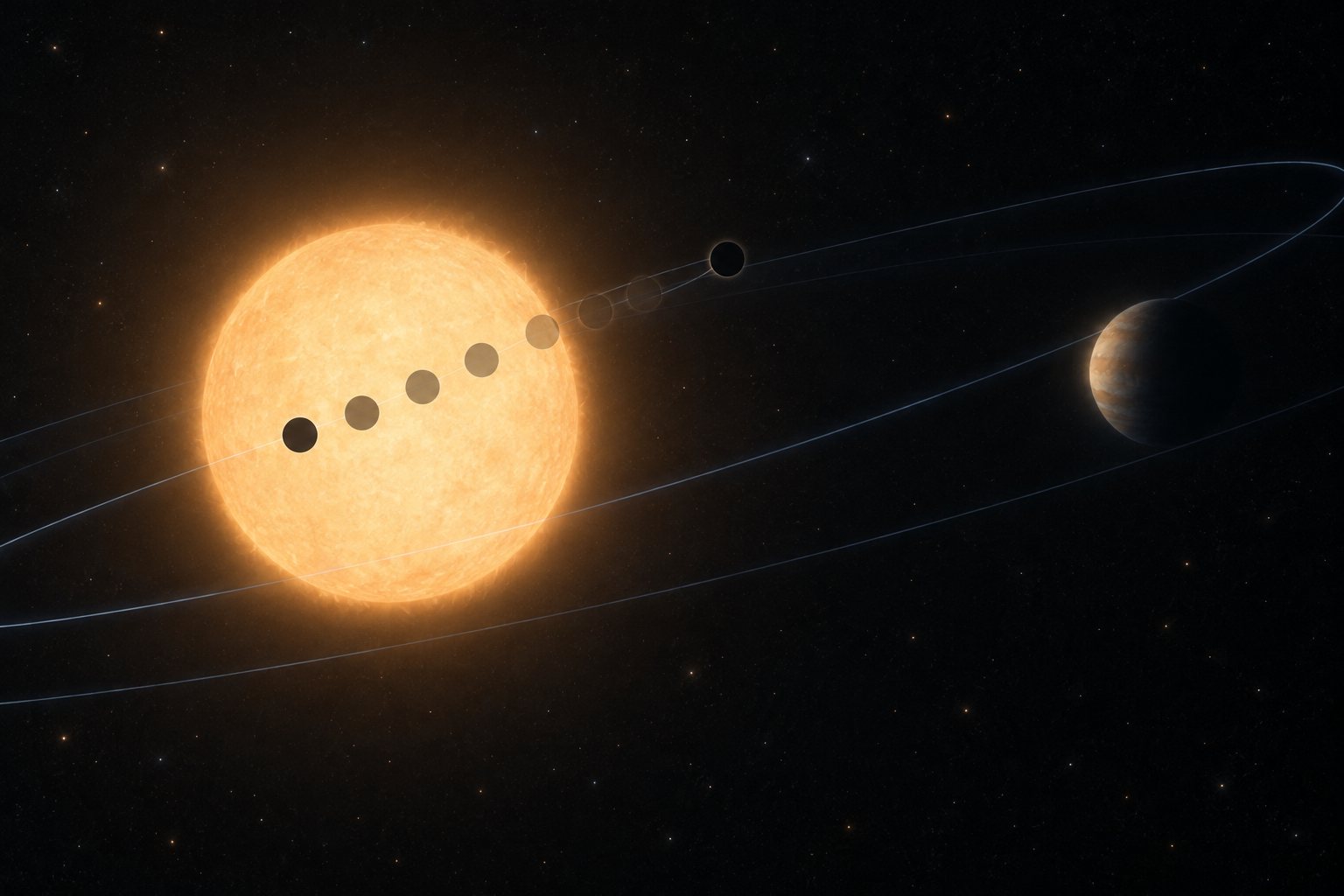
Solar and Stellar Astrophysics

The Sun, stars and how they live and die

17

The Impact of a Magnetic Field on stochastically generated g-modes

T. M. Rogers, L. M. Corrigan, L. Barrault+1 more

AstronomerTwo-dimensional nonlinear MHD simulations of a star with core convection test gravity-wave interactions with magnetic fields of varying strengths in global and local geometries. The simulations show gradual, frequency-dependent amplitude changes: low-frequency modes are preferentially attenuated, while higher-frequency modes can be amplified. Significant suppression requires fields at least an order of magnitude stronger than commonly used linear criteria predict. The authors suggest that wave excitation by Maxwell stresses partly offsets magnetic attenuation. These simulation results indicate that strong changes to wave propagation need not produce comparable suppression of the global oscillation spectrum, warranting caution when using linear suppression criteria to infer internal field strengths.

PublicMagnetic fields have been proposed as a way to weaken certain slow oscillations inside stars, potentially allowing astronomers to estimate otherwise hidden internal fields. In two-dimensional computer simulations of a star with a churning core, researchers found that magnetic fields weakened lower-frequency oscillations gradually, while sometimes strengthening higher-frequency ones. Substantial weakening required fields at least ten times stronger than commonly used simplified calculations predict. The researchers suggest that magnetic forces may also generate waves, partly counteracting the weakening. These are simulation findings, not direct measurements of stars, and they caution that changing how waves travel does not necessarily quiet the star’s overall pattern of oscillations.

Young explorerA star can wiggle inside, and magnetic fields might make some wiggles quieter. Scientists made a flat computer model of a star to try this out. Slower wiggles became quieter, but faster ones could get stronger. Making the wiggles much quieter took a magnetic field at least ten times stronger than simpler calculations expected. The scientists think the magnetic field might also make new wiggles. This was a computer experiment, not something they watched happen in a real star.

The chemical DNA of the Magellanic Clouds -- VII. The lithium abundance in the Small Magellanic Cloud and the discovery of 4 lithium-rich stars

A. Mucciarelli, M. Palla, C. T. Nguyen+7 more

  • Astrophysics of Galaxies

AstronomerThe study presents lithium abundances, A(Li), for 209 red giant branch stars in the Small Magellanic Cloud observed with FLAMES at the VLT. Approximately one-third have lithium-line detections above 5 sigma and about half above 3 sigma; the remainder yield upper limits. The sample shows significant star-to-star abundance scatter. Theoretical models suggest two likely contributions: mass- and metallicity-dependent lithium depletion through thermohaline mixing, given the sample’s range of ages, masses and [Fe/H], and nova-driven lithium enrichment expected at lower [Fe/H] than in the Milky Way because of the SMC’s lower star formation efficiency. An observed rise in A(Li) toward younger ages in three SMC globular clusters supports the enrichment interpretation. The authors also report the first identification of four low-mass lithium-rich giants in the SMC. Although evolutionary mixing complicates interpretation of abundances near the RGB tip, these measurements can constrain stellar and galactic lithium evolution.

PublicAstronomers measured lithium in a sample of 209 red giant stars in the Small Magellanic Cloud using FLAMES at the Very Large Telescope. About half showed a lithium signal above the study’s 3-sigma detection threshold, including roughly one-third with stronger detections above 5 sigma; for the others, the team could only set upper limits. Lithium abundance varied substantially between stars. Models suggest that this variation likely reflects both internal mixing, which can deplete lithium differently in different stars, and the galaxy’s history of lithium enrichment from novae. The latter explanation is supported by measurements in three SMC globular clusters showing more lithium at younger ages. The team also reports the first identification of four low-mass, lithium-rich giant stars in this galaxy. Because aging stars can alter their lithium content, these measurements require careful interpretation, but they still offer clues to how stars and galaxies change their chemical makeup.

Young explorerAstronomers looked for a material called lithium in 209 big stars in a galaxy called the Small Magellanic Cloud. They could spot it clearly in some stars, but not in all of them, and the stars had different amounts. Their models suggest two possible reasons: mixing inside stars can use up lithium, and star explosions called novae may have added lithium to the galaxy over time. These ideas are not certain. The team also found four small-mass giant stars with unusually lots of lithium. Studying them can help us learn how stars and galaxies change.

High-precision abundance analysis of a unique CEMP-no star in Sculptor

Francisco Cuadra, Ása Skúladóttir, Romain Lucchesi+5 more

  • Astrophysics of Galaxies

AstronomerThe authors present the first detailed abundance study of a CEMP-no star with [Fe/H] < -3 in the Sculptor dwarf spheroidal galaxy. High-resolution VLT/UVES spectra of DR20080 yield abundances for 17 elements and four upper limits: [Fe/H] = -3.26, mixing-corrected [C/Fe] = +1.60, and [Ba/Fe] = -1.28. Its [O/Fe] = +1.53 is significantly above the Milky Way CEMP-no average, while [Mn/Fe] = -1.02 and [Ni/Fe] = -0.45. Comparison with theoretical Pop III and Pop II supernova yields favors enrichment by two Pop III progenitors: a dominant 43-solar-mass faint supernova with explosion energy 0.6 × 10^51 erg and a minor 19.4-solar-mass hypernova contribution with energy 10 × 10^51 erg. This progenitor scenario is a model-based inference, not a direct observation. The authors report that DR20080's distinctive abundance pattern has not previously been observed in Sculptor or elsewhere in the Milky Way and its satellites. The rarity of CEMP-no stars in dwarf spheroidals motivates testing possible environmental differences in Pop III properties, but this study does not establish such a dependence.

PublicAstronomers have measured a distinctive chemical fingerprint in DR20080, a star in the Sculptor dwarf galaxy. Their detailed spectra provide abundances for 17 elements and upper limits for four more. The star contains very little iron, is rich in carbon relative to iron, and has little barium relative to iron. Its oxygen-to-iron ratio is substantially higher than the average for comparable carbon-rich stars in the Milky Way, while manganese and nickel are low relative to iron. Comparing these measurements with theoretical predictions, the researchers favor a picture in which two stars from the universe's first stellar generation supplied its ingredients: mainly a relatively weak supernova, with a smaller contribution from a much more energetic explosion. That history is an interpretation of the chemical pattern, not something directly witnessed. Such carbon-rich, barium-poor stars are unexpectedly rare in dwarf spheroidal galaxies, so DR20080 offers a way to investigate whether the earliest stars differed between environments.

Young explorerScientists studied the light from a star called DR20080 in a small galaxy called Sculptor. Its light shows what it is made of: it has very little iron and lots of carbon compared with iron. Its mix of ingredients is unusual. The scientists compared that mix with calculations of how stars explode. Their best match suggests that two of the universe's first stars helped supply its ingredients, one with a weaker explosion and one with a much stronger explosion. They did not see those explosions happen, so this is their best explanation, not something they know for sure.

Signatures of mass transfer in open-cluster blue straggler stars. I. Collinder 261: Evidence from rotation, binarity, and chemical abundances

M.J. Rain, L. Monaco, S. Villanova+1 more

  • Astrophysics of Galaxies

AstronomerVLT/FLAMES-GIRAFFE spectroscopy of the 6.7-Gyr open cluster Collinder 261 measures projected rotation in 40 blue straggler stars (BSS) and 42 turn-off/subgiant reference stars. Of the 39 BSS entering the statistics, 17 (44 ± 8%) have v sin i above 40 km/s; all reference stars rotate slowly. Fast rotation is strongly associated with spectroscopic binarity. TESS identifies seven eclipsing or ellipsoidal binaries with orbital periods of 0.5–2.1 days and rotation consistent with tidal synchronisation. The authors interpret their rapid rotation as maintained by close post-mass-transfer orbits, rather than as a formation clock. Among 22 slow rotators analysed chemically, 62% show abundance signatures attributed to mass transfer: a Ba-rich group associated with AGB donors and a C/O-enhanced, Ba-normal group associated with donors below the s-process activation mass, separated by an approximately 1-dex gap in [Ba/Fe]. Iron abundances are consistent with cluster membership; differential reddening partly explains the few apparent excesses. The authors interpret the C–O enrichment, opposite to depletion in globular-cluster BSS, as evidence for binaries wide enough to permit AGB donor evolution. Together with A+ within the half-mass radius of 0.171 ± 0.034, these findings extend globular-cluster rotation–density trends to an open cluster and support an ongoing binary formation channel.

PublicA study of blue straggler stars in the old star cluster Collinder 261 links their fast spinning and unusual chemistry to interactions with companion stars. Seventeen of the 39 blue stragglers included in the rotation statistics spin faster than 40 kilometres per second as measured along our line of sight, while all 42 comparison stars rotate slowly. Seven close binaries have spins matching their orbital motion. The researchers conclude that interactions within these close pairs maintain the rapid spinning, so it cannot reliably reveal when those blue stragglers formed. Chemical measurements of 22 slow-spinning blue stragglers show that 62% have surface patterns interpreted as material received from a companion. Two distinct chemical groups point to different kinds of donor stars. Taken together, the results support a continuing role for companion-star interactions in producing the cluster’s blue stragglers, with their chemistry reflecting the cluster environment.

Young explorerAstronomers studied special stars in an old star group. Many spin quickly, and some have a nearby partner star. In seven pairs, each star’s spin keeps time with its trip around its partner, so fast spinning does not tell us when it became special. Some stars also have chemical clues that suggest a partner gave them material. The clues point to different kinds of giving stars.

Planetary material is a major source of hydrogen in helium-atmosphere white dwarfs

Paula Izquierdo, Andrew Swan, Christopher J. Manser+36 more

  • Earth and Planetary Astrophysics

AstronomerHelium-atmosphere white dwarfs commonly show trace hydrogen, whose mean total mass in their convective envelopes increases with age; its origin remains debated. The authors construct a simple model combining upward diffusion from hidden hydrogen reservoirs with accretion of planetary material. They test it against two independent DESI and SDSS samples of DB white dwarfs selected by Gaia BP-RP > -0.25, roughly corresponding to effective temperatures of 10,000–19,000 K. Their model-based inference is that at least 22 ± 2 per cent of helium-atmosphere white dwarfs with detectable hydrogen must have accreted some hydrogen from planetary systems, potentially through ices, hydrated minerals or atmospheres. Within this framework, planetary hydrogen is needed to explain the population’s spectral evolution, not merely extreme hydrogen-rich cases.

PublicMany white dwarfs with atmospheres made mostly of helium also contain a little hydrogen. Observations show that, on average, older stars in this group have more hydrogen in their outer, mixing layers, but where it comes from is unsettled. The researchers tested a simple model using two independent survey samples. It allows hydrogen both to rise from hidden layers inside a star and to arrive in material from its planetary system. They infer that at least 22 ± 2 per cent of the helium-atmosphere white dwarfs with detectable hydrogen must have received some of it from planetary material. Possible sources include ice, water-bearing minerals and planetary atmospheres; the study does not identify which source supplied each star. The result argues that planetary hydrogen matters across this stellar population, not just in unusually hydrogen-rich examples.

Young explorerSome white dwarfs have a little hydrogen gas mixed into an outside layer made mostly of helium gas. Scientists wondered whether that hydrogen came from deep inside the stars or from things in their planetary systems. They tested a simple model against observations of the stars. The model says that, for some stars, hydrogen coming from inside is not enough: some must also have come from planetary material, perhaps ice, minerals containing water, or planets’ blankets of gas.

Near-Ultraviolet and Optical Observations of the White Dwarf ZTF J0328-1219 Reveal Variable Periodicity in its Transiting Debris System

Joseph A. Guidry, J. J. Hermes, Zachary P. Vanderbosch+35 more

  • Earth and Planetary Astrophysics

AstronomerHST/STIS near-ultraviolet spectroscopy of the transiting white dwarf debris system ZTF J0328−1219, obtained over five consecutive orbits in October 2025, yields abundances supporting accretion of a chondritic body. A 16-day optical campaign shows rapidly evolving transit morphology and changing dominance between previously identified periodicities: the 11.17 hr signal initially dominates, while the 9.937 hr signal starts weaker and later regains predominance. A candidate 7.64 hr period appears in the final days, but its significance and persistence remain uncertain. Simultaneous ULTRACAM ugr photometry from November 2024 is dominated by the 9.937 hr period and shows no significant color dependence. Optical photometry concurrent with the NUV observations likewise shows no transit-dependent extinction, except for possible reddening during the fifth HST orbit. The authors interpret the changing periodicities and possible color changes as evidence of ongoing dynamics involving collisions, highlighting opportunities to investigate dust physics in real time.

PublicObservations of debris passing in front of the white dwarf ZTF J0328−1219 reveal a changing pattern of dimming. During 16 days of monitoring in autumn 2025, dips repeating roughly every 11.17 hours initially dominated, but a previously prominent 9.937-hour pattern later took over again. A possible third pattern, repeating every 7.64 hours, appeared near the end, though researchers cannot yet establish its reliability or persistence. Hubble ultraviolet spectra also support the idea that the star is taking in material from a body with a composition like that of chondritic meteorites. The dips generally showed no significant color dependence, although one observing interval may show reddening. The authors interpret the changes as signs of ongoing activity involving collisions in the debris, offering a way to study how dust behaves as the system evolves.

Young explorerBits of leftover material pass in front of a white dwarf star and make its light look dimmer. Scientists watched the dimming change: one repeating pattern was strongest at first, but another became strongest later. They may have spotted a third pattern too, but they are not sure yet. The star’s light also gives clues that it is taking in rocky material. The scientists think crashes among the leftover bits help explain the changes, and watching longer could help them learn about the dust.

Identification of chromospheric dynamical signatures in the 2022 December 27 solar flare with DKIST

Sarah Riley, Jiong Qiu, Graham Kerr+2 more

AstronomerDKIST Visible Spectropolarimeter observations of a minor flare sampled Ca II 8542 Å spectra, formed in the middle chromosphere, in a single 1.5-hour raster. A newly developed multilayer hierarchical clustering algorithm grouped 17,422 flaring line profiles into 19 spectral clusters. The clusters trace spatially coherent structures with a central kernel and surrounding halo; the smallest identified kernel has a width of ≤400 km. The authors examined these structures relative to local heating histories inferred from Atmosphere Imaging Assembly observations. Clusters in pore and plage regions differ in kernel size, line shift, and spatial variation. These differences may reflect background atmospheric conditions and different stages of local heating, rather than an established single cause. Higher-cadence, high-resolution observations are needed to better understand the evolution of this fine structure.

PublicObservations from the Daniel K. Inouye Solar Telescope reveal small-scale structure in the Sun’s chromosphere during a minor solar flare. Researchers used an automated method to sort 17,422 spectra—patterns in the observed light—into 19 groups with similar features. These groups mapped out coherent structures with a central core surrounded by a halo; the smallest identified core was no more than 400 kilometres wide. Different solar regions showed differences in core size, shifts in spectral lines, and how the patterns varied across the region. The authors suggest that these differences could arise from the surrounding atmosphere or from different stages of local heating, but the cause is not established. Because the telescope’s scan took 1.5 hours, faster high-resolution observations would help clarify how the structures change.

Young explorerScientists used a solar telescope to study a small flare, a burst of activity on the Sun. They sorted patterns in the sunlight and found tiny patches with a middle part and a halo around it. The patches looked different in different places. That might be because their surroundings were different, or because they were at different steps of warming up. The scientists are not sure yet. Their scan took an hour and a half, so faster observations would help them learn how the patches change.

Understanding Coronal `Seeing' using High Angular Resolution Radio Observations of Active Solar Emissions

Soham Dey, Deepan Patra, Divya Oberoi+4 more

AstronomerSolar radio bursts produced by accelerated electron beams through plasma emission probe the coronal plasma and magnetic field, but low-frequency propagation effects complicate inference of intrinsic source properties. Scattering by coronal density inhomogeneities is widely expected to broaden sources and obscure fine structure, yet model estimates of apparent point-source sizes range from sub-arcseconds to arcminutes, depending on the inhomogeneity model and scattering prescription. Recent high-angular-resolution observations with the SKAO pathfinders uGMRT and LOFAR have revealed unexpectedly compact type-I noise-storm sources as small as approximately 9 arcseconds. The abstract anticipates that forthcoming SKAO observations will constrain scattering models, improve coronal diagnostics, and reveal fine structure; these are prospective capabilities, not reported SKAO results.

PublicRadio bursts from the Sun can reveal conditions in its outer atmosphere, but the turbulent plasma they pass through can blur their images. This makes it difficult to separate the bursts' true structure from changes caused by their journey. Models disagree widely about how much blurring to expect. Recent observations with the uGMRT and LOFAR radio telescopes have found unexpectedly compact sources in a kind of solar radio activity called type-I noise storms, with apparent sizes down to about 9 arcseconds. These findings highlight the value of sharp radio images. Future observations with the Square Kilometre Array Observatory are expected to help test the blurring models and uncover finer structures, but those benefits have not yet been demonstrated here.

Young explorerThe Sun sends out radio signals we cannot see with our eyes. As those signals travel through the Sun's outer atmosphere, they can get blurred, making a tiny spot look bigger. Radio telescopes have found some surprisingly small spots even with that blur. Scientists hope a future telescope will help them see more detail and understand how much the signals get blurred.

Thermal-pulse-resolved Binary Population Synthesis with Detailed Stellar Models: Implications for Long-period WD+MS Formation

Yanxu Shi, Hongwei Ge, Diogo Belloni+3 more

AstronomerGaia’s long-period WD+MS binaries challenge the usual association of common-envelope evolution (CEE) with short final periods. This study models a possible formation channel using thermal-pulse-resolved population synthesis based on 51 detailed MESA tracks with initial masses of 1–6 solar masses, applied to 5 million initially sampled binaries. Envelope binding energies are calculated from the donor structure at Roche-lobe overflow. In the simulations, thermal-pulse expansion and tidal orbital shrinkage can initiate interaction, while weakly bound envelopes of late TP-AGB donors permit envelope ejection with limited orbital contraction. For the standard model, with αCE = 0.3 and αth = 0.5, approximately 11.5% of TP-AGB-initiated post-common-envelope binaries have periods above 30 days. Long-period outcomes occur over a broad range of CE parameters; with αCE = 1, periods can reach several hundred days without an internal-energy contribution. Their modeled WD masses peak near 0.6 solar masses, with more massive WDs rare. The predicted proximity to the single-star initial–final mass relation offers a potential formation-channel diagnostic in clusters with independently constrained progenitor masses. These results support late TP-AGB CEE as a viable contributor, not an established explanation for the entire observed population.

PublicGaia has revealed pairs consisting of a white dwarf and an ordinary star with surprisingly long orbital periods. Such pairs are a puzzle because a shared-envelope phase, in which both stars lie inside one star’s outer layers, is usually associated with much tighter final orbits. In computer simulations, the researchers found a possible way around this: a highly evolved giant star can swell during thermal pulses and begin interacting with its companion when its outer layers are only weakly bound. Those layers can then be expelled without greatly tightening the orbit. In the standard model, about 11.5% of the surviving pairs formed through this route had orbital periods longer than 30 days. Some modeled systems reached periods of several hundred days under other assumptions. The simulations also predict a relationship between the original star’s mass and the resulting white dwarf’s mass that might help test this explanation in star clusters. The work suggests a possible contributor to the observed population, rather than proving how all these pairs formed.

Young explorerGaia has spotted pairs of stars that take a long time to go around each other. One is a small leftover star called a white dwarf. Scientists used computer models to explore how these pairs might form. In the models, an old, puffy star can swell until its outer gas surrounds both stars. If that gas is easy to push away, the stars can lose it without moving much closer together. This could explain some of the pairs Gaia sees, but scientists have not shown that it explains them all.

Asteroseismology of the Gaia SB₂ HD 70510: From Radial Modes to Component Masses

Chenglong Lv, Ali Esamdin, Shuguo Ma+5 more

AstronomerHD 70510 combines a Gaia DR3 double-lined spectroscopic orbit with regular δ Scuti pulsations that help resolve the inclination–mass degeneracy. In nine TESS sectors, five high-signal-to-noise peaks form a sequence consistent with the radial fundamental and four consecutive overtones. Two stable pulsation clocks exhibit the sign and amplitude expected for the Gaia primary’s orbital motion, identifying that component as the pulsator. Combining stellar evolution and pulsation modelling, a two-component SED fit to unresolved Gaia and 2MASS photometry, and the Gaia orbit yields M1 = 1.594 (+0.026/−0.026) solar masses, R1 = 1.482 (+0.014/−0.012) solar radii, an age of 171 (+112/−99) Myr, an inclination of 82.1 (+3.5/−3.4) degrees, and M2 = 1.121 (+0.029/−0.028) solar masses. These statistical intervals are conditional on the adopted radial-mode identification and stellar and binary-SED models. The inferred primary is near the zero-age main sequence; the roughly 6000 K companion contributes 14–28% of the unresolved optical-to-near-infrared flux. The system illustrates how regular pulsations can constrain component masses in non-eclipsing TESS binaries with Gaia SB2 orbits.

PublicAstronomers used rhythmic changes in a star’s brightness to help estimate the masses of two stars orbiting each other in HD 70510. Their spectroscopic orbit alone leaves the masses uncertain because its tilt is unknown. TESS observations revealed five strong pulsation frequencies with a pattern consistent with a particular sequence of stellar vibrations. Timing changes in two stable pulsations identified the system’s primary star as the pulsating member. Combining those observations with models of stellar structure and the two stars’ combined light gave estimated masses of about 1.59 and 1.12 times the Sun’s mass and an age of about 171 million years. These estimates depend on the assumed vibration pattern and models; the quoted statistical uncertainties do not remove that dependence. The study demonstrates a way to estimate masses in binary systems that do not eclipse.

Young explorerTwo stars travel around each other, and one makes regular little changes in brightness, like a blinking beat. Scientists watched those beats to work out which star was pulsing. Then they used the beats, the stars’ light, and computer models to estimate how heavy both stars are. Both seem heavier than our Sun. The answers depend on whether the models and the scientists’ ideas about the beats are right.

Angular momentum transport in a newborn protostar--disc system: magnetic braking, spiral arms and the magneto-rotational instability

Antonin Borderies, Benoît Commerçon, Adnan Ali Ahmad

  • Astrophysics of Galaxies

AstronomerA three-dimensional non-ideal MHD simulation with Ohmic and ambipolar diffusion follows the collapse of a one-solar-mass core through protostar formation and approximately 64 years of subsequent evolution, reaching approximately 10^-4 AU resolution at the protostellar surface. During a quasi-steady phase, the authors decompose the azimuthally averaged angular momentum budget into radial and meridional Reynolds, Maxwell and gravitational torques. The simulated collapse produces a thick disc roughly ten times more massive than the protostar, with specific angular momentum decreasing as it accretes. Accretion is vertically layered, with inward and outward flows coexisting at a given radius. Three transport regimes emerge: envelope magnetic braking; Maxwell-stress dominance within approximately 0.1 AU, where magnetic recoupling permits magneto-rotational instability; and Reynolds-stress dominance across the bulk ambipolar dead zone, carried by m=2 spiral arms in a marginally unstable disc, with gravitational stress secondary. Meridional transport is as important as radial transport. Consequently, a one-dimensional viscous model fitted to the simulated net mass flux would require negative alpha in part of the disc. These findings describe this simulation rather than observational measurements.

PublicA computer simulation follows a collapsing gas cloud as it forms a young star and a surrounding disc, then tracks about 64 years of their evolution. It examines how gas redistributes its rotation, allowing material to move inward. The simulated disc is thick and roughly ten times more massive than the young star. Different layers at the same distance from the star can flow inward or outward. Magnetic effects control the transport in the surrounding envelope and the innermost disc, while two spiral arms carry the dominant contribution through most of the disc. Transport between layers matters as much as transport toward or away from the star. For this simulated system, a simple one-dimensional model cannot straightforwardly represent the more complex flows: matching the net flow would require a negative value of its viscosity parameter in some regions.

Young explorerScientists used a computer to model a baby star growing inside a thick, spinning disc of gas. In the model, some layers of gas moved toward the star while other layers moved away. Magnetic forces and two spiral arms helped move the gas's spin around. Gas also passed spin between layers, showing that the flow was more complicated than a simple flat picture. This was a computer experiment, not a view of a real star.

Towards a new model of the compact triple system λ Tauri I. Improved periods and preliminary elements of the triple system

P. Harmanec, J. Švrčková, P. Doležal+19 more

AstronomerNew and archival radial velocities and photometry yield improved linear ephemerides for both orbits of the compact triple λ Tau. The inner eclipsing period is 3.952952845(81) days; its ephemeris improves on previous solutions by more than an order of magnitude and reproduces all available eclipse minima, including the first recorded in 1844. The outer period is 33.02480(28) days and appears constant over the available observations. Preliminary physical properties, inferred assuming near-coplanar orbits, indicate that the inner secondary fills or nearly fills its Roche lobe. The long-term stability of the inner period places a strong upper limit on proposed episodic mass transfer to the primary, rather than establishing that transfer occurs. Planned work will incorporate optical spectro-interferometry and a full numerical model of orbital evolution, with particular attention to the inner orbit’s forced eccentricity and the absence of outer-orbit apsidal advance in the present solution.

PublicAstronomers combined new and earlier measurements of stellar motion and brightness to refine the orbital timetable of λ Tau, a compact three-star system. Two stars eclipse each other roughly every four days, while the outer orbit takes about 33 days. The improved eclipse timetable fits records reaching back to 1844, and the outer orbital period appears unchanged across the available observations. Assuming the two orbits lie nearly in the same plane, the researchers infer that one star in the inner pair fills or nearly fills the region within which its gravity can hold material. The steady eclipse period strongly limits how quickly it could be passing material to its companion in proposed episodes; it does not establish that such transfer occurs. More detailed modelling and additional types of observations are planned.

Young explorerλ Tau is a family of three stars. Two go around each other and sometimes hide one another from our view. Scientists used measurements of their light and motion to make a better timetable for this star dance, matching even an eclipse recorded in 1844. One star may be close to spilling material toward its partner, but the study does not show that this is happening. The scientists plan to study the dance more closely.

Constraining electron heat flux from reduced measurements

Victor Edmonds

  • Space Physics

AstronomerUsing one Wind solar-wind measurement, the authors test which constraints on the electron velocity distribution suffice to determine heat flux. In a fixed-bin model, distributions preserving density, mean flow, temperature and per-energy-channel angular summaries permit heat fluxes of 3.58–19.85 μW m−2. Retaining the correlation between electron motion parallel and perpendicular to the magnetic field fixes the flux at 11.73 μW m−2, matching the original bin calculation without reconstructing the full distribution. When measured counts vary, preserving the required correlations yields the same heat-flux range as direct calculation from those counts; it does not remove that uncertainty. The authors propose applying this constraint-based test to coronal observations to clarify which electron-motion features determine heat transport and, potentially, the heating requirements used to assess coronal heating mechanisms.

PublicEstimates of the energy needed to heat the Sun’s corona depend partly on how electrons carry heat. Different patterns of electron motion can fit the same observations while transporting different amounts of heat. Using one solar-wind measurement from Wind, the researchers found that, in their fixed-bin model, several retained summaries of electron motion allowed heat fluxes from 3.58 to 19.85 μW per square metre. Keeping information about how motion along and across the magnetic field is linked recovered the original calculation’s value of 11.73 μW per square metre, without rebuilding the complete pattern of electron velocities. Variation in the measured counts still leaves uncertainty in the heat flux. The researchers propose testing observations of the corona in a similar way; this could improve estimates of its heating needs, but is not itself a solution to coronal heating.

Young explorerTiny particles called electrons carry heat away from the Sun’s hot outer layer. Just knowing a few things about how they move may not tell us how much heat they carry. Scientists tried a test using one measurement of particles flowing away from the Sun. In their model, keeping track of how two directions of motion were linked let them work out the heat flow without knowing every detail of the particles’ motion. The answer was still only as certain as the measurement. They suggest trying a similar test with observations of the Sun’s outer layer to help understand how much heating it needs.

Revisiting the centrifugal breakout scaling relationship for Hα emission in light of ρ Oph C, the coolest B-type star with an Hα-bright centrifugal magnetosphere

M. E. Shultz, E. Alecian, I. Berry+6 more

Astronomerρ Oph C (HD 147932), a rapidly rotating magnetic B5 V star, is the least-luminous B-type star with detected magnetospheric Hα emission. Such emission largely disappears below log(L/L☉) ≈ 2.8. New high-resolution ESPaDOnS spectropolarimetry samples its rotation, with the rotational period revisited using Hipparcos, K2 and TESS photometry. The inferred magnetic strength and geometry agree with the radio-derived model, and Hα shows very little variability, as expected from that geometry. Comparisons with metallic-line equivalent widths and magnetospheric models suggest that surface abundance spots dominate the photometric variability, while complex rotational modulation at roughly the millimagnitude level probably originates in the magnetosphere. Both Hα emission and photometric eclipse depth are substantially weaker than centrifugal breakout (CBO) predictions, although radio luminosity agrees with them. The authors speculate that this combination may mark a transition between effective-temperature regimes characterized by hydrogen-dominated winds and decoupled metallic winds.

PublicThe star ρ Oph C is the least luminous B-type star yet found to show a particular hydrogen emission signal from gas in its magnetic surroundings. New observations spanning its rotation show that its magnetic field agrees with a model previously inferred from radio observations. The hydrogen signal changes very little as the star turns. Comparisons suggest that most of its changing brightness comes from patches with different chemical abundances on its surface, although smaller, more complicated changes probably arise in the surrounding gas. A model called centrifugal breakout predicts stronger hydrogen emission and a deeper brightness dip than observed, but correctly predicts the star’s radio luminosity. The authors suggest—not establish—that the star may lie between temperature ranges where stellar winds behave differently: one dominated by hydrogen and another in which metallic material flows separately.

Young explorerAstronomers watched a spinning star called ρ Oph C. It has a magnetic field and gas around it. The magnetic field matched what earlier radio observations suggested. Patches with different kinds of material on the star probably explain most of its changing brightness. But the surrounding gas gives off less hydrogen light, and makes a smaller dip in the star’s brightness, than one model expected. Its radio glow does match that model. Scientists wonder whether the way gas blows away from this star is between two different kinds of flow, but they are not sure.

131 Revised arXiv:2607.28530

Is the Quiet-Sun Heating Requirement Observationally Established?

Victor Edmonds

  • Plasma Physics

AstronomerThe study examines whether temperature observations adequately constrain the conductive energy term used to assess heating mechanisms in the quiet corona. Two radio methods yield temperatures near 0.62 and 1.5 million kelvin. A population with excess fast electrons can explain both readings, but unresolved structure and delayed ion formation also leave Maxwellian interpretations viable. Neither interpretation alone determines the heat flux. The tested local conduction formula diverges for an idealized fast-electron distribution with an unbroken tail. Even after applying X-ray constraints, the model permits about 5–6% of electrons to hold 28–33% of its kinetic energy; their heat transport depends on directional balance and conditions along their paths. Source and collision calculations test whether such a population could be sustained, rather than establish its presence. The examined observations do not demonstrate that the conductive estimate is accurate enough for the heating comparison. Measuring, reliably calculating, or sufficiently bounding that loss is needed to resolve this part of the energy budget.

PublicThe quiet corona radiates energy, so it needs an energy supply. Electrons can also carry heat into or out of it, complicating attempts to decide whether a proposed heating process supplies enough energy. Two radio methods give temperatures of about 620,000 and 1.5 million kelvin. A model containing extra fast electrons could explain both readings, but more conventional explanations remain possible. Crucially, neither temperature interpretation tells researchers how much heat the electrons actually transport. One tested heat-flow formula even breaks down for an idealized model whose fast-electron tail continues without a cutoff. The study concludes that the observations examined do not establish the heat loss well enough to judge the heating mechanism’s energy supply. That loss must first be measured, reliably calculated, or adequately bounded.

Young explorerThe corona is a very hot outer layer of the Sun. It gives energy away as light, and tiny particles called electrons can carry heat in or out. Two ways of checking its temperature give different answers, and scientists have more than one possible explanation. But those answers do not tell us how much heat the electrons carry away. Until scientists work that out, they cannot fairly check whether an idea for keeping the corona hot gives it enough energy.

141 Revised arXiv:2610.28443

Tight asteroseismic upper limits on hot subdwarf magnetism

Nicholas Z. Rui, Linhao Ma

AstronomerThe authors derive magnetic-field upper limits for 30 hot subdwarfs from observed low-frequency dipole and quadrupole gravity modes. Strong fields are expected to damp these modes, so their presence constrains fields that would otherwise suppress them. Even with conservative assumptions, near-surface field limits fall below 1 kG for roughly half the sample, with the tightest individual limit about 20 G. These are upper limits, not magnetic-field detections or proof of zero magnetism. They reinforce the apparent scarcity of magnetism in hot subdwarfs, a puzzle given the likely binary-interaction origin of sdB stars, and demonstrate the diagnostic potential of asteroseismology.

PublicResearchers used stellar vibrations to constrain magnetism in 30 hot subdwarf stars. Strong magnetic fields are expected to weaken certain slow vibrations; observing those vibrations therefore lets researchers set upper limits on the fields. Under conservative assumptions, the limits on fields near the surface are below 1,000 gauss for about half the stars, with the tightest limit around 20 gauss. This does not mean the stars have no magnetic fields, only that fields strong enough to suppress the observed vibrations are ruled out under the study's assumptions. The findings strengthen the puzzle of why magnetism appears scarce in these stars, especially because subdwarf B stars likely form through interactions between paired stars.

Young explorerStars can wiggle, and those wiggles can give us clues about their magnets. Scientists studied wiggles in 30 stars called hot subdwarfs. They expect strong magnetic fields to make some wiggles much weaker. Because they could see those wiggles, they worked out limits on how strong the stars' magnetic fields could be. The stars might still have weaker fields; the scientists did not show that they have none.

146 Revised arXiv:2611.00329

Slowly rotating white dwarfs in f (R, T ) = R + 2λT gravity: structure and stationary tidal response

Edson Otoniel, Jonathan A. Rebouças, P. H. R. S. Moraes

  • High Energy Astrophysical Phenomena

AstronomerThis theoretical study calculates cold carbon fluid white-dwarf equilibria and stationary tidal responses in f(R,T)=R+2λT gravity through second order in uniform rotation. Models are compared at fixed baryon number, with angular momentum conserved during aligned electric quadrupolar tidal perturbations. Negative coupling increases radii and dimensional tidal deformabilities over the common mass range. For the baryon sequence studied, at 40% of each model’s Kepler reference frequency, background readjustment supplies 95.8–97.5% of the rotational enhancement; the explicit mixed rotational–tidal contribution is positive and numerically resolved but subdominant. At that spin, enhancement over each coupling’s static model falls from 107.4% in general relativity to 14.2% at the most negative coupling, despite the latter’s larger absolute deformability. The authors attribute this reduction to less relative background expansion and a different Love-number variation.

PublicThe researchers calculated how rotating white dwarfs made of cold carbon respond to tidal forces in a particular modified theory of gravity. These are theoretical results, not observations. Across the mass range shared by the models, a negative value of the theory’s coupling parameter produces larger stars that are more easily deformed by tides. Yet greater absolute deformability does not mean a greater percentage increase from rotation: at 40% of each model’s reference maximum rotation frequency, that increase drops from 107.4% in general relativity to 14.2% for the most negative coupling studied. Most of the rotation-related increase comes from changes in the star’s underlying structure, rather than the explicit interaction between rotation and the tidal response. These numerical findings apply to the sequence of models studied.

Young explorerScientists used math to study how spinning stars called white dwarfs stretch when gravity pulls on them. They tried a different rule for gravity. In their models, that rule could make the stars bigger and easier to stretch. But spinning then gave them a smaller extra boost in stretchiness, compared with the same stars not spinning. Most of that boost came from spinning changing the star itself. This is what their calculations say, not something they watched happen in the sky.

Earth and Planetary Astrophysics

Planets, moons and small bodies, here and elsewhere

17

Searching for Planets around Altair with JWST/NIRcam

Tiffany Meshkat, Charles Beichman, Jorge Llop-Sayson+13 more

AstronomerTwo epochs of simultaneous JWST/NIRCam F444W and F200W MASK430R coronagraphy searched for giant planets around Altair, at 5.13 pc with a recently revised age of 88 ± 10 Myr. Post-processed F444W contrasts reach 2 × 10^-6 at 1 arcsec (5.1 au), 1.5 × 10^-7 at 2 arcsec (10.3 au), and a few × 10^-8 beyond 4 arcsec (20 au). Sonora Flame Skimmer models translate these contrasts into sub-Jupiter mass sensitivity beyond 5 au and sub-Saturn mass sensitivity beyond 10 au; these are model-dependent sensitivities, not planet detections. None of the first-epoch candidate sources co-moves with Altair in the second epoch, and their colors are consistent with background stars. Altair has no known companions or detected debris disk and is not associated with a stellar association, but its youth and proximity motivate further imaging. Measurements of background sources indicate that Altair will remain at least a few arcseconds from background stars over the next 10–20 years, supporting its proposed use as a reference star for future campaigns, including Roman coronagraph observations.

PublicAstronomers used the James Webb Space Telescope to look for giant planets around Altair, a nearby star whose age was recently revised to about 88 million years. Images taken at two different times showed that none of the initially promising points of light moved with Altair; their colors also fit background stars. No planet was confirmed. Models suggest the observations were sensitive to planets less massive than Jupiter beyond about 5 times the Earth–Sun distance, and less massive than Saturn beyond about 10 times that distance. These sensitivity estimates depend on the models and do not mean that such planets were found. Altair’s youth and closeness make it a promising target for more searches. The researchers also predict that it will stay sufficiently separated from background stars for the next 10–20 years to serve as a useful reference star for future imaging, including with the Roman Space Telescope’s coronagraph.

Young explorerScientists used the Webb telescope to look for big planets around a nearby star called Altair. They saw some little dots that might have been planets. But when they looked again, the dots did not move along with Altair, and their colors fit stars far behind it. So they did not find a planet. Their pictures could have shown some planets smaller in mass than Jupiter or Saturn if they were far enough from Altair, according to their models. Altair is still a good star to search around again. The scientists also think it could help them check future telescope pictures.

Imaging exoplanets below the telescope stability limit

Rodrigo Ferrer-Chavez, Jason J. Wang, Katherine L. Bouman+4 more

  • Instrumentation and Methods for Astrophysics

AstronomerThe authors present a physics-based starlight-subtraction framework that combines multistep optimization, a flexible instrument model, and automatic differentiation to fit millions of parameters and compensate for instrumental instabilities. Such instabilities limit standard reference-image methods because the telescope changes between reference and science observations. Applied to real JWST/NIRCam coronagraphic observations, the method delivers 2–15 times better sensitivity than standard techniques and the first detection of 51 Eridani b at 4.3 micrometres. To the authors’ knowledge, this is the first demonstration of substantially improved sensitivity with this type of approach on on-sky coronagraphic data. Extension to other observatories, including Roman and HWO, is proposed; any relaxation of their demanding stability requirements remains a potential benefit rather than a demonstrated result.

PublicPlanets are difficult to photograph beside their much brighter stars. Standard image-processing methods estimate the unwanted starlight using reference pictures, but changes in the telescope between pictures can leave glare behind. The researchers developed a method that uses a physical model of the instrument and adjusts millions of model settings to account for those changes. Tested on actual observations from the James Webb Space Telescope’s NIRCam instrument, it achieved 2–15 times better sensitivity than standard methods, including the first detection of the planet 51 Eridani b at a wavelength of 4.3 micrometres. The researchers suggest that the approach could also help other telescopes and perhaps ease stability demands on future observatories, but those benefits have not yet been demonstrated.

Young explorerTaking a picture of a planet next to its star is hard because the star is so bright. Scientists made a new computer method to work out which light comes from the star, even when the telescope changes a little, and remove that glare from the picture. They tried it on real pictures from the James Webb Space Telescope, and it helped them see faint planet light better than the usual methods. They hope it could help other telescopes too, but they have not shown that yet.

Cryohydrologic Flow and Pingo Formation Within Freezing Impact Melts in Occator Crater, Ceres

A. R. Kubas, H. G. Sizemore, B. E. Schmidt

AstronomerDawn imagery shows mound-like features on Occator Crater’s floor resembling terrestrial pingos, alongside landslides, gullies, and carbonate faculae. Proposed sources of water for some of these landforms include ascending deep crustal brines and freezing impact melt. This study tests the latter mechanism using simulations of heat transfer and groundwater flow in a shallow, freezing impact-melt deposit across a broad range of regolith properties relevant to Ceres. The simulations produce pressure gradients sufficient to drive flow within the melt matrix and potentially deliver fluids near the surface through hydraulic fracturing. Across most tested parameters, modeled water delivery meets or exceeds the estimated requirements for pingo formation. These results support the feasibility of a shallow impact-melt source but do not establish the origin of the observed mounds. Similar processes may operate elsewhere on Ceres and on other ice-rich bodies.

PublicImages from NASA’s Dawn mission show mounds in Ceres’s Occator Crater that resemble ice-related hills on Earth called pingos. Researchers tested whether freezing material melted by an impact could supply water to build such mounds, rather than requiring salty water rising from deep underground. Their computer simulations show that freezing can create pressure differences that move water through the melt deposit and could push it toward the surface by cracking the surrounding material. In most of the conditions tested, the modeled water supply was at least as large as the amount thought necessary to form the mounds. This makes the proposed process plausible, but it does not prove that the actual mounds formed this way. Similar water movement might occur elsewhere on Ceres or on other ice-rich worlds.

Young explorerPictures of the little world Ceres show bumps that look like icy hills on Earth. Scientists used a computer to test an idea: could water in a patch melted by a space crash get pushed upward as the patch freezes? In most of their tests, enough water moved toward the top to help make hills like those bumps. The idea could work, but the tests do not prove that this is how Ceres’s bumps were made.

The climate and potential habitability of a warm and oxygenated Mars

Ashwin S. Braude, Edwin S. Kite, Preston Cosslett Kemeny+3 more

  • Atmospheric and Oceanic Physics
  • Geophysics

AstronomerThe authors present the first 3-D global climate model simulations of an oxygen-rich, terraformed Mars, assuming an O2–CO2 atmosphere with additional warming from a well-mixed grey gas. Increasing pressure and grey-gas opacity both reduce diurnal temperature variations, but only slightly reduce seasonal variations; southern mid-latitudes remain climatically harsher than the Northern Hemisphere. Simulated temperatures at 30 hPa, five times present-day pressure, are consistent with lichen and moss, and at 60 hPa with forests, initially in the Hellas Basin. These are conditional temperature-suitability results, not demonstrations of viable ecosystems: the simulations omit dust and water-cycle climate effects and possible soil-chemistry and nutrient constraints. At present-day terrestrial biome oxygen-production rates, photosynthesis alone would require at least thousands of years to produce a human-breathable atmosphere and more oxygen than photosynthesis using known Martian CO2 reserves could supply, unless CO2 is recycled.

PublicComputer simulations explore how Mars might behave if it were given an oxygen-rich atmosphere and an extra warming gas. In the models, thicker air and stronger warming from that gas soften temperature differences between day and night, but do much less to soften seasonal changes. Southern middle latitudes remain harsher than the Northern Hemisphere. At five times Mars’s current atmospheric pressure, modeled temperatures could suit lichens and mosses; at ten times current pressure, they could suit forests, first in the Hellas Basin. This does not show that plants could actually thrive: the study leaves out climate effects from dust and the water cycle, along with possible soil and nutrient limits. Making breathable air through photosynthesis alone would take at least thousands of years at the oxygen-production rates of Earth’s present-day ecosystems. Known Martian carbon dioxide reserves would also be insufficient for that route unless carbon dioxide were recycled.

Young explorerScientists used a computer to imagine Mars with thicker air, more oxygen, and an extra gas to help warm it. In their pretend Mars, days and nights became less different in temperature, but the seasons still changed a lot. Some versions had temperatures that might suit moss, and versions with even thicker air might suit trees. That does not mean plants would really grow: water, dust, soil, and plant food still need to be considered. Plants making oxygen on their own would need at least thousands of years to make air people could breathe. Mars’s known supply of carbon dioxide, which plants use to make oxygen, would not be enough unless it could be used again.

A TESS Disappearing Act: The Vanishing Transits of TOI-2535 b

Samuel W. Yee, Erik A. Petigura, Rafael Brahm+25 more

AstronomerTOI-2535 b is a newly discovered hot Jupiter reported as the first confirmed planet around a single star whose transits have been directly observed to disappear. Seven years of TESS photometry show its transit chord moving off the stellar disk, with an impact-parameter drift of 0.16 per year; transit mid-times deviate by up to ±6 hours from a linear ephemeris. Joint modeling of transit timing and duration variations and NEID radial velocities indicates a nearby planetary perturber with mutual inclination of at least approximately 5 degrees. The modeling attributes the duration changes primarily to orbital-plane precession and favors a perturber of Saturn mass or greater in mean-motion resonance with TOI-2535 b. This interpretation implies an unusual pair of short-period giant planets, with exceptionally strong interaction-driven orbital evolution on human timescales.

PublicAstronomers report discovering TOI-2535 b, a hot giant planet whose passages across its star have now disappeared from view. Seven years of TESS observations tracked the planet’s path across the star until it no longer crossed the visible stellar disk. The passages also occurred as much as six hours earlier or later than a regular schedule predicted. Models combining these observations with measurements of the star’s motion point to gravitational influence from another nearby planet on a tilted orbit. That companion is likely at least as massive as Saturn, and the models suggest the two planets have linked orbital rhythms. The proposed explanation is that their gravitational interaction slowly changes the orientations of their orbits. The planet itself has not vanished: its alignment with our view has changed. The researchers describe this as the first confirmed planet around a single star directly observed to stop transiting.

Young explorerA big planet called TOI-2535 b used to pass in front of its star, making the star look a little dimmer. Astronomers watched its path shift until it stopped passing in front of the star from our point of view. The planet did not disappear—it just stopped lining up with us! Their calculations suggest another big planet may be tugging on it and changing the way its path is tilted.

A Possible Non-Transiting Companion in the TOI-2109 System Supported by Transit Timing Variations

Kaviya Parthasarathy, Prangsutip Cherdwongsung, Ing-Guey Jiang+19 more

AstronomerAn analysis of 87 transit epochs of the ultra-short-period hot Jupiter TOI-2109 b, spanning 2006–2025 and combining TESS, CHEOPS, HST, and ground-based photometry, compares linear-ephemeris, orbital-decay, apsidal-precession, sinusoidal, and two-planet n-body timing models. The decay fit gives a period derivative of −3.96 ± 2.05 ms per year, with no significant evidence for ongoing decay. The sinusoidal fit identifies a transit-timing signal with an amplitude of approximately 44 seconds. Dynamical modelling favours a non-transiting companion near the 7:3 mean-motion resonance, with a model-inferred period of 1.57813 ± 0.000089 days and mass of 0.70 ± 0.02 Jupiter masses. The reported ΔBIC of 4.95 relative to the sinusoidal model provides positive evidence for the two-planet interpretation, rather than establishing the companion as a confirmed detection.

PublicResearchers studied 87 passages of the giant planet TOI-2109 b across its star, using observations spanning 2006–2025. A timing model reveals a repeating pattern in which these passages shift by about 44 seconds. Of the explanations tested, modelling favours the gravitational pull of a second planet that does not cross the star from our viewpoint. The proposed companion would orbit in about 1.58 days and have roughly 70% of Jupiter’s mass, according to the model. The comparison provides positive evidence for this explanation, but does not establish the second planet as confirmed. The study also finds no significant evidence that TOI-2109 b’s orbital period is steadily shrinking.

Young explorerAstronomers watched a big planet pass in front of its star many times. Its crossings did not happen exactly on schedule: they found a repeating timing wiggle of about 44 seconds. Their calculations suggest another planet might be tugging on it, even though that other planet does not pass in front of the star where we can see it. That is a promising explanation, but they are not sure the other planet is really there. They also did not find clear signs that the big planet’s trips around its star are steadily taking less time.

Breaking the Chain: The Dynamical History of the Barnard's Star Planetary System

Tian Yi, Qiran Huang, Shuo Huang+1 more

AstronomerBarnard's Star, the nearest single-star system to the Sun, hosts four recently detected sub-Earth-mass planets whose architecture bears imprints of a broken resonant chain. The authors explore a proposed additional planet that no longer exists separately: resonance breaking would have triggered a merger of two planets, c1 and c2, producing the present-day planet c. They find two viable dynamical pathways that reproduce the observed configuration: long-term, stellar-driven tidal expansion and early, disk-driven expansion in which one-sided Lindblad torques separate the two outermost planets. Both permit the proposed merger; neither establishes that it occurred. The disk-driven pathway is also consistent with a census comparison: of 14 identified compact four-planet systems with similar broken-chain architectures, ten have the third planet breaking the resonant sequence.

PublicBarnard's Star, the nearest single-star system to the Sun, has four recently detected planets, each less massive than Earth. Their orbital arrangement shows signs of a disrupted pattern of coordinated orbits. The researchers propose that the system once contained an extra planet and that two planets merged to form today's planet c. They find two possible routes to the current arrangement: slow orbital expansion driven by the star's tidal effects, or early expansion driven by forces from a surrounding disk that pushed the outermost two planets apart. These are viable explanations, not evidence that a merger actually happened. The disk-based explanation also fits a wider pattern: among 14 similar four-planet systems identified by the authors, ten have their third planet interrupting the orbital sequence.

Young explorerBarnard's Star has four known planets, all less heavy than Earth. The way they go around their star looks like a once-matching rhythm that got mixed up. Scientists explored an idea: perhaps there used to be one more planet, and two planets joined together to make the planet called c. They found two ways this might have happened: the star could slowly change the planets' paths, or a disk around the young star could push some planets apart. These ideas can explain the pattern, but scientists have not shown that the planets really joined together.

An Archival Search for Outer Solar System Objects in the NOIRLab Source Catalog DR2: 65 Candidates, Including Four L4 Neptune Trojans

Gioele Cerati

  • Instrumentation and Methods for Astrophysics

AstronomerA search of NOIRLab Source Catalog DR2 single-epoch DECam detections from 2012–2019 links detections with a bound-orbit model and seeks confirmation on at least two additional archival nights. The catalogue contains 81 objects: four designated objects and 77 others, including 53 class-A candidates with multiple oppositions and at least nine nights, 12 class-B candidates, and 12 class-C candidates excluded from the dynamical tally. Although the linker recovers 96% of known objects present on four nights within one tile, end-to-end recall is only about 7%, and no selection function is supplied. Forced photometry on exposures excluded from fitting detects 41 testable objects at 99% of predicted positions, versus 6% at control positions; a post hoc rule yields 22 passes, 19 inconclusive cases, and no failures. Shifted controls produce no archival-image confirmations in 11,467 trials, but a 2.2% confirmation rate in catalogue precovery means those precovery nights alone are insufficient evidence. For the 65 class-A/B candidates, 10-Myr integrations suggest four candidate L4 Neptune Trojans with 13–19-year arcs, 21 resonant, 13 detached, nine scattering, two Centaurs, and 16 classical objects. One detached class-B candidate has perihelion q = 48.8 au. No object beyond 80 au is confirmed, providing barely any constraint on Planet Nine. Positions are withheld until designation or June 30, 2027; position digests are published.

PublicA researcher searched archived telescope detections for objects in the outer Solar System, linking sightings into possible orbits and checking additional archival images. The resulting catalogue lists 81 objects, including four already designated and 65 other candidates in the two stronger evidence classes; another 12 candidates are not included in the orbital classification. Independent image checks support the detections, but some remain inconclusive, and one catalogue-based checking method can produce false confirmations on its own. The full search recovers only about 7% of known objects available in the data, so the catalogue is far from complete. Computer simulations of the 65 stronger candidates suggest several types of orbits, including four possible objects sharing Neptune’s orbit near its leading L4 region. These are simulation-based classifications, not proof of long-term orbital behavior. No object farther than 80 times the Earth–Sun distance was confirmed, but this does little to test the proposed Planet Nine. The objects’ positions are being withheld until designation or June 30, 2027.

Young explorerA scientist looked through old pictures of space for little worlds far from the Sun. The scientist checked more pictures to see whether the moving dots were really there. Many checks looked good, but some were still uncertain, and the search missed lots of objects. A computer then tried out how some of these worlds might move. It suggested that four might travel around the Sun alongside Neptune, but that is still a possibility, not a sure answer. The search also did not tell us much about whether a proposed planet called Planet Nine exists.

Nucleation of water ice under weak ionization via clustering on negative ions

André Nicolov, Efstratios M. Kritikos, William A. Goddard III.+1 more

  • Plasma Physics
  • Space Physics

AstronomerLaboratory experiments demonstrate spontaneous water-ice grain formation in a cold, weakly ionized plasma containing trace water when neutrals and ions are cooled below about 200 K. Grains form without particulate impurities but not without ionization, indicating ion-induced nucleation. Time-resolved ion mass spectrometry detects both positive and negative hydrated ions: predominantly OH−(H2O)n clusters grow to about 200 amu, whereas predominantly H+(H2O)n clusters remain small and short-lived. During cooling toward 200 K, negative clusters grow and then decline sharply in abundance, consistent with rapid growth into macroscopic ice grains below a critical temperature. The authors interpret hydrated negative ions as key nucleation precursors, with potential relevance to Earth's mesosphere and protoplanetary disks rather than direct evidence from those environments. They estimate that this pathway can dominate over deposition onto existing dust in disk regions with sufficient UV-driven water dissociation and efficient low-temperature electron attachment to form negative ions such as OH−.

PublicIn a laboratory experiment, researchers found that water-ice grains formed in a cold, partly ionized gas containing a little water, even without dust particles to start the process. Ice appeared below about 200 kelvin, but did not form when ionization was absent. Measurements showed that water molecules gathered around both positively and negatively charged ions, but only the negatively charged clusters grew substantially. As the gas cooled, these clusters grew and then became much less abundant, consistent with their rapidly growing into ice grains. The researchers interpret this as evidence that negative ions can help start ice formation. The experiment offers a possible explanation for ice formation high in Earth's atmosphere and in disks where planets form, but does not directly demonstrate the process there. The authors estimate that it could outpace ice buildup on existing dust in parts of such disks, provided ultraviolet light breaks apart enough water and negative ions form readily in the cold.

Young explorerScientists made a very cold gas with a little water in a laboratory. Tiny bits of ice appeared even though there was no dust for the ice to start on. When the gas had no electrically charged particles, the ice did not form. The scientists saw water molecules gathering around tiny negatively charged particles. They think these little groups helped start the ice. Something like this might also help ice form high above Earth and around young stars, but this experiment only tested it in the laboratory.

092 Cross-listed arXiv:2611.12897

EoSAlign: An Open-Source Software for Calculating, Comparing, and Aligning Pressure Under Extreme Conditions

Allison Pease, Heidi N. Krauss, Kassandra Amezcua+1 more

  • Geophysics
  • Instrumentation and Methods for Astrophysics
  • Materials Science

AstronomerInconsistent pressure calibrations complicate comparisons of high-pressure experiments and introduce uncertainty into phase boundaries, melting conditions, and thermodynamic models. Above 100 GPa, existing scales diverge by more than 10 GPa. The open-source software EoSAlign calculates pressures from measurements such as volume, Raman shift, or luminescence peak position using published calibrations, and compares and aligns pressure scales. The authors use it to fit and align the equations of state of bridgmanite and post-perovskite to a common scale, reducing scale-related differences. The abstract does not quantify that reduction or establish an independently validated absolute pressure scale. Broader improvements in experimental consistency and understanding of planetary interiors are presented as potential applications.

PublicExperiments that squeeze materials to extreme pressures need reliable ways to measure that pressure. Different calibration methods can disagree by more than 10 gigapascals at pressures above 100 gigapascals, making studies difficult to compare. EoSAlign is free, open-source software that converts experimental measurements into pressure estimates using published calibrations and helps compare those estimates on a common scale. The researchers applied it to pressure-volume descriptions of two materials, bridgmanite and post-perovskite, reducing differences caused by the pressure scales used. They do not specify how large the improvement was. The software could help researchers compare experiments more consistently and study conditions inside planets; it does not by itself establish which pressure scale is absolutely correct.

Young explorerScientists squeeze materials very hard to learn how they behave. But their ways of measuring the squeeze do not always agree. A computer program called EoSAlign helps them compare those measurements using the same measuring rules. The scientists tried it with two materials and made the answers agree better, though they do not say how much better. It could help people study what happens deep inside planets, but matching the answers does not prove they are exactly right.

093 Cross-listed arXiv:2611.12910

Leveraging Large Language Models to Predict Atomic Oxygen Erosion of Polymers in Low Earth Orbit

Jared Solovei, Sakshi Agarwal, Aubrey Toland+5 more

  • Geophysics
  • Instrumentation and Methods for Astrophysics
  • Materials Science

AstronomerThe study fine-tunes GPT-4o to predict polymer erosion yields under atomic oxygen exposure, using 201 measurements compiled from multiple NASA low-Earth-orbit exposure missions. The authors report an order-of-magnitude error of 0.154 and a log-scaled R² of 0.719, outperforming conventional machine-learning approaches without extensive feature engineering. Adding film thickness and layering descriptors did not improve predictions. The authors interpret this as suggesting that chemical and environmental variables dominate over bulk structural characteristics, rather than as direct proof of the erosion mechanism. They propose the framework for rapid screening of candidate polymers to reduce reliance on costly spaceflight tests; the abstract does not report newly developed or flight-validated materials.

PublicAtomic oxygen in low Earth orbit can wear away the plastics used on satellites. Researchers trained a version of the AI model GPT-4o on 201 measurements from NASA space-exposure missions to predict how readily different plastics erode. They report better predictions than conventional machine-learning methods. Including information about material thickness and layering did not improve the predictions, suggesting—but not proving—that chemistry and environmental conditions matter more for erosion than those structural details. The researchers propose using the model to screen materials before expensive space tests. The study reports a predictive tool, not a newly demonstrated longer-lasting satellite material.

Young explorerA kind of oxygen near Earth can wear away plastic on satellites. Scientists taught an AI using 201 measurements from materials that had been in space. The AI learned to guess how easily plastics would wear away, and its guesses were better than those from other computer methods they compared. Scientists hope it can help them choose plastics to test, but it has not yet shown that a new plastic will make satellites last longer.

094 Cross-listed arXiv:2611.12914

Trace element distribution in coarse-grained Ca-Al-rich inclusions by femtosecond LA-ICP-MS: Implications for U-Pb chronology

Merel E. Onderwater, Elishevah M. M. E. van Kooten, Glenn J. MacPherson+2 more

  • Geophysics

AstronomerThe study maps major and trace elements in six coarse-grained CAIs from CV3 chondrites using femtosecond laser ablation ICP-MS. In inclusions lacking perovskite or hibonite, Al,Ti-pyroxene is the dominant host of U, Th, and most REEs, with strong enrichments toward grain edges, while light REEs reside in melilite. The authors interpret the zoning as a record of igneous fractional crystallization overprinted by melt evaporation, with outer regions and rims depleted in Yb, Eu, Ce, and U. Using Nd and Th maps as proxies for Cm, they model mineral-scale U isotope effects from 247Cm decay to 235U. Variable Cm-U partitioning is predicted to produce resolvable inter-mineral 235U/238U differences, with the largest excesses in melilite; these are model predictions, not reported isotope measurements. Predicted apparent U-Pb age offsets are approximately 0.1–1.0 Myr when U isotope compositions and radiogenic Pb come from isotopically distinct mineral reservoirs, but generally remain below 0.15 Myr when bulk U isotope compositions are used. The findings link U distribution and isotope systematics to crystallization and evaporation, although actinide behavior in coarse-grained CAIs remains poorly constrained.

PublicCalcium-aluminium-rich inclusions in meteorites are the Solar System’s earliest solids. Some later melted, redistributing elements among their minerals. Researchers mapped six such inclusions and found that, in those without two particular minerals, uranium, thorium, and most rare earth elements mainly occupy an aluminium- and titanium-bearing pyroxene, especially near its grain edges. They interpret the patterns as evidence of progressive crystallization and evaporation from the melt. Separately, a model using other elements to estimate curium’s distribution predicts that radioactive curium decay could leave different minerals with different uranium isotope ratios. These predicted differences could shift calculated uranium-lead ages by about 100,000–1,000,000 years if the uranium isotope information and lead come from different mineral reservoirs. Using the bulk uranium isotope composition generally keeps the modeled shifts below 150,000 years. The isotope differences are predictions, not direct measurements reported here.

Young explorerSome meteorites hold tiny pieces of the first solid stuff in our Solar System. Scientists made maps of six of these pieces to see where different ingredients ended up after melting. They found that certain minerals held more uranium and other ingredients than others. They think cooling and evaporation helped make these patterns. They also used a computer model to explore how radioactive changes might affect the clocks scientists use to date these pieces. The model says mixing information from different minerals could make an age look a little different, but that prediction is not a measured age change.

107 Cross-listed arXiv:2611.14151

Response of Circular Binaries to Monochromatic Gravitational Waves

Corey McInerney, Phil J. Sutton

  • General Relativity and Quantum Cosmology
  • Astrophysics of Galaxies
  • High Energy Astrophysical Phenomena
  • Solar and Stellar Astrophysics

AstronomerThis theoretical study examines specific orbital energy exchange between a test particle in a Keplerian binary orbit and a continuously incident, linearized gravitational wave. It derives analytical rates of change for orbital energy, semi-major axis, and mean motion. Numerical solutions illustrate resonance involving the wave frequency and the initial orbital frequency, distinguishing bounded short-period oscillations from resonant libration. The analysis also considers the wave’s incidence angle relative to the orbital plane. For an initially flat, circular orbit, an illustrative high-strain calculation yields bounded eccentricity changes and small linear growth in inclination. These are model results, not observations; long coherence requirements limit the observational significance of resonance to astrophysical systems with very short orbital periods.

PublicCan a gravitational wave change an orbit? This study uses mathematical calculations and numerical models to explore how a continuous gravitational wave could exchange energy with an orbiting particle. The models show a resonance effect involving the wave’s frequency and the particle’s starting orbital frequency, and distinguish short, bounded variations from a different oscillating behavior associated with resonance. The researchers also examine how the wave’s direction matters. In an illustrative calculation using a strong wave, an initially circular orbit has limited changes in how stretched it becomes, while its tilt grows slowly. These are theoretical findings, not detected changes in a real system. The wave and orbit must remain in step for a long time, limiting the effect’s observational relevance to systems with very short orbital periods.

Young explorerImagine something going around in a circle while a ripple in space passes by. Scientists used math and computer calculations to see how the ripple might change its path. Their model shows that the timing of the ripple and the trip around can matter, a bit like timing pushes on a swing. In one example with a strong ripple, the path’s shape changed only a limited amount, while its tilt slowly grew. They have not watched this happen in space. The timing needs to stay steady for a long time, so the effect may matter for observations only when things go around very quickly.

138 Revised arXiv:2609.09063

The size and mass distribution of cold classical TNOs for 5<H<13

Gary M. Bernstein, Wesley C. Fraser, Marielle R. Eduardo+7 more

AstronomerRecent JWST observations constrain the cold classical trans-Neptunian population’s differential absolute-magnitude distribution over 5 < H_r < 13, enabling inference of dN/dM across at least five orders of magnitude in mass. Lognormal, generalized Gamma, and double-power-law distributions fit equally well. Mass per logarithmic interval peaks near 75 km diameter, approximately 10^-7.5 Earth masses. The fitted forms diverge beyond H_r = 13, making extrapolation unreliable and leaving a faint-end turnover unresolved. Uncertainty in the mass–absolute-magnitude relation dominates the total-mass uncertainty; calibration with cold classical binaries suggests 1.7–2.7 × 10^-3 Earth masses. A possible trend toward lower density and/or higher albedo at smaller sizes would reduce this estimate. Qualitative comparison suggests streaming-instability simulations yield more sharply peaked mass distributions with steeper bright ends. Inhomogeneous formation conditions absent from the models could explain the differences, but the diversity and uncertainty of current simulations prevent a definitive test of the streaming-instability hypothesis.

PublicCold classical objects beyond Neptune are thought to be remnants of planet formation that formed where they are found and avoided being ground down by collisions. Using recent JWST observations, researchers inferred how their mass is distributed among bodies of different sizes. The greatest share of mass per logarithmic mass interval lies in objects about 75 kilometers across. Several mathematical descriptions fit the observations equally well, but disagree when extended to fainter objects, so the abundance of those objects remains uncertain. A calibration using pairs of cold classical objects suggests the population totals about 0.17–0.27 percent of Earth’s mass. That estimate depends strongly on how brightness translates into mass; tentative evidence that smaller bodies are less dense or more reflective could lower it. Simulations of a proposed formation process called the streaming instability appear to produce a more narrowly concentrated mass distribution than inferred from the observations. However, uncertainties and differences among simulations mean this comparison cannot yet establish whether that process formed these objects.

Young explorerFar beyond Neptune, many icy space objects may be leftovers from when planets were made. Scientists used observations from the JWST space telescope to work out how much material is in objects of different sizes. They think the biggest share is in objects about 75 kilometers wide. But brightness does not tell us exactly how heavy something is: a shiny object can look bright without being very big. Scientists also compared their findings with computer models of how these objects might have formed. The models do not quite match, but there is still too much uncertainty to say whether that idea is right or wrong.

151 Revised arXiv:2611.12543

Kinematic Signatures of Stellar Flybys in Protoplanetary Discs

Vasundhara R. Prasad, Cristiano Longarini, Carolin N. Kimmig+1 more

AstronomerObserved large-scale non-Keplerian gas motions in protoplanetary discs have been interpreted as warp signatures, but their origin is not unique. This study uses 3D smoothed particle hydrodynamics simulations of inclined and coplanar stellar flybys to examine disc evolution several thousand years after periastron. Inclined encounters initially induce warping and twisting that damp on a viscosity-dependent timescale. Synthetic ALMA CO observations nevertheless retain complex spiral velocity residuals after the warped morphology relaxes; such residuals also occur in coplanar encounters that never produce a warp. Fitting the residuals with a simple warped-disc model systematically overestimates the warping. These simulation-based findings indicate that kinematic residuals alone cannot establish a warp. The study also identifies scattered-light spiral arms and lateral asymmetries as an independent diagnostic.

PublicGas in young planet-forming discs sometimes moves differently from the motion expected around a star. Such patterns have been interpreted as signs that a disc is warped, but this study shows why that interpretation can be misleading. In computer simulations, a passing star on an inclined path initially bends and twists a disc, and that distortion later fades at a rate controlled by the disc's viscosity. Simulated ALMA observations still show complicated spiral patterns in the gas motions long afterward. Similar patterns appear even when the passing star stays in the disc's plane and never creates a warp. A simple model that interprets these motions as warping therefore exaggerates how bent the simulated disc is. The authors conclude that gas motions alone cannot confirm a warp, and identify spiral arms and side-to-side differences in scattered-light images as an additional, independent diagnostic.

Young explorerA young star can have a big disc of gas around it. Scientists used computer models to see what happens when another star passes nearby. Some visits bent and twisted the disc, but the bend later faded while swirly gas motions stayed. Other visits made swirly motions without bending the disc at all. So seeing gas move in funny ways does not prove that a disc is bent. Pictures of light scattered by the disc can give scientists another clue.

153 Revised arXiv:2611.12881

The Brown Dwarf Desert is a Mass-Ratio Desert: Astrometric Demographics of 63,254 Stars

William Thompson, Alexandre Bouchard-Côté, Dori Blakely+19 more

  • Solar and Stellar Astrophysics

AstronomerA joint model of Hipparcos and Gaia DR2/DR3 astrometry for 63,254 stars measures planetary and stellar companion occurrence on 3–94 yr orbits, approximately 2–20 au, for hosts spanning M dwarfs to B stars. The survey finds a strong companion deficit at companion-to-host mass ratio q ≈ 0.02 across this host-mass range and excludes a desert at fixed companion mass. Occurrence increases with metallicity below the mass-ratio desert but decreases above it. The authors interpret these distinct populations as plausibly reflecting two formation channels that both scale with host mass. Illustratively, the lightest stellar-like companions of K stars are about 13 Jupiter masses, below the roughly 27 Jupiter masses reached by the heaviest planet-like companions of B stars. The authors therefore argue for mass ratio, rather than absolute mass or the deuterium-burning limit, as the physically meaningful dividing criterion; the formation-channel interpretation is not directly established.

PublicBrown dwarfs are unusually scarce as close companions to stars, a pattern called the brown dwarf desert. By jointly analyzing Hipparcos and Gaia measurements of 63,254 stars, this study examines companions with orbital periods of 3–94 years around stars ranging from M dwarfs to B stars. It finds that the scarcity tracks a companion's mass relative to its star: companions weighing about 2% as much as their host are strongly depleted, rather than companions at one fixed mass. Below this gap, companions become more common around stars richer in elements heavier than helium; above it, the trend reverses. The authors suggest that the gap separates populations that may form in different ways. In their interpretation, a companion's mass relative to its star is a more meaningful way to distinguish planet-like from stellar-like companions than its mass alone.

Young explorerStars can have smaller things going around them, such as planets or other stars. Scientists studied tiny changes in the positions of many stars to learn about their companions. They found that companions are especially rare when they weigh about two hundredths as much as the star they go around. The missing size changes with the star: a bigger star has its gap at a bigger companion size. The scientists think the companions on either side of this gap may be made in different ways, but that idea is not yet proved.

156 Revised arXiv:2512.23730

Pair Space Analysis of Some Four-Body Central Configurations

Alon Drory

  • Mathematical Physics
  • Solar and Stellar Astrophysics

AstronomerThis mathematical study examines central configurations of the four-body problem, defined here as configurations in which the forces on all bodies point toward a single fixed point. A newly formulated pair-space formalism provides vector equations that fully characterize these configurations. For the subclass with at least two pairs of equal inter-body distances, the only non-collinear solutions are tetrahedral, kite-shaped, or isosceles-trapezium configurations; the tetrahedron is the unique non-planar configuration. The study gives mathematical relations connecting internal angles to mass ratios. These are theoretical results, not observational findings.

PublicThis theoretical study asks how four bodies can be arranged so that the forces on them all point toward one fixed location. Using a new mathematical framework, the author examines arrangements with at least two pairs of matching distances between bodies. Excluding arrangements along a straight line, the possibilities are a tetrahedron, a kite, or an isosceles trapezium. Only the tetrahedron extends outside a flat plane. The study provides formulas showing how the bodies' relative masses determine the shapes' angles; it does not report observations of such systems.

Young explorerImagine four objects pulling on one another, with all their pulls pointing toward the same spot. A scientist used math to study shapes where at least two pairs of distances between the objects match. If the objects are not all in a straight line, the shapes can be a little pyramid called a tetrahedron, a kite, or a shape called an isosceles trapezium. How heavy the objects are compared with one another sets the shapes' angles. This is a math study, not a report of objects seen in space.

Instrumentation and Methods for Astrophysics

Telescopes, detectors, software and techniques

17

Spacetime contactability in Galactic civilization networks: Contact counts and percolation

Kohji Tsumura

  • Astrophysics of Galaxies
  • Popular Physics

AstronomerThis theoretical study separates listening, audibility, mutual-listening, relay connectivity, and reply closure when Galactic civilizations arise at different times. It derives contact counts and estimates connectivity thresholds for uniform populations, then applies the framework to a structured Galactic disc. Detection range and lifetime light horizon are distinguished by χ = d_max/(cL), with contactability η = πn d_max². Averaged over appearances, the lifetime listening count is 2η for every χ and, at fixed detection range, any lifetime distribution; audibility and mutual-listening counts sum to 4η. These counts do not alone establish connectivity. As χ approaches zero, the listening threshold falls from the coeval value 4.51 to 1.32 ± 0.01. Conditional on an ideal complete survey, our non-detection supplies a reference bound η(R₀) ≤ 2.75, above the listening, audibility, and relay thresholds across the studied range. Unlike the coeval model, the spacetime model can meet both this benchmark and a local connectivity criterion, shifting the modeled local-contact frontier outward by 3.2 kpc. Under that benchmark, the mean listening count is at most 5.5, while the mean reply-closing count drops below one for χ ≳ 1. These are model-based possibilities, not evidence of detected civilizations.

PublicHow many civilizations exist in the Galaxy is not enough to tell us whether they could communicate. This mathematical study considers civilizations that begin at different times and distinguishes hearing a signal, being heard, forming communication networks, and receiving a reply before the original sender's civilization ends. Its models show that networks can be possible even when civilizations do not all exist simultaneously, but simply counting potential contacts does not establish a connected network. Assuming an ideal survey that would detect every relevant signal, the authors translate our lack of detections into a benchmark limit. Their model can allow local connectivity while respecting that limit. Under the same benchmark, civilizations hear at most 5.5 others on average, and completed exchanges can be much rarer. The study explores possible communication patterns; it does not report alien signals.

Young explorerImagine space neighbors sending messages that take a very long time to arrive. Some neighbors might stop listening before an answer gets back. Scientists made a math model showing that hearing a message could be much easier than getting a reply. They did not find any space neighbors.

Mitigating oscillatory systematics in MeerKLASS L-band H i intensity maps

Boyan Zhao, Eloy de Lera Acedo, Zhaoting Chen+21 more

  • Cosmology and Nongalactic Astrophysics

AstronomerEmission-line stacking in MeerKLASS L-band data reveals beam-related systematics. Simulations using a full-sky electromagnetic beam model show that beam chromaticity and sidelobes modulate spectrally smooth foregrounds, producing oscillatory structures that survive foreground cleaning. Combining scans with different beam orientations before cleaning strengthens the residuals. Processing the two scan types separately in the data significantly suppresses these residuals while preserving the stacked HI signal, increasing the ratio of HI signal amplitude to systematic fluctuation amplitude by 81%. An oscillatory structure appears in PCA mode 11 of the previous processing, but removing that mode alone does not improve the stacked spectrum because of signal loss. Separate scan processing may help mitigate beam-induced spectral ripples in future MeerKAT and SKA-Mid surveys.

PublicMapping radio emission from neutral hydrogen can reveal the Universe’s large-scale structure, but brighter foreground emission and telescope effects can interfere. In MeerKLASS observations with MeerKAT, combining many hydrogen emission lines revealed unwanted ripples. Simulations indicate that the telescope’s changing response across radio frequencies and its sensitivity away from the main pointing direction can turn otherwise smooth foreground emission into these ripples. The telescope beam has different orientations relative to the sky in two kinds of scans. Cleaning foregrounds from each scan type separately, rather than combining them first, reduced the ripples in the observations while preserving the combined hydrogen signal. The ratio of hydrogen signal strength to unwanted fluctuation strength improved by 81%. Simply removing one mathematical component containing ripples also removed hydrogen signal and did not improve the spectrum. The separate-processing approach could help future MeerKAT and SKA-Mid surveys.

Young explorerAstronomers use a radio telescope to listen for hydrogen gas in space. But the telescope can make unwanted wiggles that get in the way. Computer tests helped show how this can happen. In real observations, the team cleaned up two kinds of telescope scans separately before putting them together. That made the wiggles smaller while keeping the hydrogen message. Trying to erase one wiggly part instead erased some of the message too. The better method might help with future maps of space.

Aster: A Flexible and Robust Collection of Numerical Tools for N-Body Problems

Federico Benevelli

  • Astrophysics of Galaxies

AstronomerAster is an open-source, modular library for large-scale gravitational N-body simulations. It includes a spatial tree force solver optimized with coordinate-dependent identifiers for CPU and GPU architectures, alongside SIMD optimization and extensive parallelization. Available symplectic integrators include first- through tenth-order SABA schemes, leapfrog, and Wisdom-Holman; additional tools include 1PN, 2PN, and 2.5PN expansions, data collection, plotting, rendering, and body-initialization presets. The work describes the modules and performance and accuracy tests across different physical applications, but the abstract gives no quantitative benchmarks or test outcomes. This is a computational-tool contribution, not a report of astronomical observations.

PublicAster is a free, open-source collection of computer tools for simulating how many objects move under their mutual gravity. It offers several calculation methods and is designed to use both conventional processors and graphics processors efficiently. It also includes tools for setting up simulations, collecting data, and displaying the results. The paper discusses the software and tests of its speed and accuracy, but the abstract does not report how well it performed. Its focus is on computer simulations rather than new observations of space.

Young explorerAster is a set of computer tools for making pretend space objects pull on one another with gravity. It helps researchers work out how those objects move and make pictures of the computer results. The paper describes the tools and checks of how fast and accurate they are, but this short description does not tell us the scores. These are computer models, not things seen through a telescope.

Mars Seed: A Reference Architecture for Biomanufacturing Habitats from Martian Resources

Devon A. Stork, Harley Greene, Una Nattermann+6 more

  • Earth and Planetary Astrophysics

AstronomerMars Seed is a proposed end-to-end reference architecture for producing polyhydroxybutyrate (PHB) bioplastic from entirely Martian feedstocks, including feedstock generation, biological conversion, and purification for habitat construction. The analysis finds that the initial power and launch-mass costs of deploying the equipment would be recovered within two synodic periods relative to shipping alternatives from Earth. With no further feedstock imports required, production could continue until equipment failure. These are architecture-analysis results, not a demonstration on Mars; they support the potential mass and power competitiveness of biological in situ resource utilization for settlement materials.

PublicThe proposed Mars Seed system would use resources found on Mars to feed a biological process that makes and purifies plastic for building habitats. The authors calculate that the initial costs in power and equipment mass sent from Earth would be offset within two cycles of the relative orbital positions of Earth and Mars, compared with shipping alternatives from Earth. Because all production feedstocks would come from Mars, the system could keep making material until its equipment failed without further material shipments. This is an analysis of a proposed system, not evidence that plastic has already been made this way on Mars.

Young explorerPeople living on Mars would need lots of building materials. Researchers have designed a system that would use tiny living things and materials found on Mars to make plastic for homes. Their calculations suggest that, after getting started, it could save on supplies sent from Earth and keep making plastic until the machines broke. It is a plan they studied, not a factory already working on Mars.

STarlight Acquisition and Reflection toward Interferometry (STARI) mission

John D. Monnier, James Cutler, Akshat Dubey+29 more

AstronomerSTARI is a NASA-funded, two-spacecraft technology demonstrator targeting launch in 2029 to advance long-baseline space interferometry. Two propulsive 8U CubeSats in low Earth orbit are planned to fly in formation at separations up to 200 m, with one relaying a narrow stellar beam to the other for reimaging by an off-axis parabola into a single-mode fiber. Differential GNSS, visible LED beacons, and fast-steering mirrors in closed-loop control are intended to sustain diffraction-limited, high-throughput fiber coupling. The authors describe the planned transfer as, to their knowledge, the first in-space starlight transfer between free-flying spacecraft. The abstract presents mission plans, not demonstrated performance. STARI is intended to mature technologies for future concepts such as LIFE, which would seek atmospheric biomarkers on nearby Earth-like exoplanets.

PublicA NASA-funded mission called STARI plans to test whether two small satellites flying separately can pass starlight from one to the other with high precision. Targeting launch in 2029, the satellites would orbit Earth up to 200 metres apart. One would send a narrow beam of starlight to the other, which would focus it into an optical fiber. Position measurements, light beacons, and rapidly adjusting mirrors are intended to keep the beam aligned. The team says this would, to its knowledge, be the first such transfer of starlight between independently flying spacecraft. This is a planned technology test, not an achievement already reported. It could help prepare future space observatories such as the proposed LIFE mission, which would search nearby Earth-like planets' atmospheres for possible signs of life.

Young explorerScientists plan to send two little spacecraft around Earth and try passing light from a star between them. One would send the light, and the other would try to catch it in a very thin fiber. They would use little lights and moving mirrors to help aim carefully while flying apart. The team hopes to launch in 2029; they have not done this test yet. If it works, it could help people build future space telescopes to look for clues of life on planets near other stars.

Extracting Published Discussions of 13,616 Galaxies with Language Models

Nolan Koblischke, Jo Bovy

  • Astrophysics of Galaxies

AstronomerThe authors present GalaxyWiki, a literature resource designed to distinguish substantive galaxy discussions from objects merely listed in tables or catalogs. Language model agents identify and extract passages discussing individual galaxies in more than two sentences from 156,006 arXiv astro-ph papers. The resulting dataset contains 44,332 discussions and 85,314 quotes from 18,641 papers. Sky coordinates are available for 98.2% of discussions, enabling grouping into 13,616 galaxies. GalaxyWiki lets users locate discussions, read extracted text, and access source papers; the code, dataset, and webpage are available. These are reported extraction results, not new astronomical measurements, and the abstract does not provide an accuracy assessment.

PublicFinding a galaxy’s name in a research paper does not necessarily mean the paper actually discusses it: the galaxy might simply appear in a table or catalog. The authors used AI language-model agents to search 156,006 astronomy papers for galaxies discussed in more than two sentences. They report extracting 44,332 discussions from 18,641 papers and using sky positions, available for 98.2% of the discussions, to group them into 13,616 galaxies. Their GalaxyWiki resource lets readers find these discussions, read excerpts, and follow links to the original papers. The abstract does not say how accurately the AI identified the discussions.

Young explorerA galaxy’s name can show up in a science paper even when the paper says almost nothing about it. The researchers used AI helpers to look through lots of papers and find places where writers talked about a galaxy in more than two sentences. They put what they found into GalaxyWiki, so people can look up a galaxy, read what scientists wrote, and open the original papers. The researchers do not say here how often the AI helpers got things right.

Beyond the Fast Rotators: A JWST Multi-Cycle Treasury Survey of Substellar Weather

Natalia Oliveros-Gomez, Elena Manjavacas, Niall Whiteford+18 more

  • Earth and Planetary Astrophysics
  • Solar and Stellar Astrophysics

AstronomerRecent JWST time-resolved spectroscopy has revealed complex wavelength-dependent variability in brown dwarf and giant exoplanet atmospheres, providing insight into clouds, thermal perturbations, and chemistry. Existing observations emphasize individual benchmarks and targeted questions, with heterogeneous spectral and temporal coverage and gaps across rotation periods, spectral types, and viewing geometries. The abstract proposes a JWST Multi-Cycle Treasury program combining broad infrared spectroscopy, monitoring over multiple rotations, and strategically selected epochs for a diverse, well-characterized sample. Such a program would aim to disentangle physical contributions to variability, constrain dependencies on rotation, viewing geometry, and fundamental properties, refine rotation periods, and track atmospheric evolution. A consistently designed, uniformly processed dataset would enable population comparisons and tests of three-dimensional circulation-model predictions. These are proposed capabilities, not results of a completed survey.

PublicJWST has observed complicated changes in the infrared light from brown dwarfs and giant planets outside our solar system. These changes offer clues about their clouds, temperatures, and atmospheric chemistry. But existing studies have concentrated on particular objects and questions, using uneven coverage of wavelengths and time. The authors propose a coordinated JWST observing program covering a diverse group of objects, watching each through multiple spins and returning at selected times. The goal would be to separate possible causes of the changing light, measure spin periods more accurately, and follow how atmospheric features change. A uniform set of observations could also help researchers compare weather across these objects and test computer models of atmospheric circulation. The program is a proposal; those broader findings have not yet been obtained.

Young explorerFar away, there are giant planets and objects called brown dwarfs. JWST has seen their light change in complicated ways. Those changes give scientists clues about clouds and other things happening in their skies. The scientists want JWST to watch many different ones as they spin around, then look again at other times. They hope this would help them learn how the skies change and check whether computer guesses about the weather are right. This is a plan for more watching, not something they have already finished.

ExoPlanetLab: Bayesian orbit fitting of Gaia-DR4 epoch astrometry, radial velocities and relative astrometry

David Hobbs

  • Earth and Planetary Astrophysics
  • Astrophysics of Galaxies
  • Solar and Stellar Astrophysics

AstronomerExoPlanetLab is an open-source Bayesian orbit-inference package for Gaia epoch astrometry, optionally combined with radial velocities and relative astrometry. It accounts for orbital motion absorbed by the single-star fit and uses a Student-t likelihood for heavy-tailed residuals. A robust Keplerian periodogram supplies starting values; five samplers, fixed-companion-number evidences, and acceleration and scan-angle models support inference and assessment of whether an orbit is warranted. In a simulated two-planet system, samplers agree within 0.1 sigma. All 180 injection fits converge, and all injected signals with S >= 10 are detected. Posteriors show no significant bias, but period intervals under-cover: nominal 95% credible intervals contain only 90% of true periods. No false detections occur in 30 companion-free tests. On DR4 pre-release data, Gaia BH3's orbit is recovered within 1.4 sigma of published solutions; for HD 114762, the Student-t model brings the astrometric period and eccentricity into agreement with its RV orbit. Eight simulated relative positions reduce the period interval to 0.27 of its previous width, with Octofitter agreeing within 0.2 sigma on the same data. Validation covers single sources with DR4-like epoch astrometry, with or without RVs; relative astrometry has been tested only in simulations. Principal limitations are uncorrelated noise and computational cost that grows linearly with measurement count and steeply with companion count.

PublicExoPlanetLab is free, open-source software for working out the orbits of planets and other companions from Gaia's measurements of stellar positions, together with other kinds of orbital data when available. Tests combine simulations with real observations. In 180 simulated signal-injection tests, every fit converged and every signal above the stated strength threshold was detected. None of 30 tests without companions produced a false detection, though this does not establish that false alarms are impossible. The software also recovered Gaia BH3's orbit from pre-release Gaia DR4 data close to published solutions and brought two orbital properties of HD 114762 into agreement with radial-velocity measurements. A key caution is that the estimated period ranges were sometimes too narrow: ranges intended to contain the true period 95% of the time did so only 90% of the time. Tests adding measurements of a companion's position relative to its star used simulations only. The software also assumes uncorrelated noise and becomes much more computationally demanding as more companions are included.

Young explorerA planet or another companion can make a star wobble. Scientists made a computer tool to help work out the companion's path from measurements of that wobble. They tried it with pretend stars and real measurements, and it worked well in many tests. But it sometimes sounded too sure about how long a trip around the star takes. Some parts have only been tested with pretend measurements, so there is more checking to do.

DustER: Dust Extinction with Photometric Red Galaxies

Ivan Espinoza-Bustamante, Eli S. Rykoff, Eduardo Rozo+2 more

  • Cosmology and Nongalactic Astrophysics

AstronomerDustER reconstructs dust reddening maps from photometric galaxy surveys using red-sequence galaxies as standard crayons, assuming their mean color at a given redshift is independent of sky position. Observed-minus-expected colors estimate line-of-sight reddening, but photometric-redshift errors and selection effects bias the reconstruction. The method characterizes and corrects these biases using known statistical properties of the Milky Way dust distribution. In simulation tests, the recovered maps retain contamination from large-scale structure. Nevertheless, after using the DustER map to deredden and select red-sequence galaxies, the authors find no dust contamination in the resulting two-point function.

PublicDustER is a new method for mapping how dust reddens the light of distant galaxies. It uses a class of red galaxies whose average color, at a given redshift, is assumed to be the same across the sky. Differences from that expected color indicate reddening by dust. Uncertainties in redshifts estimated from galaxy images, together with the way galaxies are selected, can bias the maps; DustER corrects for these biases using known statistical patterns of dust around the Milky Way. In simulations, the maps still pick up patterns from the large-scale distribution of galaxies. However, when the researchers use these maps to correct galaxy colors and select red galaxies, they find that dust does not contaminate the resulting measure of how galaxy pairs cluster.

Young explorerDust in space can make galaxies look redder. Scientists made a new way to map that dust by comparing the colors of certain red galaxies with the colors they expect. They tested it in computer-made skies. The maps still mixed up some galaxy patterns with dust, but when the scientists used the maps to fix the colors and choose galaxies, dust did not spoil their check of how those galaxies were grouped.

SHINE: Shear inference environment - Generative forward modelling for radio weak gravitational lensing

Ezequiel Centofanti, Benjamin Remy, Emma Ayçoberry+3 more

AstronomerThe authors propose forward generative inference of cosmic shear directly from radio-interferometric visibilities, avoiding explicit ellipticity measurements and potential shear biases from image-domain deconvolution. The model shears simulated galaxies, includes the instrumental response, and uses a Fourier-space likelihood with Monte Carlo sampling to infer a common shear across galaxies. In parametric galaxy simulations, it yields unbiased shear estimates with sub-percent accuracy, uncertainties reduced by up to a factor of three relative to state-of-the-art estimators, and no apparent multiplicative bias. However, applying the parametric model to COSMOS galaxies with realistic morphologies produces a shear bias exceeding 10 sigma. An autoencoder-based generative model trained on real galaxy images reduces this bias to below the 2-sigma level, rather than establishing its complete removal. These tests support the proposed approach but do not constitute a cosmic shear measurement from next-generation radio observations.

PublicGravity can subtly distort the apparent shapes of distant galaxies. Future radio telescopes could help measure this effect, but their data are not recorded as ordinary pictures, and reconstructing pictures can introduce errors. The researchers propose instead simulating galaxies, gravitational distortions, and the telescope's response, then comparing the simulated signals directly with the recorded form of radio data. In tests using simplified simulated galaxies, the method recovered the distortion accurately and reduced uncertainty by as much as a factor of three compared with leading alternatives. But the simplified model gave strongly biased answers when applied to galaxies with realistic shapes. A more flexible model trained on real galaxy images reduced that bias to below twice the statistical uncertainty. This is a promising method under development, not a new measurement of cosmic distortion from the radio sky.

Young explorerGravity can make faraway galaxies look a little stretched. Scientists want to measure that tiny stretch using radio telescopes, but turning the telescopes' signals into pictures can cause mistakes. This team suggests making pretend galaxies and pretend telescope signals to find which stretch fits best. Their method worked well on simple pretend galaxies, but it made mistakes with more realistic galaxy shapes. A computer model that learned from real galaxy pictures made those mistakes smaller, though the tests do not show that every mistake is gone.

Learning a model of non-stationary nuisances with non-local correlations for object detection

Olivier Flasseur, Eric Thiébaut, Loïc Denis+1 more

AstronomerThe authors propose a data-driven detector for faint sources in multivariate data dominated by strong, spatially correlated nuisance signals when few samples are available. To avoid unstable covariance estimation, they model the precision matrix using a pivoted sparse Cholesky factorization, learning its nonzero coefficients by maximum likelihood. They then derive a generalized likelihood ratio test that enables direct control of the false alarm rate. In an evaluation on high-contrast exoplanet imaging, they report state-of-the-art detection performance; the abstract does not specify the dataset, comparison methods, or quantitative gains.

PublicThe study proposes a way to find faint objects hidden in strong background signals that vary together across an image, even when little data is available. It learns a compact statistical model of that interference and uses it to test for faint sources while controlling the rate of false alarms. The authors report state-of-the-art performance when evaluating the method on high-contrast imaging for exoplanet detection, but the abstract gives no numerical results or details of the evaluation.

Young explorerImagine trying to spot a tiny dim dot in a picture full of bright, messy patterns. The researchers made a new computer method that learns about those patterns and looks for faint dots, with a way to control how often it gives a false alarm. They report that it worked very well in a test about finding planets around other stars, but they do not say here that it found a new planet.

095 Cross-listed arXiv:2611.12917

First results from a borehole network for the seismic characterization of the Einstein Telescope Euregio Meuse-Rhine candidate site

L. D'Onofrio, S. Koley, P. Barneo+14 more

  • Geophysics
  • General Relativity and Quantum Cosmology
  • Data Analysis, Statistics and Probability

AstronomerThe study reports initial seismic characterization of the Euregio Meuse-Rhine candidate site for the Einstein Telescope, using the first seven months of 2026 from four underground stations and co-located surface sensors. Seismic motion affects low-frequency sensitivity through mechanical coupling to the test masses and Newtonian noise. Two boreholes were deliberately placed near railway infrastructure, so the reported levels characterize anthropogenic transients reaching depth at different source distances rather than only the background noise. The authors developed SiteChar, a Python pipeline that processes data in sequential chunks and separates the noise floor from transient contributions. They characterize an observed transient catalogue and offer a tentative classification. The measurements contribute to an integrated approach combining seismic observations with three-dimensional geological and wave-propagation models to predict Newtonian noise and guide mitigation; the abstract does not report a Newtonian-noise prediction or demonstrated mitigation.

PublicResearchers report early measurements of ground vibrations at the Euregio Meuse-Rhine candidate site for the Einstein Telescope. Such vibrations can affect the telescope both by physically shaking its sensitive components and through changes in nearby gravitational forces, called Newtonian noise. The team analyzed the first seven months of 2026 using four underground stations and sensors at the surface above them. Two boreholes were intentionally located near railways to study how human-caused bursts of vibration travel underground at different distances from their source. New software separates the background vibration level from these temporary disturbances, which the researchers catalogued and tentatively classified. The measurements will contribute to models intended to predict Newtonian noise and help plan ways to reduce it; the abstract does not establish that this noise has already been reduced.

Young explorerThe Einstein Telescope needs a place where the ground is very still. Scientists put sensors above and below the ground at one possible home for it and studied seven months of recordings. Two holes were put near railways to see how bursts of shaking travel down into the ground. Their computer program helps tell the usual small shakes apart from sudden ones. They are still working out the kinds of sudden shakes they found. They plan to use these recordings with computer models to understand how moving ground could disturb the telescope and help find ways to make those disturbances smaller.

104 Cross-listed arXiv:2611.13655

Toward Pseudorange-Based PNT with Starlink: A Mock Fused LEO GNSS Implementation

Samuel C. Morgan, Zacharias M. Komodromos, Wenkai Qin+4 more

  • Signal Processing
  • Systems and Control

AstronomerA field experiment demonstrates pseudorange-based positioning, navigation, and timing using live Starlink Ku-band downlinks in a mock architecture combining communications with a secondary low-Earth-orbit navigation mission. Time-of-arrival observables were paired with high-fidelity, beam-specific orbit and clock models distributed as though supplied natively by the constellation operator. This emulation addresses frame-timing irregularities and poor-quality, uncorrected public ephemerides that prevent opportunistic, stand-alone Starlink signals from achieving GNSS-competitive accuracy. Despite consumer-grade receiver limitations, the campaign yielded reported 95% error bounds of 2.33 m horizontally, expressed as a semi-major axis, 3.37 m vertically, and 11.19 ns in timing; actual solution errors lay well within these bounds. The results concern an experimentally emulated fused system, not an operational operator-provided navigation service.

PublicResearchers tested whether Starlink communications signals could also support precise location and time estimates. They used real satellite signals together with detailed satellite-orbit and clock models, supplied in a way that imitated a future service from the satellite operator. In the field test, the reported 95% error bounds were 2.33 metres horizontally, 3.37 metres vertically, and 11.19 billionths of a second in time; the actual errors were well inside those bounds. These numbers are uncertainty bounds, not measured error sizes. The demonstration used consumer-grade receiving equipment, but it was not a test of ordinary Starlink signals alone: the added models were essential to the approach. It does not establish that Starlink currently offers this navigation service.

Young explorerSatellites that send internet signals might also help people work out where they are and what time it is. Scientists tried this with real Starlink signals and extra information about where the satellites were and how their clocks behaved. Their outdoor test gave position and time estimates with small errors. But the extra information mattered: they were testing what a combined internet-and-navigation system could do, not showing that ordinary Starlink signals can already do this by themselves.

111 Revised arXiv:2503.14741

Validation of the DESI DR2 Lyα BAO analysis using synthetic datasets

L. Casas, H. K. Herrera-Alcantar, J. Chaves-Montero+95 more

  • Cosmology and Nongalactic Astrophysics

AstronomerThis paper presents updates to the mock catalogues and analysis framework used to validate the DESI DR2 Lyα-forest BAO analysis. DR2 covers the first three years of observations and doubles the number of Lyα-forest spectra relative to DR1, providing the largest dataset of its kind. The new CoLoRe-QL mocks use a quasi-linear input power spectrum to incorporate nonlinear broadening of the BAO peak. Validation uses 400 realisations, compared with 150 for DR1. The authors also study the impact of quasar redshift errors on BAO measurements and compare strategies for masking damped Lyα absorbers. The abstract does not report the outcomes of these systematic tests; the DR2 Lyα BAO measurement itself appears in a companion publication.

PublicDESI’s second data release contains three years of observations and twice as many spectra showing the Lyman-alpha forest, a pattern of light absorption, as its first release. This paper focuses on checking the methods used to measure a large-scale cosmic pattern called baryon acoustic oscillations, rather than reporting the measurement itself. The team introduces updated simulated datasets that account for broadening of that pattern and expands its validation from 150 simulation realisations to 400. It also examines how errors in quasar redshifts could affect the measurement and compares ways to exclude strong absorption features. The abstract describes these checks but does not state their outcomes. The actual measurement is reported in a separate paper.

Young explorerScientists have a much bigger collection of light patterns from space. Before measuring a special pattern, they want to check that their tools work well. They made pretend data to practise on and looked at things that might confuse the tools. This paper explains those checks; another paper gives the space measurement.

120 Revised arXiv:2604.19830

The General Antiparticle Spectrometer (GAPS) Antarctic Balloon Payload

GAPS Collaboration, Kazutaka Aoyama, Tsuguo Aramaki+65 more

  • Instrumentation and Detectors

AstronomerThis paper details the design, integration, and preflight commissioning of the General Antiparticle Spectrometer (GAPS), whose first science payload flew for 25 days during the 2025/26 NASA Antarctic balloon campaign. GAPS is designed for exceptionally sensitive measurements of cosmic-ray antiprotons, antideuterons, and antihelium nuclei below 0.25 GeV per nucleon as potential dark-matter signatures. Particle identification combines energy loss during slowing and capture into an exotic atom with de-excitation X-rays and nuclear annihilation products. More than 1000 custom silicon strip detectors and a plastic-scintillator time-of-flight system covering more than 40 square metres provide complementary tracking, velocity, energy, and X-ray measurements to discriminate rare antinuclei from abundant positive-nucleus backgrounds. A multi-loop capillary heat-pipe system maintains tracker temperature with substantial mass and power savings relative to conventional pump-based cooling. The abstract reports the flight and payload development, not antinucleus detections or dark-matter constraints.

PublicThe General Antiparticle Spectrometer, or GAPS, is a balloon-borne experiment built to search for low-energy antimatter particles in cosmic rays that could offer clues about dark matter. Its first science payload flew above Antarctica for 25 days during the 2025/26 NASA balloon campaign. The instrument is designed to identify incoming antimatter nuclei by following how they slow down, become captured in atoms, and then produce X-rays and particles from annihilation. Silicon detectors and a system that measures particle travel times work together to separate these rare targets from much more common positively charged nuclei. A specially developed cooling system reduces mass and power needs compared with conventional pump-based cooling. This paper describes how the payload was built and prepared for flight; the abstract does not report finding antimatter or evidence of dark matter.

Young explorerScientists built a machine called GAPS and sent it high above Antarctica on a balloon for 25 days. It was made to look for tiny bits of antimatter coming from space. The machine looks for special clues as these bits slow down and meet ordinary matter. Scientists hope those clues could help them learn about mysterious dark matter. This paper tells how they built the machine and got it ready to fly, not that they found dark matter.

127 Revised arXiv:2606.21606

Carruthers Data Processing Pipeline: Instrument Effect Correction

Alex Zhang, Heather Filippini, Lara Waldrop+1 more

  • Earth and Planetary Astrophysics

AstronomerLaunched in September 2025, NASA’s Carruthers Geocorona Observatory investigates Earth’s exosphere from a halo orbit around Earth–Sun L1. Its GeoCoronal Imager uses two coaligned photometric imagers to measure exospheric hydrogen Lyman-alpha radiance simultaneously over wide and narrow fields of view. This paper describes algorithms for correcting instrument effects associated with its microchannel-plate-intensified CMOS detectors, addressing detector voltage bias, thermal dark current, particle radiation, flat-field response, and distortion. It also details the processing pipeline from raw telemetry to instrument-effect-corrected images. Algorithm performance is assessed using synthetic images or pre-launch experiments; the abstract does not report new exospheric findings or in-orbit validation results.

PublicNASA’s Carruthers Geocorona Observatory, launched in September 2025, studies Earth’s outermost atmosphere from a distant orbit around the Earth–Sun L1 point. Its two aligned cameras observe ultraviolet light from hydrogen over both wide and narrow views. But the detectors introduce unwanted patterns and distortions that must be corrected before the images can be used for science. This paper explains the software that processes the spacecraft’s raw data, correcting effects related to detector voltage, heat, energetic particles, uneven sensitivity, and image distortion. The reported checks use computer-generated images or experiments performed before launch, rather than demonstrating new discoveries about Earth’s atmosphere.

Young explorerEarth has a very thin outer layer of gas. A spacecraft called Carruthers watches light from that gas with two special cameras. The cameras can add unwanted spots and make parts of a picture look wrong. This paper explains how computer programs help clean up those pictures. The researchers check the programs with made-up test pictures or tests done before the spacecraft launched. It is about getting the pictures ready to study, not about a new discovery in the gas.

145 Revised arXiv:2610.40008

Identifying narrow-band mutual coupling resonances in SKA-low stations using frequency-independent current basis functions

John Cumner, Oscar S.D. O'Hara, Quentin Gueuning+4 more

AstronomerThe study develops a method for identifying narrow-band mutual-coupling features in embedded element patterns by using singular value decomposition to construct frequency-independent current basis functions. Demonstrations on a three-element linear array and a full pseudo-random station of SKA log-periodic antennas reveal numerous current resonances in the latter, including strong features at 50.8 and 83.6 MHz where passive-element coupled power can approach or exceed the excited-element power. Simulated SKA-low core delay power spectra show substantial foreground leakage into the EoR window when observing bands include these resonances. For the modeled pseudo-random SKALA4.0 station, the authors identify 59.2–76.2 MHz and 84.2–103.3 MHz as bands free of current-resonance contamination, preserving the EoR window in those simulations.

PublicClosely packed radio antennas can interact with one another, producing sharp frequency-dependent features that could interfere with measurements of the early universe’s 21-centimeter signal. The researchers describe a mathematical method to identify these features and demonstrate it on models of SKA antenna arrays. In their simulations, some resonances transfer enough power to an antenna that is not being directly excited to match or exceed the power on the excited antenna. Simulated observations show that these resonances can spread foreground interference into the region used to search for the early-universe signal. For the particular station layout and antenna design studied, two frequency ranges, 59.2–76.2 MHz and 84.2–103.3 MHz, avoid this resonance contamination. These are simulation findings, not demonstrated performance from sky observations.

Young explorerRadio antennas placed close together can affect each other, a bit like neighbors making noise. That can make it harder to pick out a faint signal from the universe long ago. The scientists made a math tool to find the troublesome radio frequencies. In computer tests, they found that some frequencies made a big mess, while two stretches of frequencies avoided this particular problem. They have not shown this with real sky observations here.

No papers match — try widening the search.