astro-ph Nightly Edition 2026-11-16All editionsindex

Astrophysics preprints, explained

Tonight’s sky of new research

Monday, 16 November 2026

A guided tour of today’s 145 astro-ph abstracts, sorted into 6 arXiv subject areas. The busiest were Cosmology and Nongalactic Astrophysics (34) and High Energy Astrophysical Phenomena (34), with recurring themes of general relativity and quantum cosmology, high energy physics - phenomenology and high energy physics - theory. Every paper is explained three ways — choose the level that suits you.

145Papers
82New
47Revised
16Cross-listed

Cosmology and Nongalactic Astrophysics

The origin, contents and expansion of the cosmos

34

Holographically motivated Hubble-running dark energy: Phantom-divide crossing in VCDM and observational constraints

Antonio De Felice, Burin Gumjudpai, Shinji Tsujikawa+1 more

  • General Relativity and Quantum Cosmology

AstronomerThe authors study HoloEoS, w_DE = w0(H/H0)^q, motivated by expansion-scale power laws in holographic dark energy. They embed it in VCDM, a type-II minimally modified gravity theory with only the two propagating tensor modes of general relativity. For regular expanding histories with standard matter, they reconstruct the nondynamical auxiliary-scalar potential, specifying both background evolution and cosmological perturbations and allowing smooth late-time phantom-divide crossing. They fit SPT, Planck and ACT CMB data and DESI DR2 distances, optionally adding Dovekie-recalibrated DESY5 supernovae. For the full combination, posterior medians and central 68% credible intervals are w0 = -0.881 (+0.040, -0.038) and q = 0.453 (+0.143, -0.133). The inferred crossing redshift is 0.476 (+0.106, -0.081), conditional on 0 < z_cross < 6. Metropolis–Hastings simulated-annealing likelihood optimization yields AIC differences relative to LambdaCDM of approximately -3.40 for HoloEoS and -4.10 for CPL-VCDM. These model-dependent fits indicate comparable performance to CPL-VCDM, not a direct observation of phantom-divide crossing.

PublicThis study tests a model in which dark energy’s equation of state—how its pressure relates to its energy density—changes with the universe’s expansion rate. The researchers place this idea within a specified modified theory of gravity that lets the equation of state pass smoothly through -1, the value associated with a cosmological constant. They compare the model with measurements of the cosmic microwave background, cosmic distances and supernovae. With all the data included, a statistical comparison that accounts for model complexity gives it a lower score than the standard cosmological model and performance comparable to another changing-dark-energy model. The fitted history places the crossing in the universe’s recent past, but that inference depends on the model and a restriction on the allowed crossing time; it is not a direct detection of such a change.

Young explorerThe universe is getting bigger. Scientists tested an idea in which dark energy, something used to explain that growth, can change as the universe grows. They compared their idea with measurements of space. It worked about as well as another changing-dark-energy idea, but that does not prove dark energy really changes.

Full-shape analysis of the Lyman-alpha forest power spectrum and bispectrum: validation on simulations

Roger de Belsunce, James M. Sullivan, Mikhail M. Ivanov

  • High Energy Physics - Theory

AstronomerThe authors develop an effective field theory framework for joint full-shape analyses of the Lyα forest, combining the one-loop flux power spectrum and flux–halo cross-power spectrum with the tree-level flux bispectrum. Halos serve as proxies for high-redshift quasars. The bispectrum breaks the Lyα-specific degeneracy between mean flux and power-spectrum amplitude. Tests use idealized Lyα mocks painted onto AbacusSummit N-body simulations at z=2.5. With maximum wavenumbers of 0.6 and 0.3 h Mpc⁻¹ for the flux and cross-power spectra, respectively, and 0.1 h Mpc⁻¹ for the flux bispectrum, the analysis recovers unbiased cosmological constraints in these simulations. For a fully sampled simulated flux field spanning 8 h⁻³ Gpc³, the reported precisions are 0.6% on H₀, 1.6% on Ωm, and 3.5% on σ₈; adding the flux bispectrum improves the σ₈ constraint by 28%. Including the quasar one-loop power spectrum and tree-level bispectrum further improves cosmological constraints by approximately 35%. These are idealized simulation results, not measurements from DESI observations. The framework is intended for high-redshift full-shape analyses with DESI and DESI-II.

PublicNeutral hydrogen leaves a pattern of absorption in distant light called the Lyman-alpha forest, which can map variations in the Universe’s matter distribution. This study develops a model to extract more information from that pattern by combining statistics of pairs and triplets with correlations involving quasar proxies. The triplet statistic helps separate two effects that are otherwise difficult to distinguish: average light transmission and the strength of matter clustering. In idealized computer simulations, the method recovered the input cosmological parameters without bias. For a fully sampled simulated volume, it achieved precisions of 0.6% for the Hubble constant, 1.6% for matter density, and 3.5% for clustering strength. These are simulation results, not measurements of the real Universe. The framework is designed to support analyses of DESI and DESI-II data.

Young explorerLight from far away gets little marks when it passes through hydrogen gas in space. Scientists can use those marks to learn how matter is spread out. This team made a new way to study the marks together. It worked in pretend universes made by computers, helping recover the numbers used to build them. Scientists want to use the method with telescope data, but this test was not a measurement of the real Universe.

Euclid Data Release 1 (DR1). Enhancing deep-learning models: the impact of image processing and training data selection for strong-lens detection

Euclid Collaboration, M. Fogliardi, P. Holloway+97 more

  • Astrophysics of Galaxies

AstronomerThis ablation study tests how training data, image representation, preprocessing, and training strategy affect the ECLIPSE convolutional neural network for Euclid galaxy-galaxy strong-lens searches. Comparisons use simulated and real Euclid data with a fixed test set; ensembling is also assessed on about 67 million DR1 cutouts. Omitting simulation-based pretraining reduces high-Recall weighted average Precision by 83.7% for VIS-only models and 74.5% for pseudo-RGB models. Negative-sample selection substantially affects performance, while FITS offers modest gains over JPEG at high Recall, approximately 2–5%. On DR1, logit-mean ensembling improves average Precision by 28.0% and 39.9% relative to the individual VIS-only and pseudo-RGB models. Among approximately 70,000 candidates selected for visual inspection, the ensemble recovers 11,256 unique grade A (secure) or B (probable) lenses, versus 9,650 and 10,395 for the individual models; these are not all secure identifications. The branches have complementary ranking preferences, particularly for systems benefiting from near-infrared information. The final ensemble achieves approximately 80% Recall at the operational threshold, outperforming ablation models with better global classification metrics and emphasizing survey-relevant optimization.

PublicEuclid is expected to discover roughly 100,000 cases in which one galaxy gravitationally lenses another, making reliable automated searches essential. This study investigates how to train the ECLIPSE image-search system using simulated and real Euclid data. Tests show that the choice of training examples, especially simulation-based preparation and examples that are not lenses, strongly affects performance. Combining two models that use different image representations works better than either alone. Applied to about 67 million image cutouts, the combined system recovered 11,256 objects judged secure or probable lenses among roughly 70,000 candidates selected for visual inspection; the probable objects should not be treated as confirmed discoveries. At its chosen selection threshold, the final system achieves about 80% recovery of lenses in the performance assessment. The findings favor careful training and complementary image information over choosing a model solely for its overall classification score.

Young explorerScientists want computers to help find pictures where one galaxy acts like a magnifying glass for another. They taught computers using both pretend space pictures and real ones from Euclid. Which pictures they used for practice mattered a lot. Letting two different computer models work together helped them find more good choices than either model alone. People checked the choices and judged many to be sure or likely examples, but the likely ones are not certain yet. Even the combined computer helper still misses some.

The Full-Shape Analysis of the Fading Dark Sector Model

Georges Obied, Cumrun Vafa, David H. Wu

  • High Energy Physics - Phenomenology
  • High Energy Physics - Theory

AstronomerThe authors test the string-theory-motivated Fading Dark Sector (FDS) model, in which a scalar field drives dark-sector fading. Its two order-unity parameters, (c,c'), describe logarithmic derivatives of the dark energy and dark matter densities with respect to the field in Planck units. Extending their previous analysis, they add the DESI DR1 full-shape galaxy power spectrum to probe structure-growth history. Combined with CMB, DESI DR2 BAO, and DES-Dovekie data, FDS improves on the equal-parameter-count CPL w0–wa parameterization by Δχ²_MAP = −4 and is reported to be preferred over ΛCDM at 4.1σ. The inferred (c,c') values remain unchanged from the previous analysis. The authors interpret this consistency and improved fit as evidence that FDS predicts the observed growth history better than CPL; the reported preference is conditional on this dataset combination and model comparison.

PublicThe researchers test a theory called the Fading Dark Sector, in which an evolving field causes dark matter and dark energy to fade. Earlier work found that it fit several measurements of the universe well. This study adds measurements of how galaxies are clustered, providing another check through the history of cosmic structure growth. With the combined datasets, the model fits better than a competing two-parameter description of changing dark energy and is statistically preferred over the standard ΛCDM model at a reported significance of 4.1 sigma. Its two inferred parameters do not change when the galaxy-clustering data are added. The authors interpret this as support for the model’s prediction of how cosmic structure grows, rather than proof that the dark sector really fades.

Young explorerGalaxies make patterns across space. Scientists tested an idea in which the universe’s mysterious dark matter and dark energy fade over time. They added information about galaxy patterns to other clues, and their idea matched the combined clues better than two other descriptions they compared it with. The idea’s two main settings stayed the same with the new clues. That is encouraging, but it does not prove the idea is true.

Augmenting Galaxy Catalogues using Machine Learning in the FLAMINGO Simulations

Elliot Scott, Marika Asgari, Joop Schaye+2 more

AstronomerThe authors construct a galaxy catalogue for the 2.8 Gpc FLAMINGO-10k dark-matter-only simulation by learning conditional stellar-mass distributions from the FLAMINGO hydrodynamical simulations. Extremely Randomized Trees link halo mass profiles, histories and environments to galaxy stellar mass. Central-galaxy training uses halos matched between hydrodynamical and dark-matter-only runs; for satellites, a Gaussian Processes emulator optimises model hyperparameters and selects predictive halo features that are insensitive to differences between the two simulation types. The resulting catalogue reproduces statistics predicted by the smaller-volume hydrodynamical training simulation: the stellar mass function, stellar mass–dark matter mass relation, two-point correlation functions, and stellar-mass correlations with halo concentration, half-mass radius and dark matter mass within 3 Mpc. This is agreement with simulation predictions, not a reported validation against observations; the abstract gives no quantitative accuracy estimates.

PublicSimulations that track both dark matter and ordinary matter help researchers interpret galaxy surveys, but combining a very large simulated region with fine detail is computationally costly. This study uses machine learning to add galaxies to a large simulation that follows only dark matter. The models learn from more detailed FLAMINGO simulations how a galaxy’s mass in stars relates to the properties, history and surroundings of its dark matter halo. The researchers treat central and satellite galaxies separately, taking extra steps for satellites to avoid relying on properties that change between the two simulation types. Their new catalogue covers a simulated region 2.8 gigaparsecs across and reproduces several statistical relationships and clustering patterns predicted by the smaller, more detailed training simulation. The reported test is a comparison between simulations, not confirmation using real galaxies, and the abstract does not state how precise the agreement is.

Young explorerMaking a big pretend universe with lots of tiny details takes a computer a lot of work. The researchers taught a computer to use smaller, more detailed pretend universes as examples. It learned how much star stuff to put in galaxies inside big clumps of dark matter. Then it added galaxies to a much bigger pretend universe. Several patterns in the new galaxy collection matched patterns in the smaller computer universe. That is a useful check, but it is not the same as checking the galaxies we see in the real sky.

Multipoles in the IllustrisTNG simulation galaxies and implications for Strong Gravitational Lens modelling in Time-delay Cosmography

Abdullah Al Zaif, Suhail Dhawan, Vasily Belokurov+1 more

  • Astrophysics of Galaxies

AstronomerUsing massive elliptical galaxies from the IllustrisTNG hydrodynamic simulations, the authors investigate angular mass multipoles with m=1, 3 and 4 and their effects on time-delay cosmography. Adding multipoles to an elliptical power-law model is preferred by the Bayesian Information Criterion in a reported 51% of the total sample. In their modelling tests, neglecting perturbations of approximately 2% produces H0 biases of roughly 1–2% for m=1, 4–5% for m=3 and 3–6% for m=4. The m=4 mode produces a predictable directional bias, whereas odd-order modes introduce substantial stochastic scatter. Unmodelled internal multipoles can be absorbed by external shear; together with low signal-to-noise data, this can conceal cosmological biases despite reduced chi-squared near unity. These simulation-based findings motivate astrophysically informed multipole priors and more flexible mass models for the sub-2% precision sought to resolve the Hubble tension, including future Euclid and LSST cosmography.

PublicMeasuring time delays in gravitationally lensed light offers a way to estimate how fast the universe is expanding, but the answer depends on how accurately researchers model the lensing galaxy’s mass. Using simulated galaxies, this study finds that irregularities beyond a simple elliptical mass distribution are common. In the modelling tests, ignoring mass perturbations of about 2% shifts the inferred expansion rate by roughly 1–6%, depending on the irregularity’s shape. Some irregularities can also masquerade as the gravitational influence of the galaxy’s surroundings, allowing a model to fit noisy images well while giving a biased expansion rate. These are simulation-based warnings, not a new measurement of cosmic expansion; the authors argue that more flexible galaxy models are needed for future precision measurements.

Young explorerA galaxy’s gravity can bend light, and scientists use clues in that light to work out how fast the universe is growing. The researchers studied pretend galaxies made in a computer and found that small uneven bits could make their answers wrong if they left those bits out. A model could even look like a good match and still give the wrong answer. They say scientists need to allow for more of these uneven shapes.

Note on quantum optimal measurements of CMB spectral distortions

Roshni Singh, Jacques Delabrouille, Daniel Carney

  • Quantum Physics

AstronomerUsing quantum Fisher information, the authors prove that frequency-binned intensity measurement is the optimal strategy for measuring CMB spectral distortions. They also numerically estimate the information-theoretic minimum observation times for detecting the μ- and y-distortions expected in ΛCDM. Comparisons place the PIXIE and SPECTER mission concepts within a few orders of magnitude of this fundamental limit. These are theoretical bounds and mission-concept comparisons, not reported detections of the distortions.

PublicCould sophisticated quantum sensing help measure tiny departures from the expected spectrum of the cosmic microwave background? The authors’ theoretical analysis finds that the optimal strategy is simply to measure the radiation’s intensity in separate frequency bands. They estimate the shortest observation times fundamentally needed to detect two types of distortion predicted by the standard cosmological model. The proposed PIXIE and SPECTER missions are within a few orders of magnitude of that limit in their comparison—not necessarily close to the limit in practical terms. The study does not report a detection.

Young explorerSpace has a faint leftover glow. Scientists want to look for tiny changes in it. This study used math to show that the best way is to sort the glow by frequency and measure how bright each part is, rather than use a fancy quantum trick. The scientists also estimated how long looking might take and compared that with two ideas for space missions. They did not find the tiny changes in this study.

Predicting Individual Dark Matter Halo Concentrations from Their Assembly Histories

Dao-Zhou Wang, Weipeng Lin, Weishan Zhu+1 more

AstronomerThe authors develop an empirical, simulation-calibrated model for individual halo concentrations in cold and warm dark matter cosmologies over z=0–5, supporting both virial and 200ρcrit halo definitions. It separately incorporates linear growth, the mass dependence of linear density fluctuations, assembly history through the Extended Press–Schechter (EPS) scaled formation variable, and WDM damping tied to the half-mode mass. Global logarithmic fits yield scatter of approximately 0.09 dex for relaxed halos and 0.09–0.10 dex for all halos across the tested models. However, the all-halo scatter at z>3 rises from 0.10 to 0.18 dex, which the authors attribute to violent relaxation; relaxed-halo scatter remains near 0.09 dex. Assembly history dominates concentration scatter at fixed mass. Formation-variable distributions extracted from merger trees depart from standard EPS and are narrower in WDM than in LCDM, interpreted as consequences of suppressed small-scale perturbations and delayed, rapid collapse near the truncation scale. Monte Carlo realizations reproduce concentration distributions and agree with the authors’ prior peak-concentration model, while standard EPS underestimates concentrations through delayed-formation bias. These are simulation-based findings, not observational tests.

PublicUsing computer simulations, the researchers built a lightweight model to predict how centrally concentrated individual dark matter halos are in cold and warm dark matter universes. The model accounts for cosmic expansion, halo mass, and how each halo assembled, with an additional adjustment for warm dark matter. In the simulations, formation history explains most of the variation in concentration among halos of the same mass. Settled halos show fairly consistent prediction scatter, but including unsettled halos produces substantially more scatter at early cosmic times, which the authors link to violent rearrangements during relaxation. Warm dark matter simulations also show a narrower range of formation histories than the cold dark matter comparison. The model reproduces simulated concentration distributions; the abstract reports no observational validation.

Young explorerThe researchers used computers to make pretend universes filled with dark matter. They made a rule to guess how tightly each dark matter clump packs together in its middle. How a clump grew mattered a lot. The rule worked more consistently for settled clumps than for a mix that included clumps still getting shaken up in the young pretend universes. These tests used computer universes, not observations of the real sky.

Axion quintessence with a negative cosmological constant: Bayesian constraints from current cosmological data

Masroor C. Pookkillath, Gary Shiu, Shinji Tsujikawa

  • General Relativity and Quantum Cosmology
  • High Energy Physics - Theory

AstronomerThe authors constrain canonical axion quintessence plus a negative cosmological constant using DES Year 5 supernovae, DESI DR2 BAO, compressed CMB information, and geometry-corrected Gold-2017 growth data, solving background and linear-growth equations and sampling with PolyChord. Their prior is logarithmic in f/M_Pl over 0.005–10 and uniform in the initial angle, subject to an inflationary-fluctuation condition with H_inf = 10^13 GeV. The broad-prior posterior favors recent thawing: w_DE,0 = -0.865 (+0.068, -0.053), with central 68% intervals m_phi = [0.91, 4.39] × 10^-33 eV and f/M_Pl = [0.589, 4.899]. Bayesian comparisons depend strongly on prior normalization: Bayes factors against flat LambdaCDM are 0.70 for the normalized fluctuation-conditioned prior and 30.1 after further conditioning on numerical acceptance. Restricting f to at most M_Pl gives f/M_Pl = [0.262, 0.822] at 68% credibility and corresponding Bayes factors of 0.233 and 32.4. Against the zero-vacuum axion model, broad-prior Bayes factors of 0.620 and 1.65 provide no compelling evidence for a negative cosmological constant. Local likelihood optimization yields Delta AIC approximately -10.87 for the zero-vacuum model relative to flat LambdaCDM. For that zero-vacuum model, assuming the mass-generating instanton satisfies the axionic Weak Gravity Conjecture, the one-sided 95% posterior lower limit on c_min rises from 37 to 55 as the ultraviolet scale increases from 10^-10 M_Pl to M_Pl, creating tension with an order-one coefficient under those assumptions.

PublicThis study tests a dark-energy model combining an evolving axion field with a negative constant contribution. The researchers compare its calculated expansion and structure-growth histories with supernova, galaxy-distance, cosmic microwave background, and growth data. Within their broad set of starting assumptions, the inferred axion field favors having begun evolving relatively recently. This is a model-dependent inference, not a detection of an axion. Whether the model is favored over the standard flat cosmological model changes sharply with how the allowed starting possibilities are normalized, particularly whether an additional numerical-acceptance condition is imposed. The analysis finds no compelling evidence that adding a negative cosmological constant improves on an axion model without that constant. The latter model does better by a separate best-fit statistical criterion, but that is not the same as establishing it as correct. A further comparison with a theoretical quantum-gravity conjecture finds tension only under specified assumptions about how the axion's mass is generated.

Young explorerScientists used clues from space to test an idea about how the universe grows. Their idea includes an invisible field that could change with time. When they matched the idea to the clues, it looked as though the field might have started changing recently. But that does not prove the field is real. The answer also depends on the rules used for the test, and an extra part of the idea was not clearly needed.

Euclid Data Release 1 (DR1) : Performance of the redshift measurement and spectroscopic analysis

Euclid Collaboration, V. Le Brun, M. Moresco+97 more

AstronomerThe paper presents Euclid DR1 spectroscopy and the evolution of the SPE PF pipeline for automated analysis of NISP one-dimensional spectra, including classification, redshift determination, and spectral-feature measurements. Emission-line fluxes are measured independently by direct integration and Gaussian fitting. A dedicated QSO mode separates nuclear and host-galaxy components for broad Hα profiles with velocity dispersion above 1500 km s−1. Validation combines cross-matching to DESI DR1 with visual inspection of approximately 4000 sources in the Euclid Deep Field North. Selected high-quality samples in that field show 98.5% redshift agreement with DESI, rising to 98.9% when pipeline probability and reliability estimators are incorporated; these figures do not establish performance for the full DR1 sample.

PublicEuclid’s first major data release includes spectra, which spread light into wavelengths to help researchers classify distant objects, determine their redshifts, and measure features in their light. This paper describes the software that performs those tasks, including two independent ways to measure emission-line strength and a special method for separating light from a galaxy’s nucleus and its host when a particular hydrogen feature is broad. The team checked the results against DESI observations and visually inspected about 4000 sources in Euclid’s Deep Field North. For selected high-quality samples in that field, Euclid and DESI redshifts agreed in 98.5% of cases, increasing to 98.9% when additional software confidence measures were included. These agreement rates apply to the selected samples, not necessarily to the entire release.

Young explorerEuclid is a space telescope that collects light from faraway galaxies. A computer sorts that light into a kind of rainbow and looks for clues about the galaxies. The scientists checked its answers against another set of observations and looked carefully at about 4000 objects. For a chosen group with very good data, the two sets of answers matched about 99 times out of 100. That does not mean the computer does this well for every object.

General δN formalism in Single Field Inflation and Graph Theory

Amin Nassiri-Rad, Hassan Firouzjahi

  • General Relativity and Quantum Cosmology
  • High Energy Physics - Theory

AstronomerThis theoretical study combines the δN formalism with graph theory to classify connected tree-level contributions to higher-order correlators in single-field inflation by topology, momentum shape, and amplitude. Arbitrary tree amplitudes factorize into products of primary amplitudes, furnishing relations among correlators that include the Suyama–Yamaguchi equality. Tree topologies proliferate exponentially with the number of external legs, while algebraically distinct amplitude products grow considerably more slowly. For ultra-slow-roll inflation transitioning to a slow-roll attractor without a potential step, the authors derive all-order vertex amplitudes, establish their positivity, and determine their dependence on transition sharpness. Upward potential steps preserve positivity of all nonlinear vertex amplitudes; downward steps permit cancellations at specific parameter values. These can remove entire families of tree contributions, including configurations where the leading local bispectrum and trispectrum vanish simultaneously but higher-order correlations remain nonzero. These are analytical model results, not observational findings.

PublicThe researchers use mathematics to study how patterns in a single-field model of inflation—an early period of rapid cosmic expansion—can be related. By drawing contributions to these patterns as branching diagrams, they show that complicated diagram amplitudes can be assembled from simpler building blocks. They then examine models in which one inflationary phase changes into another. The details of that transition matter: a downward step in the model’s potential can make some contributions cancel at particular parameter values. In some configurations, the leading correlations involving three and four fluctuations both vanish, while more complex correlations survive. These are theoretical results, not patterns reported as observed in the universe.

Young explorerScientists used maths to explore ideas about how the very young universe grew quickly. They drew branching pictures to help understand how tiny changes could be linked together. In some versions of their model, simpler links can cancel out while more complicated links remain. This is something their maths shows could happen, not something they saw in the sky.

Cubic Galileon Gravity on Nonlinear Scales with Hi-COLA for LSST Year 1

C. M. A. Zanoletti, A. Sen Gupta, N. Ramachandra+8 more

AstronomerThe authors present a Gaussian-process emulator of the nonlinear 3D matter power spectrum in Cubic Galileon gravity, a Horndeski theory whose additional parameter, f_phi, modifies the background expansion, growth, and lensing. Unlike emulators that impose a Lambda-CDM background, it allows these effects to vary together. Trained on Hi-COLA simulations, it achieves approximately 2% or better accuracy relative to Hi-COLA at the fiducial cosmology for k ≤ 1.2 h Mpc^-1, and approximately 5% or better relative to full N-body EFT-RAMSES simulations. In simplified LSST Year 1 weak-lensing and galaxy-clustering 3×2pt forecasts, conservative angular cuts excluding bins affected by baryonic physics yield unbiased parameter estimates, including tests against mock data from higher-resolution N-body simulations. These are simulation-based validation and forecasting results, not observational constraints on gravity; the claimed suitability for Stage IV-precision inference infrastructure is conditional on the simplified setup and adopted cuts.

PublicThe researchers developed a fast computer model to help Rubin Observatory's LSST test an alternative theory of gravity called Cubic Galileon gravity. The model predicts how matter clusters, allowing the alternative theory to change cosmic expansion, the growth of structure, and the bending of light. Trained on simulations, its predictions agree to about 2% or better with its training simulator over a specified range at a reference cosmology, and about 5% or better with more detailed simulations. In simulated tests of a simplified first-year LSST analysis, excluding angular measurements affected by ordinary-matter physics allowed the method to recover the input parameters without bias. This supports its use in developing future analysis tools under those assumptions; it is not evidence that this alternative gravity theory describes the real universe.

Young explorerScientists made a fast computer helper to predict how stuff in space clumps together if gravity works in a different way. They checked it against pretend universes made by computers, and it came close to the more detailed calculations. In a simplified practice test for a future sky study, it recovered the starting settings when some tricky parts were left out. That could help scientists test gravity, but it does not show that gravity really works this different way.

Distinguishing cosmologies with topological analysis of 21-cm hydrogen 2D brightness fields at Cosmic Dawn

Maksym Tsizh, Anton Rudakovskyi, Vitalii Tymchyshyn

AstronomerThis simulation study tests whether a single-frequency, single-redshift slice of the 21-cm brightness field can distinguish cosmological models, rather than relying on broad-frequency power-spectrum information. The authors generate Epoch of Reionization snapshots with 21cmFAST and apply persistent homology using cubical complexes, comparing persistence diagrams through Wasserstein distances. Within the parameter ranges considered, snapshots near z=10 show potential to distinguish models differing in h0, ns, Omega_m, and sigma_8, including instrumental thermal noise. PERMANOVA tests on the distance matrices support distinguishability for all four parameters. These are simulation-based indications of observational potential, not constraints obtained from observed 21-cm data.

PublicCould a map of hydrogen's 21-centimeter radio signal at just one frequency help distinguish models of the universe? The researchers tested this idea using computer simulations of the Epoch of Reionization. Instead of using the usual statistical measure of variations across many frequencies, they compared the maps' topology: patterns of connected regions and holes. Their simulations suggest that maps near redshift 10 could distinguish models with different values of four cosmological parameters, even with instrumental thermal noise included. Statistical tests supported the differences within the models studied. The work demonstrates promise in simulations, not a measurement of these parameters from real observations.

Young explorerScientists made pretend maps on computers of a radio signal from hydrogen long ago. They looked at how the shapes in the maps connected and where they had holes. Different ideas about the universe made maps that they could tell apart, even after adding some messy noise. This suggests that a real map might help us learn about the universe, but they have only tested the idea with computer maps so far.

Precise Deep-Learning Reconstruction of Galaxy Cluster Mass Maps and Substructures from Optical Observations

Atulit Srivastava, Weiguang Cui, Daniel de Andres+6 more

  • Instrumentation and Methods for Astrophysics

AstronomerThe authors introduce a simulation-based inference framework that uses deep learning trained on realistic hydrodynamical cluster simulations to reconstruct total mass maps, including dark matter substructure, from optical imaging. Applied to HST observations of CLASH clusters, the inferred maps reproduce overall cluster shapes and radial mass profiles in strong agreement with independent gravitational lensing measurements. Subhalo mass functions derived from these maps show power-law behaviour broadly consistent with numerical simulations; these are model-inferred substructures rather than direct mass measurements. The method complements lensing approaches that often impose smooth analytical profiles. Applications to upcoming wide-field surveys and incorporation of X-ray and Sunyaev–Zel'dovich observations are presented as future opportunities, not demonstrated results.

PublicResearchers have developed an AI-based way to estimate where mass, including dark matter, lies within galaxy clusters using optical images. They trained the system on simulated clusters, then applied it to real Hubble Space Telescope images from the CLASH survey. The resulting maps agreed strongly with independent gravitational lensing measurements in their overall shapes and in how mass is distributed with distance from cluster centres. The inferred abundance of smaller mass clumps also broadly matched patterns predicted by simulations, although these clumps are estimates from the model rather than direct measurements. The approach could complement gravitational lensing and help study large samples of clusters in future imaging surveys. Adding other kinds of observations is a proposed improvement.

Young explorerA galaxy cluster is a big group of galaxies with matter we can see and dark matter we cannot see directly. Scientists taught a computer using pretend clusters made in simulations. Then they gave it real Hubble pictures to make maps of where the matter might be. The big shapes in its maps matched another way scientists measure matter well. Its guesses about smaller clumps also roughly matched what simulations predict. The maps are estimates, and scientists hope to use this method on many more clusters.

Probing baryonic feedback using fast radio bursts and galaxy surveys

Haruki Ebina, Martin White

AstronomerThis forecasting study argues for cross-correlating FRB dispersion measures with galaxy surveys to constrain baryonic feedback on megaparsec scales relevant to Stage IV weak lensing. The authors compare the DM auto-spectrum, DM–shear cross-spectrum, and kinetic Sunyaev–Zel'dovich effect, and model electron, galaxy, and matter clustering with Hybrid Effective Field Theory coupled to a Padé feedback model. They forecast informative feedback constraints from next-generation FRB and galaxy samples, rather than report measurements from such surveys. Within this framework, modeling galaxy bias is not expected to be the limiting factor; higher-order electron biases and electron–galaxy cross-stochasticity dominate the limitations and require improvement to reach percent-level constraints. The proposed measurements could also constrain feedback in hydrodynamic galaxy-formation simulations without tying the comparison to the modeling of particular galaxy samples.

PublicFast radio bursts provide a noisy measure of how many free electrons lie between a burst and us, offering a way to trace ordinary matter across space. This study forecasts what future, much larger burst surveys could reveal when combined with galaxy maps. The authors argue that this combination has advantages over other approaches and could help constrain how processes associated with galaxy formation redistribute matter—an important uncertainty for upcoming surveys that study weak gravitational lensing. These are predictions, not new observational results. In their modeling, the main obstacles to percent-level constraints concern how electrons cluster and how their distribution relates to galaxies, rather than how galaxies trace the overall matter distribution. The same approach could also help test galaxy-formation simulations.

Young explorerQuick flashes of radio waves from space can give scientists clues about tiny particles they pass along the way, but the clues are not exact. Scientists worked out how future maps of many flashes, together with maps of galaxies, might show where ordinary matter is spread out. This could help them check computer models of how galaxies change their surroundings. They have not made these future measurements yet, and they still need better ways to describe where the tiny particles are.

Parity conservation of the isotropic galaxy 4PCF in redshift space

Chanasorn Kongprachaya, Nicola Bartolo, Daniele Bertacca+1 more

  • General Relativity and Quantum Cosmology

AstronomerMotivated by observational searches for cosmological parity violation with the galaxy four-point correlation function (4PCF), this theoretical study finds that redshift-space-distortion-induced parity-odd contributions to the isotropic 4PCF estimator vanish after averaging over all line-of-sight orientations, through leading-order relativistic corrections of order Hubble conformal rate divided by wavenumber. The calculation uses the relativistic galaxy number density, biased tracers, and Standard Eulerian Perturbation Theory through third order in density perturbations. It extends earlier trispectrum work to local galaxy lines of sight and wide-angle effects, tidal bias, and arbitrary cosmological backgrounds. Wigner 3-j selection rules enforce the cancellation in both plane-parallel and full wide-angle treatments. Within these assumptions and perturbative limits, the result excludes the modeled RSD contribution as an explanation for a possible parity-odd signal; it does not establish an observational detection of parity violation or exclude all other contaminants.

PublicCould an apparent difference between galaxy patterns and their mirror images come from the way galaxy motions distort the positions inferred from redshifts? This theoretical study examines that possibility using a statistic that measures patterns among four galaxies. The authors find that, when the statistic is averaged over all viewing directions, the mirror-asymmetric contribution from the modeled redshift distortions cancels out. Their calculation includes leading relativistic corrections and allows for different viewing directions toward individual galaxies, rather than treating them as parallel. This supports interpreting a possible mirror-asymmetric signal as something other than this particular distortion effect. It is not a new detection of cosmic mirror asymmetry, and the conclusion remains limited by the calculation's assumptions and approximations.

Young explorerImagine looking at groups of four galaxies and asking whether their patterns are different from their mirror pictures. The way galaxies move can change where they seem to be. The scientists used math to check whether that could make a pretend mirror difference. In their calculation, that effect disappears when all looking directions are averaged together. This does not prove that real galaxy patterns have a mirror difference, and it does not rule out every other trick.

Does Dark Energy Evolve and Cluster?

Maria Luisa Gallavotti, Alessandra Silvestri

  • General Relativity and Quantum Cosmology

AstronomerThe authors jointly reconstruct the effective dark-energy contribution to expansion and the gravitational responses governing clustering and lensing, without imposing model-specific relations between these sectors. Combining CMB, DESI DR2 BAO and Pantheon+ data, then adding large-scale structure observations including DES Year 3 6×2pt, they recover a broad maximum in the effective dark-energy density near z ≃ 0.6–0.7. Reconstructed gravitational responses show suggestive low-redshift enhancements relative to GR, roughly coincident with the background feature. Adding large-scale structure data preserves that feature but favours a mildly reduced lensing response. A combined covariance-mode analysis quantifies departures from ΛCDM and finds that the best-constrained modes are decisively background dominated; gravitational responses remain less precisely constrained. Current data therefore do not establish whether the features share a physical origin, a question the authors expect ongoing Stage-IV surveys to address.

PublicThe study asks whether possible changes in dark energy over cosmic history come with changes in how gravity gathers matter and bends light. Rather than assume a particular theory linking the two, the researchers reconstruct them jointly from observations of the early universe, galaxy distances, supernovae and large-scale cosmic structure. They infer a broad peak in the effective dark-energy density at redshift about 0.6–0.7, along with tentative signs of stronger gravitational responses at relatively recent cosmic times. Adding observations of cosmic structure preserves the dark-energy feature but shifts the inferred light-bending response slightly lower. The data constrain the expansion history much more tightly than the gravitational responses, so they cannot yet show whether these hints have a common cause. The authors expect ongoing major surveys to help resolve that question.

Young explorerScientists studied clues from space to ask two questions: has the thing we call dark energy changed as the universe grew, and has gravity changed too? Their work hints that dark energy may have had a broad high point in the past. There are also weaker hints of changes in how gravity pulls things together and bends light. But the clues about gravity are still too fuzzy to know whether the two are connected. Scientists hope more observations will help.

Reconstruction of Dynamical Dark Energy and Gravity from latest cosmological data

Maria Luisa Gallavotti, Alessandra Silvestri

  • General Relativity and Quantum Cosmology

AstronomerThe authors jointly reconstruct the effective dark energy density Ω_X(a) and gravitational response functions μ(a) and Σ(a) non-parametrically using CMB, DESI DR2 BAO, Pantheon+, and large-scale structure data, including DES Year 3 6×2pt measurements. Reconstructions are performed with and without a correlation prior motivated by stable Horndeski models. A persistent maximum in Ω_X at z ≈ 0.5–0.7, corresponding to an effective phantom-divide crossing, appears already with CMB+BAO and survives allowing modified clustering and lensing responses. Suggested enhancements in μ and Σ over a similar redshift range are less significant; including large-scale structure information instead favours Σ < 1 while largely preserving the expansion-history feature. A Generalized Brans-Dicke interpretation illustrates possible contributions from a modified effective gravitational coupling and a scalar-mediated fifth force, rather than establishing either mechanism. The strongest reconstructed departure from ΛCDM concerns expansion history; correlated changes in gravitational dynamics remain an open possibility for future Stage IV surveys to test.

PublicResearchers combined several kinds of cosmological observations to reconstruct how cosmic expansion and gravity may have changed over time, without imposing a fixed formula for their evolution. Their reconstruction suggests that the effective dark energy density reached a maximum at redshift about 0.5–0.7. This feature persists even when gravity is allowed to affect matter clustering and light bending differently from the standard picture. Evidence for changes in gravity itself is weaker: some reconstructions suggest stronger responses, but adding information about large-scale cosmic structure instead favours weaker gravitational light bending. A theory involving an additional field offers a possible explanation, not a confirmed discovery. The clearest departure from the standard cosmological model is in the reconstructed expansion history; future surveys can test whether gravity also changes.

Young explorerScientists used clues from space to work out how the universe has been growing. Their best-fit story suggests that the growth may not have followed the usual simple picture. They also checked whether gravity might behave differently, but those clues are less clear and do not all point the same way. This is not proof of a new kind of gravity. Future observations can help check.

083 Cross-listed arXiv:2611.13170

Depletion of Dark Matter Spikes by Massive Black Hole Mergers

Charlie Sharpe, Thomas F. M. Spieksma, Yonadav Barry Ginat+3 more

  • General Relativity and Quantum Cosmology
  • Astrophysics of Galaxies

AstronomerThis theoretical and simulation-based study examines whether dark-matter spikes survive massive-black-hole mergers well enough to produce detectable gravitational-wave dephasing in IMRIs/EMRIs. Within roughly 100 Schwarzschild radii, a single merger with mass ratio q = 0.03 can reduce spike densities by approximately three orders of magnitude at 100 Schwarzschild radii and five at 5 Schwarzschild radii, across all polar angles relative to the binary plane and independently of primary black-hole mass. Larger mass ratios cause stronger depletion; even q = 0.005 can reduce central densities by two to three orders of magnitude, making dephasing difficult to detect. In Horizon-AGN cosmological simulations, mergers with q > 0.03 have occurred in 50% and 95% of black holes with masses of 3 × 10^7 and 10^8 solar masses, respectively, at z = 0. At z = 3, those fractions occur at 2 × 10^7 and 5 × 10^7 solar masses. Accretion-driven adiabatic growth produces no appreciable spike regrowth between mergers in Horizon-AGN. Combined with previous work on EMRI-induced depletion, these results constrain potentially detectable spikes to host masses of 10^6–5 × 10^7 solar masses at z ≤ 3. This is a model-based constraint, not an observational detection of spikes or dark matter.

PublicDense concentrations of dark matter around massive black holes could alter the timing of gravitational waves from smaller objects spiraling into them, offering an indirect way to search for dark matter. But those concentrations must survive long enough. This modeling study finds that even a merger with a much smaller black hole can severely thin out the surrounding dark matter, making its effect on gravitational waves difficult to detect. Cosmological simulations indicate that more massive black holes are more likely to have experienced disruptive mergers, and that growth through accretion does not substantially rebuild these concentrations between mergers. Together with earlier research, the results suggest that detectable concentrations may be limited to black holes weighing about one million to fifty million Suns over the cosmic epochs studied. No dark-matter detection is reported.

Young explorerDark matter is invisible stuff that might gather around black holes. It could change tiny ripples in space and help scientists find it. Using computer models, researchers found that when black holes join together, they can scatter much of that stuff away. That could make it harder to find. They have not found dark matter this way yet.

087 Cross-listed arXiv:2611.17402

Microscopic Realizability of Non-unique Bubble Hydrodynamics

Giulio Barni, Eric Madge

  • High Energy Physics - Phenomenology

AstronomerThis theoretical study revisits fluid-flow classification in first-order phase transitions, whose flows transport energy and produce gravitational waves. The authors show that wall velocity and transition strength alone do not classify flows when the phases have unequal sound speeds. New mixed-hybrid profiles may occur; for a strong hierarchy c+ >> c−, with a much softer phase behind the wall, heating or cooling ahead of it permits distinct stationary flows at the same wall velocity and transition strength. Specifying thermodynamic normalization and entropy production removes this ambiguity. The authors also identify microscopic settings for these hierarchies: thermal plasmas require exponentially large mass-to-temperature ratios, while a conserved charge at finite density removes that obstruction, making dense matter a natural setting. These are theoretical findings, not observational detections.

PublicWhen matter changes phase in a first-order transition, the resulting fluid motion can carry energy and generate gravitational waves. This theoretical work finds that two usual descriptors—the speed of the boundary between phases and the strength of the transition—are not enough if sound travels at different speeds in the two phases. New combinations of flow patterns may appear. If sound travels much more slowly behind the boundary than ahead of it, different steady flows can share those same two descriptors. Additional thermodynamic information, including entropy production, resolves the ambiguity. The authors identify dense matter with a conserved charge as a natural setting for such large sound-speed differences; achieving them in thermal plasmas requires exponentially large particle-mass-to-temperature ratios. The study does not report an observed transition or a gravitational-wave detection.

Young explorerImagine stuff changing from one form into another, with a moving edge between them. The change can make the stuff flow. Scientists usually describe the flow by how fast the edge moves and how strong the change is. This study uses theory to show that those clues may not be enough when sound moves at different speeds on the two sides. More than one steady flow can fit the same clues, so scientists need extra information to tell them apart. The researchers say very dense matter is a promising place for big differences in sound speed, but they have not reported seeing this happen.

088 Cross-listed arXiv:2611.17411

HydróDex: gotta match 'em all!

Giulio Barni, Eric Madge

  • Fluid Dynamics
  • High Energy Physics - Phenomenology

AstronomerThis theoretical study classifies stationary hydrodynamic profiles for first-order phase transitions in the constant-sound-speed model, allowing different sound speeds ahead of and behind the bubble wall. Solving wall-matching conditions and the surrounding plasma profiles recovers known direct and inverse detonations, deflagrations, and hybrids, and identifies mixed hybrids with rarefaction waves on both sides of the wall and oppositely directed flows. For a sufficiently large sound-speed hierarchy c+ > c−, distinct stationary profiles can share the same wall velocity and asymptotic strength parameter. This degeneracy reflects thermodynamic information omitted by that parametrization and is resolved when the underlying microphysics is specified. Calculated acoustic gravitational-wave spectra within the sound-shell model show no additional feature from mixed hybrids and can closely resemble spectra from ordinary direct or inverse hybrids with very different fluid profiles. The authors release HydróDex to implement the classification, profile construction, kinetic-energy budget, and gravitational-wave calculations; these are model-based results, not observational detections.

PublicThe researchers mathematically map how fluid can move around an expanding bubble during a first-order phase transition, using a model in which sound can travel at different speeds inside and outside the bubble. Alongside previously known patterns, they identify a new type called a mixed hybrid, with spreading waves on both sides of the bubble boundary and fluid flowing in opposite directions. When sound travels sufficiently faster ahead of the boundary than behind it, the same boundary speed and transition-strength parameter can describe several different flow patterns. Specifying the underlying microscopic physics removes this ambiguity. Their calculations also suggest that the new patterns need not leave a distinctive gravitational-wave signature: within the model used, very different flows can produce closely similar spectra. These are theoretical findings rather than observations. The team also releases a public program, HydróDex, for calculating the flows, their kinetic energy, and their gravitational-wave spectra.

Young explorerImagine a bubble growing in a fluid while the fluid changes from one form to another. The scientists used math to work out how the fluid could move if sound traveled at different speeds inside and outside the bubble. They found a new possible pattern where fluid on the two sides moves in opposite directions. They also calculated the ripples in space that these motions could make. In their model, different fluid patterns can make ripples that look almost the same, so the ripples alone might not tell us which pattern made them. This is a math result, not something they watched happen.

089 Cross-listed arXiv:2611.17432

Many-body Response to Spin-Independent and Spin-Dependent Dark Matter Scattering in a Superfluid Helium-3 Target

A. Ting, N. Darvishi, S. Autti+25 more

  • High Energy Physics - Phenomenology
  • High Energy Physics - Experiment

AstronomerThis theoretical study calculates sub-GeV dark-matter scattering rates in the ultra-low-temperature superfluid helium-3 target of QUEST-DMC, treating the quantum many-body response for both spin-independent and spin-dependent interactions. Fermi-Dirac statistics produce a kinematic rate enhancement that extends the higher-energy recoil tail and improves the projected low-mass reach relative to a single-atom approximation. Under the benchmark detector assumptions, the effect is negligible at a roughly 31 eV readout threshold but improves the projected low-mass reach by approximately 2.5% at the 0.51 eV SQUID-readout benchmark. The benefit grows at lower thresholds; achieving 5 meV could extend sensitivity to sub-MeV dark matter. These are calculated sensitivity projections, not a dark-matter detection or demonstrated detector thresholds.

PublicQUEST-DMC aims to detect lightweight dark matter using extremely cold superfluid helium-3. This study calculates how the helium's collective quantum behavior changes its response to a possible dark-matter collision, rather than treating each atom as independent. The calculation suggests that accounting for this behavior could let the experiment search for lighter dark-matter particles, provided its detector can register very small energy deposits. The predicted benefit is negligible at a threshold of about 31 electronvolts, but the projected low-mass reach improves by about 2.5% at a proposed SQUID-based readout threshold of 0.51 electronvolts. Still lower thresholds could bring larger gains, potentially allowing searches below a dark-matter mass of one megaelectronvolt at a 5-millielectronvolt threshold. These are predictions under assumed detector conditions, not evidence that dark matter has been found.

Young explorerScientists want to use very cold helium to look for tiny, hidden particles called dark matter. They worked out what might happen if one of those particles bumped into the helium. The helium acts like a quantum team, not just separate atoms, and their calculation says this could help the search find lighter particles. But the detector would need to notice very tiny amounts of energy for this to help much. This is a prediction about how the search could work, not a discovery of dark matter.

095 Cross-listed arXiv:2611.18337

Gravitational production of dark QED by the trace anomaly

Simon Cléry, Aliaksei Kachanovich, Michel HG Tytgat

  • High Energy Physics - Phenomenology

AstronomerThis theoretical study revisits fermionic dark matter production through the graviton portal from inflaton annihilation at the end of inflation. The helicity-suppressed production rate, proportional to mχ², ordinarily requires mχ ≳ 10^10 GeV to reproduce the observed relic abundance, with the bound depending on the reheating temperature. In a dark-QED toy model with a light dark photon, the authors find that dark-photon bremsstrahlung does not remove the suppression for light fermions, owing to classical conformal invariance. However, the dark-QED trace anomaly modifies the graviton coupling to dark photons and enables fermion production through a Dalitz process. This could lower the viable mass range to approximately 10^7 GeV, depending on the reheating temperature and dark-QED coupling. The study also determines conditions for hidden-sector thermal equilibrium and derives a lower bound on the hidden-to-visible temperature ratio at reheating as a function of those parameters. These are model-dependent theoretical results, not a detection of dark matter.

PublicThis study explores a theoretical way dark matter could have formed just after the Universe’s early period of rapid expansion. In the original mechanism, gravity connects the field driving that expansion to dark matter particles, but production becomes inefficient for lighter particles. Matching the observed amount of dark matter therefore requires masses of roughly 10^10 GeV or more, depending on the temperature reached during reheating. The researchers test a simplified model in which dark matter also interacts with a light particle called a dark photon. Simply emitting a dark photon does not solve the production problem. A quantum effect, however, opens another production route that could allow masses as low as about 10^7 GeV, depending on the model’s interaction strength and reheating temperature. They also calculate when the hidden particles could reach thermal equilibrium and a minimum hidden-to-ordinary temperature ratio at reheating. The work proposes a possible production history; it does not report dark matter observations.

Young explorerScientists are trying to understand how dark matter could have been made when the Universe was very young. In one idea, making lighter dark matter particles is especially hard. The scientists used a simplified model to ask whether those particles could get help from another hidden particle called a dark photon. One kind of help did not work, but a tiny quantum effect might let lighter dark matter particles form. Whether it works depends on how hot the young Universe became and how strongly the hidden particles interact. This is a calculation about what might have happened, not a discovery of dark matter.

099 Revised arXiv:2507.07171

Little Red Dots from Small-Scale Primordial Black Hole Clustering

Borui Zhang, Wei-Xiang Feng, Haipeng An

  • Astrophysics of Galaxies
  • General Relativity and Quantum Cosmology
  • High Energy Physics - Phenomenology

AstronomerJWST has identified compact “little red dot” galaxies at redshifts roughly 4–8, whose black holes of 10^5–10^8 solar masses are interpreted as favoring a heavy-seed origin. The authors propose that primordial black hole clusters, produced by coupling between long- and short-wavelength modes in the early Universe, undergo sequential mergers and eventually runaway growth. They use Monte Carlo simulations to solve the Smoluchowski coagulation equation and determine the runaway-merger timescale. The proposed mechanism can avoid cosmic microwave background distortion constraints while producing heavy black hole seeds. It predicts a distinctive stochastic gravitational-wave background and suggests high initial black hole spins if the merger remnants inherit residual cluster angular momentum imparted by tidal fields; these signatures are model predictions, not reported detections.

PublicJWST has found compact galaxies in the early Universe called “little red dots.” Their black holes, with masses about a hundred thousand to a hundred million times the Sun’s, favor the idea that they grew from already massive starting objects. This paper proposes one way to make those starting objects: clusters of black holes born in the early Universe could merge repeatedly, eventually entering a phase of runaway growth. The researchers simulate the merger process to estimate how long that takes. Their model can avoid producing excessive distortions in the cosmic microwave background and predicts a distinctive background of gravitational waves. It also suggests that the resulting black holes could begin life spinning rapidly, but only if they retain the cluster’s leftover rotation. The abstract does not report observational confirmation of this formation route.

Young explorerA space telescope called JWST has spotted tiny-looking red galaxies far away. They have very big black holes, and scientists want to know how those black holes got so big. This paper suggests that groups of black holes from the very early Universe might have joined together again and again to make bigger ones. The scientists used computer experiments to study how long this might take. Their idea could make special ripples in space, and the new black holes might spin fast if they keep some of their group’s turning motion. These are clues to look for, not proof that it happened this way.

104 Revised arXiv:2604.11694

Cosmological inference with halo clustering reconstructed from the redshift-space galaxy distribution

Ryuichiro Hada, Teppei Okumura

AstronomerUsing AbacusSummit luminous red galaxy mock catalogs at z = 1.1, this study tests cylinder-grouping halo reconstruction for EFT-based full-shape redshift-space power-spectrum analyses. The method selects effective halo-center tracers from the galaxy distribution, addressing clustering affected by satellite contributions to one-halo terms and Finger-of-God distortions. In these simulations, the dominant reconstruction-induced systematics are captured within standard EFT: a multipole-dependent rescaling inferred from large-scale mock data accounts for the main effect, while standard counterterms and stochastic terms absorb residual small-scale changes without additional reconstruction-specific parameters. The reconstructed sample yields unbiased constraints on the growth parameter fσ_s8 and Alcock–Paczynski parameters. At k_max = 0.2 h Mpc^-1, the uncertainty on fσ_s8 is reduced by more than 20% relative to the galaxy sample. Tests extending to higher k_max show comparatively stable goodness of fit and nuisance parameters. These findings establish performance in the tested mocks, rather than demonstrate results from an observed galaxy survey.

PublicGalaxies sharing a dark matter halo can complicate attempts to learn about the universe from galaxy clustering. This study tests a way to group galaxies and choose a representative tracer for each halo. Using simulated galaxy catalogs, the researchers find that the changes introduced by this grouping can be handled by their existing mathematical framework, without adding special reconstruction parameters. The method recovers the simulation’s cosmological parameters without bias and reduces uncertainty in a measure of cosmic structure growth by more than 20% at the study’s reference analysis limit. It also appears more robust when including smaller-scale clustering. These are simulation results, not yet a demonstration with real survey observations.

Young explorerScientists made pretend galaxies on a computer to test a way of studying the universe. They grouped galaxies together and picked one to stand for each group. In their computer test, this helped them work out how the universe’s big patterns grow, with less uncertainty. They still need to see how well it works with real galaxy observations.

109 Revised arXiv:2607.18384

Bispectrum BAO and the baryon-dark matter relative velocity

Adriana Nadal-Matosas, Héctor Gil-Marín, Licia Verde

AstronomerThe authors present an updated redshift-space, tree-level bispectrum model incorporating all relative velocity terms and an unbiased, template-based extraction of the isotropic BAO dilation parameter, alpha_iso, from the bispectrum monopole alone. Validation against N-body simulations recovers the acoustic scale; combining this estimator with the pre-reconstruction power spectrum improves statistical constraining power by about 30%, complementing standard post-reconstruction pipelines. Their analysis finds different relative velocity-induced shifts in power-spectrum and bispectrum BAO estimates, with discrepancies up to 2% for b_v² = ±0.05 and up to 20% for b_delta_bc ≤ −2. These are model-dependent systematic effects, not reported observational detections. The authors propose comparing the two BAO measurements to break parameter degeneracies and constrain three relative velocity bias parameters, with particularly high joint sensitivity to b_v² and b_delta_bc.

PublicPatterns in galaxy clustering contain a characteristic scale that astronomers use as a cosmic ruler. This study develops a way to measure that scale using three-point clustering, called the bispectrum, and tests it against computer simulations. Combining it with the usual two-point clustering measurement improves statistical constraining power by about 30% in the reported tests. The analysis also shows that relative-motion effects can shift the ruler inferred from the two methods by different amounts. Comparing the measurements could therefore help identify and constrain these effects rather than mistake them for changes in the cosmic scale. The work offers a proposed diagnostic for galaxy surveys, not an observational detection of the effects.

Young explorerScientists look for a special pattern in where galaxies are, like a giant ruler in space. This team tested a way to read that ruler by looking at groups of three, as well as pairs, in computer-made universes. Using both helped them measure it better. Their calculations also showed that motion effects could make the two ways give different answers. Checking those answers against each other could help scientists spot a misleading measurement. They have not reported finding those effects in the real sky.

111 Revised arXiv:2607.20413

The road towards precision measurements of H₀ with bright sirens in the Einstein Telescope era

Chiara De Leo, Elsa M. Teixeira, Vivian Poulin

AstronomerThis forecasting study uses mock Einstein Telescope binary-neutron-star bright-siren catalogues, with GW170817 as a reference, to estimate Hubble-constant constraints in flat ΛCDM. Gravitational waves supply luminosity distances, while electromagnetic counterparts enable source-redshift measurements. In the standalone forecasts, low-redshift events dominate the H0 information; gains saturate above z ≈ 1 because of the H0–Ωm degeneracy. Approximately 90 and 45 low-redshift bright sirens are needed for σ(H0) ≈ 1 and 2 km s−1 Mpc−1, respectively. Adding external baryon acoustic oscillation information reduces the degeneracy, makes intermediate-redshift events more informative, and lowers the corresponding counts to roughly 20 and 15. These are simulation-based, cosmology-dependent forecasts, not achieved measurement precisions, and they emphasize counterpart identification and complementary probes for a distance-ladder-independent test of the Hubble tension.

PublicSimulations suggest that future observations of colliding neutron stars could help measure how fast the Universe is expanding. Their gravitational waves reveal their distances, while an identified light signal allows astronomers to obtain their redshifts. The study forecasts what the planned Einstein Telescope could achieve, assuming a flat ΛCDM cosmological model. Using these events alone, nearby sources provide most of the information: adding sources beyond a redshift of about 1 brings diminishing improvements because the expansion rate is difficult to separate from the Universe’s matter density. About 90 nearby events would be needed for an uncertainty of roughly 1 kilometre per second per megaparsec in the Hubble constant, or about 45 for an uncertainty of 2. Adding information from baryon acoustic oscillations lowers those forecast counts to about 20 and 15, respectively. These are predictions from simulated catalogues, not results from future telescope observations; the approach could independently test the disagreement over the Universe’s expansion rate.

Young explorerScientists want to know how fast space is stretching. When two neutron stars crash together, they can make ripples in space and a flash of light. The ripples help tell us how far away the crash was, and the light helps us learn how much space has stretched. Scientists used pretend crashes in a computer to work out how well a future telescope might do this. Their study suggests that closer crashes would help most when used on their own, and that adding another kind of information about space could mean needing fewer crashes. This is a prediction, not something the future telescope has measured yet.

114 Revised arXiv:2607.28214

Domain walls through different cosmologies

I. Dankovsky, D. Gorbunov, S. Ramazanov+1 more

  • High Energy Physics - Phenomenology
  • High Energy Physics - Theory

AstronomerLattice simulations of domain walls in a double-well potential, across cosmologies ranging from dust to stiff-matter domination and the effective Minkowski limit, show approximate universality in network evolution. Wall area within a large volume is governed mainly by the particle horizon, with expansion details subdominant. The authors therefore identify the particle horizon, rather than the inverse Hubble rate, as the key scale setting network correlation lengths and characteristic gravitational-wave wavelengths. Closed-wall formation depends strongly on the equation of state, but its contribution is too small to disrupt the overall universality. Gravitational-wave spectra from annihilating biased walls also break universality: the infrared slope depends on the equation of state, and an ultraviolet plateau becomes more pronounced for stiffer equations of state. Dependence near the spectral peak is comparatively weak, relevant to pulsar timing arrays and other stochastic-background searches. Near-peak spectral fits are provided for selected primordial cosmologies. These are simulation-based findings, not observational detections.

PublicComputer simulations suggest that networks of domain walls in possible early-universe cosmologies evolve similarly despite differences in cosmic expansion. The amount of wall within a large region depends mainly on the particle horizon—the distance light could have traveled since the universe began—rather than on the inverse expansion rate. This similarity is not exact: the formation of closed walls is sensitive to the cosmology, although these walls contribute little to the overall network. The calculated gravitational waves from disappearing walls also differ across cosmologies, especially at low and high frequencies. Near the spectrum’s peak, where searches such as pulsar timing arrays are most relevant, the differences are relatively small. The study supplies formulas describing this peak region for selected cosmologies; it does not report a detection.

Young explorerScientists used computers to study possible walls in the very young universe. In their models, the walls grew in surprisingly similar ways even when the universe expanded differently. How far light could have traveled mattered most. Some details changed, including the ripples the walls could make in space as they disappeared. These are computer results, not walls scientists have seen.

116 Revised arXiv:2607.28564

Dark Matter Constraints from Small-Scale Cosmic Structure

Ethan O. Nadler, Keir K. Rogers, Alex Drlica-Wagner

  • Astrophysics of Galaxies
  • High Energy Physics - Phenomenology

AstronomerThis review surveys constraints on dark matter from structure on scales below approximately 1 Mpc, emphasizing dwarf galaxies, strong lensing, the Lyman-alpha forest, stellar streams, and high-redshift galaxies. It discusses how free-streaming, wave interference, and self-interactions or interactions with Standard Model particles can modify halo abundances and internal structure in warm, fuzzy, and interacting dark matter scenarios. The review summarizes the translation of observational constraints into limits on microphysical models, with attention to modeling uncertainties and observational systematics. It also highlights probe combination, simulation-based inference, and upcoming facilities as avenues for strengthening these tests, rather than presenting a new measurement or a definitive identification of dark matter.

PublicThe way matter gathers into small cosmic structures can help scientists test what dark matter might be. This review brings together evidence from dwarf galaxies, the bending of light by gravity, absorption by cosmic gas, streams of stars, and galaxies in the early universe. Different dark matter models predict different numbers and internal structures of dark matter clumps, so these observations can limit which models remain possible. Drawing those limits depends on modeling assumptions and possible observational errors. The authors discuss how combining several kinds of evidence, using simulations to interpret observations, and gathering data with future facilities could improve the tests; they do not report discovering dark matter’s identity.

Young explorerScientists cannot yet say what dark matter is, but they can look at how it gathers into clumps in space. Different ideas about dark matter could make different kinds of clumps. This paper explains how scientists use galaxies, light, and groups of stars to check those ideas. The clues are not perfect, so scientists must be careful. Putting more clues together and making new observations could help them learn more.

127 Revised arXiv:2610.42151

Model-Independent Assessments of Tidal Alignment and Density-Weighting Dependence in Galaxy Intrinsic Alignments

Paul Rogozenski, Sukhdeep Singh, Jonathan Blazek+3 more

AstronomerIntrinsic galaxy alignments are both a systematic uncertainty for weak lensing and a probe of galaxy formation. Model-agnostic tests using IllustrisTNG hydrodynamical simulations and SDSS-III (BOSS) observations show that density-weighting primarily increases the large-scale alignment amplitude, while its small-scale effect depends on the galaxy sample. Separately, two-point correlations of shapes and tidal fields in IllustrisTNG test the tidal-alignment paradigm. Within the measurement precision, simulated central galaxies exhibit a linear alignment response to the underlying nonlinear tidal field well into the one-halo regime.

PublicGalaxies can have related orientations because of their surroundings, a pattern that complicates measurements of how gravity bends light. Using both simulated galaxies and SDSS-III (BOSS) observations, the researchers tested how accounting for galaxy density changes the measured alignment pattern. They find that density-weighting mainly strengthens the pattern over large distances; at smaller distances, the effect depends on which galaxies are selected. A separate test using only the simulation finds that central galaxies follow a simple proportional relationship with the surrounding gravitational stretching field, even on scales within a single dark matter halo, within the precision of the measurements.

Young explorerGalaxies are huge groups of stars, and some point in matching directions. Scientists studied real galaxies and galaxies made in a computer. When they gave crowded places more importance in their counting, the matching pattern looked stronger across big distances. Nearby, the change depended on which galaxies they studied. In the computer galaxies, they also found that the directions of galaxies at the centers of groups followed a simple rule linked to gravity’s stretching, as closely as their tests could tell.

132 Revised arXiv:2611.16407

Minimal vacuum histories beyond ΛCDM: model comparison within VCDM

Antonio De Felice, Eleonora Di Valentino, Luis A. Escamilla+1 more

  • General Relativity and Quantum Cosmology

AstronomerThe study compares ΛCDM with three evolving-dark-energy alternatives, each adding one cosmological parameter: F42, with w(a)=w0/√a, and Ag and Qui, which have smooth sign-changing effective dark-energy profiles. All are implemented in VCDM, which specifies background evolution and linear perturbations without an additional propagating gravitational degree of freedom. Fits combine SPT, Planck, and ACT CMB observations with DESI DR2 distances, with and without DESY5 Dovekie supernovae. All three alternatives improve the best-fit likelihood over ΛCDM. With supernovae included, the Akaike information criterion favors F42, while Ag and Qui are nearly indistinguishable from ΛCDM by that criterion. Bayesian evidence does not establish a robust preference among the three alternatives. The results demonstrate that physically different dark-energy histories can improve current fits, motivating complementary expansion and structure-growth measurements rather than establishing a unique preferred history.

PublicResearchers tested three models in which dark energy changes over cosmic history against the standard ΛCDM model. They compared the models with observations of the cosmic microwave background and cosmic distances, both including and excluding a supernova sample. Each alternative adds one adjustable cosmological parameter, and all three achieved better best fits than the standard model. But a better fit alone does not establish which model is best supported. When supernovae were included, one statistical criterion favored the model called F42, while the other two performed almost the same as the standard model. A Bayesian comparison did not establish a robust preference among the three alternatives. The study shows that different dark-energy histories can fit today's observations better; complementary measurements of cosmic expansion and the growth of structure could help distinguish them.

Young explorerScientists compared three new ideas about how a mysterious part of the universe, called dark energy, might change as the universe gets older. They checked the ideas against measurements of the universe. All three matched the measurements better in one test than the usual idea did. But different ways of judging the ideas did not give one clear winner. More measurements of how the universe grows and how things gather together could help scientists tell the ideas apart.

134 Revised arXiv:2412.16282

The Sound of Dark Sectors in Pulsar Timing Arrays

Amitayus Banik, Yanou Cui, Yu-Dai Tsai+1 more

  • High Energy Physics - Phenomenology

AstronomerThe study investigates a dark-sector phase transition as a possible origin of the stochastic gravitational-wave signals reported by pulsar timing arrays. Rather than relying solely on phenomenological fits, it systematically delineates simple microscopic, Lagrangian-level dark-sector models and identifies conditions needed to reproduce the observed spectrum. Within this framework, the characteristic dark-sector scale is of order MeV, with complementary tests envisaged at future energy- and intensity-frontier experiments. The phase-transition origin remains a proposed explanation, not an established detection of dark-sector physics.

PublicRecent pulsar timing array observations have detected gravitational-wave signals that might be explained by a change of state in a dark sector. This study explores simple models of the underlying physics, rather than just adjusting descriptive parameters to match the data. It identifies the conditions those models need to explain the signals and finds a characteristic energy scale of roughly a million electron volts within this framework. Future experiments could provide complementary tests, but the observations do not establish that a dark-sector transition caused the signals.

Young explorerScientists have detected signals of tiny ripples in space. This study explores one possible explanation: a hidden part of the universe might have changed its state and made the ripples. The researchers worked out what simple versions of that idea would need to be like. They have not shown that this is what really happened, and future experiments could help test the idea.

137 Revised arXiv:2605.18965

Affine ANEC selects the closed FRW branch for geodesically complete cosmology

Nathan L. Burwig, Damien A. Easson

  • General Relativity and Quantum Cosmology
  • High Energy Physics - Theory

AstronomerThis theoretical study classifies ANEC-compatible eternal cosmologies within globally nondegenerate FRW models with a(t)>0 at all cosmic times. Using the affinely parameterized ANEC along radial null geodesics, the authors prove that non-static flat models and all open models cannot be both null geodesically complete and ANEC-satisfying. The obstruction also applies to bounded oscillatory or cyclic models in these branches; for non-static periodic cases, the negative affine-ANEC integral accumulates to minus infinity. Closed FRW geometry avoids this sign obstruction because positive spatial curvature can offset the negative expansion contribution. Explicit closed-FRW scalar-field constructions are nonsingular and geodesically complete with NEC-respecting matter, whereas their flat realizations require NEC violation; global de Sitter provides the closed vacuum representative. The authors also show that omitting small positive curvature when reconstructing an expansion history as flat can yield an apparent phantom equation of state, with a percent-level shift at z=1. These are mathematical results and model constructions, not observational evidence for positive curvature or phantom matter.

PublicCan a universe remain nonsingular and allow light paths to continue indefinitely while satisfying an averaged energy condition? This theoretical paper shows that spatial geometry matters. Within the class of cosmological models studied, changing flat universes and all negatively curved universes cannot meet both requirements. Repeated expansion-and-contraction cycles do not remove the obstacle. Positively curved universes can avoid it: the authors construct examples that are nonsingular and complete while their matter satisfies the usual null energy condition. They also show that treating a slightly positively curved model as exactly flat can make its inferred equation of state appear to cross into the unusual “phantom” regime, with a percent-level shift at redshift 1. The work establishes mathematical possibilities and restrictions; it does not measure the universe’s curvature or discover phantom matter.

Young explorerScientists used math to ask whether a universe could keep going without a broken beginning or ending for light’s journeys. In the kinds of universes they studied, some shapes run into trouble if they follow a certain energy rule. A positively curved shape can avoid that trouble, and the scientists made math examples showing how. This does not tell us which shape our real universe has.

142 Revised arXiv:2609.02142

Quasicrystalline Inflation: From the Cosmological Dipole to Primordial Diffraction

Jiro Soda

  • High Energy Physics - Phenomenology
  • General Relativity and Quantum Cosmology
  • High Energy Physics - Theory

AstronomerThe authors propose quasicrystalline inflation, with six quasiperiodic phases decomposing into three phonons and three phasons. A coherent pure-phason displacement can generate a local power dipole while the linear traceless quadrupole vanishes. Using a spatially varying quadratic effective field theory, they derive off-diagonal correlations with momentum transfer restricted to integer combinations of six icosahedral wavevectors. They identify these correlated signals as a potential observational signature of primordial quasiperiodic order, termed primordial diffraction; the abstract reports theoretical results, not an observational detection.

PublicThe authors propose that inflation in the early universe involved an orderly pattern that did not repeat exactly. Their calculations show that a particular displacement of this pattern could make the strength of primordial fluctuations differ with direction. The model also predicts a distinctive set of connections between fluctuations, constrained by the pattern's geometry. The authors call this possible signature primordial diffraction. These are theoretical predictions, not reported observations.

Young explorerScientists have an idea that the very young universe had an orderly pattern that did not repeat exactly. Their math says this pattern could leave special clues in how tiny differences in the universe are connected. Those clues could help people test the idea, but the scientists do not report finding them.

Astrophysics of Galaxies

Galaxies, their black holes and the Milky Way

20

Effect of galaxy-informed merger timescales on massive black hole binaries in LISA

Jaelyn S. Roth, Kelly Holley-Bockelmann, Michael Tremmel+6 more

AstronomerThe authors post-process Romulus25 with a galaxy-informed massive black hole binary merger-timescale prescription to account for stellar scattering and gravitational-wave-driven coalescence below the simulation’s resolution. The modeled median stellar-scattering timescale is roughly an order of magnitude shorter than estimates based on extrapolated stellar density profiles. They predict a merger rate of about 11.5 per year, corresponding to 46 mergers over a four-year LISA mission; these are model predictions, not observed events or an explicitly established detection yield. Binaries counterrotating relative to their host galaxies and systems assigned nuclear star clusters have the shortest modeled merger times. The authors suggest that these dependencies may matter for identifying host galaxies in multi-messenger studies.

PublicHow quickly two massive black holes merge depends on the structure and motion of the galaxy around them. Because most simulations of cosmic evolution cannot resolve the final stages, the authors added a galaxy-dependent timing model to the Romulus25 simulation. Their model makes the stage driven by encounters with stars roughly ten times shorter than estimates that extend stellar density profiles into unresolved regions. It predicts about 11.5 mergers per year, or 46 during a four-year LISA mission—not a count of observed mergers or a guaranteed number of detections. The fastest modeled mergers involve black hole pairs orbiting opposite to their galaxy’s rotation and galaxies assigned dense central star clusters. These patterns might help researchers identify the galaxies where mergers occur.

Young explorerTwo giant black holes can circle each other before joining together. This study used a computer model, not sightings of real mergers, to work out how long that might take. The stars around the black holes can change the wait. In the model, pairs circling the opposite way from their galaxy, and pairs in galaxies given a tight bunch of stars at the center, joined together fastest. The model also guessed how many mergers might happen during a future space mission, but that does not mean the mission will spot them all.

Astrometric microlensing by isolated black holes in the Roman Galactic Bulge Time Domain Survey

Zofia Kaczmarek, Peter McGill

  • Solar and Stellar Astrophysics

AstronomerSimulations combining Galactic and stellar-population models with a black-hole initial–final mass relation and kick-velocity distribution predict 487 ± 37 isolated stellar-mass black-hole microlensing events with detectable astrometric signals in Roman’s Galactic Bulge Time Domain Survey (GBTDS). Of these, 82% have impact parameters exceeding 2 Einstein radii and small or undetectable photometric signals; standard astrometric fits give unit weight errors >1.2 for 18% and >2 for 2%. Sensitivity peaks at black-hole masses of 5–6 solar masses and is limited by the five-year survey baseline. Weak microlensing parallax constraints hinder precise mass measurements, although events with Einstein timescales >100 days and angular Einstein radii >1.2 mas have high black-hole lens probabilities within the adopted Galactic model. These predictions motivate dedicated multi-season searches, joint astrometric–photometric modeling, and treatment of other astrometric variability. Wide-separation astrometric events could provide a discovery channel independent of photometric selection and, through probabilistic lens classification, constrain the Galactic abundance of isolated black holes.

PublicBlack holes can reveal themselves by bending the light of a background star, making its apparent position shift. Researchers simulated how the Nancy Grace Roman Space Telescope’s Galactic Bulge Time Domain Survey could use this effect to find isolated black holes. They predict 487 ± 37 events with detectable position shifts, not an observed tally. In 82% of those simulated events, the black hole passes far enough from the star’s line of sight that the star brightens only slightly or not detectably, so searches based on brightness changes could miss them. The survey is predicted to be most sensitive to black holes with five to six times the Sun’s mass. Its five-year duration and weak constraints on a key lensing effect will make precise individual masses difficult to obtain. Dedicated searches spanning multiple observing seasons, combining position and brightness data and accounting for other causes of apparent motion, could nevertheless help estimate how many isolated black holes inhabit our Galaxy.

Young explorerA black hole can bend a faraway star’s light and make the star look like it has moved a little. Scientists used computer models to work out how a space telescope called Roman could spot these tiny shifts. Their models suggest it could find signs of hundreds of black holes that are alone, even when the stars do not look much brighter. These are predictions, not black holes already found. Scientists would need to check carefully for other things that make stars seem to move. It would still be hard to tell exactly how heavy each black hole is, but the search could help them learn how many are out there.

Properties of stellar disks and spheroids in simulated galaxies

Valeria A. Cristiani, Julio F. Navarro, Mario G. Abadi

AstronomerUsing a dynamical decomposition of 3,452 TNG100 simulated galaxies with stellar masses of 10^10–10^12 solar masses, the authors examine how coexisting disks and spheroids depend on one another. Spheroids comprise retrograde stars plus an equal number of co-rotating stars mirrored in angular momentum and energy; the remaining co-rotating stars define the disks. At fixed disk mass, disks embedded alongside more massive spheroids rotate faster, are larger, and have earlier stellar formation times. At fixed spheroid mass, spheroid properties are comparatively insensitive to the accompanying disk: classical bulges in these simulated disk galaxies closely resemble ellipticals of similar stellar mass. The authors suggest that this approximate structural invariance arises because disks form from high-angular-momentum material surrounding the spheroid and therefore exert less dynamical influence on its structure. These are simulation findings, and the proposed explanation is an interpretation rather than an established mechanism.

PublicGalaxies can contain both a rotating disk of stars and a more rounded stellar component called a spheroid. A study of 3,452 simulated galaxies asks how each component's properties vary with the mass of its companion. Among disks with the same stellar mass, those accompanying heavier spheroids rotate faster, spread farther out, and formed their stars earlier. The reverse relationship is weaker: spheroids of the same mass have broadly similar properties whether or not a substantial disk is present. In the simulations, the central bulges of disk galaxies closely resemble elliptical galaxies of similar stellar mass. The researchers suggest that disks have relatively little influence on spheroid structure because they form from material with high angular momentum surrounding the spheroid. That explanation remains an interpretation of the simulations, not a direct observational finding.

Young explorerScientists used computer-made galaxies to study flat, spinning groups of stars and rounder groups beside them. When the flat groups had the same amount of stars, those beside heavier round groups spun faster and spread out more. The round groups changed less. These clues come from computer galaxies, not observations of real ones.

Effects of Environment on the Star Formation Histories and Shapes of Simulated Galaxies

Francisco J. Mercado, Brian A. Giraud Calderon, Jorge Moreno+6 more

AstronomerUsing the FIREbox cosmological simulation, the authors analyze 1,720 resolved galaxies at z=0 with stellar masses of approximately 5 million to 500 billion solar masses, in environments from isolation to groups in roughly 10 trillion solar-mass halos. Environment is characterized by the Perturbation Index, which measures cumulative neighboring tidal influence relative to a galaxy’s own binding force. Formation times are derived from cumulative star formation histories, and intrinsic stellar shapes from axis ratios. Stellar mass is the strongest correlate of formation time, but below 10 billion solar masses, stronger tidal environments are associated with earlier star formation, especially differences in low-mass galaxies’ late-time star formation. Stronger perturbations also correlate with larger minor-to-major axis ratios at all masses, indicating rounder low- and intermediate-mass systems and thicker high-mass systems. Controlling for formation time removes the significant environment–shape correlation below 100 million solar masses, leaves a modest correlation between 100 million and 10 billion solar masses, and does not explain the weak correlation above that range. Below 10 billion solar masses, high-PI galaxies have lower halo masses at fixed stellar mass. At fixed halo mass, environmental correlations with formation time and shape are weak, while formation time and shape remain correlated. These simulation results motivate the observational prediction that, at fixed stellar mass, dwarfs in stronger tidal environments should appear rounder, with the difference largely tracking stellar population ages.

PublicA computer simulation suggests that neighboring galaxies are linked to when a galaxy forms its stars and how round or thick it becomes. The researchers studied 1,720 simulated galaxies, measuring how strongly nearby galaxies tug on each one compared with its own gravity. Stellar mass was most strongly linked to when stars formed. But among galaxies with less than 10 billion solar masses in stars, those experiencing stronger neighboring tugs tended to form their stars earlier. Stronger tugs were also associated with rounder smaller galaxies and thicker larger ones. These links do not establish that neighboring galaxies directly caused the differences: stellar ages account for much of the shape connection among the smallest galaxies, and environmental links weaken when galaxies are compared at the same dark-matter halo mass. The researchers predict that real dwarf galaxies with equal stellar masses should look rounder in stronger tidal environments, largely in step with having older stars.

Young explorerScientists studied pretend galaxies inside a computer. Small galaxies with stronger pulls from their neighbors tended to have older stars and rounder shapes. That does not prove the pulls made them round. The scientists think real small galaxies with the same amount of stars might look rounder near stronger pulls, especially when their stars are older. That still needs checking.

Insights into low-ionization structures in planetary nebulae: near-IR longslit spectroscopy

M. B. Mari, S. Akras, L. Konstantinou+2 more

AstronomerNear-IR longslit spectroscopy with GNIRS at Gemini North detects H2, Brγ, and [Fe II] in all low-ionization structures studied in NGC 6818 and NGC 7354. H2 level populations are consistent with predominantly thermal, near-LTE excitation at approximately 1860–2450 K. Low [Fe II]/Brγ ratios favor photoionization over shock- or X-ray-dominated excitation of the atomic gas. Both nebulae show spatial stratification: Brγ peaks nearer the central star, while H2 1–0 S(1) and [Fe II] are co-spatial farther out. Warm molecular masses inferred from H2 line emission agree with estimates from H2 column densities, extending a previously established molecular mass trend. These diagnostics support, rather than establish uniquely, a photoevaporation interpretation in which stellar radiation progressively ionizes dense clumps from outside while their molecular cores remain self-shielded. A slow internal shock may release iron into the gas phase.

PublicInfrared spectra of small, dense clumps in the planetary nebulae NGC 6818 and NGC 7354 reveal molecular hydrogen, ionized hydrogen, and ionized iron in every structure examined. The molecular hydrogen has excitation temperatures of about 1860–2450 K. The atomic emission favors radiation from the central stars, rather than shocks or X-rays, as its main excitation source. Ionized hydrogen emission peaks closer to each central star, while molecular hydrogen and iron emission occur together farther away. Two methods of estimating the warm molecular mass give consistent results. The findings support a picture in which starlight gradually ionizes the clumps from the outside while their dense interiors shield the molecular hydrogen. A slow shock inside the clumps could still help release iron into the gas.

Young explorerAstronomers looked at little, thick clumps of gas in two glowing clouds in space. They found that different kinds of gas shine in different places: one shines closer to the star, while others shine together farther away. The clues suggest that the star’s light slowly changes the outside of each clump, while gas deep inside stays sheltered. A gentle shock inside might also help free some iron, but the astronomers are not sure.

The ISM-CGM Transition of a Star-forming Dwarf Galaxy Resolved in Ionized Gas Emission

Chloe Neufeld, Pieter van Dokkum, Imad Pasha

AstronomerKeck/KCWI and KCRM observations spatially resolve ionized gas across the ISM–CGM interface of UGC 6578, a dwarf galaxy with M* = 10^7.8 solar masses, out to approximately 0.1 Rvir. The Halpha surface-brightness profile changes from exponential to a shallow power law at 0.033 Rvir, identifying an ISM–CGM transition reported as the first such detection below M* = 10^8 solar masses. BPT diagnostics and ionization-budget calculations favor the galaxy's own star formation, rather than shocks or the UV background, as the source of inner-CGM ionization. A kinematically distinct, low-metallicity clump is detected in the inner CGM; ongoing accretion is discussed as a possible interpretation, not established. This pilot study precedes BRIDGES, which will combine resolved KCWI observations of low-mass galaxies' ISM–CGM interfaces with MOTHRA observations of diffuse ionized gas out to the virial radius.

PublicAstronomers mapped glowing gas in and around the dwarf galaxy UGC 6578 using instruments on Keck. They found a clear boundary where the gas's brightness changes from falling steeply with distance to declining more gradually, distinguishing gas within the galaxy from its surrounding gas. The authors report this as the first such detection in a galaxy with less than 100 million solar masses in stars. Their analysis suggests that the galaxy's own star formation supplies the energy that keeps the nearby surrounding gas ionized. They also detected a gas clump that moves differently from its surroundings and contains relatively few elements heavier than helium. It could be gas arriving at the galaxy, but that interpretation remains uncertain. The work is a pilot for BRIDGES, a planned survey of gas within and around low-mass galaxies.

Young explorerA galaxy is a huge group of stars with gas around it. Astronomers looked at a small galaxy and mapped its glowing gas. They found a place where the glow changes from fading quickly to fading more slowly, marking an edge between the galaxy's gas and the gas around it. They think stars forming in the galaxy help make that nearby gas glow. They also found a blob of gas moving differently from the rest. It might be coming into the galaxy, but they are not sure yet.

Unsupervised learning reveals a small number of galaxy formation pathways in IllustrisTNG

C. Alvarez-Fernandez, H. Dominguez Sanchez, J. Vega-Ferrero+3 more

AstronomerThe authors apply unsupervised learning to the star formation histories of approximately 10,000 galaxies in the TNG50 and TNG100 simulations. A two-dimensional UMAP representation orders mass assembly histories, separating quenched and star-forming systems and distinguishing galaxies with substantial ex situ stellar mass contributions. Catalog properties not used in the dimensionality reduction also correlate with position in this representation. K-means clustering identifies six groups with distinct evolutionary histories and systematic differences in stellar mass, morphology, angular momentum, star formation activity, and merger history, occupying different regions of the SFR–mass and mass–size planes. These simulation-based results suggest that the diversity of IllustrisTNG formation histories can be organized into a small number of characteristic pathways connecting accretion histories with present-day structure and star formation; the abstract does not establish these pathways observationally.

PublicGalaxies seen through telescopes offer snapshots, while computer simulations let researchers follow how individual galaxies develop. This study uses machine learning to organize the star formation histories of about 10,000 simulated galaxies. A two-dimensional map separates galaxies still forming stars from those that have stopped, and also distinguishes galaxies with substantial amounts of stellar material formed elsewhere. A clustering method identifies six groups whose histories, shapes, masses, rotation-related properties, and merger histories differ systematically. The findings suggest that galaxy growth in these simulations can be described by a small set of characteristic evolutionary paths linked to galaxies’ present-day properties. They are results from simulations, not a demonstration that real galaxies fall into the same six groups.

Young explorerScientists used a computer to study about 10,000 pretend galaxies and how they made stars as they grew. A computer program sorted them into six groups with different growing-up stories. Some were still making stars, while others had stopped, and the groups also differed in their shapes and sizes. This suggests that galaxies in the computer model can grow in a few common ways. It does not show that real galaxies fit into those same six groups.

Hydrodynamic and photoionization analysis of a Cosmic Dawn dwarf galaxy based on a JWST-inferred star formation history

B. Melekh, S. Chudyk, I. Koshmak

AstronomerThis modeling study follows the emergent spectrum of Cosmic Dawn dwarf galaxy 2779 from z ≈ 29.5 to 9.5 using spherically symmetric, multi-component hydrodynamic and photoionization sequences, with a JWST-derived star-formation history and BPASS stellar populations. The calculations include escaping stellar light, nebular lines and continuum, and X-rays from a hot superwind cavity. Initially, the nebular shell blocks Lyman-continuum photons while transmitting X-rays; significant ionizing escape develops near z ≈ 20, after which both the escape fraction and X-ray luminosity per unit star-formation rate evolve non-monotonically. Including diffuse nebular ionizing radiation can yield an effective escape fraction above unity. The sequences end at stagnation or complete displacement of the outer nebular component into a shell. The final spectrum generally matches the shape of the JWST spectral energy distribution but overpredicts its flux. An illustrative comparison with a previous lower-stellar-mass model suggests that evolving nebular emission can lower the stellar mass needed to match observations, but a precise mass requires self-consistent refinement of the star-formation history. These models provide groundwork for future tests of whether dwarf galaxies alone could have driven reionization, rather than establishing that conclusion.

PublicResearchers modeled how the light from an early dwarf galaxy, called 2779, changes as its stars and surrounding gas evolve. They used a history of star formation inferred from JWST observations, then calculated how stellar light, glowing gas, and a hot cavity inflated by a galactic wind would contribute to the escaping radiation. In the models, surrounding gas initially traps light capable of ionizing hydrogen while allowing X-rays to escape. Substantial ionizing light begins escaping around a modeled redshift of 20, and its escape fraction subsequently rises and falls rather than changing steadily. Counting additional ionizing light produced by the gas can make the effective escape fraction exceed 100%; this measure includes more than escaping stellar photons alone. The final modeled spectrum broadly resembles the observed pattern of brightness across wavelengths, but is too bright overall. A comparison suggests that accounting for the changing gas emission could reduce the estimated stellar mass, although a reliable estimate needs further modeling. The work lays a foundation for testing whether dwarf galaxies could have reionized the Universe on their own; it does not yet answer that question.

Young explorerScientists made a computer model of a small galaxy from when the Universe was very young. They used clues from telescope observations to describe how its stars formed. In their model, gas around the stars first traps one kind of light, while X-rays can get out. Later, more of the trapped kind of light escapes, but not at a steady rate. The gas also makes light of its own. The model’s mix of light looks roughly like what the telescope sees, but it is too bright overall, so the scientists still need to improve it. They hope models like this will help them test whether little galaxies could have changed the gas spread through the young Universe.

Detectability limits of Ce abundances in Gaia RVS

S. Vitali, A. Escorza, T. Signor+8 more

  • Instrumentation and Methods for Astrophysics

AstronomerUsing synthetic spectra representative of the Gaia RVS sample, the authors combine the Cayrel equivalent-width criterion and Cramér–Rao bound to predict Ce detectability, assess continuum-placement biases, and compare the resulting boundary with DR3 GSP-Spec abundances. At an average SNR of 50, reliable detection is predicted primarily for cool giants with [Fe/H] ≳ 0.5 dex and [Ce/Fe] ≳ 0; higher SNR extends detectability toward higher surface gravities. Continuum-placement errors ≳1% significantly bias abundances, while errors ≳2% prevent detection. Depending on the assumed continuum uncertainty, only about 40–70% of published DR3 Ce measurements lie within the predicted detectable region; the authors regard the remainder as unreliable. The criterion is intended to guide use of RVS Ce abundances, including future DR4 values and supervised estimates. In particular, the study finds Ce lines undetectable in the RVS range for metal-poor stars.

PublicHow much can Gaia’s stellar spectra really tell us about the element cerium? Researchers tested this using simulated spectra and compared their predictions with Gaia’s published measurements. Their calculations indicate that cerium can be measured reliably mainly in cool giant stars rich in elements heavier than helium, with a wider range of stars becoming accessible as the spectra become less noisy. Small errors in setting the spectrum’s baseline are critical: errors of about 1% or more can substantially distort the result, and about 2% or more prevent detection. Depending on the assumed baseline error, only roughly 40–70% of Gaia’s published DR3 cerium measurements fall within the predicted reliable region. The authors judge the rest unreliable and warn that cerium lines in this wavelength range cannot be detected in stars poor in heavy elements. Their test can also help assess future Gaia DR4 measurements.

Young explorerScientists look for tiny marks in starlight to find a material called cerium. This team made pretend starlight on a computer to check when those marks should be clear enough to trust. They found that some cool, giant stars are better places to look, but noisy light and small mistakes can hide the marks. When they checked Gaia’s list of cerium measurements, many were outside the range their test said could be trusted. Their work can help scientists decide which measurements to use carefully.

Observations of stellar feedback: tracers, diagnostics, measurements, and physical interpretation

Anna F. McLeod

AstronomerThis review frames stellar feedback as an inference problem: how reliably can observables connect massive stars to energy and momentum transfer into the multiphase interstellar medium? It examines ionised gas, mechanically driven bubbles, giant molecular cloud lifetimes, galactic outflows, and Lyman-continuum escape. Four central uncertainties are indirect diagnostics, the need to validate stellar population synthesis models, potentially inadequate local calibrations at high redshift, and the interdependence of feedback and environment. The review argues that feedback measurements must be interpreted by mechanism, gas phase, environment, and spatial and temporal scale. It calls for measurements across diverse star-forming systems and, especially, real and simulation-derived synthetic observations matched in tracer and spatial scale across the same systems; this is a proposed route forward, not a reported demonstration.

PublicMassive stars affect their galaxies through radiation, stellar winds, and supernova explosions, but how these processes transfer energy and momentum to surrounding gas remains uncertain. This review examines how astronomers infer those effects from indirect clues, including glowing gas, expanding bubbles, and gas flowing out of galaxies. Its central message is that a measurement cannot be interpreted separately from its surroundings: dust, chemical composition, galaxy properties, and the size and timescale being studied all matter. Observations of the distant, early Universe are also testing methods calibrated nearby, which may need adjustment. The authors recommend broader measurements and more closely matched comparisons between actual observations and artificial observations made from simulations.

Young explorerBig stars shine, blow winds, and sometimes explode. These things can push on the gas around them, but scientists are still figuring out how that happens. This article looks at the clues scientists use and explains why they can be tricky to understand. The same clue can mean different things in different places. The authors say scientists should study many kinds of galaxies and compare real views with pretend views made from computer models, looking at the same kinds of clues on the same size scales.

Counter-rotating Ionized and Neutral Gas in a Star-forming Elliptical Galaxy

Pralay Biswas, Yogesh Wadadekar, Omkar Bait+1 more

AstronomeruGMRT 21 cm imaging and SDSS-MaNGA spectroscopy reveal distinct gas kinematics in the compact, star-forming elliptical MaNGA 10214-1902. Its 45 kpc HI disk, with log(M_HI/M_sun) = 9.65, co-rotates with the stars and has a central column-density depression. Within that depression, ionized gas at r ≲ 2 kpc counter-rotates relative to both the stars and the surrounding HI, with position-angle differences of 152° ± 20° and 179° ± 10°, respectively. No co-spatial HI is detected, but a fainter inner HI component with another orientation remains possible. Emission-line diagnostics indicate central star formation; radio-continuum and SED-based star formation rates agree, with no evidence for a dominant AGN. The central stellar population is younger than the outskirts. These observations are consistent with, but do not establish, acquisition of oppositely rotating gas into a pre-existing, stellar-aligned HI disk, potentially fueling recent central star formation.

PublicAstronomers found gas turning in opposite directions in different parts of the star-forming elliptical galaxy MaNGA 10214-1902. Radio observations show a large disk of neutral hydrogen rotating in the same direction as the stars, while spectroscopy shows ionized gas near the center rotating the other way. The neutral-hydrogen disk has a central dip in gas density, where the oppositely rotating ionized gas lies. No neutral hydrogen was detected alongside this inner gas, although a faint component could have escaped detection. The center contains younger stars than the outskirts, and the observations show no evidence that a central active black hole dominates the emission. One interpretation is that the galaxy acquired gas rotating the opposite way, which could have supplied material for its recent central star formation; the observations do not prove that history.

Young explorerIn one galaxy, the stars and a big disk of gas go around the same way. But some gas near the middle goes around the other way! The middle also has younger stars. Scientists think gas from outside may have come in spinning backward and helped make new stars there. That is a possible story, not something they know for sure. Some very faint gas could also be hiding from their observations.

Beyond the Inner Slope γ: A Schwarzschild-based Probe of the Core-Cusp Problem in the Milky Way Dwarf Spheroidal Galaxies

Rin Miyazaki, Masashi Chiba, Shunichi Horigome

AstronomerThe authors present a spherical Schwarzschild orbit-superposition framework to constrain dark matter density profiles and stellar orbital structure in Milky Way dwarf spheroidals. A mixture density network trained on unbinned stellar velocities represents the line-of-sight velocity distribution as a radially varying Gaussian mixture, reducing sensitivity to statistical fluctuations in velocity moments. The analysis includes covariance and smoothing-induced correlations and samples halo parameters with Markov Chain Monte Carlo. Mock tests generally recover density profiles and slopes near the half-light radius well, but show systematic deviations in inferred velocity anisotropy. Applications to Sculptor, Draco, and Ursa Minor find that enclosed mass and logarithmic density slope at the projected half-light radius are less sensitive to the two adopted priors than the asymptotic inner slope. Comparisons at the three-dimensional half-light radius and half that radius, at a given stellar mass, show broad consistency with FIRE-2 ΛCDM simulations including baryonic feedback. This comparison avoids introducing halo masses or virial radii that are not directly observable. Current uncertainties and the limited SIDM simulation sample prevent a robust distinction between the dark matter models.

PublicResearchers developed a method that uses the measured motions of stars to estimate how dark matter is distributed inside small satellite galaxies of the Milky Way. The method combines many possible stellar orbits and uses machine learning to describe how the distribution of measured velocities changes across a galaxy. Tests with simulated data generally recovered the dark matter distribution well near the radius enclosing half the galaxy’s light, although estimates of the stars’ orbital patterns showed some systematic errors. Applying the method to Sculptor, Draco, and Ursa Minor, the researchers found that estimates of the enclosed mass and how sharply density changes near that radius depend less on their chosen statistical assumptions than estimates of the density’s behavior at the very center. The inferred density slopes broadly agree with FIRE-2 simulations of cold dark matter that include the effects of ordinary matter. However, uncertainties and a limited set of simulations of self-interacting dark matter mean the study cannot yet reliably distinguish these dark matter models.

Young explorerScientists watched how stars move in three small galaxies to learn where invisible dark matter might be. They made a computer method that tries many possible paths for the stars. When they tested it on pretend galaxies, it usually found the dark matter’s spread well in some parts, but it sometimes got the stars’ paths a bit wrong. The real galaxies seem to fit one kind of computer prediction about dark matter. But there is still too much uncertainty to tell which of the dark matter ideas they compared is right.

WISE-VAULT: Decade-long Mid-Infrared Variability of WISE AGN

Suvendu Rakshit

  • High Energy Astrophysical Phenomena

AstronomerUsing more than a decade of WISE and NEOWISE photometry, the authors examine mid-infrared variability in approximately 4.5 million color-selected AGNs. Maximum–minimum W1 amplitudes, excess variance, reduced chi-squared, and structure functions spanning 0.5–10 years identify 632,939 variable sources, including 54,897 with ΔW1 > 0.5 mag and 624 with intrinsic variability A_var > 0.5 mag. Some show flare-like behavior and are proposed as changing-look AGN or tidal disruption event candidates, pending spectroscopic and multi-wavelength follow-up. Structure functions show the largest variability amplitudes in radio-detected AGNs, followed by X-ray-detected AGNs and the overall sample. Variability amplitude strongly anticorrelates with Eddington ratio, indicating greater variability at lower relative accretion rates; a weak positive dependence on radio-loudness suggests, but does not establish, a non-thermal contribution. The variable-source catalog is publicly available.

PublicThe researchers used more than ten years of WISE and NEOWISE infrared observations to study brightness changes in about 4.5 million objects selected by their colors as active galactic nuclei, the bright central regions of galaxies powered by accretion. They identified 632,939 variable objects, including 54,897 with large brightness swings and 624 meeting a separate criterion for extreme intrinsic variability. Some displayed flare-like changes that could signal a changing-look active nucleus or a star being torn apart, but these possibilities require follow-up observations. Radio-detected objects showed the strongest variability, followed by X-ray-detected objects and the full sample. Objects with lower relative accretion rates tended to vary more strongly. A weaker link with radio-loudness also hints that non-thermal radiation contributes to the changes. Infrared light is less affected by obscuring dust than visible light, making these measurements useful for studying accretion and dust reprocessing. The catalog is publicly available.

Young explorerScientists watched the bright middles of millions of galaxies using a kind of light our eyes cannot see. Over more than ten years, they found that many grew brighter and dimmer, and some changed a lot. A few looked as if they had a flare. Those flares might mean a big change in a galaxy’s middle, or a star being torn apart, but scientists need more clues to know. They shared their list so other scientists can study these changing lights too.

Extending an X-ray & Mid-Infrared diagnostic for absorption in Active Galactic Nuclei to higher redshifts using NuSTAR and XMM-Newton

Ryan J. Turney, Claire L. Greenwell, David M. Alexander

AstronomerThe study extends an AGN column-density estimator based on the observed 2–10 keV X-ray to 12 μm luminosity ratio beyond its previous local-universe application at z < 0.1. For 47 bright AGN from the NuSTAR 80-month catalogue (NSS80), with median redshift 0.35, physically motivated X-ray spectral fits provide comparison column-density constraints. The higher-redshift relation is consistent with the same model used locally, although its parameters differ modestly; the authors attribute these differences to the higher X-ray luminosities of the NSS80 sample. Applying the estimator to the full NSS80 catalogue yields a statistical estimate of the observed Compton-thick fraction of 4.9%, with +2.0/−2.3 percentage-point uncertainty at 1σ. This agrees with recent low-redshift Swift/BAT measurements. The reported fraction describes the observed catalogue population, not an inferred intrinsic fraction of all AGN.

PublicActively growing supermassive black holes can be surrounded by material that strongly obscures their X-rays. Researchers tested a way to estimate this obscuration by comparing X-ray and mid-infrared light, extending a method previously used in the nearby universe to more distant objects. They checked the method against detailed X-ray measurements for 47 bright active galactic nuclei. The relationship remained broadly consistent, with small differences that the authors attribute to the sample’s greater X-ray brightness. Applied to the full NuSTAR 80-month catalogue, the method estimates that about 5% of its observed active nuclei are heavily obscured, with substantial uncertainty. This agrees with recent nearby-universe measurements, but is not a census of all growing black holes.

Young explorerSome giant black holes are feeding behind thick blankets of material. Scientists compared two kinds of light from around them to help tell how thick those blankets are. Their test suggests that about 5 out of every 100 feeding black holes in one catalogue are very heavily covered. That number is an estimate, not an exact count of all black holes.

092 Cross-listed arXiv:2611.17922

Improved Bounds on the Dark Matter-Neutrino Cross Section using LSBGs

Akari Suezaki, Shunsaku Horiuchi

  • High Energy Physics - Phenomenology

AstronomerThe authors constrain the dark matter–neutrino elastic-scattering cross section using a mechanism in which core-collapse supernova neutrinos heat a dark matter halo, transforming a central cusp into a core. They apply this mechanism to low surface brightness galaxies, which have measured dark matter cores. Their revised method counts each dark matter particle at most once, weakening previous limits, including the Fornax dwarf spheroidal limit by a factor of approximately 50. Nevertheless, the low surface brightness galaxy analysis yields σνχ < 8.5 × 10^-25 cm² for mχ = 1 GeV at a typical supernova neutrino energy of 15 MeV. This is approximately three orders of magnitude tighter than the Fornax constraint obtained with the same method and slightly tighter than the dark matter diffused supernova neutrino background bound. The limit relies on the adopted heating mechanism; it is not a detection of dark matter–neutrino scattering.

PublicThe study uses galaxies with low stellar densities and measured dark matter cores to limit how strongly neutrinos might interact with dark matter. The authors consider a mechanism in which neutrinos from collapsing, exploding stars transfer energy to dark matter, changing a sharply concentrated center into a flatter core. This is an assumed explanation, not an observed interaction. Their revised calculation avoids counting any dark matter particle more than once. Although that correction weakens earlier limits, applying the method to low surface brightness galaxies gives a limit about 1,000 times tighter than the one obtained for the Fornax dwarf galaxy using the same method. The new limit applies to the particular dark matter mass and neutrino energy considered and is slightly tighter than a comparison bound based on the dark matter diffused supernova neutrino background.

Young explorerScientists studied galaxies with spread-out stars and dark matter whose middle is not sharply piled up. They explored an idea: tiny particles called neutrinos from exploding stars might give dark matter little bumps and spread it out. They made sure not to count the same dark matter particle twice. Their calculation puts a tighter limit on how strongly those bumps could happen, if the idea is right. It does not show that the bumps really happened.

101 Revised arXiv:2510.19904

The Synthetic Absorption Line Spectral Almanac (SALSA)

Dylan Nelson, Celine Peroux, Philipp Richter+10 more

  • Cosmology and Nongalactic Astrophysics

AstronomerThe authors present SALSA, a publicly released library described as the first large-scale mock spectroscopic survey of absorption sightlines through the ISM, CGM, and IGM in cosmological hydrodynamical simulations. A new mesh-free Voronoi ray-tracing algorithm generates synthetic spectra across multiple ions, transitions, instrument configurations, and modeling choices, including treatments with and without dust depletion, noise, quasar continua, and foregrounds. Coverage extends from z=0 to approximately 6 and includes IllustrisTNG, TNG50, TNG-Cluster, EAGLE, and SIMBA. Ancillary products include integrated equivalent widths, column densities, nearby-galaxy properties and distances, Faraday rotation measures, and dispersion measures relevant to FRBs. This is a synthetic data resource rather than an observational survey; proposed applications include connecting absorption signatures to gas structures, absorber–galaxy correlations, survey optimization, weak-feature stacking, reduction and completeness tests, physical inference, and matched comparisons between simulations and observations.

PublicResearchers have released SALSA, a collection of simulated spectra showing how gas inside galaxies, around them, and between them would absorb light. They built it by tracing paths through computer simulations of the universe using a new calculation method. The collection covers many kinds of atoms and ions, telescope instrument settings, and cosmic eras, with options that include or omit effects such as dust and measurement noise. It also provides simulated quantities related to how magnetic fields and gas affect radio signals. These are not new observations of real gas. Instead, the resource is intended to help researchers interpret absorption patterns, plan surveys, test analysis methods, and compare simulated universes with real data.

Young explorerGas in space can take away certain colors from light that passes through it. Scientists made pretend universes on computers and worked out which colors the gas would take away along many paths. They shared a big collection of these pretend light patterns, called SALSA. Scientists can use it to practice looking for gas and to compare their computer worlds with the real universe. The patterns come from computers, not new pictures or measurements of real space.

118 Revised arXiv:2608.12466

Why is GN-z11 Bright, Compact, and Nitrogen Enhanced? Insights from UV Absorption and Emission Diagnostics

Minami Nakane, Masami Ouchi

AstronomerDeep JWST/NIRSpec high-resolution IFU and medium-resolution MSA spectra of GN-z11 at z = 10.60 agree after optimized reduction and assessment of statistical and systematic uncertainties. Accounting for data-quality limitations, the authors identify prominent N V, Si IV, and C IV P-Cygni profiles and broad N IV] emission with FWHM approximately 1600 km/s. The profiles resemble winds from massive stars, including O stars and luminous blue variables, while the broad N IV] resembles nitrogen-sequence Wolf-Rayet (WN) emission. Stellar UV models are strongly preferred over the tested AGN models (ΔWAIC = -20), primarily because of the N V P-Cygni profile, indicating a massive-star-dominated compact UV continuum rather than establishing the absence of an AGN. Nitrogen-line density diagnostics extend beyond the C III]-based limit, with N IV] reaching electron densities of at least about 10^6.5 cm^-3, indicating physically distinct carbon- and nitrogen-emitting nebular components. The authors suggest that the apparent galaxy-wide nitrogen enhancement may instead reflect strong narrow nitrogen emission from dense gas locally enriched by WN winds and photoionized by nearby massive stars.

PublicObservations with the James Webb Space Telescope favor massive stars as the main source of ultraviolet light in GN-z11, a bright, compact galaxy at redshift 10.60. After checking uncertainties and limitations in the data, the researchers found spectral features resembling powerful stellar winds, including broad nitrogen emission similar to that of nitrogen-rich Wolf-Rayet stars. Models of stellar light fit the ultraviolet spectrum substantially better than the active-galactic-nucleus models tested; this does not rule out an active nucleus. Different emission lines also indicate that the carbon-emitting and nitrogen-emitting gas occupy physically distinct regions, with the nitrogen lines tracing especially dense gas. The authors propose that winds from nitrogen-rich stars could enrich nearby dense gas, making the galaxy appear unusually nitrogen-rich without requiring the same enrichment throughout the galaxy.

Young explorerAstronomers used the James Webb Space Telescope to study light from a very faraway galaxy called GN-z11. They found patterns that look like gas blowing away from huge stars. Their tests suggest that huge stars make most of the galaxy’s bright ultraviolet light. They also found clues that some gas is much more crowded together than other gas. They think winds from special stars might add nitrogen, a kind of atom, to nearby gas. That could make the whole galaxy look richer in nitrogen than it really is, but this idea is not yet certain.

119 Revised arXiv:2608.23558

The descendants of z ≳10 JWST galaxies in the COLIBRE simulations

Xu Zhao, Carlos S. Frenk, Andrew Pontzen+9 more

AstronomerMotivated by JWST observations of UV-bright galaxies at z ≳ 10, this study uses COLIBRE cosmological hydrodynamical simulations to trace bright galaxies selected at z = 10 to z = 0. In the simulations, most do not survive as distinct, self-bound objects, instead merging into or being disrupted within more massive systems. Surviving descendants span a broad stellar-mass range, most commonly M⋆ ∼ 10^10–10^11 solar masses, and typically inhabit groups and clusters with M200c ∼ 10^13–10^14 solar masses. Their large stellar-mass scatter indicates only weak memory of progenitor stellar mass. Descendant host-halo growth agrees with the forward conditional distribution of extended Press–Schechter theory in both median and scatter. The theory also supports the finding that massive present-day galaxies typically do not originate from the most massive high-redshift objects. These model-based results argue against assigning galaxies observed at z ≳ 10 to a single present-day descendant class.

PublicJWST has revealed galaxies shining brightly in ultraviolet light very early in cosmic history. To explore what such galaxies might become, researchers followed bright early galaxies through the COLIBRE computer simulations. Most simulated galaxies lost their separate identities as they merged into larger systems or were disrupted. Those that survived as separate galaxies ended up with widely varying masses, most commonly about 10 billion to 100 billion times the Sun’s mass in stars, and typically lived in galaxy groups or clusters. An early galaxy’s stellar mass was only a weak guide to its descendant’s stellar mass. The simulated growth of the surrounding dark-matter halos also agreed with an established theoretical prediction. These are simulated histories, not direct observations of the galaxies’ futures: they suggest that bright early galaxies cannot all be linked to one kind of galaxy today.

Young explorerJWST has seen bright galaxies from when the universe was very young. Scientists used a computer to explore what galaxies like these might become as the universe grew older. In the computer’s story, most joined bigger galaxies or were pulled apart. The ones that stayed separate grew into galaxies of many different sizes. So seeing a bright baby galaxy does not tell us exactly what kind of grown-up galaxy it will become.

131 Revised arXiv:2611.16109

Euclid: Data Release 1 (DR1) -- Bayesian 3D shape inference of star-forming galaxy populations

M. Dunn, M. Huertas-Company, J. H. Knapen+97 more

AstronomerThe study applies Bayesian population-level shape inference with Hamiltonian Monte Carlo to Sérsic axis ratios and effective radii from Euclid Data Release 1 optical imaging. For 40,864,304 star-forming galaxies with stellar masses of 10^9–10^10.5 solar masses at 0 < z < 1.2, it constrains mean intrinsic 3D ellipticity, triaxiality and size, together with their covariances. The sample includes over 9 million galaxies at z < 0.5 and enables finer mass–redshift binning than previous studies. Inferred mean ellipticities of approximately 0.600–0.821 indicate statistically dominant flattened geometries across all bins. At 10^9–10^9.5 solar masses, the inferred prolate fraction declines toward z = 0, reproducing earlier findings. Consistency across independent data sets with different depths and resolutions argues against small-sample statistics as the explanation and suggests, rather than establishes, a genuine evolutionary trend. These are population-level inferences from projected images, not direct measurements of individual galaxies’ 3D shapes.

PublicA galaxy’s image shows only a flat view, making its true three-dimensional shape difficult to determine. Researchers used statistical modeling of Euclid optical images to infer the distribution of shapes among about 40.9 million star-forming galaxies. Their analysis indicates that flattened shapes dominate throughout the mass and redshift ranges studied. Among the lower-mass galaxies, long, cigar-like shapes appear less common closer to the present day, confirming a trend previously inferred from smaller samples. Its appearance in independent data sets with different image depths and resolutions suggests that it may reflect real galaxy evolution rather than a chance effect of small samples. The study infers patterns across galaxy populations; it does not directly reveal each galaxy’s three-dimensional shape.

Young explorerA picture of a galaxy does not show its whole shape, just as a picture of a pancake might make it look round or thin depending on how you look at it. Scientists studied pictures of millions of galaxies to work out what shapes they probably have. Their clues suggest that flattened shapes are very common. Among smaller galaxies, long shapes like cigars seem less common closer to today than long ago. Other sets of pictures show the same pattern, so it may be a real change in the galaxy population, but the pictures cannot tell us every galaxy’s exact shape.

133 Revised arXiv:2611.17290

Radiation, Thermochemistry, and Stellar Feedback in DISPATCH

William Lake, Paolo Padoan, Åke Nordlund+1 more

  • Solar and Stellar Astrophysics

AstronomerThis work extends DISPATCH with coupled directional stellar radiation, diffuse infrared transport, and thermochemistry in self-gravitating MHD simulations that include individual stellar accretion and protostellar jets. The AMR method uses local timestepping to evolve stellar and cluster environments on separate timescales, providing a framework for long-duration giant molecular cloud simulations. Multiband direct radiation includes ionizing and nonionizing photons, while reprocessed infrared transport offers M1 and stationary-ray options. Stellar masses emerge through gas accretion rather than a prescribed IMF. Numerical tests retain geometric shadows under multiple-source illumination while diffuse reprocessing heats shielded gas; jet, ionization-front, and radiation-pressure tests show expected behavior and convergence. Ionization fronts cross asynchronous refinement boundaries with late-time speeds within a few percent of analytic predictions. These are method-validation results, not yet a determination of how feedback controls accretion or the high-mass IMF.

PublicThe researchers present an expanded computer simulation tool for studying how massive stars grow while radiation and jets from forming stars affect their gas supply. The tool follows gravity, magnetic fields, gas chemistry, starlight, and heat carried by infrared radiation. Simulated stars gain mass by collecting gas rather than being assigned a predetermined distribution of masses. Tests show that the method preserves shadows, allows reprocessed infrared radiation to heat shielded material, and reproduces expected behavior for jets and radiation-driven effects. In one test, the late-time speed of a moving boundary of ionized gas agrees with a mathematical prediction to within a few percent. These are simulation tests, not observations of stars. The framework is intended to investigate how feedback changes how long and how efficiently stars gather gas, and how this shapes the masses of the most massive stars; those questions are not yet answered here.

Young explorerThe researchers improved a computer model of how stars grow by gathering gas. It includes light and jets of gas from young stars, which can change the gas around them. In computer tests, the model made shadows and let heat reach gas hidden from direct starlight. Other tests also worked about as expected. This does not yet tell us how big real stars will grow. It gives scientists a tool to explore that question.

High Energy Astrophysical Phenomena

Explosions, jets, compact objects and cosmic rays

34

Gravitational-wave hierarchical inference from population samples

Federico De Santi, Davide Gerosa, Matthew Mould

  • General Relativity and Quantum Cosmology

AstronomerThe authors present a gravitational-wave population-inference method that requires only samples from the target population model, avoiding explicit evaluations of its probability density. This enables inference with population-synthesis predictions whose densities are unknown. The approach combines efficient surrogates for single-event likelihoods and detection probability with an efficient sampling strategy. Using detections up to GWTC-5.0, they validate it against standard inference for a parametric model. They also demonstrate flexibility with a simulated population containing hierarchical mergers and apply it to a grid of population-synthesis simulations with five formation channels. The abstract reports methodological validation and applications, but no constraints on the contributions of those channels.

PublicResearchers have developed a way to compare gravitational-wave observations with computer simulations of the populations that produce them. Standard methods need a mathematical expression for how likely each possible population member is, but sophisticated astrophysical simulations may provide only samples, not that expression. The new approach works directly with those samples. The authors checked it against a standard method using detections up to GWTC-5.0, tested it on a simulated population that includes repeated mergers, and applied it to simulations covering five formation pathways. This is a step toward testing astrophysical models more directly with gravitational-wave data; the abstract does not say which formation pathway the observations favor.

Young explorerScientists study tiny ripples in space to learn about things that crash together far away. Computers can make pretend groups of these things, but comparing those groups with real clues can be tricky. The scientists made a new way to do that using examples from the computer. They checked it against an older method using real detections and also tried it on pretend groups. It could help them learn how the things making the ripples came to be, but this summary does not say which explanation wins.

Searching for magnetic field changes in the central compact object 1E 1207.4-5209 in two decades of X-ray spectra

Timothy Leon, Wynn C. G. Ho

  • Solar and Stellar Astrophysics

AstronomerAn analysis of XMM-Newton EPIC pn spectra from more than 30 observations of the CCO 1E 1207.4-5209 during 2001–2020 finds stable rotation-phase-averaged spectral parameters over nearly two decades. The authors fit phase-averaged and phase-resolved spectra with two blackbodies and multiple absorption lines, searching for changes potentially associated with a possible 2015 spin glitch and the recent radio detection. Interpreting the absorption features near 0.7 and 1.4 keV as electron cyclotron resonance implies a surface field of approximately (7–8) × 10^10 G, broadly consistent with the spin-inferred field. The temporal spectral stability therefore suggests a stable magnetic field under this interpretation. Some phase-resolved parameters vary with rotation; line energies and widths imply a field distribution of approximately (6–11) × 10^10 G across the X-ray-emitting regions, with the strongest fields visible during the declining pulse phase.

PublicThe pulsar 1E 1207.4-5209 has distinctive absorption features—dips in its X-ray spectrum—that may reveal its magnetic field. Researchers examined more than 30 XMM-Newton observations spanning 2001–2020, looking for spectral changes that might relate to a possible sudden change in its spin in 2015 or its recent detection in radio waves. They found that the spectrum averaged over each rotation remained stable across nearly 20 years. If the absorption features arise from electrons resonating in the magnetic field, this indicates that the field also stayed stable. Some spectral properties do change as the pulsar rotates. Under the same interpretation, these differences indicate a range of magnetic strengths across the X-ray-emitting regions, with the strongest fields visible as the pulses fade.

Young explorerScientists studied X-rays from a spinning star for almost 20 years. They found that the overall pattern stayed much the same, though some details changed as the star turned. They think dips in the X-rays can tell us about the star’s magnetism. If that idea is right, its magnetism stayed steady over those years but is stronger in some places than others.

Soft Excess Variability and a Test of X-ray Reprocessing in AGN Mrk 359 and NGC 4051 using NICER and TESS

Tejas Sewak, Michael M. Fausnaugh, Edward M. Cackett+6 more

  • Astrophysics of Galaxies

AstronomerA cross-correlation study of approximately 30 days of simultaneous NICER and TESS observations of Mrk 359 and NGC 4051 tests the expectation that X-ray-driven disk reprocessing should correlate optical variability with a reflection-produced soft excess. Time-resolved X-ray fits separate power-law and soft-excess components. Both sources show only modest optical–soft-excess correlations, with R(τ) approximately 0.5, and similarly poor optical–total-X-ray correlations, while primary X-ray and soft-excess fluxes correlate more strongly. The authors interpret these findings as evidence that simple linear X-ray reprocessing does not dominate the observed optical variability. Possible explanations include an intervening reprocessor that dilutes the X-ray–optical correlation, extreme-UV reprocessing, or intrinsic disk variability; the study does not establish which explanation applies or confirm a reflection origin for the soft excess.

PublicResearchers compared about 30 days of simultaneous X-ray and visible-light observations of two active galaxies, Mrk 359 and NGC 4051, using NICER and TESS. They tested a picture in which X-rays illuminate the surrounding disk, making its visible light vary and potentially producing an extra component of low-energy X-rays called the soft excess. The visible light and soft excess tracked one another only modestly, with correlation coefficients around 0.5 in both galaxies. Total X-ray brightness also tracked visible light poorly, although the primary X-rays and soft excess followed each other more closely. The authors conclude that a simple, direct response to X-rays is unlikely to be the main driver of the visible-light changes during these observations. Material that alters the signal before it reaches the outer disk, illumination by extreme-ultraviolet light, or changes within the disk itself could explain the findings, but none is established here.

Young explorerScientists watched the bright centers of two galaxies for about a month. They wanted to see whether changes in X-rays went along with changes in the light our eyes can see, as expected if the X-rays made a nearby disk shine. The two kinds of light did not change together very closely, though two parts of the X-ray light matched better. This suggests that X-rays alone, acting in a simple way, were not making most of the visible-light changes. Something might be changing the light along the way, another kind of light might be helping, or the disk might be changing on its own. The scientists do not yet know which explanation is right.

Polarization of strongly lensed gravitational waves as a probe of the lens-induced orientations of electromagnetic counterparts

Kyungmin Kim

AstronomerThe study presents GW polarization, which is unchanged by lensing, as an absolute orientation reference for resolved EM structures accompanying strongly lensed binary neutron star mergers. Unlike comparisons between EM images alone, this reference allows the lens-induced orientation offset of each image to be measured individually. The authors combine this orientation information with image positions from lensed host arcs and Fermat-potential heights inferred from GW time delays and magnifications. In a mock merger population observable by the Einstein Telescope and Cosmic Explorer, predicted image positions and arrival times are calibrated once detection selection is included. Simulated orientation offsets reach tens of degrees and are detectable in up to one-third of events, at viewing angles above about 40 degrees for quadrupole-dominated signals. These are simulation-based forecasts, not detections of lensed mergers.

PublicGravity can bend light into multiple images, and future detectors are expected to record multiple arrivals of gravitational waves from the same distant event. This study shows how gravitational-wave polarization could act as a compass for images of neutron star mergers with visible structures such as jets. Because lensing leaves that polarization unchanged, it supplies a reference for measuring how much each visible structure's apparent direction has shifted. The authors combine this information with image locations, arrival delays and magnifications. In simulated events for two next-generation detectors, the shifts reach tens of degrees and could be measurable in up to one-third of events, with detectability depending on viewing angle and signal properties. The forecasts account for which events the detectors would detect; they are not observations of actual lensed mergers.

Young explorerGravity can act like a strange magnifying glass, making more than one picture of something far away. When two neutron stars crash, they can send out light and ripples in space. Scientists say those ripples could work like a compass, helping show how gravity changed the direction things seem to point in each picture. Their pretend examples suggest this could work for some crashes, but they have not seen it happen yet.

Periodic Modulation of Linear Polarization Fraction in Repeating FRB 20240114A

Fang Sun, Yong-Feng Huang, Chen Du+11 more

AstronomerA search for periodicity in the degree of linear polarization (DOL) of FRB 20240114A used 6,099 FAST-detected bursts from 95 observing days spanning approximately 488 days. Phase distance correlation and Lomb–Scargle searches of daily mean DOL over 10–240 days peak at 119.91 and 122.31 days, respectively. Their global permutation-based false-alarm probabilities are 9.98 × 10^-4 and 8.95 × 10^-4, equivalent to 3.09σ and 3.12σ. The reported period ranges, +2.67/−2.04 and +2.63/−2.82 days, are intervals above the global 3σ thresholds, not conventional parameter confidence intervals. Daily median DOL gives similar peaks near 120 days. A descriptive sinusoid fixed at 119.91 days has a semi-amplitude of 3.23%. These findings suggest, rather than establish, periodic polarization variability; precession-driven viewing changes and propagation variations in a binary system are possible interpretations, not demonstrated causes.

PublicObservations of the repeating fast radio burst source FRB 20240114A suggest that the fraction of its radio emission that is linearly polarized may vary on a roughly 120-day cycle. Researchers analyzed 6,099 bursts recorded by the FAST radio telescope on 95 days across about 488 days. Two statistical methods found similar cycles, with significance levels of about 3.1 sigma based on tests that shuffled the daily measurements among the observing dates. Using daily medians instead of averages gave similar results. This is evidence for a possible cycle, not a definitive detection. The authors suggest that changes in viewing direction caused by precession, or changing conditions along the radio waves’ path in a binary system, could explain it, but neither explanation is established.

Young explorerA repeating source in space sends out quick flashes of radio waves. Scientists looked at how neatly some of those waves line up. They found a hint that this changes in a pattern about every 120 days, but they are not sure yet. Maybe our view of the source slowly changes, or maybe the waves travel through changing surroundings. Those are possible explanations, not things the scientists have proved.

Probing the Activity History of Repeating Fast Radio Bursts with Cluster Lensing

Huan Zhou, Kai Liao, Zhengxiang Li+1 more

  • Cosmology and Nongalactic Astrophysics

AstronomerThe authors propose using cluster-lensed repeating fast radio bursts to constrain engine activity durations, which remain uncertain. Known relative lens delays allow distinct bursts detected in different images to sample widely separated emission epochs and establish a lower bound on active lifetime; multiple images of the same burst measure only the lens delay. Calculations using the MACS J0717.5+3745 lens model account for finite activity episodes, observing windows, and discovery selection. For an assumed 100-year source-frame episode at redshift 2 and a source-frame burst rate of 0.1 per hour, a five-year campaign conditional on discovery gives a 95% gain threshold of approximately 25.6, corresponding to a source-frame epoch span of approximately 42.6 years. At population level, combining distinct-burst associations and same-burst echoes could distinguish specified activity durations differing tenfold, with expected Bayes factors above 20. These are model-based prospects, not observed lifetime constraints; the approach could also connect burst activity with engine and environmental evolution.

PublicFast radio bursts are brief flashes of radio waves, and some sources flash repeatedly. How long their engines remain active is still uncertain. This study proposes using galaxy clusters as gravitational lenses: different images can show a source at different times in its history. Catching separate flashes in those images could establish a minimum active lifetime, provided the light-travel delays are known. Seeing delayed copies of just one flash would not do that. In one model calculation, a five-year observing campaign could sample roughly 43 years of the source’s history, under specific assumptions about its distance, burst rate, and activity duration, and conditional on discovering it. The study presents a possible future test of activity-lifetime models, not a measured lifetime.

Young explorerSome things in space send out tiny, quick radio flashes. Scientists want to know how long they keep flashing. A huge group of galaxies can bend the flashes’ paths, so older and newer flashes might reach us close together. The researchers worked out how this could help us look back in time. They have not yet measured a flashing lifetime this way, and seeing the same flash twice would not be enough.

What constrains the neutron-star crust? Present data, future measurements, and EOS doppelgängers

Vishal Parmar

  • Nuclear Theory

AstronomerThis Bayesian analysis uses a unified crust-core equation of state to assess current constraints and forecast the contribution of future stellar measurements. Within the adopted model, chiral effective field theory dominates present crust constraints; laboratory data add information, while current stellar observations have a smaller impact. Constraint widths depend on the adopted theoretical bands, and inferred values depend on the treatment of neutron-rich surface energy. Forecasts centred on one reference equation of state indicate that improved radius, tidal-deformability, and total-moment-of-inertia measurements mainly constrain crust thickness, adding little information about the crust-core transition, crust mass, or crustal moment of inertia. They do not restore the precision lost when the chiral effective field theory constraint is removed. Two models with nearly identical global observables differ by about a factor of two in crust mass and crustal moment of inertia but remain indistinguishable at the assumed measurement precision. The study therefore argues for observations that directly probe the crust rather than relying solely on precise global measurements.

PublicHow much can measurements of a neutron star reveal about its crust? This study combines nuclear theory, laboratory data, and astronomical observations within a model linking the crust and core. In that model, current knowledge of the crust comes mainly from nuclear theory, with laboratory measurements contributing more than existing stellar observations. The answers also depend on how theoretical uncertainties and neutron-rich surface energy are treated. Forecasts based on one reference model suggest that more precise measurements of a star’s overall properties would chiefly improve estimates of crust thickness, not most other crust properties. Two example models look almost identical in their overall stellar properties even though their crust masses differ by roughly a factor of two. These are model comparisons and forecasts, not new measurements of crusts. The findings suggest that observations directly sensitive to the crust are needed to tell such models apart.

Young explorerA neutron star has an outside layer called a crust. Scientists used models to ask what we can learn about that layer. Their models suggest that measuring the whole star more carefully could help tell how thick its crust is, but might not tell how much the crust weighs. Two model stars can look almost the same overall and still have different crusts. To tell them apart, scientists need clues that come more directly from the crust.

Evidence for a Fast, Long-Period, Hot Population of Accreting Neutron Stars

A. Patruno, M. A. Ferrer Martínez, B. Haskell+1 more

AstronomerAn analysis of 39 accreting neutron stars in low-mass X-ray binaries finds that the spin distribution is best described statistically by a broad low-frequency component and a narrow high-frequency concentration centred near 566 Hz with a width of about 32 Hz. Fast rotators preferentially occur in longer-orbital-period systems and may have higher quiescent surface temperatures. Stochastic drift-diffusion estimates indicate that short-timescale accretion-torque fluctuations cannot explain either component’s dispersion, even under generous assumptions. Simple braking models show that nonlinear deterministic braking can shift and compress a spin distribution, but the spin data alone do not identify the mechanism. The authors interpret the widths as reflecting differences in long-term torque conditions and/or evolutionary histories rather than short-timescale torque noise. If the fast systems are near spin equilibrium, the physical-parameter combination setting that equilibrium must vary relatively little among sources. An explanation must also account for the orbital-period association and possible temperature association.

PublicA study of 39 neutron stars drawing in matter from companion stars finds that their spin rates are best described by two groups: a broadly spread slower group and a tightly clustered faster group, centred around 566 rotations per second. The faster stars tend to be in systems where the companions take longer to orbit one another, and their surfaces may be warmer when accretion is quiet. Calculations suggest that short-lived fluctuations in the forces changing the stars’ spins cannot explain the spread within either group. Models show that a systematic slowing process could shift spin rates and bunch them together, but the measurements do not reveal what that process would be. The authors instead link the observed spread to differences in long-term spin-changing forces or evolutionary histories.

Young explorerScientists studied 39 stars that spin while taking in stuff from nearby stars. The fastest spinners turn at nearly the same speed, while the slower ones have more different speeds. The fast spinners also tend to have companions that take longer to go around them. The scientists’ calculations suggest that little, brief changes in spinning cannot explain the pattern. Something happening over a long time may explain it, but they do not yet know exactly what.

Unsupervised Machine Learning Classification of FRB 20121102A across Distinct Active Episodes: Implications for FRB Emission Physics and Source Environments

Xiao Li, En-Wei Liang

AstronomerAn unsupervised machine-learning analysis of FAST observations of FRB 20121102A across three active episodes identifies four burst clusters distinguished primarily by spectral properties. Cluster 1 has bimodal-like central-frequency and bandwidth distributions, contains nearly all high-energy bursts, and has a mean energy roughly an order of magnitude above the other clusters. It also occupies a distinct region of width–fluence space. Its burst fraction falls from about 27% in 2019 to about 8% in both 2022 and 2023. Cluster 2, characterized by higher central frequencies and narrower bandwidths, is the most common in 2019 and 2022; Cluster 3, with broader bandwidths and intermediate central frequencies, dominates in 2023. Cluster 1 may represent a distinct population with different emission physics, but this is an interpretation rather than an established mechanism. The changing cluster fractions may reflect evolving emission-region conditions or the local propagation environment.

PublicFast radio bursts are flashes of radio waves from beyond our galaxy that last only milliseconds. Researchers used machine learning to sort bursts from the repeating source FRB 20121102A, observed with the FAST telescope during three active periods. They found four groups, separated mainly by the frequencies their radio signals cover. One group contains nearly all the high-energy bursts and has an average energy about ten times that of the other groups. It made up about 27% of bursts in 2019 but only about 8% in each of 2022 and 2023. The most common group also changed between the earlier periods and 2023. These findings suggest that the unusually energetic group might arise through different emission physics, while the changing mix could reflect changes near the source or in the material the radio waves travel through. Neither explanation is established by this analysis.

Young explorerA repeating source far beyond our galaxy sends out very quick radio flashes. Scientists used a computer to sort flashes seen by a big telescope into four groups, mostly by which radio frequencies they used—like sorting light by color. One group had much more energetic flashes on average. The mix of groups changed from one observing time to another. The scientists think this might mean something changed where the flashes were made or along their path to us, but they do not know for sure.

Constraining Accretion Regimes of Little Red Dots from Their Variability

Indu K. Dihingia

AstronomerLittle red dots (LRDs) show no detected photometric or spectroscopic variability over rest-frame month-scale baselines, with a 5.9-sigma variability deficit relative to ordinary AGNs. Assuming LRDs host accreting black holes, the authors present a semi-analytic super-Eddington slim-disk variability model incorporating advective attenuation, photospheric averaging, and photon diffusion filtering. The model predicts a steep collapse in fractional rms above dimensionless accretion rates mdot of a few. Comparison with JWST monitoring constraints requires mdot ≳ 30 for a black hole mass of approximately 10^7 solar masses over a 0.5-year rest-frame baseline; Monte Carlo forward modeling of TWINKLE non-detections for 18 LRDs tightens this to mdot ≳ 60 at 95% confidence. These are model-dependent constraints: current non-detections remain formally degenerate with a frozen sub-Eddington disk at mdot ≲ 0.1. The framework predicts that longer monitoring will distinguish the regimes because frozen-disk variability grows with baseline, whereas super-Eddington suppression persists. It also predicts strongly suppressed X-ray variability, testable with future X-ray observatories.

PublicObjects called little red dots show no detectable changes in brightness or spectra over months measured in their own rest frames, unlike ordinary active galactic nuclei. If they contain feeding black holes, a new mathematical model suggests that extremely rapid feeding could smooth out the usual flickering. The model includes three processes that damp or average fluctuations in the surrounding disk. Applied to monitoring observations, it favors very high feeding rates within this explanation. However, the observations do not uniquely establish rapid feeding: a slowly feeding disk that appears effectively frozen over the present observing period could also fit. The authors predict that longer monitoring can distinguish these possibilities, because the slowly feeding disk should reveal variability over time while the rapidly feeding disk remains strongly smoothed. They also predict weak X-ray flickering, a possibility for future observatories to test.

Young explorerAstronomers watched tiny-looking red dots in space and could not see them flicker. One idea is that each has a black hole eating gas so fast that its light gets smoothed out. But a slowly eating black hole might also look steady for now. Watching longer could help tell which idea is right.

Discovery of a Short-Duration Fast X-ray Transient Associated with a Short Gamma-Ray Burst

Yi-Han Iris Yin, Run-Duo Liang, Hui Sun+9 more

AstronomerEP260411a is an approximately 8-second extragalactic fast X-ray transient identified in archival Einstein Probe Wide-field X-ray Telescope data through a time-targeted search for short-GRB counterparts. It is temporally coincident with GRB 260411A; pulse width and peak time both anticorrelate with characteristic photon energy across the soft X-ray and gamma-ray bands. Joint EP-WXT and Fermi-GBM spectra are described by a cutoff power law with an additional low-energy break, suggesting a common origin for the single-pulse emission in both bands. Its location in the Type I GRB region of the rest-frame peak-energy–isotropic-equivalent-energy plane supports, but does not establish, a compact-object-merger origin. Unlike previously known merger-driven Type I EFXTs with long-lived X-ray emission, this event extends the reported population to few-second durations, linking short, hard EFXTs to compact object mergers in a sparsely explored part of parameter space.

PublicAstronomers searching archived Einstein Probe observations found an X-ray flash lasting about eight seconds at the same time as the short gamma-ray burst GRB 260411A. Across the X-ray and gamma-ray bands, higher-energy light peaked earlier and had a narrower pulse. A combined analysis of Einstein Probe and Fermi data suggests that both flashes came from the same source process. The event’s energy properties support an origin in a merger of compact objects, although that interpretation is not proven. Previously known X-ray transients attributed to such mergers had much longer-lasting X-ray emission. EP260411a indicates that this population can also include flashes lasting only a few seconds, with an unusually short duration and a spectrum weighted toward higher energies.

Young explorerScientists found an X-ray flash in saved telescope observations. It lasted about eight seconds and happened at the same time as a flash of gamma rays, another kind of light our eyes cannot see. The more energetic light peaked sooner and made a shorter flash. The clues suggest the two flashes came from the same event, possibly two very small, dense objects joining together in space, but scientists are not certain. This flash shows that X-ray flashes linked to such crashes can be very quick, not just long-lasting.

A helium-rich mass-donor in a 3.5-hr low mass X-ray binary

Duncan K Galloway, Ryosuke Harai, Adelle J. Goodwin

AstronomerA BEANSP Bayesian model-comparison analysis of 21 thermonuclear bursts from the accretion-powered millisecond pulsar IGR J17511-3057 strongly favors extremely hydrogen- and CNO-deficient fuel, with X ≈ 0.03 and Z_CNO ≈ 4 × 10⁻⁴. This inferred composition is unexpected at the system’s 3.5-hour orbital period: approximately solar-composition accretion is usually assumed outside ultracompact systems with periods ≲80 minutes, although donor compositions remain poorly constrained. The authors explore possible evolutionary histories, also considering the three transient outbursts observed to date. The findings add to evidence for diverse donor compositions, which may help explain the diversity of burst properties.

PublicAn analysis of 21 thermonuclear flashes from the neutron star IGR J17511-3057 suggests that the material it draws from its companion contains remarkably little hydrogen, carbon, nitrogen, or oxygen. The researchers inferred this composition by comparing models with the burst observations, rather than measuring the companion’s composition directly. The result is surprising because the stars orbit each other every 3.5 hours; hydrogen-poor material is usually expected in much tighter systems. The researchers explore how this unusual system might have formed. Differences in companion-star composition may help explain why neutron-star flashes vary so widely.

Young explorerA very dense star pulls stuff from a nearby star, and that stuff can make big flashes. Scientists studied 21 flashes and used models to work out what the stuff might contain. It seems to have much less hydrogen and some other ingredients than they expected for these two stars. They are exploring how this could have happened. Different ingredients might help explain why these star flashes can look so different.

Magnetic kink instability of jet-wind outflows. I. Static column configuration

Krishna Kumar, Serguei S. Komissarov

AstronomerComputer simulations examine the stability of an initially static, axisymmetric equilibrium comprising a highly magnetised central column (σ = 1000) and a mildly to weakly magnetised outer shell (σ = 0.1–0.001), with a helical, mostly force-free magnetic field of constant pitch. Linear instability growth rates agree with, but slightly exceed, the maximum rate calculated by Appl et al. (2000) for a uniform-density column with a constant-pitch force-free field. In the nonlinear phase, the column–shell interface becomes corkscrew-shaped, with shell plasma filling the spaces inside and between its coils. High-resolution runs also show helical protrusions of low-σ plasma entering the coils, apparently aligned with local magnetic field lines. The authors tentatively identify this secondary instability as magnetic Rayleigh–Taylor instability. The simulations suggest that current-driven kink instability may supply the baryon loading of AGN jets inferred from observations; they do not establish that this mechanism operates in observed jets.

PublicComputer simulations explore how a strongly magnetised central column interacts with a less magnetised surrounding layer. The simulated structure develops a corkscrew shape, and material from the surrounding layer fills spaces inside and between the coils. The instability initially grows at a rate close to, but slightly faster than, an earlier theoretical calculation. More detailed simulations reveal a second disturbance: fingers of less magnetised material push into the coils and appear to follow the magnetic field. The researchers tentatively interpret this as a magnetic Rayleigh–Taylor instability. These results suggest a possible way for jets from active galactic nuclei to acquire the ordinary matter suggested by observations, rather than demonstrating that this process happens in real jets.

Young explorerScientists used computers to watch what might happen to a column of hot material with a strong magnetic field, wrapped in material with a weaker magnetic field. In the computer model, the column’s edge twisted like a corkscrew, and material from outside filled the gaps. In more detailed models, little fingers of outside material also poked into the twists. The scientists think this twisting might help explain how giant jets in space pick up extra matter, but they have not shown that real jets do it this way.

090 Cross-listed arXiv:2611.17604

Resonant Trapping of Neutrinophilic Dark Matter in Supernovae

Christopher V. Cappiello, P. S. Bhupal Dev, Amol V. Patwardhan

  • High Energy Physics - Phenomenology

AstronomerThis theoretical study shows that resonantly enhanced s-channel scattering with neutrinos can trap sub-GeV dark matter in a supernova for certain DM–neutrino interactions, altering conventional cooling constraints. Such constraints usually exclude an intermediate coupling range in which new particles are efficiently produced and escape, carrying away excessive energy. When the mediator mass is comparable to the supernova core temperature, resonant scattering can prevent a substantial fraction of the produced dark matter from escaping freely, significantly weakening or potentially evading the usual cooling bounds in these models. The result is model-dependent, not an observational detection of dark matter.

PublicSupernova cooling can constrain hypothetical light dark matter particles: if a stellar explosion produced many of them and they escaped, they could carry away too much energy. This theoretical study finds a possible loophole for certain ways dark matter might interact with neutrinos. Scattering between the two can be strongly enhanced under a resonance condition, trapping much of the dark matter rather than letting it escape freely. The effect occurs when the mass of the particle mediating the interaction is comparable to the supernova core temperature. In these models, the usual cooling limits could become much weaker or even be avoided; the study does not report a detection of dark matter.

Young explorerWhen a star explodes, tiny particles might carry heat away. Scientists use this idea to work out what invisible dark matter could be like. In this study, they worked out that some possible kinds of dark matter could bump into tiny particles called neutrinos so strongly that much of the dark matter stays inside. If that happens, the usual rules based on escaping heat might not rule out those kinds of dark matter. This is a calculation, not something they saw happen.

091 Cross-listed arXiv:2611.17651

⁸B Solar Neutrino Measurements of Solar Core Size and Temperature from 5805 Days of Super-Kamiokande

Super-Kamiokande Collaboration, Y. Jiang, K. Abe+97 more

  • High Energy Physics - Experiment
  • Solar and Stellar Astrophysics

AstronomerThe study uses Super-Kamiokande phase I–IV solar neutrino data to infer solar-core size, density, and temperature from the temperature-sensitive boron-8 production rate and density-dependent adiabatic flavor conversion, together with an approximately exponential solar electron-density profile. The reported 90% confidence upper bounds on core radius are 0.499 solar radii for the high-metallicity B16+GS98 Standard Solar Model and 0.381 solar radii for K2-A09-MZvar-12, which includes protosolar accretion. A combined fit incorporating SNO polynomial coefficients tightens these bounds to 0.268 and 0.215 solar radii, respectively. Other metallicity cases are also considered. Under the high-metallicity scenario, with nominal core density and size assumed, the inferred temperatures are (15.599 ± 0.0016) million K at the center and (15.492 ± 0.0017) million K at the peak of the boron-8 production profile. These are model-dependent inferences, and the size constraints are upper bounds rather than measured core boundaries.

PublicNeutrinos from the Sun provide direct evidence that nuclear fusion is happening inside it. This study analyzes solar neutrino observations from Super-Kamiokande to investigate the Sun’s core: the production of boron-8 depends sensitively on temperature, while changes in neutrino type carry information about electron density. The analysis places upper limits on the core’s size, rather than locating a definite edge. Adding information from SNO tightens the limits to 26.8% or 21.5% of the Sun’s radius, depending on the solar model used. For a model with a high abundance of elements heavier than helium, and assuming the model’s nominal core density and size, the authors infer a central temperature of 15.599 million kelvin, with a quoted uncertainty of 0.0016 million kelvin. That temperature estimate is conditional on those assumptions.

Young explorerThe Sun makes tiny particles called neutrinos as it makes energy deep inside. Scientists studied neutrinos reaching Earth to look for clues about how hot and big the Sun’s core is. Their calculations suggest the very center is about 15.6 million kelvin, but that answer depends on assumptions about the Sun. They also worked out limits on how big the core could be, not exactly where its edge is.

093 Cross-listed arXiv:2611.18146

Suprathermal bulk viscosity in binary neutron star mergers

Pranjal Tambe, Debarati Chatterjee

  • Nuclear Theory
  • High Energy Physics - Phenomenology

AstronomerNumerical relativity simulations indicate that binary neutron star mergers and core-collapse supernovae can drive neutron star matter far from equilibrium through large-amplitude, kilohertz density oscillations. Urca reactions act to restore chemical equilibrium and damp these oscillations through bulk viscosity. Moving beyond the usual small-amplitude assumption, μΔ < T, this work calculates the full amplitude-dependent bulk viscosity, including, for the first time, thermal blurring and collisional broadening of in-medium nucleons. The calculations find that nonlinear effects become important at density oscillation amplitudes of about 10% of the background density, where bulk viscosity can increase by three to five orders of magnitude. These theoretical results have implications for merger simulations and their connection to multi-messenger observations; they are not observational measurements.

PublicSimulations suggest that matter inside neutron stars can undergo rapid, strong changes in density during neutron star mergers and collapsing-star explosions. Particle reactions help push this matter back toward balance, creating a form of internal resistance called bulk viscosity that weakens the oscillations. This study calculates how that resistance depends on the size of the density changes, including two effects on the particles that had not previously been included together in this calculation. The calculations indicate that when the density oscillates by about 10% of its background value, nonlinear effects become important and the bulk viscosity can rise by a factor of 1,000 to 100,000. This theoretical finding could matter for simulations of neutron star mergers and for interpreting their signals, but it is not a direct observation.

Young explorerComputer models suggest that the stuff inside a neutron star can squeeze and stretch very quickly when stars crash together or a star collapses. Tiny particles can change in ways that help calm this shaking. Scientists calculated how strong that calming effect could be when the squeezing gets bigger. Their math suggests it can become much stronger than calculations for small squeezes would suggest. This could help scientists make better models of crashing neutron stars, but they have not watched this effect happen directly.

102 Revised arXiv:2601.06577

A binary merger product as the direct progenitor of a Type II-P supernova

Zexi Niu, Ning-Chen Sun, Emmanouil Zapartas+16 more

AstronomerThe authors identify a red supergiant progenitor for the Type II-P supernova SN 2018gj. Its effective temperature and luminosity resemble those of other II-P progenitors, but its very old environment and the supernova’s unusually short light-curve plateau pose a challenge for single-star evolution. Within their binary-evolution simulations, the authors find that these characteristics require a close-binary merger product, with an altered interior structure and a longer evolutionary timescale than a single star. They interpret this combination of observations and modeling as the first compelling evidence for a binary progenitor channel for SNe II-P. The merger history is inferred from simulations rather than directly observed.

PublicResearchers have identified the red supergiant star that produced the supernova SN 2018gj. Its temperature and brightness were similar to those of other stars that produce Type II-P supernovae, but two clues stood out: its surroundings were very old, and the explosion’s period of relatively steady brightness was unusually short. In the team’s computer simulations, these clues could be explained only if two closely orbiting stars had merged before the explosion. Such a merger would change the star’s internal structure and extend the time before it exploded. The authors describe this as the first compelling evidence that stellar mergers can produce Type II-P supernovae, although the merger itself was not directly seen.

Young explorerAstronomers found a giant red star that exploded. The stars around it were very old, and its explosion stayed steady in brightness for less time than usual. Computer models suggest it may once have been two stars that joined together. The astronomers did not see the stars join; they worked out this possible story from the clues.

103 Revised arXiv:2603.22419

Neutrino flux from collisions of red giant cores in globular clusters

Cecilia Romero Rodríguez, Pau Amaro Seoane

  • General Relativity and Quantum Cosmology

AstronomerThe authors propose merging degenerate helium cores in red giant collisions, termed erythrohenosis, as transient high-energy neutrino sources. Combining MESA stellar models, SPH simulations of the final inspiral, and a semi-analytical treatment, they estimate hydrogen mixing, an energy release of approximately 4.28 × 10^49 erg, a remnant temperature of 5.3 × 10^8 K, and magnetic-field amplification to approximately 1.77 × 10^10 G. These are model estimates, not observed measurements. The predicted TeV–PeV emission could contribute to IceCube's diffuse neutrino flux; the estimated distance yielding one expected neutrino event on average above roughly 100 TeV is 55 kpc per merger. The authors also consider a possible magnetized helium flash and CNO-cycle activation following hydrogen mixing. They propose fluorine-18 decay neutrinos as a test of detonation, estimating a flux above the solar CNO neutrino background for sources within approximately 4.4 pc. Coincident hadronic neutrinos, gravitational waves, and electromagnetic emission could provide a distinctive multimessenger signature, but electromagnetic escape is conditional on optical depth; the estimated core Thomson optical depth is approximately 10^14.

PublicCould collisions between red giant stars create brief bursts of high-energy neutrinos? This study proposes that the stars' dense helium cores could merge, mixing in hydrogen, releasing energy, and strengthening magnetic fields. Using stellar models and collision simulations, the researchers predict neutrino emission that might contribute to the diffuse signal measured by IceCube; they do not report detecting such a merger. Their model estimates that a merger about 55 kiloparsecs away would yield one detected neutrino on average above roughly 100 trillion electron volts. They also explore whether the merger could trigger a helium flash and further nuclear reactions. Neutrinos from radioactive fluorine-18 could offer a test of a detonation, though the predicted signal exceeds the Sun's CNO neutrino background only for sources within about 4.4 parsecs. Neutrinos arriving alongside gravitational waves and light could help identify these collisions, but the remnant's extremely opaque core may prevent light from escaping.

Young explorerRed giant stars have very tightly packed middles. Scientists used computers to explore what might happen if two of those middles crashed together and joined. They think the crash could make tiny particles called neutrinos that might reach us, along with ripples in space. Light might be trapped inside. These are predictions, not a crash the scientists have seen.

107 Revised arXiv:2607.06200

A deep intrinsic decline of accretion activity in GRS 1915+105 during 2025

Poshak Gandhi, Peter G. Boorman

AstronomerMultiwavelength constraints favour intrinsic quenching of GRS 1915+105 in 2025 rather than obscuration of a persistently luminous nucleus. NuSTAR did not detect the source in November 2025, with hard-X-ray flux limits several orders of magnitude below historical levels. Obscuration alone would require effectively complete Compton-thick coverage, suppressing direct and scattered emission to roughly 10^-4 of the nuclear power or less. An ionised cocoon could also absorb the compact radio jet, absent in deep mid-2026 imaging, but its expected reradiation conflicts with faint SPHEREx infrared emission from September 2025 onward, consistent with the donor alone. The authors therefore exclude a quasi-static Compton-thick cocoon capable of concealing an otherwise luminous source; the infrared–X-ray position also resembles quiescent black-hole binaries. They propose that outflows during repeated 2023–2025 flares depleted the inner accretion flow, reducing its power by at least two orders of magnitude, or roughly four or more if the nucleus is now unobscured. This suggests a return to quiescence after 33 years, without ruling out near-term rebrightening. Minimal disc veiling now offers direct access to the donor, orbit, and residual accretion.

PublicThe black-hole binary GRS 1915+105 appears to be entering a quiet phase after 33 years of activity. NuSTAR observations in November 2025 did not detect its hard X-rays, placing limits far below its historical brightness, and deep radio images in mid-2026 did not reveal its compact jet. A thick cloud could potentially hide a bright source, but it should reradiate the absorbed energy. Instead, SPHEREx infrared observations from September 2025 onward were faint enough to be explained by the companion star alone. Together, these findings argue against a long-lived, thick cocoon hiding a still-powerful source and favour a genuine drop in power. The researchers propose—not demonstrate—that strong outflows during flares in 2023–2025 drained the inner flow of material feeding the black hole. They infer a power decline of at least a factor of 100, and potentially about 10,000 or more if the centre is no longer obscured. Further brightening remains possible. With less light from the surrounding disc, astronomers can now study the companion star, the orbit, and remaining accretion more directly.

Young explorerA black hole and its nearby star have been very busy, but now they seem to be getting quiet. Astronomers could not see the X-rays they looked for, and other kinds of light were faint too. They checked whether a thick cloud might just be hiding something bright. But that cloud should shine with the energy it catches, and they did not see that extra glow. So they think the black hole really has much less material feeding it. Their idea is that earlier bursts blew much of that material away, but that is not proven. It might brighten again. For now, the quieter glow lets astronomers get a clearer look at its companion star.

108 Revised arXiv:2607.13242

Time-resolved leptonic modeling of the prompt emission of GRB 211211A

Maria Petropoulou, Maria Gkoni, Konstantinos Xyloportas+3 more

AstronomerTime-resolved leptonic modeling of the merger-origin, long-duration GRB 211211A reproduces its 10 keV–10 MeV prompt spectra with synchrotron radiation from relativistic electrons. The authors use MCMC fitting of numerical SEDs calculated with LeHaMoC, including synchrotron emission and self-absorption, inverse Compton scattering with Klein–Nishina cooling, and photon-photon pair production. Best-fit solutions favor fast electron cooling during the first 8 s and slow cooling thereafter, interpreting the first minute’s spectral evolution as changing physical conditions in the emitting region. The models also predict a synchrotron self-Compton component extending to TeV energies, not a reported TeV detection. For a similar burst, the predicted flux could be detectable by CTAO with a sufficiently rapid response to a Fermi-GBM trigger or if the burst were already within its field of view. The observed rapid variability requires Doppler factors of approximately 1000–2500 throughout the burst evolution. These are difficult to reconcile with the jet Lorentz factor inferred from afterglow modeling unless the prompt-emitting regions move relativistically relative to the jet plasma.

PublicGRB 211211A was a long-lasting gamma-ray burst originating from a merger of compact objects. Researchers modeled how its gamma-ray spectrum changed over time and found that radiation from extremely energetic electrons spiraling in magnetic fields can explain the measured emission. Their best-fitting models suggest that the electrons lost energy rapidly during the first eight seconds and more slowly afterward. The calculations also predict much higher-energy gamma rays, reaching TeV energies; these are predictions, not reported detections. A similar burst could be detectable at those energies by CTAO if it responded quickly enough to a Fermi-GBM alert or the burst occurred within its field of view. One challenge remains: the burst’s rapid flickering requires extreme motion that is hard to reconcile with estimates from its later afterglow, unless the emitting regions also move rapidly within the jet.

Young explorerScientists studied a powerful flash in space. Their computer model suggests that tiny particles moving very fast around magnetic fields could make the light they saw. The model says the particles lost energy quickly at first, then more slowly. It also predicts even more energetic light, but that light was not reported as seen. Catching it from a similar flash would need a telescope looking in the right place at the right time.

115 Revised arXiv:2607.28438

Binary neutron stars in the next-generation era: multimessenger detection prospects and constraints on the equation of state, mass distribution, and cosmology

Hauke Koehn, Thibeau Wouters, Gilad Sadeh+5 more

  • Cosmology and Nongalactic Astrophysics
  • Nuclear Theory

AstronomerThis simulation study forecasts multimessenger binary neutron star detections with the Einstein Telescope (ET) and Cosmic Explorer (CE), and uses joint hierarchical Bayesian inference to recover the equation of state, mass distribution, and cosmology. The forecasts assume a local merger rate of 107 Gpc^-3 yr^-1, a specific equation of state, and either a narrow mass distribution centred on 1.4 solar masses or a broad distribution spanning 1.1–2 solar masses. A mock follow-up algorithm yields approximately 40–100 short-term electromagnetic counterparts per year for ET and 100–500 for ET plus CE, depending on configuration and mass distribution; tens to hundreds of late-time afterglow detections are also projected. For ET alone, the largest analysed kilonova catalogue contains 78 simulated events and yields projected constraints on R_1.4 at the ≲0.2 km level and H_0 at the ≲1 km s^-1 Mpc^-1 level, in the absence of systematic modelling offsets. Adding light-curve information has negligible impact on equation-of-state constraints but can improve cosmological inference. These are assumption-dependent forecasts, not observational measurements.

PublicFuture gravitational-wave observatories could combine ripples in spacetime with light from merging neutron stars to study both ultra-dense matter and the expansion of the Universe. Using simulated mergers and follow-up observations, the researchers estimate that the Einstein Telescope could identify about 40–100 mergers with prompt light signals each year, rising to about 100–500 when combined with Cosmic Explorer. These estimates depend on assumptions about merger frequency, neutron star masses, and the properties of their matter. In the largest simulated Einstein Telescope sample analysed, 78 mergers with kilonova light signals could constrain the radius of a neutron star weighing 1.4 times the Sun to within roughly 0.2 kilometres and the cosmic expansion rate to within roughly 1 kilometre per second per megaparsec, provided systematic modelling errors are absent. Including the changing brightness of the light signals could help measure cosmic expansion, but adds little to the constraints on neutron star matter. These are predictions rather than results from actual detections.

Young explorerWhen two neutron stars crash together, they can make tiny ripples in space and flashes of light. Scientists made pretend crashes on computers to see what future detectors might learn by catching both. Their study suggests this could help us learn how big neutron stars are and how fast the Universe is growing. Watching how the flashes brighten and fade might help with the Universe question. But these are predictions, not things the new detectors have seen yet, and they depend on whether the scientists’ guesses and models are right.

117 Revised arXiv:2608.12464

Interacting Supernovae: a Radio and X-ray Strategy to Constrain the Structure of the Circumstellar Medium

Shunke Ai, Irene Tamborra, Leonardo Dinoi

AstronomerThe study investigates how spherical, hourglass, and disk-shaped circumstellar media affect X-ray and radio emission powered by supernova ejecta–CSM interaction. The modeled spectra and light curves differ substantially with geometry. For non-spherical CSM, efficient free-free absorption in unshocked material produces radio light-curve flattening near the peak frequency. Higher line-of-sight density relative to other directions yields a shallower early radio rise; lower line-of-sight density produces flattening near the radio peak and negligible reverse-shock X-ray emission. The authors propose using the radio rise near peak to constrain CSM structure, the post-peak decline to assess whether the density profile is wind-like, and X-rays as a cross-check. Applied to SN 1993j and SN 2023ixf, asymmetric CSM models agree well with the radio and X-ray observations, offering a viable alternative to previously suggested non-wind scenarios rather than uniquely establishing the CSM structure. These diagnostics can inform interpretations of progenitor mass loss.

PublicWhen debris from an exploding star strikes dense surrounding material, the collision turns some of its energy into radiation, including radio waves and X-rays. This study explores how those signals change if the surrounding material forms a sphere, an hourglass, or a disk. The models show that both shape and viewing direction affect how the radio emission brightens and levels off, partly because surrounding material absorbs radio waves. The researchers propose using these changes, together with the later radio fading and X-rays, to investigate the material’s arrangement and density pattern. For SN 1993j and SN 2023ixf, unevenly distributed material fits the observations well, providing an alternative to earlier interpretations involving density patterns unlike those of a stellar wind. The findings may help reveal how the stars lost material before exploding, but do not establish a unique explanation.

Young explorerWhen a star explodes, its flying pieces can crash into stuff around it and make radio waves and X-rays. Scientists explored what happens if that stuff is shaped like a ball, an hourglass, or a disk. The signals change with the shape and the direction we look from. For two exploded stars, uneven surroundings explain the signals well, but other explanations may work too.

120 Revised arXiv:2609.29139

SN 2025aedz: A typical short-plateau type IIP supernova with rapid post-peak decline

Bo Wang, Luhan Li, Chengyuan Wu+5 more

  • Solar and Stellar Astrophysics

AstronomerOptical photometry and spectroscopy identify SN 2025aedz as a rapidly declining, short-plateau Type IIP supernova. It reached M_r = -17.16 ± 0.03 mag, declined initially at about 5 mag per 100 days in r, and displayed a plateau lasting about 50 ± 3 days. Its spectral evolution broadly resembles normal SNe IIP, but metal lines remain weak and expansion velocities decline rapidly. Its overall evolution resembles SN 2018gj, while its pronounced early decline resembles SN 2023ufx. The bolometric radioactive tail implies a synthesized nickel-56 mass of about 0.03 ± 0.01 solar masses. MESA+STELLA radiation-hydrodynamic simulations exploring circumstellar-material configurations favor a relatively low-mass hydrogen envelope, possibly resulting from enhanced mass loss or binary interaction. The models suggest that additional luminosity from circumstellar interaction likely explains the steep early decline; these progenitor and interaction conclusions are model-based interpretations.

PublicSN 2025aedz is a stellar explosion belonging to the common Type IIP class, but it has an unusually short period of relatively steady brightness. Optical observations show that it faded rapidly after its peak, then entered a plateau lasting about 50 days. Its changing spectrum mostly resembles those of ordinary Type IIP supernovae, although its metal features stay weak and the speed of its expanding material drops rapidly. The late-time light output implies that the explosion produced about 0.03 solar masses of radioactive nickel-56. Computer simulations suggest that the star exploded with a relatively low-mass outer hydrogen layer, perhaps because it had lost material through stronger mass loss or interaction with a companion star. The simulations also suggest that the explosion's encounter with surrounding material supplied extra early light, helping explain the rapid fading. These explanations are inferred from models rather than directly observed.

Young explorerAstronomers watched an exploding star called SN 2025aedz. It faded quickly at first, then stayed at a more even brightness for about 50 days—a short time for this kind of explosion. They used computer models to explore why. The models suggest the star had only a small outer blanket of hydrogen gas left. They also suggest that crashing into gas around the star made extra light at first. These are possible explanations, not things the astronomers saw directly.

124 Revised arXiv:2610.21863

Convective Oscillations of Cosmic Rays

Yiran Zhang, Siming Liu

AstronomerThis theoretical study derives cosmic-ray density-fluctuation spectra produced by turbulent convection, assuming an ensemble-averaged Gaussian cosmic-ray distribution of width Lambda(t,p). At k much smaller than 1/Lambda, the incompressible and acoustic contributions scale as k^4 and k^2, respectively. At k much larger than the inverse outer scale of each turbulent component, their spectra scale as k^(gamma_s−4) and k^(gamma_d−2), where gamma_s and gamma_d are the corresponding velocity-spectrum indices. These model results suggest potential diagnostics of interstellar turbulence in future high-resolution images of pulsar gamma-ray halos; the abstract reports no observational test.

PublicTurbulent flows in space plasma can make cosmic rays more unevenly distributed. Using a mathematical model with a Gaussian average particle distribution, this study finds different patterns of unevenness for flows that do not compress the plasma and for sound-wave-like flows. The predicted patterns depend on spatial scale and on the properties of the turbulence. Future high-resolution images of gamma-ray halos around pulsars could potentially reveal information about these turbulent motions, but this study does not report such an observational measurement.

Young explorerSwirling gas in space can move tiny particles around, making them more crowded in some places than others. Scientists used math to work out how two kinds of swirling could make different patterns. They hope future detailed pictures of gamma-ray glows around pulsars could help them learn about the swirls. That is a possibility, not something the pictures have shown yet.

125 Revised arXiv:2610.23081

How reliable are automated X-ray reflection spins of supermassive black holes? A methodological study of 41 AGN with simultaneous XMM-Newton and NuSTAR data

K. Balasubramaniam, H.-K. Chang, Ł. Stawarz

AstronomerThis methodological study tests the reliability of automated reflection-based spin inference, not the AGN spin distribution. One simultaneous XMM-Newton EPIC-pn and NuSTAR observation for each of 41 AGN is fitted with relxillCp, distant reflection and a warm-Comptonisation soft excess. The analysis uses prespecified quality criteria, multiple starting points, bidirectional spin scans, spin–inclination grids, model variations, sensitivity tests and simulations. Disc reflection is not detected in 21 sources; five sources pass all checks. Their 90% spin regions comprise one lower bound (NGC 4051, a*>0.75), one upper bound, two disconnected regions and one unconstrained profile, with no two-sided interval. Accepted fits have inclinations of 32–56 degrees. No constrained region retains its type across all tests involving the inclination limit, exclusion of pn data below 3 keV, and high-density-disc and lamppost alternatives, indicating dependence on soft-excess and coronal modelling. In two accepted sources, including NGC 4051, disc reflection is detected mainly below 2 keV rather than in the iron band. Of 18 sources accepted by the previous analysis without a soft-excess component, 14 are rejected here, 11 for undetected disc reflection; none of the current accepted fits is edge-on. In correct-model simulations, nominal 90% regions contain the true spin in 82% of cases. Fitting the previous model to simulations from the new model produces spuriously high spins and, for one of two templates, edge-on inclinations. The incomplete sample supports no spin-distribution claim.

PublicThe researchers tested how reliably an automated analysis can estimate black hole rotation from X-rays reflected by surrounding discs. They examined observations of 41 active galactic nuclei, comparing different modelling choices and testing the method on simulated data. Disc reflection was not detected in 21 objects, and only five passed all the checks. Even those five did not yield a spin range bounded at both ends: the results included limits, separated possibilities and one case with no useful spin constraint. The form of every constrained result changed under at least one of several tests of the viewing angle or the modelling of the X-ray emission. In two accepted objects, the reflection signal came mainly from lower-energy X-rays rather than the iron-band feature. Simulations also exposed limitations: even with the correct model, ranges labelled 90% contained the true spin only 82% of the time. Using the previous, simpler model on simulated data could falsely suggest high spins and, in one test case, an edge-on view. This is a test of measurement reliability, not evidence for how black hole spins are distributed across the population.

Young explorerScientists used X-ray light to try to tell how fast black holes spin. They checked 41 places, but often could not clearly see the reflected light they needed. Only five passed all their checks, and even those did not give firm answers about spinning speed. Changing the way they explained the light changed the answers. Tests with pretend data also sometimes got the answer wrong. The lesson is to be careful, not that black holes all spin a certain way.

130 Revised arXiv:2611.09628

Fundamental Noise Processes in Pulsar Timing

James M. Cordes, Stella Koch Ocker, Shami Chatterjee+4 more

AstronomerThis study reviews pulsar-timing fundamentals and precision limits, develops timing-quality metrics, and applies them to sources in current pulsar timing arrays to help assess future discoveries. It identifies sources of non-Gaussian timing residuals, distinguishing chromatic from achromatic contributions and variability on seconds-to-minutes versus days-to-months timescales. Limitations include spin noise, magnetospheric beam variability, interstellar multipath propagation, uncertainties in the changing pulsar–observatory vector, and instrumental effects. The authors anticipate that interstellar propagation will increasingly limit precision as telescope sensitivity improves. They describe how simultaneous, wide-band arrival-time measurements enable mitigation of chromatic interstellar effects and identification of non-Gaussian events, and recommend corresponding changes to timing procedures.

PublicPulsars are spinning neutron stars whose regular radio pulses make them useful astronomical clocks. But their pulses do not arrive with perfect regularity: changes in the star’s spin and radio beam, the turbulent material between stars, and measurement uncertainties can all affect the timing. This study develops ways to judge a pulsar’s timing quality and applies them to pulsars already used in timing arrays. It also distinguishes disturbances that depend on radio frequency from those that do not, and separates rapid changes from slower ones. The authors expect interstellar propagation effects to become a greater obstacle as telescopes grow more sensitive. They recommend using advances in receivers that observe many radio frequencies at once to better correct some disturbances and recognize unusual timing events.

Young explorerSome stars spin and send us radio flashes, a little like lighthouses. Their flashes are very steady, but they do not reach us like a perfect clock. The star can change, and the stuff between stars can make the flashes take different paths. The researchers made ways to judge how good these star clocks are. They suggest that listening to many kinds of radio waves at the same time can help us spot and correct some of the timing mix-ups, but not all of them.

135 Revised arXiv:2502.18643

Perturbative and non-linear analyses of gravitational turbulence in spacetimes with stable light rings

Jaime Redondo-Yuste, Alejandro Cárdenas-Avendaño

  • General Relativity and Quantum Cosmology
  • High Energy Physics - Theory

AstronomerStable light rings can trap light or high-frequency gravitational waves, producing slow linear decay and motivating concerns about nonlinear instability. The authors study a cubic nonlinear wave equation as a proxy for Einstein’s equations on a four-dimensional model geometry with stable trapping. A perturbative reduction to a nonlinear wave equation on the sphere with dissipative terms captures several features of the full nonlinear wave problem. Within this framework, they confirm the conjectured growth of all higher-order energy norms for arbitrarily small initial fluctuation amplitudes. The late-time mode spectrum also exhibits an inertial range dominated by a direct energy cascade. These model results support the interpretation that spacetimes with stable light rings develop weak, high-frequency radiation hair without generically becoming unstable; they are not a demonstration for the full Einstein equations.

PublicSome theoretical alternatives to black holes, along with certain higher-dimensional spacetimes, have regions that can trap light or gravitational waves. Because disturbances there fade slowly, researchers have questioned whether nonlinear effects could make them unstable. This study uses a simplified mathematical wave model rather than solving the full equations of gravity. It finds that even arbitrarily small starting disturbances produce growth in quantities sensitive to fine-scale wave structure, while the late-time wave spectrum shows energy flowing toward higher frequencies. The authors interpret these findings as support for weak, high-frequency radiation lingering around such objects, rather than instability being a generic outcome. These are theoretical model findings, not astronomical observations.

Young explorerImagine a place in space where light can get stuck going around and around. Scientists used a simpler math model to explore how waves might behave there. Even tiny starting ripples developed finer wiggles. The results suggest that faint, fast-wiggling waves could linger without usually making the place unstable. This was a math study, not something seen through a telescope.

136 Revised arXiv:2605.18428

Probing (sub-)solar-mass black holes and superspinars with current and next-generation gravitational-wave observatories

K. S. Sruthy, N. V. Krishnendu, Chandrachur Chakraborty+1 more

  • General Relativity and Quantum Cosmology

AstronomerThis forecasting study examines collapsed binaries with component masses of 0.1–2 solar masses, phenomenologically allowing dimensionless component spins beyond the Kerr bound. Using inspiral-only TaylorF2 waveforms and a Fisher-matrix analysis, it compares Advanced LIGO with a third-generation Cosmic Explorer–Einstein Telescope network. The forecasts indicate substantially higher signal-to-noise ratios, better intrinsic-parameter estimation, particularly for spins, and improved sky localization with the third-generation network. Favorable configurations yield primary-spin uncertainties of approximately 0.001–0.01. Strong component-spin anti-correlations, however, mean that small marginalized uncertainties alone would not establish superspinars. The formation-scenario analysis also indicates that dense dark-matter environments, especially the Galactic Centre, can enhance formation and merger rates. These are prospects rather than detections; definitive interpretation would require physically consistent superspinar waveforms and Bayesian model comparison.

PublicCould future gravitational-wave detectors test whether very low-mass collapsed objects spin beyond the limit known as the Kerr bound? This study forecasts how well detectors could measure pairs of objects, each with 0.1–2 times the Sun’s mass, while allowing spins beyond that bound in its mathematical description. The proposed Cosmic Explorer and Einstein Telescope network is predicted to measure their properties and sky positions much better than Advanced LIGO. In favorable cases, the forecast uncertainty in the larger object’s dimensionless spin is about 0.001–0.01. But the two objects’ inferred spins are strongly linked, so apparently precise measurements would not by themselves prove that either object exceeds the bound. The study also finds that dense dark-matter environments, particularly the Galactic Centre, could boost the formation and merger rates of these pairs. No such detection is reported: firmer conclusions would need more physically consistent signal models and statistical comparisons of competing explanations.

Young explorerImagine two tiny, very heavy objects spinning and circling each other, making ripples in space. Scientists used math to ask how well future ripple detectors could tell how fast those objects spin. Their calculations suggest the new detectors could do much better than today’s. They might help test whether an object spins faster than a special limit. But the two spins are hard to tell apart, so even a very careful measurement would not be enough to prove that. This study is a prediction, not a discovery of such objects.

138 Revised arXiv:2606.26945

The inclination cross-check: binary-pulsar timing and gravitational-wave polarimetry

Bhooshan Gadre

  • General Relativity and Quantum Cosmology

AstronomerThis forecasting study compares binary inclinations inferred from radio Shapiro delay and GW tensor-polarization amplitudes through ε = s_Shapiro − s_GW. The analysis includes a time-dependent, finite-arm detector response, integration-averaged timing, amplitude–inclination covariance, and nonlinear orientation posteriors. For hypothetical 15-minute binaries at 5 kpc and 65° inclination, four years of GW observations plus 125 hours of radio timing yield forecast uncertainties σε = 5.4 × 10⁻³ for a double neutron star and 1.0 × 10⁻³ for a pulsar–black-hole system when fitting two static timing harmonics. An apsidally evolving timing model with eccentricity 0.01 and a free apsidal rate gives 4.5 × 10⁻³ and 0.94 × 10⁻³, respectively, while holding the circular GW covariance fixed. Relative tensor-amplitude changes can masquerade as GW inclination shifts that radio timing could expose, but inaccurate detector-response modeling can generate a similar discrepancy despite nearly unchanged Fisher errors. These are forecasts, not observed discrepancies, and assume the n = 2 GW harmonic, a fixed orbital plane, sustained radio visibility, and the specified timing precision; additional harmonics could improve orientation information.

PublicRadio pulses and gravitational waves offer independent ways to estimate how a pair of orbiting objects is tilted toward us. This study forecasts how precisely those estimates could be compared for hypothetical, very tightly orbiting systems containing a pulsar and either another neutron star or a black hole. With four years of gravitational-wave data and 125 hours of radio observations, the modeled comparison is more precise for the pulsar–black-hole system. A disagreement could reveal changes in the relative strengths of the gravitational-wave polarizations, but it would not by itself establish such a change: an inaccurate model of the detector could produce a similar effect. These are predictions, not measurements of real systems, and depend on assumptions including continued radio visibility and an unchanging orbital plane.

Young explorerImagine two stars dancing around each other. Scientists could use radio flashes and tiny ripples in space to check which way their dance is tilted. This study worked out how well those two checks might agree for pretend star pairs, not ones they measured. If the checks disagreed, it could be a clue about the ripples—or mean the scientists need a better description of their detector.

139 Revised arXiv:2607.06704

Joule-Thomson Effect and Geodesic Structure of Charged AdS Black Holes in f(R,T) Coupled with Nonlinear Electrodynamics

Shyamalee Bora, Dhruba Jyoti Gogoi, Pralay Kumar Karmakar

  • General Relativity and Quantum Cosmology

AstronomerThis theoretical study examines Joule-Thomson expansion and geodesic properties of a charged anti-de Sitter black hole in modified gravity with nonlinear electrodynamic sources. Within the model, charge has the strongest reported influence on JT behavior, while the nonlinear electromagnetic and modified-gravity parameters further alter the inversion temperature and cooling characteristics. The authors report that the geometry closely reproduces expected outcomes at astrophysically relevant distances, but the abstract does not specify those outcomes or provide quantitative comparisons. These are model findings, not observational measurements.

PublicThe researchers study a mathematical model of an electrically charged black hole, using modified gravity and a nonlinear description of electromagnetism. They examine its heating and cooling behavior and the paths followed through its surrounding spacetime. In this model, electric charge has the largest effect on the heating and cooling process; the other model parameters introduce additional changes. The authors also say the geometry behaves close to expectations at distances relevant to astronomy, but the abstract gives no detailed comparison. The study does not report observations of a real black hole.

Young explorerScientists used math to study an imagined kind of black hole. They explored how it might get warmer or cooler and how things might travel around it. In their model, changing its electric charge made the biggest difference to its warming and cooling. This is a math study, not something they watched a real black hole do.

140 Revised arXiv:2607.26359

Dendro-GR at high mass ratios with high spins

William K. Black, David Neilsen, Eric W. Hirschmann+1 more

  • General Relativity and Quantum Cosmology

AstronomerThis study reports proof-of-concept numerical-relativity progress with Dendro-GR for high-mass-ratio binary black holes, a sparsely simulated regime whose limited coverage can bias gravitational-wave parameter estimation, particularly for high, precessing spins. The authors evolve their first Dendro-GR binaries at mass ratio q=24 without spin and q=12 with dimensionless spins up to χ=0.8 on both holes across several configurations. The simulations resolve the expected waveform multipolar hierarchy through ℓ=8, remain stable, maintain low and largely constant constraint violations, conserve horizon mass, and show high computational efficiency with relatively low wall-hour cost. These are simulation results, not gravitational-wave observations. They provide strong evidence of the code’s capability in the tested regime and motivate broader exploration, rather than establishing performance across the full high-mass-ratio, high-spin parameter space.

PublicResearchers report progress in computer simulations of two black holes spiraling together when one is much more massive than the other. Such systems are difficult and costly to model, especially when the black holes spin rapidly and their spin directions change orientation. Gaps in existing simulations can bias what scientists infer from gravitational waves. Using the Dendro-GR code, the team simulated a nonspinning pair with a 24-to-1 mass ratio and several 12-to-1 pairs with spinning black holes. These test simulations stayed stable, preserved important physical and mathematical checks, and captured detailed structure in the predicted gravitational waves at relatively low computing cost. The work is a promising starting point for a wider simulation program to support gravitational-wave analysis, not a report of newly observed black holes or proof that every difficult configuration can now be modeled.

Young explorerScientists used computers to pretend that two black holes were circling closer together, with one much heavier than the other. In some tests, the black holes were spinning too. These are tricky computer experiments, but the new tests kept working well and showed details in the ripples the black holes would make in space. The scientists did not watch real black holes in this study. Their tests are a promising first step toward making more of these difficult computer models.

141 Revised arXiv:2608.11620

Constraints on ultralight bosons from merging binary and remnant black holes observed during the second and third parts of the fourth LIGO-Virgo-KAGRA observing run

LIGO Scientific Collaboration, Virgo Collaboration, KAGRA Collaboration+97 more

  • General Relativity and Quantum Cosmology
  • High Energy Physics - Phenomenology

AstronomerThe study constrains ultralight bosons using binary black hole mergers observed during the second and third parts of the fourth LIGO-Virgo-KAGRA observing run. Directed hidden-Markov-model searches find no evidence for long-transient gravitational waves from vector boson clouds around the remnants of GW250114 and GW250207. Using sensitivity estimates at a threshold corresponding to a 1% false alarm probability, the authors disfavor vector boson masses of [2.80, 3.95] × 10^-13 eV with greater than 90% confidence. Separately, the inferred high component spins in GW240515, GW241113, and GW241225_08 constrain scalar and vector bosons, with exclusions dependent on assumed black hole ages. For an assumed age of 10^5 years, described as typical of dynamically formed binaries, the excluded scalar and vector mass ranges are [1.39, 6.94] × 10^-13 eV and [0.32, 14.4] × 10^-13 eV, respectively, at 90% confidence. These are nondetection- and spin-based constraints, not evidence for bosons.

PublicResearchers used observations of merging black holes to test for hypothetical particles called ultralight bosons. They searched for gravitational-wave signals that clouds of one kind, vector bosons, might produce around two newly merged black holes. Neither search found evidence of such a signal. From the estimated search sensitivity, the team disfavors a particular range of vector boson masses with greater than 90% confidence. A separate analysis used the inferred rapid spins of black holes in three other mergers to constrain both scalar and vector bosons. Those limits depend on how old the black holes are assumed to be; the paper reports specific exclusions for an assumed age of 100,000 years. The findings narrow the possibilities rather than rule out ultralight bosons altogether.

Young explorerScientists looked for signs of tiny particles that might make clouds around black holes after they join together. They did not find the wave signals they searched for. They also used clues about how fast other black holes spin. These tests help narrow down which particles might be possible, but do not show that the particles are real or that none exist. Some answers depend on how old the black holes are.

143 Revised arXiv:2609.12058

Accretion onto a moving black hole for stiff equations of state

Elliott Ewell, Peter K. Harris, Thomas W. Baumgarte+1 more

  • General Relativity and Quantum Cosmology

AstronomerThis numerical study revisits relativistic Bondi-Hoyle-Lyttleton accretion onto a moving Schwarzschild black hole in an asymptotically uniform fluid, emphasizing stiff equations of state with adiabatic index Γ ≥ 5/3. The simulations explore how steady-state accretion and drag rates depend on asymptotic sound speed and relative velocity. They identify subsonic and supersonic regimes in which the rates increase or decrease relative to the spherical, zero-relative-velocity accretion reference. The authors propose simple analytical approximations that capture qualitative trends, rather than claiming quantitative accuracy. The setup is motivated particularly by primordial black holes captured by neutron stars; the abstract reports simulations, not observations of such systems.

PublicHow does a moving black hole gather matter, and how strongly does that matter slow it down? This study uses computer simulations to explore those questions for a nonrotating black hole moving through a fluid that is uniform far away. It focuses on relatively stiff fluids, motivated by the possible capture of primordial black holes by neutron stars. The simulated feeding and drag rates depend on both the black hole’s speed relative to the fluid and the speed of sound in that fluid. Moving faster does not produce a single simple trend: the study finds different behavior in different slower-than-sound and faster-than-sound regimes. The researchers also propose simple formulas that reproduce the broad patterns, without claiming an exact match. These are theoretical simulation findings, not observations.

Young explorerScientists used computers to imagine a black hole moving through stuff it can swallow. They changed how fast it moved and how fast sound could travel through the stuff. In their computer tests, moving changed how much the black hole swallowed and how strongly the stuff slowed it down, but not always in the same way. They also suggested simple math rules to describe the main patterns. They did not watch a real black hole do this.

144 Revised arXiv:2610.00699

Coexistence of strange quark stars and neutron stars: metastability and nucleation in proto-neutron stars

Mirco Guerrini, Giuseppe Pagliara, Luca Passarella+1 more

  • Nuclear Theory

AstronomerAssuming absolutely stable strange quark matter (SQM), this theoretical study tests a necessary condition for the two-families scenario: that some hadronic neutron stars avoid conversion to strange quark stars during their hot proto-neutron-star stage. The authors calculate thermal nucleation of critical SQM droplets under representative conditions, including flavor-composition fluctuations and suppression of color-superconducting pairing in droplets smaller than the diquark coherence length. At states where a critical droplet is statistically expected within the system’s dynamical timescale, the reduced nucleation barrier is nearly universal, W*/T ≈ 167 to within a few units. Exploring a bag-like SQM model with a fixed hadronic equation of state compatible with a recent Bayesian analysis, they identify parameter choices and surface tensions that allow a 1.4-solar-mass neutron star to survive the proto-neutron-star stage. For this specific model combination, survival requires a hadron–quark surface tension of roughly 67 MeV fm−2 or greater. This is a model-dependent necessary condition, not observational confirmation of two stellar families.

PublicCould ordinary neutron stars coexist with stars made of strange quark matter? That possibility depends on strange quark matter being absolutely stable, and on some newborn neutron stars avoiding an early transformation into it. This theoretical study calculates when heat could produce the first critical droplet of strange quark matter inside a hot newborn neutron star, triggering conversion. The calculations account for fluctuations in quark composition and for how a droplet’s small size affects quark pairing. Within the models explored, some choices allow a neutron star with 1.4 times the Sun’s mass to survive this hot early stage. For the particular combination of matter models used, survival requires a sufficiently high energy cost for the boundary between ordinary nuclear matter and quark matter, expressed as a surface tension of roughly 67 MeV fm−2 or more. The result supports a necessary condition for coexistence in these models; it does not establish that strange quark stars exist.

Young explorerScientists wondered whether two kinds of very tightly packed stars could exist: neutron stars and stars made of a different kind of matter called strange quark matter. If that strange matter can stay stable, a tiny drop of it might start changing a hot baby neutron star into the other kind. The scientists used calculations, not observations, to explore when that could happen. In some of their models, making the first drop was hard enough that a baby neutron star could get through its hot beginning without changing. That leaves room for both kinds of stars, but it does not prove that both are really out there.
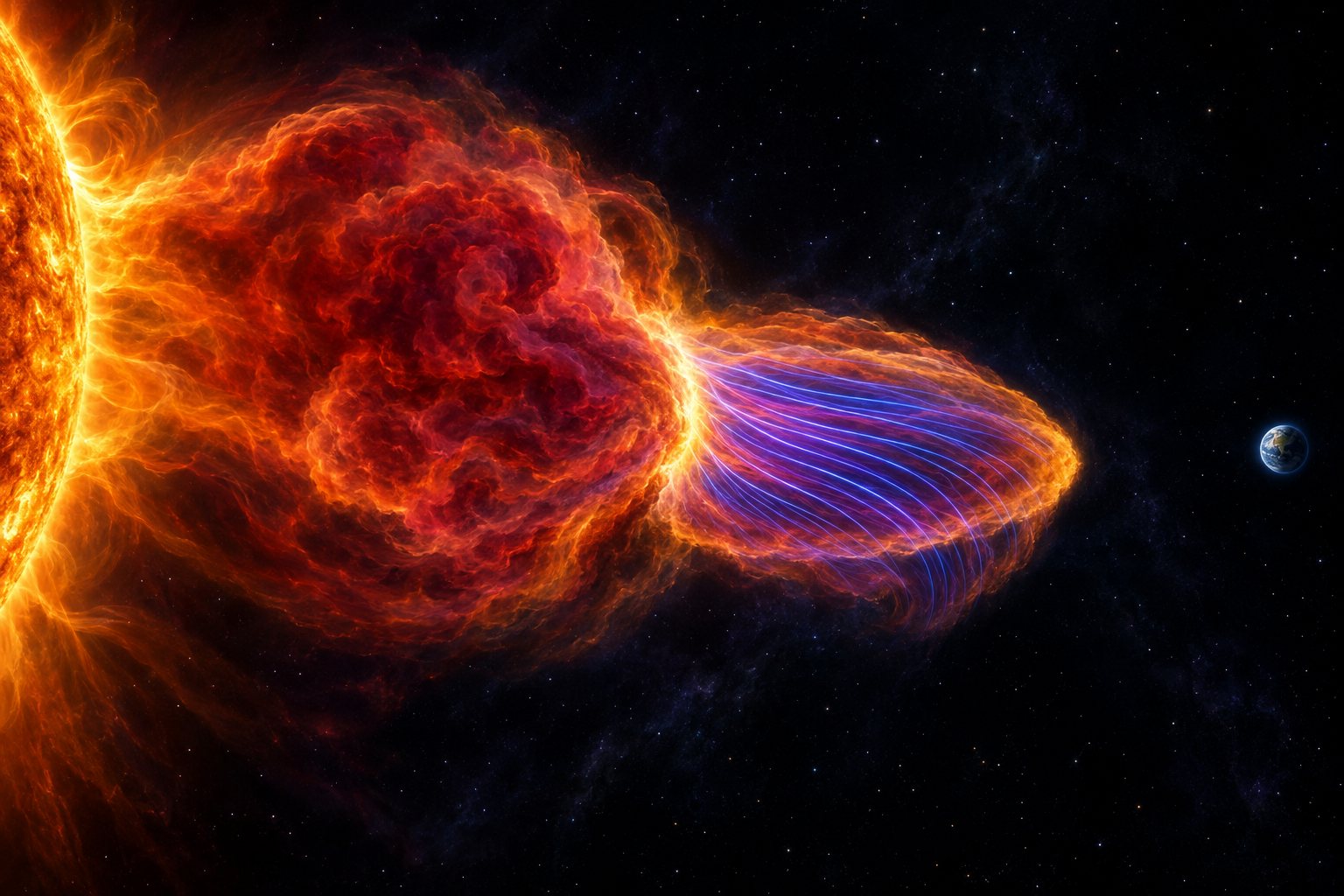
Solar and Stellar Astrophysics

The Sun, stars and how they live and die

23

The Gravitational Wave Foreground from Galactic Cataclysmic Variables in LISA

Levi Schult, Alexander Criswell, Stephen R. Taylor+1 more

  • Astrophysics of Galaxies
  • General Relativity and Quantum Cosmology

AstronomerThe authors use the Bayesian LISA Inference Package (BLIP) to simulate LISA data containing local and Galactic cataclysmic variable (CV) populations and test joint recovery of CV and double white dwarf (DWD) gravitational-wave spectra. In these simulations, the local CV population has a negligible effect, whereas the Galactic population yields a signal-to-noise ratio of approximately 76, depending on the DWD population assumed. Omitting the Galactic CV contribution biases existing DWD spectral models. Current approaches struggle to recover both spectra accurately, motivating multi-component spectral models that include both populations. These are simulation-based forecasts, not gravitational-wave observations of CVs.

PublicCataclysmic variables are binary star systems used to study how pairs of stars evolve and how matter is accreted. This study simulates how their gravitational waves could appear in data from the future LISA mission, alongside signals from pairs of white dwarfs. The simulations suggest that a local population of cataclysmic variables would have little effect, but the population across the Milky Way could make a substantial contribution. Its predicted signal strength depends on the white dwarf pairs present. Ignoring this contribution could skew estimates of the white dwarf signal, and current methods struggle to separate the two populations accurately. The authors therefore call for models that account for both; these findings are predictions from simulated data, not detections.

Young explorerSome stars come in pairs, and their movements can make tiny ripples in space. Scientists made pretend data to see what a future space mission called LISA might find. In their tests, one nearby group of star pairs made very little difference, but a group spread across our galaxy could add a much bigger signal. That signal could get mixed up with ripples from another kind of star pair. Scientists need better ways to tell the two apart. They have tested this idea on a computer, not found these signals with LISA yet.

Euclid DR1 Legacy Science on Ultracool Dwarfs: New URLD candidates in Euclid and SPHEREx

N. Lodieu, M. Žerjal, N. Vitas+4 more

  • Earth and Planetary Astrophysics

AstronomerA search of Euclid DR1 using multi-colour cuts, point-source selection and quality criteria identifies 1,202 red L dwarf candidates across about 1,900 square degrees of the wide survey and 38 across about 50 square degrees of the deep survey. Cross-matching with SPHEREx and Euclid red-grism spectra, together with spectroscopic follow-up and archival checks, confirms a substantial new population. Distance-independent diagnostics place these objects in distinct loci interpreted as showing enhanced condensate opacity and pronounced redness. Preliminary spectral classifications suggest that many candidates have Pleiades-like intermediate ages, while an extremely red subset shows signatures indicative of very young, low-gravity atmospheres, with inferred ages of 10 million years or less. These age and atmospheric interpretations remain provisional; the population offers benchmarks for young giant-exoplanet atmospheres.

PublicResearchers searching the first Euclid data release identified 1,202 candidate red L dwarfs in its wide survey and 38 in its deep survey. These brown dwarfs have unusually red colours that can help researchers study dusty, cloudy atmospheres resembling those of young giant planets. Spectra and comparisons with existing observations confirm a substantial new population, although the reported counts are candidate counts. Their colours and spectral properties point to enhanced atmospheric dust. Early classifications suggest that many resemble objects of the Pleiades in age, while some especially red candidates may be very young—10 million years old or less—with low surface gravity. Those interpretations are preliminary, but the objects could help researchers understand young planets beyond our Solar System.

Young explorerScientists searched pictures from a space telescope called Euclid and found many possible brown dwarfs that look extra red. Brown dwarfs are objects smaller than stars, and these may have lots of dust in their cloudy skies. Looking at their light more closely helped the scientists confirm many new ones. Some might be very young, but the scientists are not sure of their ages yet. Studying them can help us learn about the skies of young giant planets.

Receiving Exoplanet Messages with Gravitational-wave Carriers: The Gravitational-wave Radial Velocity Method

Casey McGrath

  • Earth and Planetary Astrophysics
  • Instrumentation and Methods for Astrophysics
  • General Relativity and Quantum Cosmology

AstronomerThis theoretical study investigates gravitational-wave radial velocity as a potential exoplanet detection method for GW-emitting ultracompact stellar remnants, including white dwarfs, neutron stars, and black holes. Unlike electromagnetic RV, the method depends on a phase modulation index (PMI) that favors higher-mass, longer-period planets. The analysis finds that PMI increases by roughly 10^4–10^6 from the mid-frequency regime associated with LISA to the high-frequency regime of LIGO-Virgo-KAGRA, producing greater redistribution of GW signal power. The authors derive analytic predictions for carrier-frequency power loss and the signal-to-noise ratios of the source and planet. They also examine observatory-motion Doppler effects and possible source-parameter biases from undetected planets. These results characterize potential discovery space rather than demonstrate a planet detection.

PublicCould gravitational waves reveal planets around compact stellar remnants such as white dwarfs, neutron stars, or black holes? This study explores a proposed method that looks for changes a planet would imprint on a gravitational-wave signal. The calculations indicate that a key measure of the effect favors heavier planets with longer orbits and becomes much larger at the higher wave frequencies studied by LIGO-Virgo-KAGRA than in the frequency range associated with the upcoming LISA mission. The researchers derive formulas to predict how a planet would redistribute signal power and how detectable the source and planet might be. They also consider interference from the observatory’s own motion and the risk that an unnoticed planet could distort estimates of the source’s properties. No planet detection is reported.

Young explorerA planet can tug on the thing it goes around and make it wobble. Scientists are exploring whether that wobble could change waves in space called gravitational waves, helping us find planets near the compact leftovers of stars. Their math suggests that heavier planets with longer trips around their hosts could make a stronger change. They also checked ways the signal could be confusing. This is an idea being studied, not a report of finding a planet.

Multimessenger Exoplanets: Combining Infrared Excess and Astrometry with Gravitational-wave Detections of Double White Dwarf Exoplanets

Casey McGrath, Mary Anne Limbach, Scott C. Noble+1 more

  • Earth and Planetary Astrophysics
  • Instrumentation and Methods for Astrophysics
  • General Relativity and Quantum Cosmology

AstronomerThis detectability study explores electromagnetic confirmation of circumbinary exoplanets identified through gravitational waves from tight double white dwarf (DWD) systems. No planets are currently known around DWDs. Using the known DWD ZTF J2243+5242 scaled to a fiducial distance of 150 pc, the authors calculate LISA sensitivity to orbiting planets and assess complementary confirmation through JWST infrared excess measurements and Gaia or Habitable Worlds Observatory astrometry. Both electromagnetic approaches cover parts of the planetary parameter space accessible to LISA in this representative system. The study also presents the first exploration of infrared excess as an exoplanet detection method for DWDs, extending its established use for solitary white dwarfs. These are modeled detection prospects, not planet discoveries; targeted electromagnetic follow-up is proposed as a pathway to validate and characterize future gravitational-wave detections, particularly the first candidates.

PublicThe authors investigate how astronomers could confirm planets found through gravitational waves around pairs of tightly orbiting white dwarfs, which are stellar remnants. No planets have yet been found around such pairs. For their calculations, they take a known white dwarf pair, ZTF J2243+5242, and place it at an assumed distance of 150 parsecs. They find that some planets detectable by the upcoming LISA gravitational-wave observatory could also be checked using extra infrared light measured by JWST or tiny shifts in the system's position measured by Gaia or the proposed Habitable Worlds Observatory. The work outlines a possible discovery-and-confirmation strategy rather than reporting a planet detection. Independent confirmation would be especially important for establishing that the first gravitational-wave planet signals really come from planets.

Young explorerImagine two leftover star cores dancing close together, with a planet going around both. Scientists have not found a planet around a pair like this yet. This study used calculations to ask how they might find one. A future space observatory called LISA could look for signs of the planet in tiny ripples in space. Other telescopes might check for extra heat light or a tiny wobble to help make sure the planet is really there. This is a plan for finding and checking planets, not a new planet discovery.

The Eclipsing δ Scuti Binary HIP 7666: Absolute Dimensions and Pulsation Properties

Jae Woo Lee, Kyeongsoo Hong, Min-Ji Jeong+2 more

AstronomerAn analysis of HIP 7666 combines 120-s TESS photometry with 63 new high-resolution echelle spectra to improve previously sparsely sampled orbital solutions. Joint light-curve and radial-velocity modeling yields a detached, circular binary with Roche-lobe filling factors of 57% and 44%. The primary has a mass of 1.822 ± 0.029 solar masses and a radius of 2.154 ± 0.017 solar radii; the secondary has 1.246 ± 0.020 solar masses and 1.170 ± 0.015 solar radii. All four quantities have better than 2% precision. The primary's effective temperature is 7376 ± 72 K, and its projected rotational velocity is 56.6 ± 5.3 km/s. The binary-based distance, 316 ± 8 pc, agrees with Gaia DR3's parallax-based value of 313 ± 1 pc, supporting the inferred parameters. Residual frequency analysis detects 15 significant signals, predominantly in the delta Scuti pulsation range. Comparison with PARSEC evolutionary tracks indicates an age of approximately 0.9 Gyr and supersolar metallicity, Z = 0.03, placing the primary on the main sequence and the secondary near the zero-age main sequence. Galactic kinematics associate the system with the thin disk.

PublicHIP 7666 is a pair of stars that pass in front of one another as seen from Earth, and the system includes a pulsating star. Researchers combined TESS brightness measurements with 63 new spectra to determine the stars' properties more precisely. Their modeling finds a circular orbit and two detached stars, neither filling the region where its own gravity dominates. The stars have about 1.82 and 1.25 times the Sun's mass, and about 2.15 and 1.17 times its radius, with uncertainties below 2%. A distance calculated from the binary agrees with an independent Gaia distance, strengthening confidence in the results. The brightness data contain 15 significant repeating signals, mostly at frequencies characteristic of delta Scuti pulsations. Comparisons with stellar evolution models suggest an age of about 900 million years and a proportion of elements heavier than helium greater than the Sun's. The system's motion places it in the Milky Way's thin disk.

Young explorerHIP 7666 is two stars going around each other. Sometimes one passes in front of the other and blocks some light. At least one star also pulses. By watching their light and studying how they move, scientists worked out how big and heavy both stars are. Both are bigger and heavier than our Sun. Comparing them with models of how stars grow suggests they are about 900 million years old.

Calibrated Period-Luminosity Relations for Mira variables in the Large Magellanic Cloud in the Vera C. Rubin Observatory zy-band Photometric Systems

Chow-Choong Ngeow, Anupam Bhardwaj

  • Astrophysics of Galaxies

AstronomerThe authors present the first empirical z- and y-band period–luminosity relations for oxygen-rich Miras, using DECam time-series observations of 85 stars in the Large Magellanic Cloud, calibrated directly against Rubin Data Preview 2 (DP2). The observed relations show a break near 300 days, so the derived calibrations are restricted to periods shorter than 300 days. An examination of known Miras in three Local Group dwarf galaxies reveals limited DP2 temporal coverage: IC 1613 has sparsely sampled light curves, while NGC 6822 and the Sagittarius Dwarf Irregular Galaxy have short baselines. One oxygen-rich Mira in NGC 6822 yields a distance modulus of 23.32 ± 0.24 mag, consistent with literature values. Improved coverage expected in the first official Rubin LSST data release should enable robust validation of these relations in nearby galaxies; that validation remains future work.

PublicMira variables are stars whose brightness changes repeatedly, and the link between their cycle lengths and luminosities can help astronomers measure distances. This study establishes that link in the red z and y observing bands using observations of 85 oxygen-rich Miras in the Large Magellanic Cloud. Because the pattern changes near a cycle length of 300 days, the researchers calibrated it only for stars with shorter cycles. Applying the method to one Mira in NGC 6822 gave a distance estimate consistent with previous work. However, the early Rubin observations examined for three nearby dwarf galaxies are too sparse or span too little time for robust validation. Better time coverage is expected from Rubin’s first official LSST data release.

Young explorerSome stars called Miras get brighter and dimmer again and again. Scientists watched 85 of them in a nearby galaxy to learn how their repeating changes can help us measure distances. Their new measuring rule is only for stars whose cycles last less than about 300 days. A check using one star in another galaxy agreed with earlier work, but scientists need more observations to test the rule well.

SN Progenitors of SNRs in OB Associations in the LMC. I. Assessment of Methodology Using N63A

Yuka Terada, You-Hua Chu

  • Astrophysics of Galaxies
  • High Energy Astrophysical Phenomena

AstronomerUsing the LMC supernova remnant N63A and its OB association LH83 as a benchmark, the authors evaluate CMD-based massive-star mass estimates under limitations from temperature sensitivity, extinction, crowding, and nebular contamination. The extinction-corrected MCPS B versus U-B CMD is the most useful diagnostic tested; V versus B-V is less reliable, and larger photometric uncertainties prevent the reddening-free W-Q diagram from improving individual masses. Gaia EDR3 recovers bright stars missing or saturated in MCPS but separates the hottest stars less effectively. For seven spectroscopically classified stars, B versus U-B masses average 8.0 solar masses below HR-diagram estimates using the same MIST tracks, with a scatter of 7.0 solar masses. Isochrone comparisons suggest that most massive LH83 stars formed 7–15 Myr ago, complicating progenitor inference from the present-day mass function. The masses of D243-1a and D243-2, MIST-predicted lifetimes, and an empirical bubble-size–progenitor-mass relation together suggest, rather than directly measure, an N63A progenitor mass of roughly 25–30 solar masses.

PublicHow well can nearby stars reveal the original mass of a star that exploded? The authors tested this approach using the supernova remnant N63A and the surrounding stellar association LH83 in the Large Magellanic Cloud. Of the color-and-brightness diagrams tested, one using blue and ultraviolet measurements, corrected for dust extinction, gave the most useful constraints. Other diagrams were less reliable or did not improve individual mass estimates. Even the preferred method gave masses averaging eight Suns lower than estimates from a temperature-and-luminosity diagram for seven stars. Comparisons with stellar models suggest that most massive stars in the association formed 7–15 million years ago, making it harder to infer the exploded star’s mass from today’s population. Combining several indirect clues, including model predictions for stellar lifetimes, suggests that the original star had roughly 25–30 times the Sun’s mass. This is an estimate, not a direct measurement.

Young explorerA star exploded and left behind a cloud called N63A. Scientists studied the colors and brightnesses of nearby stars to look for clues about how big the star was before it exploded. Some kinds of color pictures worked better than others, but none could tell them exactly. Using several clues and ideas about how stars grow old, they think the star may have had as much stuff as about 25 to 30 Suns.

Squeezing Drives Southward Magnetic Field Enhancement During 10 May 2024 CME-CME Interaction

Ziwei Wang, Liping Yang, Xueshang Feng+7 more

AstronomerCombining multi-spacecraft observations with high-resolution controlled numerical experiments, the authors trace the interacting CMEs associated with the 10 May 2024 geomagnetic storm from near the solar surface to beyond Earth. They attribute the sustained southward magnetic field, exceeding 60 nT in magnitude near Earth, to squeezing of the preceding CME. In their account, the trailing CME’s dynamic pressure initiates compression, while magnetic and thermal pressures at the interface maintain it, flattening the preceding CME into a pancake-like structure and suppressing expansion-driven field decay. The enhancement scales with squeezing intensity. This observation-and-simulation-based interpretation provides a physical basis for forecasting interacting CMEs’ geoeffectiveness, rather than a demonstrated forecast capability.

PublicThe 10 May 2024 event produced the strongest geomagnetic storm since 2003. To investigate why its southward magnetic field was so strong and persistent, researchers combined observations from several spacecraft with detailed computer experiments. They conclude that one eruption of solar material squeezed an earlier eruption, flattening it and keeping its magnetic field from weakening as it expanded. Near Earth, the southward field exceeded 60 nanoteslas in magnitude. Their analysis indicates that stronger squeezing produces greater magnetic strengthening. The work could help improve forecasts of how interacting solar eruptions affect Earth, but it does not demonstrate a working forecast system.

Young explorerThe Sun sometimes sends big clouds of hot material and magnetic fields into space. Scientists studied clouds linked to a very strong storm around Earth, using spacecraft measurements and computer experiments. They worked out that a cloud coming from behind squeezed the one in front, making it flatter, like a pancake. That squeezing helped keep its magnetic field strong as it traveled. Understanding this may help people predict storms around Earth.

High-resolution Observations of Physical Properties of Dynamic Fibrils Around a Sunspot

Guotang Wu, Xiaoli Yan, Zhike Xue+8 more

AstronomerHigh-resolution NVST chromospheric observations reveal periodic up-and-down motions in 176 dynamic fibrils around a sunspot. Their mean deceleration, maximum velocity, maximum length, and duration are 120 ± 43 m s⁻², 15.9 ± 4.5 km s⁻¹, 1.13 ± 0.48 Mm, and 270 ± 63 s, respectively. The statistical analysis finds a clear positive correlation between deceleration and maximum velocity and identifies, for the first time, consistency between fibril and running penumbral wave periodicities. Fibrils in more vertical magnetic fields show larger decelerations and shorter periods than those in more horizontal fields. These observations support, but do not establish, driving by slow magnetoacoustic waves. Multiwavelength signatures extending from the chromosphere to the corona suggest a possible role in atmospheric energy transport and heating, rather than demonstrating a heating contribution.

PublicObservations with the New Vacuum Solar Telescope tracked 176 small, elongated features called dynamic fibrils as they repeatedly rose and fell around a sunspot. On average, they reached maximum speeds of about 16 kilometres per second, grew to roughly 1,130 kilometres long, and lasted about four and a half minutes, with substantial variation among features. Faster fibrils tended to slow down more strongly. Their repeating motions had periods consistent with waves seen moving through the sunspot’s outer region. Fibrils also slowed more strongly and repeated more quickly where magnetic fields were more upright. Together, these findings support the idea that waves involving gas pressure and magnetic fields drive the motions, but they do not prove it. Signatures across multiple wavelengths suggest that the fibrils might also help carry energy and heat the Sun’s atmosphere; that contribution remains uncertain.

Young explorerScientists watched 176 tiny, skinny shapes near a dark spot on the Sun. The shapes went up and down again and again. Where the Sun’s magnetic field stood more upright, the shapes slowed down more strongly and repeated their motions sooner. Their timing matched waves seen nearby, so the scientists think waves may be making them move. The shapes might also help carry energy and warm the air-like layers around the Sun, but the scientists are not sure yet.

Numerical experiments on sunspot penumbral flows

Tanayveer Singh Bhatia, Sami K. Solanki, Aswathi Krishnan Kutty+2 more

AstronomerThree-dimensional radiative magnetohydrodynamic simulations generate sunspot penumbrae self-consistently and explore how resolution, surrounding opposite-polarity fields, and large-scale subsurface flows affect their structure and stability. A subset produces extended penumbral filaments at 25 km horizontal and 15 km vertical resolution, with initial conditions favoring strong horizontal field components in the penumbral region. Simulated surface velocities are consistent with observed Evershed flow, and the main driving mechanism remains that described in Rempel (2012). The most successful runs produce extended penumbrae with a potential-field upper boundary, unlike earlier simulations that artificially enhanced the horizontal magnetic field there. These are simulation results; extended filaments are not obtained in every run.

PublicResearchers used three-dimensional computer simulations to study how the streaked outer regions of sunspots, called penumbrae, form and persist. They tested the effects of simulation detail, nearby magnetic fields pointing in the opposite direction, and large-scale flows beneath the surface. Some runs produced extended streaks when they used fine spatial resolution and starting magnetic fields with strong horizontal components. Their simulated surface flows were consistent with observations of the Evershed flow in sunspots. The most successful runs formed extended penumbrae without the artificial strengthening of horizontal magnetic fields at the simulation’s upper edge used in earlier work. The findings concern computer models, and not all runs produced extended streaks.

Young explorerSunspots have streaky edges. Scientists made computer models to see how those streaks can form, using moving gas and magnetic fields. Some models made long streaks, but others did not. The gas in the successful models moved in ways that match flows seen on the Sun. Those models also made long streaks without an extra magnetic-field boost at the top that earlier models used. These were computer-made sunspots, not new pictures of real ones.

Asteroseismology of blue straggler stars in ω Centauri. Stellar collisions as a possible formation scenario

Jadwiga Daszynska-Daszkiewicz, P. Gora, P. Walczak+4 more

  • Astrophysics of Galaxies

AstronomerThe study models five double-radial-mode SX Phoenicis stars in the core of ω Centauri that lie in the blue-straggler region of the colour–magnitude diagram. Assuming a collisional origin, the authors evolve progenitors with MESA, reconstruct merger remnants with MMAMS, and follow their subsequent evolution to the cluster’s current age, seeking seismic models that reproduce the two observed radial-mode frequencies. They also explore a mass-transfer scenario for one star. In this first collision-based seismic modelling of SX Phe blue stragglers, convective-core overshooting is essential, though not always sufficient, for rejuvenation and main-sequence seismic solutions. The simulations exhibit absent, delayed, or immediate rejuvenation, depending in a complex way on progenitor masses, metallicity, and collision time. Relative to previous single-star seismic models, the collision-based models imply higher masses and younger ages; these are model-dependent inferences, not confirmation of collisional formation.

PublicBlue stragglers are stars that appear more massive and younger than ordinary single-star evolution would suggest. This study examines five pulsating stars in the core of the star cluster ω Centauri, using their observed vibrations to test models in which they formed through stellar collisions. The researchers simulated the collisions and the resulting stars’ evolution, then built models that match two observed vibration frequencies for each star. In the simulations, mixing beyond the usual boundary of the central convective region is necessary, but not always enough, for a merged star to become rejuvenated and yield a matching model in its main hydrogen-burning stage. Rejuvenation can occur immediately, after a delay, or not at all, depending on the original stars and the collision’s timing. Compared with earlier models treating the objects as single stars, the collision-based models suggest greater masses and younger ages. The study does not establish that collisions actually formed these stars; it also explores mass transfer between companion stars for one object.

Young explorerSome stars look younger than we would expect. Scientists studied five stars that gently swell and shrink, using those movements as clues about what is inside. They made computer models to ask whether two stars crashing together could explain them. In the models, a joined star could get a fresh start right away, later, or not at all. Mixing material near its middle was important, but did not always give it a fresh start. The crash models made these stars seem heavier and younger than earlier models did. That does not prove the real stars were made in crashes.

Symbolic Regression Fitting for Roche Lobe Radius

Ye Ma, Xiaodong Li, Bo Ma+2 more

  • Earth and Planetary Astrophysics

AstronomerThe authors use symbolic regression on radii calculated from the full Roche potential to derive a compact approximation for the dimensionless, volume-equivalent Roche lobe radius R_L/a. Across mass ratios 10^-5 ≤ q ≤ 10^5, its RMS error is 5.95×10^-4, versus 1.97×10^-3 for Eggleton’s formula, but its maximum relative error is worse: 1.39% versus 0.83%. Additional mass-ratio calculations yield a mean relative error of 0.331%. The expression is monotonic, recovers the small-q scaling q^(1/3), and approaches a large-q limit within 0.036% of the limiting Roche model. For 10^7 direct evaluations in a NumPy float64 benchmark, it takes 0.217 s versus 0.450 s for Eggleton, a 2.08-fold speed-up. These numerical tests establish an alternative with lower RMS error and lower evaluation cost in the stated benchmark, not uniformly better accuracy.

PublicThe study presents a compact formula for estimating the size of a Roche lobe in a two-star system, expressed as the radius of a sphere with the same volume. The researchers used an automated search for mathematical expressions, called symbolic regression, and tested the formula against calculations from the full Roche model—not observations of stars. Compared with the established Eggleton formula, the new expression has a lower overall error by the study’s root-mean-square measure, but its largest percentage error is higher: 1.39% rather than 0.83%. It also behaves as expected at very unequal stellar masses. In one specified computer benchmark, it evaluated about twice as fast. The result offers a computational alternative, with a trade-off between overall accuracy and worst-case error.

Young explorerWhen two stars are paired, scientists use math to work out the size of a region around each star. These researchers made a new, short math rule and checked it against more detailed computer calculations, not pictures of stars. Its mistakes were smaller overall than an older rule’s, but its biggest mistake was bigger. In one computer test, the new rule also worked about twice as fast.

2D and 3D unified RHD atmospheres and wind models of early B-supergiants including approximate NLTE effects

Dwaipayan Debnath, Jon O. Sundqvist, Nicolas Moens

AstronomerThe authors present the first multidimensional unified atmosphere–wind models for B supergiants, using 2D/3D box-in-a-star radiation-hydrodynamic simulations with hybrid opacities. Line opacities include scattering and approximate NLTE populations, with separately calculated mean opacities using Sobolev escape probabilities and two-level atoms. The simulated atmospheres become highly turbulent: time-averaged photospheric turbulent velocities are approximately 40–55 km/s in 2D and 25 km/s in 3D. Cooler B1 and B1.5 models accelerate their winds more gradually than the hotter B0 model, which reaches a substantially higher maximum wind speed. Approximate NLTE treatment strongly changes wind ionization stratification relative to LTE and modifies the line force. Simulated mass-loss rates are approximately 10^-6 to 3 × 10^-6 solar masses per year. Comparable hydrodynamically consistent, steady-state 1D NLTE CMF models can yield higher mass-loss rates and lower terminal velocities when turbulent pressure is included, in qualitative agreement with the multidimensional calculations. These simulation results suggest that turbulent pressure affects global wind properties as well as photospheric density scale heights in lower-gravity B supergiants; they are not observational measurements.

PublicB supergiants are evolved massive stars whose radiation drives strong outflows of gas. This study models their atmospheres and winds together in two and three dimensions, rather than assuming a smooth, spherically symmetric star. The simulations develop turbulent atmospheres, with typical turbulent speeds near the visible surface of about 40–55 km/s in two dimensions and 25 km/s in three dimensions. The hotter model reaches a higher maximum wind speed than the cooler models. An approximate treatment of how atoms become ionized also substantially changes the calculated force driving the wind. Separate one-dimensional calculations show that adding turbulent pressure can increase gas loss while lowering the wind’s final speed. Together, the calculations suggest that turbulence can influence the overall winds of lower-gravity B supergiants, not just their surface layers. These are modeling results, with approximate atomic physics, rather than direct observations.

Young explorerSome huge stars blow gas into space. Scientists made computer models to explore how this happens. In the models, gas near the stars’ surfaces swirls around instead of staying smooth. The calculations suggest that pushing from these swirls can change how much gas escapes and how fast it goes. This is a clue from computers, not something the scientists watched a real star do.

JWST/NIRISS-SOSS Spectroscopic Variability and Auroral Modelling of Warm Ultracool Dwarf LSR J1835+3259

Eleanor Pike, Stuart Littlefair, J. Sebastian Pineda+8 more

  • Earth and Planetary Astrophysics

AstronomerJWST/NIRISS SOSS time-series spectroscopy of the M8.5 ultracool dwarf LSR J1835+3259 reveals wavelength-dependent rotational variability. Principal component analysis identifies two spectral variability modes: FeH modulation near 1 micrometre and broadband changes across H and K. Additional GTC/MEGARA spectra show markedly weaker H-alpha emission than at earlier epochs, suggesting reduced activity during the JWST observations. Neither H3+ emission nor hydronium absorption is detected. No tested atmosphere-model grid reasonably fits the mean NIRISS spectrum. A blend of an M-dwarf photosphere and a cooler blackbody improves the fit to the mean spectrum, broadband spectral energy distribution, and NIRISS broadband variability. Perturbed PICASO models demonstrate that atmospheric heating combined with non-equilibrium chemistry can mimic this blend. These effects offer a possible explanation for the unusual spectrum and variability, rather than establishing a separate blackbody component or confirming an auroral origin.

PublicAstronomers used JWST to watch how the infrared light from the ultracool dwarf LSR J1835+3259 changes as it rotates. They found two patterns: one associated mainly with iron hydride and another spread across broader infrared wavelength ranges. Optical observations also showed that its hydrogen emission had weakened substantially since earlier measurements, suggesting a quieter period of activity. Two other molecular signals, from H3+ and hydronium, were not detected. Standard atmosphere models tested by the team could not adequately reproduce the average infrared spectrum. Combining a model of the dwarf’s visible atmosphere with a cooler thermal component worked better. However, simulations showed that heating and chemistry out of equilibrium could imitate that combination without requiring a separate cool component. These atmospheric effects may explain the unusual light, but the study does not establish that auroras cause it.

Young explorerScientists watched a very cool, star-like object with a space telescope. As it turned, its invisible infrared light changed in two different ways. Another telescope found a sign that it might be less active than before. Computer models showed that warming its air and changing its chemistry could help explain the strange light. That is a possible answer, not something scientists have proved.

Properties of near-surface turbulence in hot, massive stars: Statistical signatures from multi-dimensional models of O-type stars

Cassandra Van der Sijpt, Florian Driessen, Jon Sundqvist+2 more

AstronomerThe authors characterize sub-surface turbulence in 2D radiation-hydrodynamical simulations of O-star atmospheres, where turbulence is triggered by the iron opacity bump. Density and velocity autocorrelations reveal radially dominated velocity anisotropy that increases with the classical Eddington factor, while density structures remain nearly isotropic with no dependence on stellar parameters. Kinetic-energy spectra show an inertial-range exponent averaging -2.57, with no clear stellar-parameter dependence, steeper than the Kolmogorov (-5/3) and Burgers (-2) scalings. Scale-dependent radiative damping is proposed as the cause of the steepening but is not rigorously demonstrated. These findings concern simulated 2D atmospheres rather than direct measurements of stellar turbulence.

PublicUsing two-dimensional computer simulations, researchers studied turbulent motion just beneath the surfaces of hot, massive O-type stars. In the models, gas motions are stronger in the radial direction than sideways, and this directional imbalance grows with a stellar parameter called the classical Eddington factor. Density patterns, however, look nearly the same in all directions and show no dependence on the stellar parameters studied. The simulations also show that turbulent energy falls off toward smaller scales more steeply than two established turbulence theories predict, with no clear dependence on stellar parameters. The authors suggest that radiation increasingly damps smaller-scale motions, but they have not proved this explanation. The results describe simulations, not direct observations of these motions in stars.

Young explorerThe scientists used a computer to make pretend versions of very hot, big stars. Just under their surfaces, the gas swirled more in and out than sideways. But the crowded and less crowded patches of gas looked about the same in every direction. Smaller swirls had much less moving energy than some usual ideas about swirling gas would suggest. The scientists think light might help slow the little swirls down, but they have not shown for sure that this is why. They found these clues in their computer models, not by watching inside real stars.

Zeeman-Doppler imaging of V889 Her: Surface spots and magnetic field topology 2017 - 2023

Thomas Hackman, Jyri J. Lehtinen, Oleg Kochukhov+6 more

AstronomerZeeman-Doppler imaging of SOFIN spectropolarimetry from the Nordic Optical Telescope traces the evolving surface magnetic topology of the young solar analogue V889 Her. The reconstructed radial field near the rotational pole changes significantly across the observations, including a polarity reversal around 2021, while a strong high-latitude azimuthal component persists. The spot configuration changed abruptly on a roughly week-long timescale in June 2018. Tests of previously reported differential-rotation parameters favour solar-type differential rotation, with the adopted parameters affecting brightness maps more than magnetic topology. Rapid surface evolution complicates differential-rotation estimates, and the authors cannot link the magnetic-topology changes to long-term spot-activity evolution.

PublicAstronomers used observations from the Nordic Optical Telescope to map the surface magnetism of V889 Her, a young star similar to the Sun. The maps show substantial changes near the star’s rotational pole, where the inward-or-outward direction of the magnetic field reversed around 2021. A strong magnetic component wrapping around the star at high latitudes persisted. The arrangement of surface spots also changed abruptly within about a week in June 2018. The observations favour a rotation pattern like the Sun’s, with the equator turning faster than the poles, but rapid surface changes make that pattern difficult to measure reliably. The researchers could not connect the magnetic changes to the star’s long-term spot activity.

Young explorerA young star called V889 Her is a bit like our Sun. Scientists used telescope observations to make maps of its magnetism and spots. Near one pole, the magnetism flipped direction around 2021. In June 2018, the pattern of spots changed in about a week. The star seems to turn faster around its middle than near its poles, but its changing surface makes that hard to measure. The scientists could not tell how the magnetic changes were connected to the way its spots changed over a long time.

Density fluctuations in pseudo-streamer and helmet streamer: Generation, propagation and comparison with Metis observations

Anmol Kumar, Simon Daley-Yates, Thomas A. Howson+3 more

AstronomerMotivated by Metis/Solar Orbiter white-light observations of propagating density fluctuations with periods of about five minutes, especially in bright helmet streamers and pseudo-streamers, this study models nonlinear Alfvén-wave propagation and associated density fluctuations in a 2.5D axisymmetric global solar wind model. Alfvén waves generate density fluctuations through nonlinear coupling to compressive slow and fast modes. The simulations compare helmet-streamer and pseudo-streamer topologies, whose current sheet, X-type null point, and differing beta = 1 layer structures affect wave behaviour. The model suggests possible prominent interference patterns along the helmet-streamer axis but not the pseudo-streamer axis. Along the pseudo-streamer axis, the simulated density fluctuations arise only from fast waves despite the low plasma beta, contrasting with the usual greater contribution from slow modes in low-beta regions.

PublicSolar Orbiter’s Metis instrument has observed density disturbances travelling through bright structures in the Sun’s outer atmosphere, repeating roughly every five minutes. This study uses computer simulations to investigate how Alfvén waves could produce such disturbances indirectly by interacting with other types of waves that compress the solar gas. The researchers compare two magnetic configurations called helmet streamers and pseudo-streamers. Their simulations suggest that the different magnetic structures could produce prominent wave-interference patterns along a helmet streamer’s central axis but not along a pseudo-streamer’s. The model also finds that only fast waves contribute to density disturbances along the pseudo-streamer axis, even under conditions where slow waves generally contribute more. These are simulation findings, not new observational detections of those patterns or wave contributions.

Young explorerA spacecraft has seen ripples moving through the Sun’s outer gas, coming about every five minutes. Scientists used a computer model to explore how waves might make these ripples in two different magnetic shapes. In the model, waves might overlap to make a strong pattern down the middle of one shape, but not the other. In the other shape, only one kind of wave made the gas bunch up along the middle, which was unusual for those conditions. The computer gives scientists clues; it does not show that all of this has been seen on the Sun.

A New Galactic Close Binary Supersoft Source Candidate

Gael R. C. Barreteau, Marcos P. Diaz, Paulo E. Stecchini+5 more

  • High Energy Astrophysical Phenomena

AstronomerZTF J043609.49+364057.7 is identified as a new Galactic close binary supersoft source (CBSS) candidate from its optical spectrum, light curve, and spectral energy distribution, in a survey selecting candidates independently of X-ray emission. Its optical spectrum shows emission features typical of CBSSs. Available photometry reveals a quasi-sinusoidal modulation with a 5.42-hour period, consistent with, but not establishing, an orbital interpretation. No X-ray emission has currently been identified from the source. Its spectral energy distribution nevertheless shows a bright, highly absorbed far-ultraviolet component, with estimated reddening E(B − V) ≈ 0.7 mag. The classification remains provisional.

PublicAstronomers report a candidate for a class of closely paired stars called close binary supersoft sources in our Galaxy: ZTF J043609.49+364057.7. They found it in a search that did not require detecting X-rays. Its visible-light spectrum has emission features expected for this class, and its brightness varies in a roughly wave-like pattern every 5.42 hours. That cycle could reflect the stars orbiting each other, but this interpretation is not confirmed. The source also has a bright far-ultraviolet component whose light is strongly absorbed. No X-ray emission has yet been identified, so it remains a candidate rather than a confirmed member of the class.

Young explorerAstronomers found something in our galaxy that might be two stars very close together. Its light has clues that look like those from a special kind of star pair. It gets brighter and dimmer about every five and a half hours, which might happen as the stars go around each other. It also gives off bright ultraviolet light, a kind our eyes cannot see, though much of that light is blocked on its way to us. Astronomers have not found X-rays from it yet, so they are not sure it belongs to that special group.

100 Revised arXiv:2510.14355

Combining spectral analysis and narrow band pass filtering to predict solar cycle parameters in the next solar grand minimum

Ian Edmonds, Peter Killen

AstronomerThe paper develops a spectral method to forecast grand minima in sunspot number (SSN), using the annual SILSO record for 1700–2024 and a reconstructed annual record for 971–1899. Fourier analysis identifies eleven periods of 8–15 years in SILSO and four periods spanning 60–800 years in the reconstruction. Narrow-band filtering isolates the components, which are fitted with sinusoids for backward and forward projection. Both projections forecast a grand minimum during 2030–2150, although shorter-term structure is less certain. The authors group the eleven shorter periods into octal, decadal, and decadal-plus components; decadal components have, on average, three times the amplitude of those in the other groups. They interpret grand maxima and minima through constructive and destructive interference among the decadal components, with the other groups becoming relatively important during minima. They also explain the Waldmeier Effect through interference between octal and decadal contributions. The future minimum is a model forecast, not an observed result.

PublicThis paper presents a method for predicting long stretches of unusually low sunspot numbers. It analyzes an annual sunspot record covering 1700–2024 and a reconstructed record covering 971–1899, identifying repeating patterns on scales from roughly a decade to centuries. The researchers isolate these patterns, fit them with repeating mathematical waves, and extend those waves into the future. Both records yield a forecast of a grand solar minimum from 2030 to 2150, but the details within that interval are less certain. The authors interpret high and low sunspot activity as patterns reinforcing or canceling one another. This is a prediction based on projecting fitted cycles, not an observation that the future minimum has begun or will certainly occur.

Young explorerThe Sun has spots, and their number changes over time. Researchers looked for repeating patterns in old records of those spots. They used those patterns to predict a long time with very few spots, from 2030 to 2150. That is a prediction, not something they have already seen, and they are less sure about how the spot numbers would change during that time.

105 Revised arXiv:2605.16526

SN 2023fyq: direct detection of a Type Ibn supernova progenitor and its multiwavelength environmental constraints

Xinyi Hong, Ning-Chen Sun, Yali Shao+9 more

  • High Energy Astrophysical Phenomena

AstronomerPre-explosion and late-time HST and JWST imaging reveal a source at the position of the Type Ibn SN 2023fyq and confirm that its progenitor disappeared after explosion. Spectral energy distribution fitting is consistent with a hot (T > 15,000 K), luminous (log(L/L☉) ≳ 5.5) progenitor and a possible host star cluster. Multi-wavelength environmental analysis implies a likely progenitor age of log(t/yr) = 7.1–7.2. These findings disfavor a very massive single-star origin and support, but do not establish, a binary containing a low-mass helium star and a compact object. The authors interpret the pre-explosion emission as likely arising from binary interaction that began at least approximately 12 years before explosion. They identify this as the first direct progenitor detection for a Type Ibn SN, adding evidence for diversity in progenitor channels and mass-loss mechanisms.

PublicAstronomers have identified the star that exploded as supernova 2023fyq by finding a source in earlier images and confirming that the progenitor disappeared afterward. This is the first directly detected progenitor of a Type Ibn supernova, a class whose light shows helium in surrounding material struck by the explosion. The earlier source is consistent with a very hot, bright progenitor and possibly a surrounding star cluster. Evidence from the local environment suggests an age that makes a very massive, solitary star less likely. Instead, the researchers favor a lower-mass helium star paired with a compact stellar companion. They interpret the pre-explosion light as likely produced by interaction between the pair beginning at least about 12 years before the explosion, although that explanation is not proven.

Young explorerAstronomers looked at pictures taken before and after a star exploded. They found light where the star had been and confirmed that the star disappeared after the explosion. This is the first time scientists have spotted the original star for this kind of explosion. The clues suggest it may have had a small, tightly packed companion, rather than living alone as a very big star. The two may have been interacting for years before the explosion, but scientists are not yet sure.

110 Revised arXiv:2607.18572

Stream-Driven Ignition of a Realistic Undisturbed Helium Shell on a White Dwarf

Nethra Rajavel, Dean M. Townsley, Ken J. Shen

AstronomerThis study tests stream-impact ignition of helium in the dynamically driven double degenerate double detonation (D^6) scenario for Type Ia supernovae. Two-dimensional FLASH simulations model carbon-oxygen white dwarfs of 0.8, 0.9, and 1.0 solar masses, varying the incoming stream properties and using realistic, initially unmixed composition profiles inherited from the preceding helium-shell burning phase. Helium ignites in every simulated case, consistently near the core-shell transition but at varying distances from the impact point. The ignition mechanism varies and can involve interactions between neighboring hot, mixed regions rather than a single ignition point. All but one model sustain a propagating detonation capable of traversing the white dwarf surface. These simulation results strengthen the viability of the D^6 scenario, while distinguishing helium ignition from successful sustained detonation; they do not establish that every stream impact produces a Type Ia supernova.

PublicOne proposed explanation for Type Ia supernovae involves two closely orbiting white dwarfs. Gas flowing from one onto the other could ignite its outer helium layer, sending a shock inward that triggers a second explosion in its carbon-rich core. Researchers tested the first ignition step with two-dimensional computer simulations of three white dwarf masses and different incoming gas streams, using realistic layered compositions. Helium ignited in every simulated case, near the boundary between the core and the helium shell, though not always directly beneath the incoming stream. Sometimes ignition arose through interactions between neighboring hot regions. In all but one model, the burning sustained an explosive wave capable of traveling across the star’s surface. The results support this proposed route to a supernova, but they are simulations, not observations, and helium ignition did not always produce a lasting detonation.

Young explorerScientists used a computer to study what might happen when gas from one small, dense star pours onto another. They wanted to know if the gas could start an explosion in the second star’s outer layer. In every computer test, helium near the bottom of that layer began to burn. In all but one test, an explosion wave kept going across the star’s surface. This helps scientists explore one way a star might explode, but it does not mean they watched it happen in space.

113 Revised arXiv:2607.27832

The X-ray catalogue of FGK stars within 10 pc: The coronal temperature-brightness relation explained with the RTV scaling law

M. M. Bennedik, B. Stelzer, M. Caramazza+3 more

AstronomerThe authors compile an X-ray detection catalogue for FGK main-sequence stars within 10 pc, accounting for stellar multiplicity and detector optical loading. They analyse all available SRG/eROSITA and XMM-Newton observations of the sample and cross-match against ROSAT catalogues. Thermal plasma fits yield X-ray fluxes and coronal temperatures. The empirical coronal temperature–X-ray surface flux relation has remarkably little scatter apart from three stars and spans ranges consistent with different solar coronal magnetic structures. Its low-temperature, low-brightness end includes the Maunder minimum star HD 166620 and three possible Maunder minimum candidates. Systematic differences between the XMM-Newton and eROSITA relations are attributed to instrumental response differences. The study also examines short-term flares and long-term activity cycles. The authors interpret the relation using RTV scaling laws for solar magnetic loops, arguing that its small scatter indicates a universal scaling between loop length and filling factor. The reason the three outliers depart from this inferred scaling remains unknown.

PublicThis study catalogues X-ray detections of nearby F-, G- and K-type stars that are still in their main-sequence phase. Using observations from eROSITA, XMM-Newton and ROSAT, the researchers find a tight connection between the temperature of stars’ hot outer atmospheres and their X-ray brightness per unit surface area, with three exceptions. The range resembles that covered by different magnetic structures in the Sun’s outer atmosphere. At the cool, faint end are HD 166620, identified as a Maunder minimum star, and three other stars that may be in similarly quiet states. The researchers also examine flares and longer activity cycles. They suggest that the tight connection reflects a shared relationship between the size of magnetic loops and how much of a star’s surface those loops cover. This is an interpretation of the observations; why three stars do not follow it remains unknown. Differences between results from two telescopes are attributed to how their detectors respond to X-rays.

Young explorerStars have hot gas around them that shines in X-rays, a kind of light our eyes cannot see. Scientists looked at nearby stars and found a close pattern: stars with hotter outer gas usually give off more X-ray light from each bit of their surface. Three stars did not fit the pattern. The scientists think loops made by the stars’ magnetism may help explain it, but they do not yet know why those three stars are different.

122 Revised arXiv:2610.19009

First L-type Substellar Object Discovered in the Vicinity of the Embedded Cluster NGC 2023

Styliani Tsilia, Carlos Dominguez-Tagle, Maruša Žerjal+8 more

AstronomerThe authors report J054158.70-021031.4 as the first substellar object in a star-forming region spectroscopically confirmed with Euclid. Selected photometrically in the Euclid Early Release Observations and examined using slitless 2D spectroimages, the young source has spectral type L3, reddening A_V = 3 mag, and a Euclid optical magnitude of approximately 24.5. It lies near the embedded open cluster NGC 2023, while its proper motion is consistent with NGC 2024; this does not establish cluster membership. At a distance of 403 pc, its inferred mass is close to the planetary-mass boundary. The finding demonstrates Euclid's potential to uncover obscured populations of very low-mass objects in active star-forming regions, rather than establishing the extent of such populations.

PublicAstronomers report the first object smaller in mass than a star in a star-forming region to be confirmed through its spectrum with Euclid. The young, faint object, called J054158.70-021031.4, lies near the star cluster NGC 2023. Its motion across the sky is consistent with that of another nearby cluster, NGC 2024, though this alone does not establish membership. Researchers found it by selecting candidates from their brightnesses and colors, then examining their spectra. Using a distance of 403 parsecs, they infer a mass near the boundary associated with planetary masses; they do not establish that it is a planet. The discovery shows promise for finding more very low-mass objects hidden in obscured regions where stars are forming.

Young explorerAstronomers used Euclid to find a very faint, young object near a group of stars. They studied its light to check that it is smaller in mass than a star. They estimate that its mass is close to the dividing line for planet-sized masses, but that does not mean they know it is a planet. Finding it shows that Euclid could help uncover more hard-to-see objects in places where stars are being born.

Earth and Planetary Astrophysics

Planets, moons and small bodies, here and elsewhere

15

Exoplanets are predominately aligned with exo-Kuiper Belts

Jingwen Zhang, Maxwell A. Millar-Blanchaer, Brendan P. Bowler+4 more

  • Solar and Stellar Astrophysics

AstronomerThe authors present the first population-level constraints on planet–debris-disk mutual inclinations for 32 planets in 16 systems. They find that 30 of 32 planets, spanning orbital distances of 0.1–100 AU, are aligned with their systems’ debris disks within 10 degrees. Alignment is found across systems aged tens of millions to a few billion years. The authors interpret this predominance of alignment as evidence that the Solar System’s aligned architecture is representative of exoplanet systems’ birth conditions; the findings do not establish the origin of misalignments in other systems.

PublicDo planets usually orbit in the same plane as the leftover debris around their stars? In a study of 32 planets in 16 systems, researchers found that 30 planets’ orbits were aligned with their systems’ debris disks to within 10 degrees. The pattern appears across a wide range of orbital distances and in systems from tens of millions to a few billion years old. The authors interpret this as evidence that the Solar System’s orderly alignment reflects common conditions at planetary birth. It does not settle why some other systems have tilted planetary orbits.

Young explorerImagine planets going around a star on a flat racetrack, with a ring of leftover bits nearby. Researchers studied 32 planets around 16 stars. For 30 planets, the racetrack was tilted only a little compared with the ring. The researchers think this is a clue that planets often start out lined up, as they are around our Sun. It does not tell us for sure why some planets go around at a different tilt.

DART ejecta reveal the recoil momentum budget of a kinetic impact

Zhijun Song, Yang Yu, Jian-Yang Li+9 more

AstronomerThe study reconstructs the three-dimensional evolution of DART ejecta from time-resolved morphology and brightness observations to constrain recoil momentum and material transport. Integrating the reconstructed momentum gives momentum enhancement factors of β_D = 2.13 ± 0.19 for Dimorphos and β_sys = 2.04 ± 0.19 for the Didymos system, with uncertainties quoted at 1σ. Combining the reconstructed recoil with the measured deflection constrains Dimorphos’s bulk density to 1435.18 kg m⁻³, with lower and upper uncertainties of 153.71 and 112.59 kg m⁻³, without assuming its mass. These reconstruction-based constraints link orbital deflection to released material and offer a basis for assessing kinetic-impact effectiveness and investigating collision-driven mass loss and debris transport.

PublicDART showed that debris thrown off an asteroid after an impact can give it an extra push. This study uses observations of the debris cloud’s changing shape and brightness to reconstruct its motion in three dimensions. The reconstruction indicates that the debris recoil roughly doubled the momentum transferred compared with the impact alone. Combining that reconstructed push with the measured change in Dimorphos’s orbit, the researchers estimate its average density at about 1,435 kilograms per cubic metre, with an uncertainty extending roughly 154 below and 113 above that value, without first assuming its mass. The work provides a way to assess asteroid-deflection impacts and investigate how collisions move material among small Solar System bodies.

Young explorerWhen DART hit the asteroid Dimorphos, it sent bits of the asteroid flying away. Those bits gave the asteroid an extra push. Scientists used pictures of the changing dust and debris to work out how it moved. Their reconstruction suggests that the flying bits made the push about twice as strong as the hit alone. They also used the asteroid’s changed path to estimate how tightly its material is packed, though that estimate is not exact.

On the Existence of a Third Planet and an Apsidal Resonance Chain in the Kepler-396 System through TESS Data

Li-Chin Yeh, Ing-Guey Jiang, Prangsutip Cherdwongsung+4 more

AstronomerNew TESS data extend the Kepler-396 transit-timing baseline, with mid-transit times extracted using pixel-level decorrelation. An exploration of three-planet transit-timing-variation models yields two best-fit solutions under different orbital-inclination priors, with reduced chi-square values of 2.24 and 2.34 versus 12.97 for the two-planet model. The authors interpret this improvement as strong evidence for the previously proposed Kepler-396 d, rather than a direct detection of its transit. Both solutions give approximate masses of 9, 4, and 4 Earth masses and periods of 43, 89, and 144 days for b, c, and d, respectively. With these inferred masses, b lies near the rocky/volatile-rich boundary, while c is classified as a volatile-rich super-puff; both occupy the Neptune savanna. Three-planet dynamical simulations remain stable for one million years, and the resonant-angle analysis indicates a three-body apsidal resonance chain.

PublicChanges in when Kepler-396’s planets pass in front of their star provide strong evidence for a previously proposed third planet. Researchers added new TESS observations to extend the timing record and found that models containing three planets fit substantially better than a two-planet model. Two alternative fits, based on different assumptions about orbital tilts, suggest that planets b, c, and the proposed d have about 9, 4, and 4 times Earth’s mass and orbit every 43, 89, and 144 days. These are model-based estimates, not direct mass measurements. The updated masses place b near the boundary between rocky and volatile-rich planets and support the classification of c as a very low-density, volatile-rich “super-puff.” Computer simulations kept the three-planet system stable for one million simulated years, while analysis of the orbits indicates a linked pattern in the directions of their closest approaches to the star.

Young explorerAstronomers watched when planets passed in front of a faraway star. The timing fits much better if a third planet is there, tugging on the others. That is a strong clue, but the third planet is still inferred from the timing. The team also tried the three planets in a computer model. They stayed in stable orbits for a million pretend years, and their paths seemed to follow a linked pattern.

Separability defects in artificial satellite theory: intermediaries, zonal harmonics and secular separatrices

Vladimir Martinusi

  • Dynamical Systems

AstronomerThis theoretical study applies a five-input Poisson-bracket operator, cubic in the Hamiltonian and reproducing the Levi-Civita separability expressions, to artificial-satellite intermediaries in modified polar-nodal coordinates regular at prograde equatorial orbits. For the author's 2020 general intermediary, the linearised defects vanish exactly when the integrability ansatz for additive first-order Hamilton-Jacobi separation holds. Closed-form second-order defects identify physical-latitude dependence as the source of nodal coupling. In any axisymmetric field, the radial defect is linear and has a torque form; the first-order zonal defect is the operator response to the first-order Lie generator, which also yields the second-order mean radial defect per revolution. In the stated gauge, intermediaries without latitude terms share the long-period second-order average. Displaced-centre oblate structures separate the zonal field exactly only when its coefficients obey the recurrence for Vinti's translated spheroidal potential. Numerical propagation for 300 periods in a field truncated at J4 shows better conservation of an approximate third integral than with the centred structure, by median factors of 23–77. On secular separatrices, the integrated defect is the derivative of the Melnikov function, with a test in the eccentric Kozai-Lidov problem; transverse zero sets of the operator define event surfaces.

PublicThe paper develops a mathematical test for simplified models of artificial-satellite motion. The test checks when the equations can be separated into more manageable parts and identifies terms that prevent this separation. It also establishes a strict condition under which a model using an offset centre can exactly separate the equations for a rotationally symmetric gravitational field. In numerical orbit calculations lasting 300 orbital periods, with the gravity expansion stopped at the J4 term, the offset-centre approach preserved a quantity called an approximate third integral better than the centred approach, by median factors of 23–77. This is a result about conservation of that quantity in the numerical tests, not a measured improvement in real satellite positions. The paper also connects the test to a mathematical method for studying motion near boundaries between different long-term orbital behaviours.

Young explorerImagine using maths to work out how a satellite goes around a planet. Some maths recipes are easier to solve than others. This paper makes a special check to find out when a recipe can be split into simpler pieces. The researcher also tried a recipe with its centre moved a little. In computer tests, it kept a number that should stay nearly the same steadier than the centred recipe did. These were maths and computer tests, not measurements of a real satellite.

Model Choice or Model Bias? How stellar spectral libraries and activity modelling choices influence Ariel spectra- I. Forward model

N.-E. Nèmec, A. Thompson, Ò. Porqueras-León+4 more

  • Instrumentation and Methods for Astrophysics

AstronomerThis modelling study tests how stellar spectral libraries affect predicted spot and facular contamination in transmission spectra for Ariel’s planned survey of approximately 1000 exoplanet atmospheres. A surface-resolved forward model samples approximately 200 random active-region configurations for each of six stellar types spanning F3–M2, comparing three 1D libraries with 3D magnetohydrodynamic atmosphere spectra adopted as the physical reference. At Ariel Tier 3 resolution over 0.5–7.8 microns, library-dependent facular treatments produce systematic differences exceeding the approximately 20 ppm sensitivity threshold across most wavelengths for most stellar types and activity levels considered. These modelled biases coincide with water, carbon dioxide, carbon monoxide, and methane bands and could be indistinguishable from planetary atmospheric signals at Ariel’s precision. The findings identify spectral-library choice, particularly facular treatment, as an important systematic uncertainty; atmospheric-retrieval impacts are addressed in a companion paper, not quantified here.

PublicAriel is planned to survey the atmospheres of about 1000 planets beyond our Solar System, but bright and dark patches on their host stars can alter the light used to study those atmospheres. This study uses computer models, rather than Ariel observations, to compare different ways of representing that stellar light. Using detailed three-dimensional stellar simulations as a reference, the researchers find that simpler spectral libraries often disagree by more than Ariel’s expected sensitivity, especially in their treatment of bright stellar regions. For most of the star types and activity levels tested, these differences affect much of Ariel’s wavelength range. They overlap features associated with water, carbon dioxide, carbon monoxide, and methane, potentially making stellar contamination indistinguishable from real planetary gas signals. The study highlights a modelling uncertainty, not a detection of those gases; its effects on inferred atmospheres are examined in a separate paper.

Young explorerAriel will study light to learn about the air around faraway planets. But the stars behind those planets have bright and dark patches that can change the light, too. Scientists tried different computer models of those patches and found that the models often disagreed enough to matter for Ariel. Some differences could look just like signs of gases around a planet. This was a computer test, not a discovery of gases, and it shows why scientists need to be careful about how they model the stars.

JCMT--Venus: Daily Monitoring of HDO and SO₂ Absorption in Venus' Mesosphere

Wei Tang, David L. Clements, Jane Greaves+13 more

AstronomerThree multi-week, disc-integrated JCMT campaigns in February 2022, July 2023, and August–September 2023 monitored HDO and SO2 absorption at approximately 80–110 km in Venus’ upper mesosphere. SO2 was largely absent in 2022 but present in both 2023 campaigns, possibly tracking the long-term trend at cloud tops. The authors report the first identification of long-term H2O variability and interpret its anticorrelation with SO2 as likely involving H2SO4 formation. H2O was broadly stable within campaigns, with occasional short-term depletion; short-term SO2 variability is likely but does not dominate. When strong long-term differences are absent, daily SO2 evolution is consistent with an asymmetric local-solar-time profile peaking near midnight, reproduced by an independent model. Dense sampling and complementary geometries help separate variability across timescales and local solar time. A dedicated reduction and retrieval pipeline mitigates standing-wave baselines and quantifies systematic uncertainties.

PublicRepeated telescope observations suggest that water and sulfur dioxide high in Venus’ atmosphere change over time in opposite ways. Three observing campaigns in 2022 and 2023 used the James Clerk Maxwell Telescope to study the atmosphere about 80–110 kilometres above the surface. Sulfur dioxide was largely absent in the 2022 observations but present in both 2023 campaigns. The researchers report the first detection of long-term water variability in this region. They suggest that sulfuric acid formation may connect the opposing changes, but this is an interpretation rather than a demonstrated cause. Water was mostly steady during each campaign, with occasional brief depletion. Sulfur dioxide also appears to vary over shorter periods; its daily pattern is consistent with a peak near midnight and is reproduced by a separate model. The analysis addresses strong instrumental patterns and estimates systematic uncertainties.

Young explorerScientists used a telescope to study gases high above Venus. They found very little of a gas called sulfur dioxide in 2022, but more in 2023. Water changed over the longer time too, in the opposite direction, though it stayed mostly steady during each observing visit. The scientists think making sulfuric acid might help explain these changes, but they are not sure yet.

The effect of vertical mixing on oxygen sequestration by refractory elements in the atmosphere of giant planets

Paolo Simonetti, Diego Turrini, Eugenio Schisano+9 more

AstronomerThis modeling study quantifies how vertical mixing changes the oxygen-sequestration bias in giant-exoplanet C/O estimates derived from H2O, CO, CO2 and CH4. The authors compute 168 one-dimensional VULCAN chemical-kinetics models with an expanded Mg-Si-Fe network, including condensation and settling of enstatite, forsterite and metallic iron. Models span equilibrium temperatures of 700–1500 K, eddy diffusion coefficients of 10^6–10^10 cm²/s and metallicities of 0.9–7.2 times solar, derived self-consistently from planet-formation simulations. Vertical transport destabilizes magnesium silicates from about 900 K across the modeled metallicities, returning oxygen to H2O and minor gaseous carriers. Consequently, the inferred C/O overestimation drops sharply between 900 and 1200 K, rather than remaining nearly constant up to 1100–1300 K as equilibrium models predict. Within this transition, the bias depends on mixing and is partially degenerate with metallicity; outside it, the bias is robust against mixing strength and the atmospheric layer probed, ranging from 14.5–23% at 700 K to 4.5–7% at 1500 K. Metallic iron condensation prevents Fe from binding oxygen and reduces the bias by about one third relative to previous estimates. The models suggest that CH4, CO2 and CH4/CO could constrain vertical mixing most effectively in the transitional range; these are model predictions, not observational measurements.

PublicAstronomers use the balance of carbon and oxygen in giant planets’ atmospheres to investigate how those planets formed. But estimates based on common gases can miss oxygen locked into rocky material, making the carbon-to-oxygen ratio appear too high. This study uses 168 computer models, rather than new observations, to examine how vertical mixing changes that problem. The models predict that mixing destabilizes magnesium-containing silicates at equilibrium temperatures around 900 K, returning oxygen to water and other gases. The resulting overestimate falls sharply between 900 and 1200 K, unlike predictions that assume chemical equilibrium. Within that temperature range, the correction depends on mixing strength and can be difficult to disentangle from the abundance of heavier elements. At the modeled endpoints, the overestimate is 14.5–23% at 700 K and 4.5–7% at 1500 K. Accounting for iron condensing as metal also reduces the bias by about one third compared with earlier estimates. The authors suggest that methane, carbon dioxide and the methane-to-carbon-monoxide ratio could help reveal how strongly these atmospheres mix.

Young explorerScientists study gases around giant planets to get clues about how the planets formed. But some oxygen can hide in tiny bits of rocky material, so counting only the gases can give the wrong picture. The scientists made computer models to see what happens when the gases move up and down. In their models, that movement can make some rocky material break apart and put oxygen back into gases, including water. How much this changes the count depends on how hot the planet is and how strongly its gases mix. These are computer predictions, not something the scientists have watched happen on a planet.

Eleven Trans-Neptunian Objects and Eight Candidates Discovered by TESS

Te Han, Jeroen Audenaert, Avi Shporer+2 more

AstronomerA blind search of 572 near-ecliptic CCD fields across 95 TESS sectors, spanning 2018 July 25 to 2026 November 6, identifies eleven new TNOs. After subtracting modeled Gaia stars, the authors stack residual images along curved trial paths and link detections across sectors. Each new object appears in two to five TESS sectors and independently in archival ground-based images, yielding observational arcs of 2–20 years. The objects have V = 20.8–22.1, heliocentric distances of 25–57 au, and inclinations of 16–27 degrees; estimated diameters of about 120–910 km assume an albedo of 0.08. Eight further linked objects remain candidates without secure independent archival recovery. The search also recovers 314 known TNOs and Centaurs, with an empirical recovery fraction of 50% at V = 21.6 before quality cuts. Nine recovered objects were discovered after their TESS observations, including 2026 ED138, imaged 6.8 years before its Rubin discovery. The findings demonstrate TESS's utility for discovering bright outer Solar System objects and extending observational arcs.

PublicResearchers searching TESS space-telescope images report eleven newly identified objects in the distant outer Solar System. They removed modeled starlight and combined images along possible curved paths to reveal faint moving objects. All eleven were seen in multiple TESS observing periods and independently in older ground-based images, giving records spanning 2–20 years. They are 25–57 times as far from the Sun as Earth is. Their estimated widths range from about 120 to 910 kilometers, but those estimates depend on an assumed surface reflectivity. Eight other possible objects still lack secure independent confirmation in the archives examined. The search also found 314 already-known outer Solar System objects. These results show that TESS images can both reveal new distant objects and supply earlier sightings that lengthen their observation records.

Young explorerScientists looked through pictures from a space telescope called TESS and found eleven new objects very far from the Sun. They saw each one in several sets of pictures and checked older pictures from telescopes on the ground to make sure. They also spotted eight more possible objects, but those still need a good second check. The pictures help scientists see where these faraway objects have been over many years.

TOI-1699A: a sub-Neptune and a super-Jovian in an S-type planetary system

Angelica Psaridi, Manu Stalport, Giacomo Mantovan+97 more

AstronomerTOI-1699A is an S-type multiplanet system around a G5 V primary with an M3 V companion at a projected separation of approximately 348 au. TESS detected the inner planet, with confirmation from CHEOPS, ground-based photometry, and HARPS-N. TOI-1699A b has a period of approximately 4.55 days, radius of 3.096 (+0.057/−0.056) Earth radii, mass of 13.9 (+1.9/−1.8) Earth masses, and density of 2.58 (+0.40/−0.39) g cm−3, implying a substantial volatile envelope. HARPS-N also reveals TOI-1699A c, with a period of 108.75 ± 0.10 days, eccentricity of 0.0737 ± 0.0034, and minimum mass of 5.54 ± 0.21 Jupiter masses. Under a coplanarity assumption, c is not expected to transit. Dynamical stability analysis disfavors a stellar-mass companion and constrains its true mass to approximately 18 Jupiter masses or less. The combined data-driven and dynamical detection-limit analysis excludes additional planets at periods of 54–235 days and planets above 27 Earth masses at shorter periods. Upcoming Gaia DR4 astrometry and continued radial-velocity monitoring could constrain c’s true mass and inclination.

PublicAstronomers have identified two planets orbiting one star in a widely separated pair of stars. The inner planet, TOI-1699A b, circles its star about every 4.55 days. It is roughly 3.1 times Earth’s radius and 14 times its mass; its measured density indicates that it needs a substantial envelope of volatile material. Measurements of the star’s motion reveal an outer companion that orbits every 108.75 days and has at least 5.54 times Jupiter’s mass. Its true mass remains uncertain because its orbital tilt is not yet known. Calculations testing the system’s stability suggest that it is no heavier than about 18 Jupiters and disfavor it being a star. The researchers also used observations and dynamical analysis to rule out additional planets within specified orbital-period and mass ranges, rather than ruling out all other planets. Future Gaia measurements and continued monitoring of the star’s motion could clarify the outer companion’s mass and orbital tilt.

Young explorerAstronomers found two planets going around a star that has another star far away. The closer planet takes only about four and a half days to go around its star. It is bigger and heavier than Earth, and scientists think it needs a thick outer layer of lighter material to explain its size and weight. The farther planet makes the star wobble, which helped astronomers find it. It is much heavier than Jupiter, but scientists do not yet know exactly how heavy it is. More measurements could help them find out.

094 Cross-listed arXiv:2611.18314

A Multiscale Analysis of an Interplanetary Shock from IMAP, SOLAR-1, and the L1 Constellation to Earth

Savvas Raptis, Drew L. Turner, Domenico Trotta+28 more

  • Space Physics
  • Solar and Stellar Astrophysics
  • Plasma Physics

AstronomerMultipoint observations of the fast, CME-driven interplanetary shock of 2026 January 19 reveal structure and evolution from L1 to near Earth. At MHD scales, the shock overtakes a pre-existing solar-wind flux tube, inflating the apparent magnetic compression ratio far beyond the ideal strong-shock limit of 4: upstream and downstream intervals can sample different plasma and bias single-spacecraft estimates. At kinetic scales, IMAP and SOLAR-1, separated by about 7 Earth radii, or 340 ion inertial lengths, sample the same foreshock but detect measurably different localized structures. The authors identify these as the first candidate signatures of large-scale foreshock transients at an interplanetary shock, not confirmed detections. Shocklets hundreds of Earth radii upstream are consistent with steepening ambient solar-wind waves. Near Earth, the shock-to-flux-tube arrival lag grows to approximately six minutes, implying a nominal sheath extension of about 50 Earth radii and indicating expansion over roughly 200 Earth radii of propagation. The findings emphasize the need for multipoint sampling to distinguish spatial structure from temporal evolution.

PublicSeveral spacecraft tracked a fast shock driven by a coronal mass ejection as it traveled from L1 toward Earth. Their measurements show that the shock and the regions ahead of and behind it change across different scales. A pre-existing magnetic structure in the solar wind made the shock's magnetic compression appear unusually large because measurements taken before and after the shock sampled different material. Two nearby spacecraft also recorded different local structures ahead of the shock; the researchers describe these as possible first evidence of a particular class of large, short-lived disturbances at an interplanetary shock, rather than a confirmed discovery. Smaller shock-like features farther ahead were consistent with solar-wind waves becoming steeper. Changes in arrival timing near Earth indicate that the region behind the shock expanded during its journey. Comparing spacecraft was essential: one spacecraft alone could confuse a changing structure with motion through different regions.

Young explorerSpacecraft watched a fast shock wave travel through the stream of particles coming from the Sun. The wave caught up with a patch that was already in the stream, making one measurement look bigger than it really was for the shock itself. Two spacecraft also saw different little disturbances ahead of the wave. Scientists think some might be a special kind of short-lived disturbance, but they are not sure yet. Their measurements also suggest that the space behind the wave grew wider as it traveled toward Earth. Watching from several places helped them understand what was happening.

112 Revised arXiv:2607.25550

The Influence of Dust Composition on Accretion Outbursts

Nicolas Kaufmann, Anna B.T. Penzlin, Alfie Robinson+3 more

AstronomerThis modeling study examines how thermal-instability-driven accretion outbursts at the inner edge of a protoplanetary disc's dead zone interact with dust composition. The authors use vertically integrated, axisymmetric TriPoD dust–gas evolution models with dust-opacity-dependent heating and cooling, a dead zone prescription, and compositional tracking including volatile evaporation and condensation. For dust represented by a condensation sequence of silicates and volatiles, simulated outbursts evaporate most dust within 0.5 au. Rapid recondensation followed by viscous evolution resets the disc between bursts. The modeled burst recurrence period and maximum accretion rate both correlate with dust sublimation temperature; the abstract does not specify the direction or magnitude of these correlations.

PublicComputer simulations explore how bursts of material falling onto a young star change its surrounding planet-forming disc, and how the dust's composition affects those bursts. In models that track silicates and volatile substances, a burst heats the inner disc enough to turn most dust within half an Earth–Sun distance into vapor. Rapid condensation back into dust, followed by the disc's continued evolution, resets the disc between bursts. The simulations also link the time between bursts and the highest rate of material falling onto the star to the temperature at which dust becomes vapor. These are model findings, not reported observations.

Young explorerThe researchers used a computer to study a young star with a dusty disc around it. In their model, bursts of heat turn most of the dust close to the star into gas. The dust quickly forms again, and the disc gets reset before another burst. The model also shows that how easily the dust turns into gas is linked to how often the bursts happen and how fast material falls onto the star during a burst.

121 Revised arXiv:2610.18114

3D Global Climate Simulations of Synthetic Mars Warming

Tom N. Landefeld, Harald Lesch

AstronomerThis modeling study tests aerosol-induced warming of modern Mars using the Generic Planetary Climate Model over one Martian year (669 sols). The simulations completely replace natural dust with a single-injection profile of radiatively active aluminium nanoparticles, rather than adding particles to background dust or continuously replenishing them. A regional water-ice sheet in Hellas Basin, with a mass per unit area of 3400 kg/m², supplies strong ice-albedo cooling. Comparison with an unperturbed control examines surface temperatures, sublimation fluxes, and atmospheric water vapour to assess whether infrared aerosol forcing can initiate a self-sustaining water-vapour greenhouse or is limited by regional ice-albedo suppression. The abstract describes the simulation framework and diagnostic goals but reports no numerical outcomes or verdict on feasibility.

PublicCould engineered particles help warm Mars? This study explores that possibility with a three-dimensional computer climate model, not an experiment on Mars. The researchers simulate replacing the planet’s natural airborne dust with a single injection of aluminium nanoparticles and follow the climate for one Martian year. They test whether the particles could trap enough heat to counter cooling from a large, sunlight-reflecting water-ice sheet in Hellas Basin. They also examine whether water released from the ice could strengthen greenhouse warming enough to sustain it. The abstract does not say whether this warming succeeds, so it does not establish that the proposed approach could terraform Mars.

Young explorerScientists used a computer to ask whether tiny aluminium specks in Mars’s air could help keep the planet warm, a little like a blanket. In their pretend Mars, the specks replace the usual dust, and a big patch of ice reflects sunlight and makes warming harder. They want to know if enough warmth could turn some ice into water in the air, which could help hold in more heat. They have not put these specks on Mars, and this summary does not tell us whether the computer test worked.

123 Revised arXiv:2610.21629

A first look at the protoplanet WISPIT 2 b with VLTI/GRAVITY+

GRAVITY+ Collaboration, K. Abd El Dayem, R. Abuter+97 more

AstronomerNew VLTI/GRAVITY+ observations independently confirm WISPIT 2 b, a roughly 5 Myr-old protoplanet, as a self-luminous, point-like companion within the gap of a transitional disk, about 60 au from its host star. The companion is detected at an angular separation of approximately 322 mas. An updated orbit fit incorporating high-precision GRAVITY+ astrometry favors moderate eccentricity. Analysis of the medium-resolution K-band spectrum together with new VLT/SPHERE and literature photometry indicates an effective temperature of 900–1300 K, with a slight preference for cloudy atmospheric models over pure blackbody emission. The authors also searched for a resolved circumplanetary disk, but the observations do not establish the presence of circumplanetary material. Higher signal-to-noise or longer-wavelength observations are needed to better characterize the atmosphere and investigate thermal emission from circumplanetary dust.

PublicNew observations of WISPIT 2 b, a young planet about five million years old, confirm that it emits its own light and lies within a gap in the disk surrounding its star, roughly 60 times the Earth–Sun distance away. Using GRAVITY+ at the Very Large Telescope Interferometer, researchers measured its position more precisely; their updated orbit model favors a moderately elongated orbit. Analysis of its light, including additional observations, indicates an effective temperature of 900–1300 kelvin. Models with atmospheric clouds fit slightly better than a simple blackbody model, but the atmosphere remains uncertain. The planet appears point-like in these observations, and whether it has surrounding dusty material remains unresolved. Better-quality measurements or observations at longer wavelengths are needed.

Young explorerAstronomers looked at a very young planet called WISPIT 2 b. It glows with its own heat and sits in a gap in a big disk around its star. Their measurements suggest that its path around the star is a little stretched rather than perfectly round. Its light hints that it might have clouds, but they are not sure. They also need better observations to find out whether dust surrounds the planet.

129 Revised arXiv:2611.08719

Coherent radio emission at 45 MHz from the nearby planet-hosting star GJ 725A

H. W. Edler, J. R. Callingham, I. Davis+7 more

  • Solar and Stellar Astrophysics

AstronomerAn untargeted search in the circularly polarized LOFAR LBA Sky Survey detected transient emission spatially coincident with GJ 725A, a quiescent, planet-hosting M dwarf at 3.5 pc, during a one-hour observation. The 42–50 MHz signal reached 135±17 mJy/beam with 74±16% circular polarization. Non-detection at 50–66 MHz gives a 3σ upper limit of 48 mJy/beam, implying a drop of at least a factor of three across 12 MHz and a strong spectral feature or cutoff near 50 MHz. The authors report this as the lowest-frequency confirmed detection of a stellar system. The estimated brightness temperature of approximately 10^14 K, transient character and polarization favor electron cyclotron maser emission, but do not establish its astrophysical origin. Proposed explanations are auroral emission from an undetected wide-orbit giant planet with a magnetic field of at least 18 G, interaction with the known terrestrial planet GJ 725Ab on its 11-day orbit, or stellar magnetic activity. Distinguishing these requires further low-frequency monitoring, preferably simultaneous X-ray, UV and Hα observations, and a search across the allowed parameter space for a giant planet with an orbital period of thousands of days.

PublicA radio survey detected a brief, very-low-frequency signal at the position of the nearby planet-hosting star GJ 725A, 3.5 parsecs away. Seen during a one-hour observation, the signal was strongly circularly polarized, meaning its radio waves showed a strong preference for one direction of rotation. It appeared between 42 and 50 MHz but was not detected between 50 and 66 MHz, suggesting a sharp change near 50 MHz. The researchers report it as the lowest-frequency confirmed radio detection of a stellar system. Its properties favor a process called an electron cyclotron maser, but the observations cannot reveal which object or interaction produced it. Possibilities include aurora-like emission from an undiscovered giant planet, an interaction between the star and its known terrestrial planet, or the star’s own magnetic activity. More radio monitoring, observations at other wavelengths and a search for a distant giant planet are needed to distinguish these explanations.

Young explorerAstronomers caught a short radio signal from the direction of a nearby star that has a planet. The signal might come from the star’s magnetic activity, from the star and its planet affecting each other, or from glowing auroras on a giant planet nobody has found yet. They do not know which idea is right. They need to listen again and look in other ways for more clues.

145 Revised arXiv:2611.16715

Resolving Radiogenic Heterogeneity in the Earth's Mantle with Multi-Site Geo-neutrino Measurements

Michael Leyton, Stephen T. Dye

  • Geophysics
  • High Energy Physics - Experiment
  • High Energy Physics - Phenomenology

AstronomerA global fit combines geo-neutrino rates from Kamioka, Gran Sasso, Sudbury, and Jiangmen with site-specific lithospheric predictions to constrain mantle radioactivity. Assuming a uniform mantle and allowing lithospheric predictions to vary within their uncertainties, the inferred mantle signal is 14.8 ± 4.5 NIU, corresponding to radiogenic heating of 18.5 ± 5.6 TW; the signal is resolved at approximately 3.2σ. Tension between the mantle signals inferred at Jiangmen and Kamioka motivates tests of six families of heterogeneous mantle models, with enriched reservoirs above a depleted-mantle background and inventories constrained by bulk-silicate-Earth mass balance and a geochemical Th/U constraint. Across 968,274 configurations and approximately three million distinct fits, no plausible mantle or lithosphere model applied uniformly across all four sites reproduces the Jiangmen–Kamioka difference. Only local, site-specific prescriptions reach the observed difference, favoring a local effect or statistical scatter over large-scale mantle structure as its explanation.

PublicResearchers combined measurements of geo-neutrinos, particles produced by radioactive processes inside Earth, from four underground sites to estimate radioactivity in the mantle. After accounting for predicted contributions from Earth's outer rocky layers, a model with radioactivity spread uniformly through the mantle gives an estimated radioactive heat output of 18.5 ± 5.6 trillion watts. However, the mantle contributions inferred at Jiangmen and Kamioka do not agree well. The team tested nearly a million configurations of models with unevenly distributed radioactive material, using about three million fits to the data. None of the plausible mantle or outer-layer models applied consistently to all four sites could reproduce that difference. The findings suggest a local effect or statistical scatter, rather than a large-scale pattern deep in the mantle, but do not establish the cause.

Young explorerSome materials inside Earth make heat and send out tiny particles. Scientists counted these particles in four underground places to learn about a deep rocky part of Earth called the mantle. Two places gave answers that did not match well. The scientists tried lots of computer models with the heat-making material in different places, but big patterns deep inside Earth could not explain the mismatch in the models they tested. It might come from something near one place, or just from chance in the counts. They do not yet know for sure.

Instrumentation and Methods for Astrophysics

Telescopes, detectors, software and techniques

19

A Large-Scale Technosignature Survey of the Anti-Solar Point with the Allen Telescope Array: Survey Design and Pilot Results

Sofia Z. Sheikh, Eleanor Hort, Bárbara Cabrales+13 more

AstronomerThe authors describe an Allen Telescope Array campaign targeting the Anti-Solar Point (ASP) as a time-coordinate Schelling point for radio technosignature searches. At this alignment, Earth lies directly between the Sun and a hypothetical transmitter in the Earth Transit Zone. Three pilot nights in summer 2023 yielded no sky-localized narrowband technosignatures at 1–2.4 GHz over approximately RA 20.266–21.312 hours during the ASP, with reported upper-limit flux density thresholds of 115–936 Jy. The proposed prioritization is a search strategy, not evidence that transmitters favor this alignment; the nondetection is limited to the pilot survey's coverage and sensitivity.

PublicResearchers used the Allen Telescope Array to search for narrow-frequency radio signals that might indicate extraterrestrial technology. They targeted the direction opposite the Sun, at times when Earth would sit directly between the Sun and a hypothetical transmitter positioned to see Earth cross the Sun. The idea is that this shared alignment might provide a recognizable time and direction for sending a beacon, but that remains a search strategy rather than an established behavior. During three pilot nights in summer 2023, the team found no qualifying signals in the surveyed region at frequencies of 1–2.4 GHz. This limited search does not rule out signals elsewhere, at other times or frequencies, or below its detection thresholds.

Young explorerScientists used a radio telescope to listen for a possible hello from far away. They picked a special direction and time when Earth would be between the Sun and an imagined sender. They thought this might be a good moment for someone to send a message, but they do not know if anyone does that. They listened for three nights and did not find the kind of signal they were looking for. That does not mean there is nobody out there—only that this small search did not find a hello.

Simple multi-interacting fluids in SymBoltz

David Figueruelo, Herman Sletmoen

  • Cosmology and Nongalactic Astrophysics

AstronomerThe authors implement a general framework in SymBoltz for specifying interactions among baryons, dark matter and dark energy through covariant couplings. Its symbolic-numeric interface and approximation-free structure yield compact model definitions. Although the full equations are stiff, the authors report stable, fast integration with an efficient implicit solver, aided by a sparse analytical ODE Jacobian generated from the symbolic equations. Validation against modified CLASS implementations of single-interaction models gives 0.1%–1% agreement at most scales for background evolution and matter and CMB power spectra. They also demonstrate simultaneous interactions among all three components, with a full model in around 300 lines of code and interaction changes specified in three lines. These are computational implementation and validation results, not observational evidence for such interactions.

PublicResearchers have built a flexible way to calculate how ordinary matter, dark matter and dark energy could interact in models of the universe. Their method uses the SymBoltz computer code and makes these hypothetical interactions relatively easy to define and change. For models with one interaction, its calculations of cosmic evolution and patterns in matter and the cosmic microwave background agreed with modified versions of another code, CLASS, to within 0.1%–1% at most scales. The researchers also demonstrate models in which all three components interact at once. The work provides a tool for exploring these possibilities; it does not show that the interactions actually occur in nature.

Young explorerScientists made a computer tool to try out ideas about how ordinary stuff and two mysterious parts of the universe, called dark matter and dark energy, might affect one another. They checked some of its answers against another computer tool and found that they were very close in most of the comparisons. Their new tool makes it easier to change the ideas and try them again. But it does not tell us that these things really affect one another in those ways.

Mapping the Evolving Cosmic Web on the Lightcone with WebON: HOLI Mock Strategy

Francisco-Shu Kitaura, Francesco Sinigaglia, Kilian Peraza Vera+10 more

  • Cosmology and Nongalactic Astrophysics

AstronomerWebON is a fast method for constructing evolving dark-matter cosmic-web lightcones for survey mock catalogues without periodic-box replication or stitching separately evolved snapshot shells. It combines displacements at a limited set of redshifts with particle-wise Zel'dovich emission-redshift estimates and a continuous-redshift correction to generate positions in one forward pass. The method supports regularised ALPT and eALPT, optional short-range ridging, and optional treatments of approximate relativistic position corrections and local primordial non-Gaussianity. Demonstrations yield percent-level agreement between lightcone and fixed-redshift angular power spectra over the tested redshift and multipole ranges; this is an internal consistency check, not an observational validation. The spectral cosmic-web hierarchy links WebON to the HOLI mock strategy, where post-processing ridging and calibrated HICOBIAN bias and subgrid prescriptions can recover tracer clustering beyond the ALPT matter field's nominal resolution. Independent comparisons of ridged LPT matter fields with Abacus N-body simulations and published percent-level tracer-bias tests provide complementary evidence, distinct from the lightcone consistency tests presented here.

PublicLarge spectroscopic surveys need many simulated catalogues that represent cosmic structure at the different times from which its light reaches an observer. This paper presents WebON, a fast way to build such simulated views of the evolving dark-matter web without repeating the same simulation box or joining separately evolved layers. In the reported tests, a statistical measure of structure in the simulated views agrees at about the percent level with the corresponding fixed-time calculations, within the ranges tested. That checks the method's internal consistency; it is not a measurement of the real Universe or proof of accuracy on every scale. The paper also describes optional corrections and a connection to a broader modelling strategy that can reproduce the clustering of survey tracers beyond the underlying matter calculation's nominal resolution. Separate simulation comparisons and previously published tests complement the new checks.

Young explorerScientists make pretend maps of the Universe to help study real ones. Because light takes time to travel, a map must show faraway places as they were long ago. This paper gives a fast way to build pretend maps of a changing web of dark matter. Some checks matched closely, but that does not mean every part of the pretend map is right.

Euclid Data Release 1 (DR1): The MERge processing

Euclid Collaboration, M. Kümmel, E. Romelli+97 more

AstronomerThis paper describes the MERge processing function (MER PF), developed and run for Euclid Data Release 1 to detect sources, measure their properties, and assemble a multi-wavelength catalogue from VIS, NISP, and complementary ground-based ugriz imaging. It presents Kron total fluxes, aperture photometry on PSF-matched images, template-fitting photometry, and Sérsic-fitting photometry, alongside morphological measurements and quality flags. The authors describe validation procedures, assess photometric homogeneity, internally compare processing results, and outline DR1 products and processing scenarios. The abstract reports no quantitative accuracy or validation outcomes; the combined imaging is intended to support photometric redshifts and other galaxy-property estimates.

PublicEuclid’s images are combined with observations from telescopes on Earth to help estimate galaxy distances and other properties. This paper explains the software developed and used for Euclid’s first data release: it finds objects in the images, measures their brightness and shapes, and brings information from different wavelength bands into one catalogue. The authors describe several brightness-measuring methods, quality labels, and checks on the consistency of the measurements needed to prepare the catalogue for public release. The abstract focuses on how the processing works rather than reporting new galaxy discoveries or numerical measures of its accuracy.

Young explorerEuclid is a telescope in space that takes pictures of the sky. Scientists made computer tools to find things in those pictures, measure how bright they are and what shapes they have, and put the information into one big list. They also use pictures from telescopes on Earth. This paper explains those tools and the checks used to look for problems before sharing the list with everyone.

Euclid Data Release 1 (DR1). AstroVink-TREX: Automated strong gravitational lens segmentation as input for mass modelling pipelines

Euclid Collaboration, S. H. Vincken, N. E. P. Lines+97 more

  • Astrophysics of Galaxies

AstronomerAstroVink-TREX automates the separation of lens light, lensed-source light, and contaminants needed before strong-lens mass modelling. It combines a vision-transformer encoder reused from a lens-detection network with a parallel convolutional branch, using a loss function that penalises flux and structural errors with independently weighted components. The network predicts three flux maps in a format usable by mass-modelling pipelines; derived outputs include the modelling centre, fitting region, conjugate points, and binary maps for automated setup. Evaluation used existing fits and expert inspection of Euclid DR1 systems. Across approximately 3,000 inspected systems, using a 75% inspector-agreement criterion, 39 lens models failed because of segmentation errors; this is not a measure of all possible modelling failures. Following validation, the network supplied component separation and setup for every system modelled in DR1. The authors conclude that this removes manual preprocessing as a scaling bottleneck for a catalogue containing more than 15,000 lens candidates.

PublicWhen gravity bends the light of a distant object around a foreground object, astronomers must separate their overlapping light, along with unwanted light, before modelling the foreground object's mass. AstroVink-TREX is a neural network that automates this preparation for Euclid images and supplies the setup information needed by modelling software. In approximately 3,000 systems inspected by experts, with a 75% agreement criterion, 39 lens models failed because the light had been separated incorrectly. That count concerns this particular cause of failure, not every possible modelling problem. After validation, the tool provided the preparation for every system modelled in Euclid's first data release. The authors say it removes a manual bottleneck in handling the release's more than 15,000 lens candidates.

Young explorerSpace pictures can show light from a faraway object bent around something in front of it. The light gets mixed together. Scientists made a computer helper to sort that light so other computer tools can study what bent it. Experts checked about 3,000 pictures, and some mistakes in sorting stopped the next step from working. The helper now does preparation that people used to do by hand.

PyVesta: A new Versatile Echelle Spectra exTraction and Analysis pipeline

Lukas Stock, Andreas Schrimpf

AstronomerThe authors present PyVesta, an automated reduction package for fiber-fed echelle spectrographs, based on CERES and ported to Python 3 with revisions and additions. It covers processing from raw CCD images to continuum-normalized spectra, including CCD corrections, spectral extraction, wavelength calibration, and continuum normalization. It is designed for instruments ranging from HARPS and FEROS to the inexpensive Shelyak eShel II. Additions specifically target improved stability and resolution in inexpensive instruments, but the abstract provides no quantitative performance assessment.

PublicPyVesta is software that automatically processes images from instruments that split incoming light into detailed spectra. It handles corrections to the detector images, extracts the spectra, calibrates their wavelength scale, and normalizes their overall brightness pattern. Built by updating and extending an existing package called CERES, it is designed for both high-resolution instruments and less expensive models. Special features aim to improve the stability and resolution of inexpensive instruments, although the abstract gives no measurements showing how much they help.

Young explorerScientists use special tools to spread light into a rainbow so they can study it. PyVesta is a computer program that helps turn pictures from those tools into a tidy rainbow record. It is made to work with different tools, including cheaper ones. Its makers added features meant to help the cheaper tools work more steadily and show finer details, but this summary does not say how much better they work.

Extended Bayesian Estimation for In-flight Calibration of Space-based Instruments

Soham Das, Yang Chen, David A. van Dyk+3 more

  • Applications

AstronomerThe authors propose a Bayesian hierarchical framework for cross-calibrating photon-flux measurements from space-based instruments. Extending an additive log-Normal hierarchical model with a half-variance correction grounded in a multiplicative photon-count model, the framework incorporates domain-specific priors for correlated passbands and pools information across instruments, sources, and passbands. Markov chain Monte Carlo fitting provides uncertainty quantification for instrument- and source-specific parameters, and the authors report valid inference for additional structural parameters of the physical model. Data derived from Chandra and XMM-Newton illustrate the procedure; the abstract does not quantify calibration improvements or establish that unified flux measurements have been achieved.

PublicDifferent space telescopes can give different measurements of the photon flux from the same astronomical source because their instruments respond differently. This study proposes a statistical method to help reconcile those measurements while tracking their uncertainties. It combines information from multiple instruments, sources, and wavelength bands, and can use prior knowledge about relationships between bands. The authors illustrate the method with data derived from the Chandra and XMM-Newton X-ray observatories. The abstract presents a calibration approach, but does not say how much it improves agreement between the telescopes.

Young explorerTwo space telescopes looking at the same thing in space can count its light differently. The researchers made a new math method to help compare those counts, while keeping track of how unsure the answers are. They show how the method works using data from two X-ray space telescopes, Chandra and XMM-Newton. They do not say how much better the counts agree afterward.

bihalofit-JAX: A Differentiable Code for the Nonlinear Matter Bispectrum and its Projected Statistics

Alexander Roskill, Matteo Zennaro

  • Cosmology and Nongalactic Astrophysics

AstronomerThe authors present bihalofit-JAX, an open-source, fully differentiable implementation of the BiHalofit nonlinear matter bispectrum fitting formula, including angular bispectra, skew spectra and aperture statistics. Reported benchmarks evaluate 10,000 bispectrum triangles in approximately 1–2 ms per cosmology, one to three orders of magnitude faster than other implementations; vectorisation also enables evaluation of 500 cosmologies in approximately 2 ms. Third-order aperture statistics take approximately 6 ms per cosmology, a speed-up of 3,000–24,000 over other publicly available codes. Mean numerical agreement with the original BiHalofit implementation is better than 0.02% over the calibration cosmologies, but the underlying fitting formula is itself accurate to only approximately 20% against simulations. These are computational results, not new observational measurements. A simple inference demonstration compares NUTS with emcee, without a comparative outcome stated in the abstract.

PublicA new open-source program, bihalofit-JAX, greatly speeds up calculations used to predict how matter clusters in the universe. The authors report that it evaluates 10,000 triangle-shaped configurations of matter clustering in about 1–2 milliseconds, making this calculation roughly 10 to 1,000 times faster than other implementations. Some related calculations show still larger speed-ups. The program closely reproduces an existing mathematical recipe rather than establishing a more accurate description of the universe: its average numerical difference from the original code is below 0.02% within the recipe’s calibration range, while the recipe itself is accurate to about 20% when compared with simulations. The authors also demonstrate its use in a simple test of methods for inferring cosmological parameters. The work concerns faster theoretical calculations, not new observations.

Young explorerScientists use computers to work out how stuff in the universe bunches together. This team made a new program that does some of those sums much faster than older programs. It gets almost the same answers as the old program, but that does not mean the answers perfectly match the universe. Both use a recipe that is still only an approximation. The team tested faster calculations, rather than finding something new with a telescope.

Characterization of the GIGAPYX-4600 CMOS visible image sensor in the context of high precision astrometry

Manon Lizzana, Hugo Rousset, Sebastien Soler+3 more

AstronomerLaboratory characterization at IPAG assessed the 46-megapixel, back-side-illuminated Pyxalis GIGAPYX-4600 CMOS detector for potential use in next-generation space astrometry missions such as HWO and Theia. In low-gain mode, the measured gain was 13.3 electrons/ADU, the estimated saturation level was approximately 52,000 electrons, and readout and quantization noise was 12 electrons. Tests found 0.90% linearity errors, pixel response non-uniformity below 1.3%, dark current of 35 electrons/s at 35°C, and inter-pixel capacitance below 3%. Spatially varying kernel corrections were demonstrated to mitigate inter-pixel capacitance effects. Radiation tests confirmed robustness against protons and heavy ions, with no latch-up observed. The measurements agree with manufacturer figures and support the detector as a strong candidate for high-precision astrometry, rather than demonstrating performance in space; further improvements for space implementation are under development.

PublicResearchers tested a 46-megapixel camera sensor to assess its suitability for future space missions that precisely measure star positions. Laboratory measurements characterized its noise, response consistency and unwanted electrical signals, and agreed with the manufacturer's figures. The team also demonstrated a correction method that reduces the effects of electrical coupling between neighboring pixels. Radiation tests supported the sensor's robustness against protons and heavy ions, with no latch-up observed. These results make it a promising candidate for high-precision space astronomy, but they are not a demonstration of operation in space. Further improvements for space use are being developed.

Young explorerScientists tested a special camera that might one day help a space telescope tell exactly where stars are. They checked how well its tiny picture spots work and showed how to fix some signals that spread between neighbors. They also tested it with tiny particles like ones that can affect space cameras. The tests were promising, but they do not mean the camera has worked in space yet. Scientists are still making improvements for using it there.

Quantum Efficiency Measurements of a Low-Cost, Commercial CMOS Sensor in the Soft X-ray Bandpass

Casey T. DeRoo, Mallory Weber, Carson Bantz+4 more

AstronomerThe authors measure the quantum efficiency of Sony's low-cost, commercial, back-illuminated IMX290LLR-C CMOS sensor over 200–1000 eV using Beamline 6.3.2 at the Advanced Light Source. They find roughly 10–40% efficiency across this soft X-ray band and fit an efficiency model constrained by both these measurements and microscopy of the sensor layers. Earlier characterizations reported Fano-limited spectral resolution at room temperature and radiation tolerance compatible with low Earth orbit. The new measurements and model inform potential use in low-cost X-ray observatories and motivate, rather than demonstrate, commercial X-ray CMOS designs without microlenses and with deeper silicon depletion layers.

PublicResearchers tested how efficiently a low-cost commercial Sony image sensor detects soft X-rays, to help assess its potential for affordable space observatories. At the Advanced Light Source laboratory, they measured detection efficiencies of about 10–40% for X-ray energies from 200 to 1000 electronvolts. They also developed a model of the efficiency using these measurements and microscope studies of the sensor's layers. Previous tests had found good X-ray energy resolution at room temperature and radiation tolerance compatible with low Earth orbit. The new work helps guide possible observatory applications and suggests developing sensors without microlenses and with deeper active silicon layers; it does not report tests of those proposed designs.

Young explorerScientists tested a small camera chip to see how well it catches a kind of light called X-rays. In their laboratory test, it caught about 10 to 40 out of every 100 X-rays that reached it, depending on the X-ray's energy. They also looked at the chip's layers to help understand how it works. The test could help people plan less expensive X-ray cameras for space. The scientists suggest changing some layers in future chips, but they have not shown here how well those new chips would work.

084 Cross-listed arXiv:2611.17344

Rank-One Ultralight Dark Matter Response in a Full-Tensor Gravity Gradiometer

John J. Oh, Ho Jung Paik

  • Instrumentation and Detectors
  • General Relativity and Quantum Cosmology
  • High Energy Physics - Experiment
  • High Energy Physics - Phenomenology

AstronomerThe abstract describes a composition-dependent channel for dilaton-coupled ultralight dark matter in a full-tensor superconducting gravity gradiometer with four test masses arranged as two of each composition. The predicted reconstructed response is the rank-one tensor K = g_phi(t) ⊗ q, with the axis of q fixed by the material assignment. It obeys the parameter-free null condition K(I − Pq) = 0, presented as a discriminator against gravity gradients or platform rotation alone; the composition-dependent channel vanishes for a single composition. For copper and lead, the abstract quotes sensitivity to d_hat_m − d_g of approximately 3.4 × 10^-8, improving to 4.9 × 10^-10 with upgraded accelerometers. These are sensitivity claims for the configuration, not a reported dark-matter detection.

PublicThe abstract describes a way to make a gravity-measuring instrument sensitive to a hypothetical form of very light dark matter. Its four test masses would use two different materials, two masses of each. The predicted dark-matter interaction would produce a material-dependent pattern whose orientation is set by where the materials are placed. The authors identify a mathematical check intended to distinguish that pattern from gravity variations or rotation of the instrument alone. The special signal would disappear if all four masses used the same material. The abstract gives sensitivity estimates for copper and lead, with better sensitivity using upgraded acceleration sensors, but reports no dark-matter detection.

Young explorerImagine four little weights: two made from one material and two from another. Scientists describe how a special machine could look for a kind of invisible dark matter that might pull differently on the two materials. They predict a special pattern to look for, but they have not reported finding dark matter.

085 Cross-listed arXiv:2611.17345

Composition-dependent ultralight dark matter detection with a tetrahedral superconducting gravity gradiometer

John J. Oh, Ho Jung Paik

  • Instrumentation and Detectors
  • General Relativity and Quantum Cosmology
  • High Energy Physics - Experiment

AstronomerThis theoretical detector analysis proposes a composition-dependent ultralight dark matter (ULDM) channel in tetrahedral superconducting gravity gradiometers, including the ground-based mSOGRO design and proposed lunar LANGO observatory. Assigning two test masses each of two materials allows the existing acceleration-gradient tensor readout to probe an oscillating scalar without a separate dark-matter sensor or dedicated readout. After common-mode rejection, the composition dependence is encoded in a vector q proportional to the materials' dilaton-charge contrast; the predicted response is K_ULDM = g_phi ⊗ q. Its amplitude is halo-set and independent of scalar mass. The material assignment fixes q's axis, giving an instantaneous tensor null condition, K_ULDM(I − Pq) = 0, even for a virialized field with a stochastic gradient. The authors identify this as an exact discriminator against gravitational-wave signals within the model; a single composition gives q = 0. Using the gravitational-wave noise model and copper–lead test masses, they forecast sensitivity to d_hat m − d_g of approximately 3.4 × 10^-8 for the baseline instrument and 4.9 × 10^-10 with upgraded accelerometers. These are modeled sensitivities, not reported detections.

PublicThe paper proposes a way for certain planned gravitational-wave detectors to search for a hypothetical form of dark matter using the same sensors and readout. These detectors reconstruct how gravitational acceleration varies across four test masses. Making two masses from one material and two from another could reveal an oscillating dark-matter field that pushes different materials differently. The authors calculate that this signal would have a distinctive mathematical pattern fixed by the material arrangement, allowing it to be distinguished from gravitational-wave signals in their model. The pattern would persist even if the dark-matter field's gradient fluctuates randomly, but the composition-dependent channel would disappear if all four masses used the same material. Calculations using copper and lead suggest that upgraded acceleration sensors could substantially improve sensitivity. This is a proposed search method with predicted performance, not an observation of dark matter.

Young explorerScientists suggest giving a planned space-ripple detector another job: looking for dark matter, something mysterious they hope to find. The detector uses four small objects. If two are made of one material and two of another, a certain kind of dark matter might push them differently. The scientists worked out a special pattern those pushes should make, so they could tell them apart from space ripples. They have calculated how the idea might work; they have not found dark matter this way.

086 Cross-listed arXiv:2611.17396

WDM(G)W(W)avelets: A fast, JAX-based Python implementation of the Wilson-Daubechies-Meyer wavelet transform for the time-frequency analysis of gravitational wave data

Christopher J. Moore, Tomasz Kinowski

  • General Relativity and Quantum Cosmology

AstronomerThe paper describes a JAX-based implementation of the Wilson-Daubechies-Meyer (WDM) time-frequency transformation for intended use in gravitational-wave data analysis. The abstract reports no performance benchmarks or results from applications to gravitational-wave data.

PublicThe paper describes software built with JAX to represent data in terms of time and frequency. It implements a method called the Wilson-Daubechies-Meyer transformation and is intended to help analyze gravitational-wave data. The abstract does not report tests or discoveries made using the software.

Young explorerThe paper describes a computer tool meant to help scientists study gravitational waves. It sorts information by when things happen and how fast they wiggle. The short description does not say what scientists have found with it.

096 Cross-listed arXiv:2611.18499

Verifying the High-Energy Tail in Bi-Kappa Particle Loading: Three-Dimensional Tests, Velocity Bounds, and Finite Precision

Keheng Zhu, Yuri A. Omelchenko

  • Space Physics
  • Computational Physics

AstronomerThis computational study develops and validates an anisotropic bi-Kappa velocity loader based on an established Gamma-ratio construction. Evaluating the ratio logarithmically avoids loss of extreme draws to floating-point underflow near κ = 1/2, with tests reaching κ = 0.5001 in single and double precision. Component-wise velocity bounds can substantially alter the tail despite rejecting few draws: for κ = 2 and θ_parallel = 2θ_perp, bounds of 20 component thermal speeds reject 3.6 × 10^-4 of draws but reduce the 99.9th-percentile speed by 11%. Unlike speed-only or component-only histogram checks, the validation examines direction, normalized radius, and their joint distribution. Across nine κ values from 0.51 to 10 in double precision, with θ_parallel = 2θ_perp, χ² tests find consistency with the target distribution, testing normalized radii out to the 99.999th percentile. The range includes κ ≤ 3/2, where second moments do not exist; statistical consistency is not proof of exact agreement.

PublicComputer simulations of space plasma need to assign particle velocities that reproduce both different spreads in different directions and a tail of unusually fast particles. This study improves a method for generating those velocities and checks more than the usual speed histograms: it also tests directions and how direction relates to speed after accounting for the directional spreads. A logarithmic calculation prevents numerical underflow from losing extreme draws in the tested cases close to a difficult mathematical limit. The study also shows why imposing speed-component limits can be misleading: in one example, rejecting just 0.036% of generated velocities lowered the speed marking the fastest 0.1% by 11%. Across nine tested distribution settings, statistical checks found the generated velocities consistent with the intended model. These are computational validation results, not observations of actual space plasma, and they do not establish accuracy for every possible setting.

Young explorerTo make a pretend space plasma on a computer, scientists give pretend particles different speeds and directions. A few particles should move very fast, but computer math can accidentally leave some out. The researchers used a different way of doing the math to help keep those fast particles. They also showed that throwing away even a tiny number of very fast particles can change the speedy part of the group a lot. In the cases they checked, tests of the speeds and directions matched the pattern they wanted. They tested computer-made particles, not real particles in space.

097 Cross-listed arXiv:2611.18508

Restoring Consistency with Poynting's Theorem in Numerical MHD and RMHD

Dinshaw S. Balsara, Deepak Bhoriya

  • Mathematical Physics
  • Computational Physics
  • Plasma Physics

AstronomerThe authors identify a discrete inconsistency in MHD and relativistic MHD codes that evolve face-centered magnetic fields while maintaining a globally divergence-free field. Face-centered energy fluxes use Poynting fluxes from one-dimensional Riemann solvers, whereas magnetic-field evolution uses edge-centered electric fields from two-dimensional Riemann solvers; those electric fields do not influence the energy flux. The authors report that this mismatch can produce negative zone-centered pressures when magnetic energy greatly exceeds thermal energy. To restore consistency with the stated perfectly conducting form of Poynting’s theorem, they construct the face-centered Poynting flux from edge-centered variables and apply an accuracy-preserving energy-flux correction. They report substantial improvement in strong-field simulations, not an observational result.

PublicThis paper addresses a bookkeeping mismatch in computer simulations of electrically conducting gas with magnetic fields. Some simulation methods update the magnetic field and calculate its energy flow using information from different places in the computational grid, without making those calculations consistent. The authors report that when magnetic energy greatly exceeds heat energy, this mismatch can make the calculated pressure negative. Their correction uses shared information to make the magnetic-field and energy-flow calculations agree while preserving the method’s accuracy. They report that it helps considerably in simulations with very strong magnetic fields; the findings concern computer calculations rather than observations of space.

Young explorerScientists use computers to model gas with magnetic fields. This study found that two parts of some computer models were not keeping track of the magnetic fields and their energy in matching ways. When the magnetic energy was much bigger than the heat energy, the computer could calculate a pressure below zero. The researchers changed how the model shares information between those parts. They say the change helped a lot in computer tests with very strong magnetic fields.

098 Cross-listed arXiv:2611.18528

KELP v1.0: an agent-ready Lagrangian particle tracker for unstructured meshes and HEALPix grids

Ivan Kuznetsov, Alexey Androsov, Dmitrii Pantiukhin+4 more

  • Atmospheric and Oceanic Physics

AstronomerKELP v1.0 is an ocean-model particle tracker, not an astronomical study. It computes two- and three-dimensional virtual-particle trajectories on unstructured meshes and HEALPix grids, with documentation and task instructions designed for coding agents. An agent prepared and ran all paper experiments; in a controlled evaluation across five language models, the instructions improved study-file completeness from 75–93% to 88–100%. KELP reproduced particle distributions from two other trackers using the same velocity fields. HEALPix trajectories converged toward model-mesh trajectories with increasing resolution; after one simulated year, their median separation was 1.6 km for 25.5 km pixel spacing. The authors conclude that HEALPix output supports ensemble-statistical Lagrangian studies when the original mesh is unavailable, rather than establishing exact agreement for individual trajectories. A 63-year simulation of 7.92 million particles released in the Beaufort Gyre yielded transport to Fram Strait over years to decades and ran in 3 h 36 min on one 128-core node. A separate test tracked 10 billion particles.

PublicThe researchers present KELP, software that follows virtual particles through simulated ocean currents to study where water can travel and how it spreads. It is designed for use by AI coding assistants, with instructions for setting up, running and processing studies. Those instructions improved the completeness of study files prepared by five AI models, though not every model achieved complete files. Tests showed that KELP reproduced particle distributions from two existing trackers. It also worked with ocean output stored on a grid called HEALPix: finer grids brought particle paths closer to those calculated on the ocean model’s original grid. The authors conclude that this format can support studies of the collective behavior of particles when the original grid is unavailable. In one 63-year simulation, particles released in the Beaufort Gyre took years to decades to reach Fram Strait. These are computer-model results, not observations of real drifting particles. A separate test followed 10 billion virtual particles.

Young explorerImagine dropping pretend floating dots into an ocean inside a computer and watching where the currents carry them. Scientists made a tool called KELP to do that, with instructions that help AI coding helpers set up the work. In tests, it made groups of dots spread like those in two other tools. Using a finer map also made the dots’ paths more like the paths on the ocean model’s own map. In one computer experiment, dots took years and years to travel between two ocean places. These were pretend dots in a model, not things scientists watched floating in the real sea.

106 Revised arXiv:2605.28332

Hybrid neural denoising for resource-efficient near- and sub-threshold radio triggering of extensive air showers

Qader Dorosti, Alperen Aksoy, Ilja Bekman+7 more

  • High Energy Physics - Experiment

AstronomerThe authors evaluate a compact neural waveform denoiser followed by a classifier for autonomous radio triggering of extensive air showers. The benchmark combines experimentally measured, high-interference backgrounds with detector-folded air-shower simulations from the Pierre Auger Offline chain, concentrating on near-threshold signals. Denoising raises the conventional peak-envelope trigger’s ROC area from 0.63 to 0.98. At a false-positive rate of 10^-4, the full chain retains about 41% of held-out signal traces, versus 27% for a classifier using raw waveforms and about 2% for the peak-envelope reference. Hardware-aware optimisation and quantisation yield fixed-point firmware that achieves timing closure after synthesis, placement, and routing on representative FPGA targets, with microsecond-scale latency and compact arithmetic-resource usage. These benchmark and implementation results support a practical route toward radio-only triggering of weak and inclined showers; they do not constitute a demonstration of autonomous detection of real air showers in the field.

PublicRecognising faint radio pulses from air showers is difficult when interference is much stronger. The researchers tested a two-stage neural system that first cleans a waveform and then decides whether it contains a signal. Their tests used real recordings of noisy backgrounds and simulated air-shower signals, with an emphasis on weak signals near the detection threshold. At a setting that falsely accepted one in 10,000 background traces, the system retained about 41% of test signals, compared with 27% for a neural classifier without cleaning and about 2% for a conventional trigger. The team also implemented the design for programmable chips, achieving microsecond-scale processing delays in the hardware implementation workflow. The results support further development of radio-only air-shower detection, but the reported signal-detection performance comes from this benchmark rather than a field demonstration with real showers.

Young explorerImagine trying to hear a tiny whisper in a very noisy room. These researchers made a computer helper that cleans up radio noise, then looks for a faint signal from an air shower. They tested it with real noise and signals made in a computer. It found more of the faint test signals than the other methods they compared, though it still missed many. They also made a version for special computer chips that can work very quickly. This is a promising test, not yet proof that it can catch real air showers all by itself.

126 Revised arXiv:2610.40184

Temporal regularization of petal modes in single conjugate adaptive optics systems: The soft-limiter approach

Guido Agapito, Jueqi Lin, Carmelo Arcidiacono+3 more

AstronomerThe authors propose an MMSE Soft-Limiter to suppress poorly sensed differential-piston, or petal, modes in segmented-ELT single-conjugate adaptive optics without degrading continuous-mode correction. The lightweight deterministic controller combines a subspace MMSE estimator based on von Kármán priors with temporal regularization, acting as a leaky integrator only on relative petal degrees of freedom. In end-to-end SPECULA simulations of ELT/ANDES, it confines differential piston within one fringe across 0.6–1.2 arcsec seeing, whereas a classical integrator loses lock and wanders across multiple fringes at seeing of 1.0 arcsec or worse. The simulations show bounded science-band impact under severe turbulence and preserved optimal continuous-mode correction in good seeing, without the Strehl penalty associated with Edge Actuator Coupling. The authors derive and verify a leakage-gain window, g ≲ g_eff/π, within which the fast loop retains physical steps up to half the wavefront-sensing wavelength, with small droop. Modulo-wavelength stability would allow a slower phasing sensor to resolve integer ambiguities. The operating-window boundaries cross near 1.0 arcsec seeing; beyond this, preserving physical discontinuities falls entirely to the phasing channel. These are simulation and controller-analysis findings, not on-sky results.

PublicExtremely large telescopes use segmented mirrors, and their support structures divide the incoming light into separate regions. Differences between the light waves in those regions can be hard for the telescope’s adaptive-optics sensor to detect, allowing errors to accumulate and blur images. The researchers propose a controller that selectively restrains these errors while preserving correction of other atmospheric distortions. In computer simulations of ELT/ANDES, the controller kept the differences within one wave cycle across the tested range of atmospheric conditions. A conventional controller lost its stable correction under stronger turbulence. This is a simulation result, not a demonstration on the sky. An important limitation remains: as turbulence strengthens, the controller becomes less able to preserve real wavefront steps while restraining unwanted drift. Near and beyond the identified threshold, a separate, slower phasing sensor must take responsibility for preserving those steps and resolving whole-wave ambiguities.

Young explorerA giant telescope has a mirror made of many pieces. Light from different parts needs to line up to make a clear picture, but wiggly air makes this tricky. Scientists designed a new computer helper to stop some light-wave mismatches from wandering too far. It worked better than the usual helper in computer tests, not yet in tests on the sky. When the air gets very wiggly, another helper that checks how the light lines up still has an important job.

128 Revised arXiv:2611.05510

Fast and accurate false-alarm probabilities for linear detection statistics in Poisson noise

Maayane T. Soumagnac, Eran O. Ofek, Shachar Israeli+1 more

AstronomerThe authors derive a deterministic method for computing false-alarm probabilities for arbitrary linear detection statistics under Poisson noise, motivated by low-count astronomical imaging. They show that the statistic is a compound Poisson random variable, enabling implementations using the Fast Fourier Transform and Panjer recursion. The calculation is exact up to numerical discretization. The authors report speedups of several orders of magnitude over simulations and access to false-alarm probabilities that are computationally inaccessible through simulation. This is a statistical-method result, not a report of astronomical detections. Open-source Python and MATLAB implementations are provided, and the framework also applies to other detection problems involving Poisson-distributed events.

PublicWhen an astronomical image contains very few detected photons, random fluctuations can look like a real signal. Researchers often estimate how frequently this happens by running many simulations. This study derives a way to calculate that false-alarm probability directly for a broad class of signal-detection calculations, provided the random counts follow Poisson statistics. The authors report that their method is several orders of magnitude faster than simulations and can calculate probabilities that simulations cannot practically reach. Its accuracy is limited by the numerical discretization used in the calculation. The work provides a statistical tool rather than a new astronomical discovery, with freely available Python and MATLAB software.

Young explorerA telescope sometimes catches only a few tiny bits of light. They can arrive by chance and make a spot that looks special. The researchers made a math tool to work out how often chance alone could make a spot look special, instead of making lots of pretend pictures. They say it is much faster. It works for a certain kind of random counting, and the computer's number steps can make small differences in the answer. The tool helps check possible discoveries; it is not a new discovery in the sky.

No papers match — try widening the search.